Recherche parmi différents professeurs en Anglais…
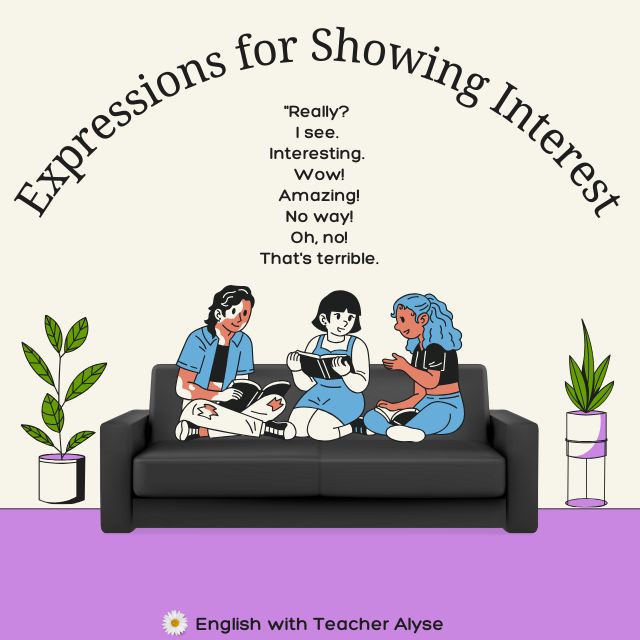
Useful expressions for showing interest
 02:02
02:02 02:02
02:02Description
Hi, and welcome back to Everyday English with Teacher Alyse! Today we are learning useful expressions for showing interest. These expressions help you respond when someone tells you good news, bad news, or just information. Let’s practice together.
Part 1: Good News
When you hear good news, you can say:
• Wow!
• Amazing!
• Really?
Example 1:
“My team won the game!”
→ “Wow! That’s amazing!”
Example 2:
“I passed my English test!”
→ “Really? Amazing!”
Part 2: Bad News
When you hear bad news, you can say:
• Oh, no!
• That’s terrible.
• No way!
Example 1:
“My phone broke yesterday.”
→ “Oh, no! That’s terrible.”
Example 2:
“I lost my wallet.”
→ “No way! That’s terrible.”
Part 3: Neutral Information
When the news is not good or bad, just information, you can say:
• I see.
• Interesting.
• Really?
Example 1:
“I have math class every Monday.”
→ “I see.” / “Interesting.”
Example 2:
“I usually wake up at 6 a.m.”
→ “Really? Interesting.”
Great job today! Now you know how to show interest when you hear good news, bad news, or just information. Try using these expressions in your conversations this week. Have a good day. See you next time.
Chaîne de podcasts
Everyday English with Teacher Alyse
Auteur
Tous les épisodes

How to Get the American Accent -- Mimicry
02:59
Vol.88 マリアの料理教室1
13:01
Hindi Consonants...
00:54
Leadership & Communication - Episode 64
06:04
What is Your Problem?
09:58
SWE 111 Basketball Diplomacy
10:15
Receptive & Productive Vocabulary
07:00
はじめのあいさつ
02:54Épisodes populaires
English for IT Pros
How to Get the American Accent -- Mimicry
02:59SAMURAI BROADCAST 侍放送 継続は力ニャり
Vol.88 マリアの料理教室1
13:01Learn Fluent Hindi with Professor Ashish...
Hindi Consonants...
00:54The Global Professional Podcast
Leadership & Communication - Episode 64
06:04LEARN BY LISTENING
What is Your Problem?
09:58Streetwise English
SWE 111 Basketball Diplomacy
10:15Rethinking Language Learning
Receptive & Productive Vocabulary
07:00Atsushi のJapanese podcast (travel/news /文法・漢字・語彙/Osaka/Hokkaido/🇹🇷🇬🇪🇦🇲🇪🇸🇵🇹)
はじめのあいさつ
02:54
