Bezocht om één uur geleden

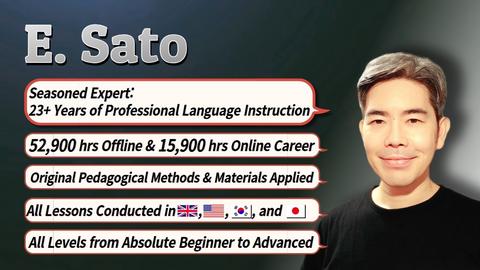
⭐ Ejderha Sato ⭐
Japans
Moedertaalspreker
Koreaans
Moedertaalspreker
Engels
Frans
Italiaans
Spaans
Chinees (Mandarijn)
Thai
Turks
Uit Japan
Woont in Other, Korea, Republiek
Mijn lesmateriaal
- PDF-bestand
- Tekstdocumenten
- Audiobestanden
- Afbeeldingsbestanden
- Artikelen en nieuws
- Quizzen
- Voorbeelden van examenvragen
Meer lezenLaat de oorspronkelijke taal zien
Interesses
Voedsel
Muziek
Reizen
Milieu & Natuur
Kunst
Japans
Koreaans
Engels
Op basis van je tijdzone (UTC)
5.0
6,641
Beoordelingen
100%
Aanwezigheid
100%
Reageren
Alle
Japans
Koreaans
Voor beginners·3959
Gestructureerde lessen·9
Geduldig·8
Uitspraak·1
Biedt materialen aan·1

Radina B
526 Koreaans lessen
Keuze van de leerkracht
As 2023 concludes with today's lesson, it’s time to reflect on a year and a half of learning Korean! I am deeply and incredibly thankful for discovering Sato! While I began the year familiar with many words, now I can engage in basic Korean conversations. My proficiency in conjugating between past, present, and casual to polite tenses has grown significantly. Sato's teaching skills are evident; he gauges precisely when to challenge me and when to allow independent exploration. Whenever I struggle with a concept, his patient explanations ensure clarity. He will always keep at it until I have fully grasped the topic. His organized Google Docs of lesson notes are invaluable, and his commitment shines through—even when responding to late-night questions! Beyond language, Sato also adds invaluable insights into Korean culture and lifestyle. His meticulous attention to my pronunciation ensures I sound as authentic as possible. Truly a dedicated and skilled instructor! Thank you!

Huyen Tue Dao
682 Japans lessen
Keuze van de leerkracht
Another fun and very helpful lesson with Sato-sensei!
I appreciate his patience and understanding when I forget vocabulary or make mistakes. And I'm super enjoying the pace and really am absorbing the new information well.
I also enjoy all the cultural and language context that he gives as we go through the lesson. It gives so much more life and meaning to learning Japanese.
I also found it very easy to study up on the previous lesson thanks to the Google Doc notes and organization.
Michael
858 Japans lessen
What I learned in this lesson.
ひさしぶりですね。
MEANS THAT ANSWER SHOULD BE IN THE FRAME OF
____ぶりです。
🧒はつかぶりに
📖はつかかんぶりに
for the first time in 3 hours
for 3 hours:さんじかん
さんじかんぶりに
ー ̄ ̄ ̄ ̄ ̄ ̄ー
for the first time in 10 days
🧒とおかぶりに
📖とおかかんぶりに
for the first time in 20 days
🧒はつかぶりに
📖はつかかんぶりに
かん is 📖WRITTEN
❌️→I was setting up a game server for my friend, I was a bit busy because I only got it working 10 minutes ago. < English is just strange and doesn't translate well.
→I was a bit busy because I had been trying to set up the game server for my friends, and only finished 10 minutes ago.
✅️⑤ずっと ともだちの ために < I had been (for a long time) (for my friends)
ゲームサーバーを こうちくしようと してて、 < Trying to set up a game server
それがじゅっぷんまえに おわったばかりだから、 < It was only finished 10 minutes ago
いそがしかったです。
→I’m pacing around the room to stay awake.
✅️⑨おきて📖いるために
✅️⑨🧒おきてるために
✅️⑧おきて 📖いようと、
✅️⑧おきて🧒ようと、< To stay awake
へやの なかを あるきまわってます。< Walking around
Hayden Salvato
100 Japans lessen
Keuze van de leerkracht
As another year studying with Sato San is finishing, I feel the need to write a proper review. A new year's resolution two years ago changed my life, I decided to try learning another language and shortly after discovered Sato San. Looking back after almost 100 lessons it is hard to believe we've come so far. Starting from scratch, we are now conducting class in almost exclusively Japanese. I am still far from proficient, but feel like I have an extremely solid foundation to build my intermediate level Japanese on. Sato San's style of teaching puts the ball in your court as a learner. The amount of information and study material he provides is abundant, its up to you as a student to study and apply. We have come a very long way together and I am very grateful as a student to have found such a great guide on my language Journey. We continue to trudge towards the metaphorical peak of Everest together.
Sato San- 本当に ありがとうございました
Michael
858 Japans lessen
I learned quite a bit today, but I was a bit fatigued during the lesson.
②せかいじゅうに ✅️ひろがってます。
Has grown and is still growing
①せかいじゅうに ❌️❌️❌️ひろがってました。
Has grown and has stopped growing
ご\きろ
わ\るくな\い
いぬ\
Do you know (about) A?
Aの ことを しってますか?
Yes, I know about A.
はい、しってます。
No, I don’t know about A.
いえ、❌️しってないです。
いえ、しらないです。
いえ、しりません。
→Today I ran my fastest 5k.
Native phrasing
A:きょう、5(ご)キロの じこベストが
でました。
A:きょう、5(ご)キロの じこベストで
はしれました。
Today I ran 5 km in the fastest time yet.
⑫きょうの ごキロの タイムは いちばん
はやかったです。
✅️⑪きょ\うは いちばん はや\い タ\イムで ご\キロを はしりま\した。
✅️⑩きょうは ✅️いままでで
いちばん はや\い タ\イムで ご\キロを
はしりま\した。
❌️いまま\で
これま\でで さいこうの タイム
いまま\でで さいこうの タイム
Why is this? Because で supplies いままで with a bounds for within what it spans
Without で, it just means that until now I ran the fastest 5k which doesn't make sense at all, especially with 今日は
Michael
858 Japans lessen
What I learned
→I haven’t exercised yet, and I need to prepare dinner and attend a friend’s watch party later.
まだ うんどうしてないのに、
ばんごはんを よういして、ともだちの
✅️⑥ウォッチパーティーに でなきゃ いけないからです。
動画配信者 - Wikipedia
streamer:はいしんしゃ
stream
はいしん
どうが はいしん
to stream:
はいしんする:配信する
to attend a class
じゅぎょうに 🧒でる
授業に出る
じゅぎょうに しゅっせきする
授業に出席する