Search from various English teachers...
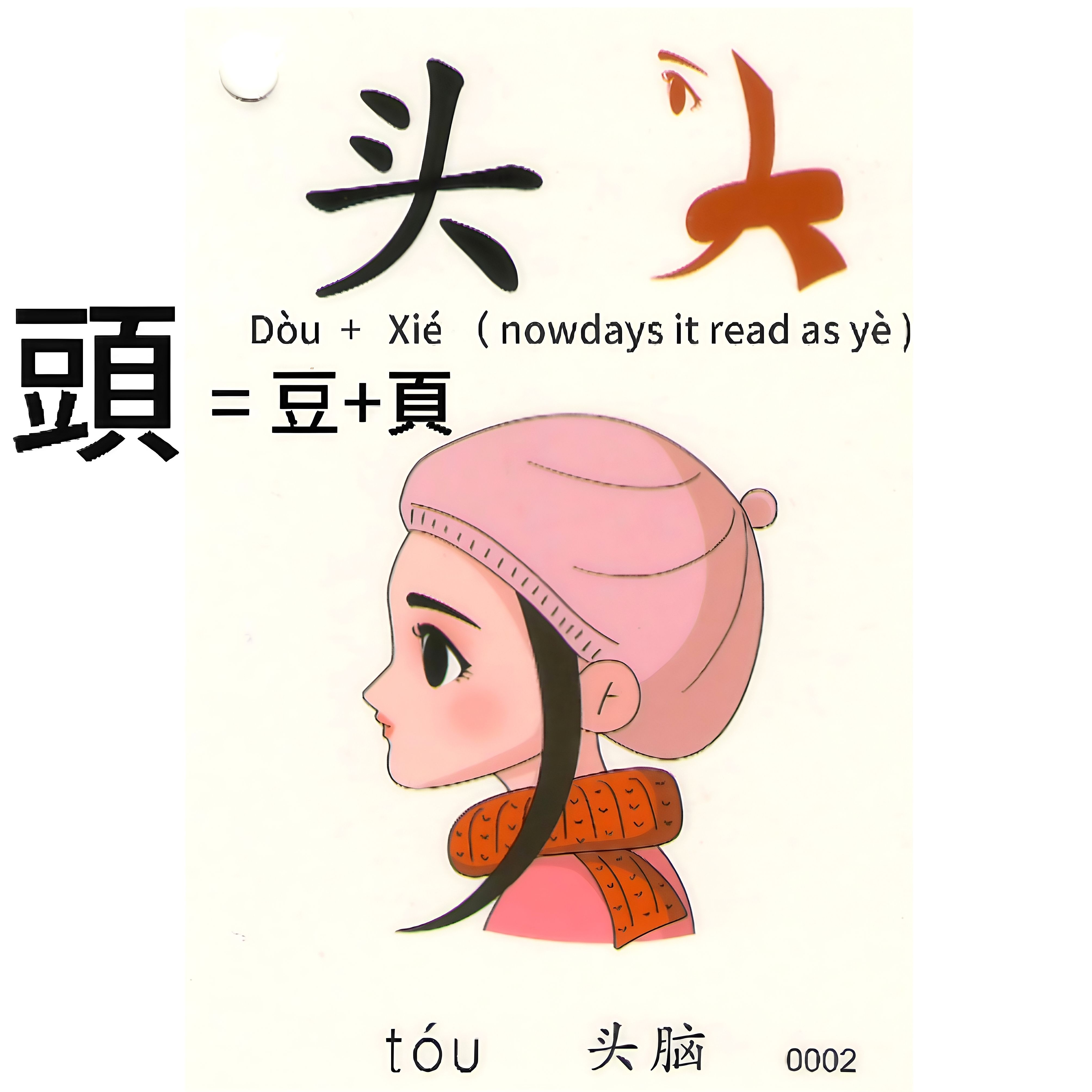
头
 05:58
05:58 05:58
05:58Description
The character "头 - Tóu " is a pictophonetic character.
Let's have a look at the traditional writing to make it easier to understand.
頭= 豆+页
It consists of two parts: the radical "页" (pronounced xié) and the phonetic "豆 - Dòu ".
In this type of pictophonetic characters, the radical provides the meaning category of the character, while the diaphragm indicates the pronunciation .
The original meaning of "页- xié" is head, Therefore "头 - Tóu" primarily means "head." It can also refer to a person's mind or intellect, and it can be used to describe the top or leading position of something, such as in a group or series.
Now let's go for the Usage
1.Noun:
General: "头 - Tóu" refers directly to the head of a person or an animal.
例如(For example): 他的头很大。-Tā de tóu hěn dà 。 (His head is very big.)
老头儿 - Lǎo tóur : Used informally to refer to an elderly man, where "头儿 - tóur" adds a sense of familiarity or endearment.
例如:公园里有几个老头儿在下象棋。- Gōng yuán lǐ yǒu jǐ gè lǎo tóu er zài xià xiàng qí 。
(There are a few old men playing chess in the park.)
插头 - Chā tóu: Refers to the plug that connects devices to a power source, emphasizing the endpoint of the connection.
例如:请拔掉插头以断开电源。- Qǐng bá diào chā tóu yǐ duàn kāi diàn yuán 。
(Please unplug the plug to disconnect the power.)
2.Measure Word:
"头" is also used as a measure word for livestock and some other animals.
例如:三头牛。- Sān tóu niú 。 (Three cows.)
3.Leadership or Priority:
It can indicate the foremost or leading element.
例如:队伍的头。- Duì wu de tóu 。 (The head of the line.)
4. Idiomatic Expressions:
例如:头痛 - Tóu tòng (headache), 开头 -Kāi tóu (beginning), 破头 - Pò tóu (literally 'crack one's head', meaning to go to a lot of trouble), 抢破头 - Qiǎng pò tóu (desperately competing, literally 'fighting until one's head breaks').
Chinese Item:
"虎头虎脑" (hǔ tóu hǔ nǎo) is an idiomatic expression in Chinese that describes someone, usually a child, who appears strong, energetic, and lively.
Podcast Channel
每日一字
Author
All episodes
Fiesta de Carnavales en Latinoamérica (2° parte) 🎆🎊🌄🔫 [Capítulo 16]
25:55
Tankar På Svenska : Om relationen till kroppen och vikt (B1+)
10:00
02_Στο καφέ
05:28
Would you like to shadow me?
02:24
EL PUEBLO Vs LA CIUDAD
28:15
According to, In Accordance with & Based on
04:08I want to contribute this vocabulary to you.
01:58
Outside the Rembrant Museum in Amsterdam (with transcript)
08:54Popular episodes
Escucha Facil Español
Fiesta de Carnavales en Latinoamérica (2° parte) 🎆🎊🌄🔫 [Capítulo 16]
25:55Tankar på svenska
Tankar På Svenska : Om relationen till kroppen och vikt (B1+)
10:00Mini Greek POD
02_Στο καφέ
05:28DAILY Business English VOCABULARY builder
Would you like to shadow me?
02:24VAMOS AL LÍO ¡¡¡ESCUCHA!!!
EL PUEBLO Vs LA CIUDAD
28:15The English Toolbox
According to, In Accordance with & Based on
04:08DAILY Business English VOCABULARY builder
I want to contribute this vocabulary to you.
01:58Teacher Joseph's Podcast
Outside the Rembrant Museum in Amsterdam (with transcript)
08:54
