Key takeaways
- Dance idioms are not about dance lessons. They often describe avoidance, control, cooperation, celebration, risk, or social confidence.
- The safest idioms to start using are “dance around something,” “it takes two to tango,” “get into the swing of things,” and “step on someone’s toes.”
- Idioms fail when learners know the dictionary meaning but miss the tone. Some expressions sound playful, some critical, and some too regional for international English.
- Practicing with an English tutor helps you test whether an idiom sounds natural in casual conversation, workplace speech, or writing.
English idioms about dancing can make your English sound more natural, but they can also expose a learner’s biggest idiom problem: using a colorful phrase in the wrong tone. You may understand “it takes two to tango,” but not know whether it sounds fair, critical, funny, or too direct.
italki solves that by giving learners live practice with English teachers who can explain meaning, tone, region, and safer alternatives. With 30,000+ teachers across 150+ languages, 10M+ learners, and 15+ years of online learning experience since 2007, italki is useful when idioms need conversation-level judgment.

Find Your Perfect Teacher
Idioms are hard because the meaning is not always literal. Practice natural English expressions with a teacher who can explain tone, context, and better alternatives.
Book a trial lesson
What are dance idioms in English?
Dance idioms are expressions that use dance-related words to mean something else. Cambridge Dictionary defines an idiom as a group of words whose meaning is different from the meanings of the individual words, so learners need context as much as vocabulary.
For example, “dance around a topic” does not mean move your body around a table. It means avoid discussing something directly.
English idioms matter because fluent speakers often use them to compress meaning. A short phrase can express attitude, humor, criticism, or social nuance. Merriam-Webster also treats idiom as established usage whose meaning may not be obvious from the words alone, which is why examples and tone notes matter.
If you want a broader idiom base first, 10 popular English idioms you should know are useful internal guides.
Which dance idioms should English learners know?
The most useful dance idioms are common enough to recognize and flexible enough to use in real conversation. Learn the meaning, then study whether the expression sounds casual, neutral, or dramatic.
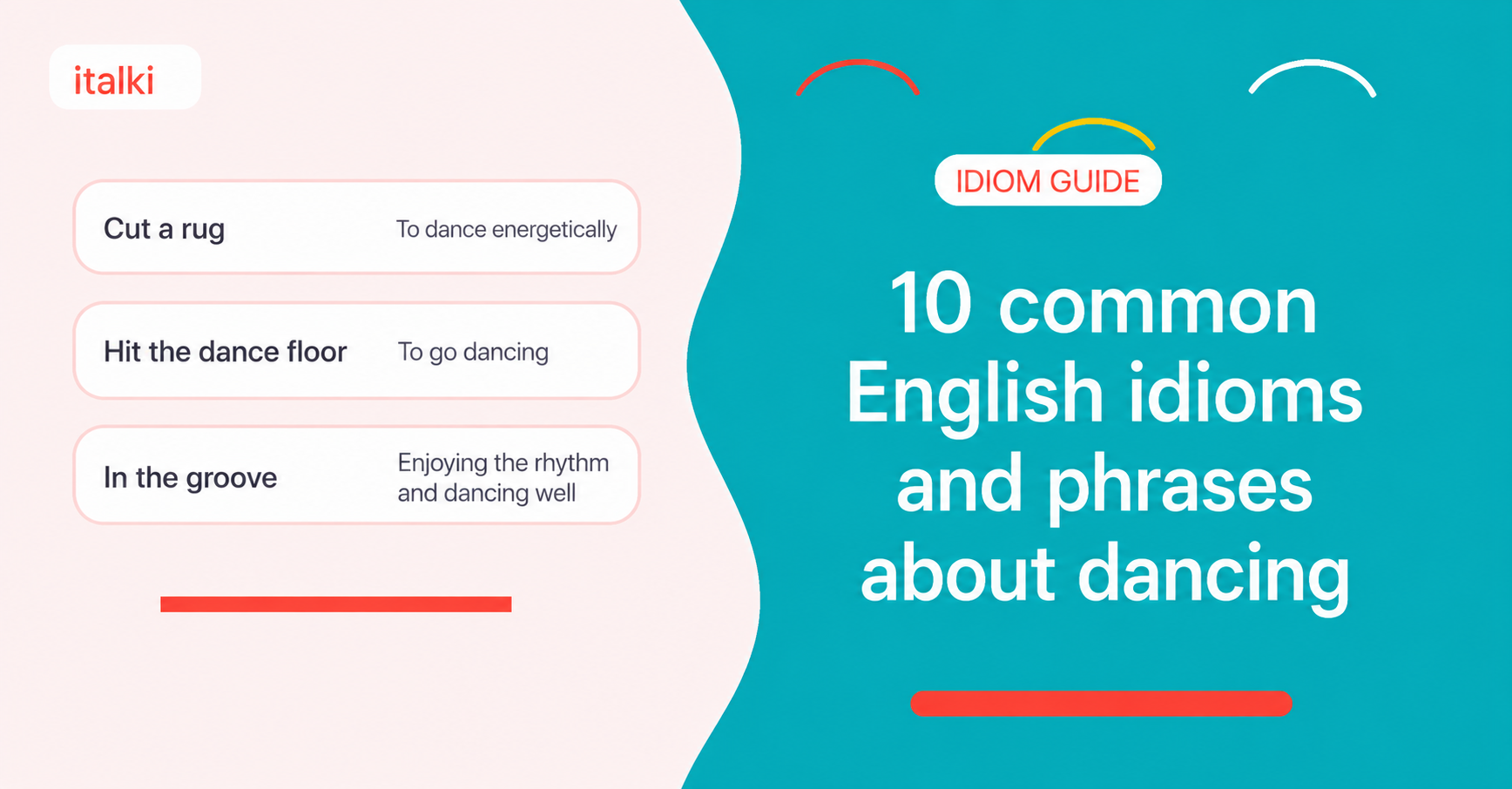
| Idiom | Meaning | Tone |
|---|---|---|
| dance around something | avoid saying something directly | neutral |
| lead someone a merry dance | cause someone trouble or confusion | British, informal |
| it takes two to tango | both people share responsibility | common, conversational |
| dance to someone’s tune | do what someone else wants | critical |
| make a song and dance about something | complain or react too much | British, informal |
| dance with danger | take a serious risk | dramatic |
| dance the night away | spend the night dancing or celebrating | positive |
| get into the swing of things | become comfortable with an activity | common, useful |
| step on someone’s toes | offend or interfere with someone | common |
| call the tune | control the situation | neutral to critical |
1. Dance around something
Meaning: avoid discussing a topic directly.
Example: “The manager danced around the budget problem instead of explaining what happened.”
Use it when someone is being indirect. It can sound critical, so use it carefully at work.
2. Lead someone a merry dance
Meaning: make someone deal with confusion, delay, or difficulty.
Example: “The delivery company led us a merry dance before they finally found the package.”
This phrase is more common in British English. If your audience is international, “gave us a lot of trouble” may be clearer.
3. It takes two to tango
Meaning: two people are both involved or responsible.
Example: “The argument was not only his fault. It takes two to tango.”
This idiom is useful in relationship, teamwork, and conflict discussions. It can sound direct, so avoid using it when you need to be very diplomatic.
4. Dance to someone’s tune
Meaning: do what another person wants, often without independence.
Example: “The team felt they were dancing to the client’s tune all month.”
This phrase usually has a negative feeling. It suggests someone else has too much control.
5. Make a song and dance about something
Meaning: react in a loud, exaggerated, or unnecessary way.
Example: “He made a song and dance about a tiny change in the schedule.”
This expression is common in British English. In American English, “make a big deal out of something” is more widely understood.
6. Dance with danger
Meaning: take a serious risk.
Example: “Ignoring the security warnings is dancing with danger.”
This phrase is more dramatic than everyday workplace English. Use it for writing, speeches, or strong warnings.
7. Dance the night away
Meaning: spend the night dancing and enjoying yourself.
Example: “They danced the night away at the wedding.”
This is one of the few expressions in this list that can be literal and figurative. It usually has a positive, celebratory tone.
8. Get into the swing of things
Meaning: become comfortable with a new activity, routine, or situation.
Example: “It took me two weeks to get into the swing of things at my new job.”
This is a very useful phrase for English learners because it works in school, work, travel, and hobbies.
9. Step on someone’s toes
Meaning: upset someone by interfering with their responsibility or area of control.
Example: “I do not want to step on anyone’s toes, but I think the report needs one more review.”
This idiom is useful when you want to be polite before giving feedback or making a suggestion.
10. Call the tune
Meaning: control what happens or make the main decisions.
Example: “The finance team calls the tune when it comes to budget approval.”
This phrase often appears in discussions about power, control, and decision-making.
How do you use dance idioms without sounding forced?
Use idioms only when they make your meaning clearer or more natural. If the idiom draws attention to itself, a simpler phrase may be better.
Here is a practical test:
| Question | If yes | If no |
|---|---|---|
| Do you understand the literal situation? | Continue. | Study examples first. |
| Do you know the tone? | Try it in a sentence. | Ask whether it is casual or formal. |
| Would a simpler phrase be clearer? | Use the simple phrase. | Use the idiom. |
| Is this a formal email? | Be careful. | Idioms are usually safer in speech. |
Idioms can also vary by region. Merriam-Webster notes that informal language is often connected to particular groups or contexts, and idioms work in a similar way: the expression may be clear to one audience and odd to another.
If you are learning for international work, combine idioms with plain alternatives. For example, learn “dance around the issue” and “avoid the issue.” That gives you flexibility. italki is useful here because a teacher can tell you whether the idiom fits the audience or whether a plain phrase would sound more natural.
Find Your Perfect Teacher
Idioms are hard because the meaning is not always literal. Practice natural English expressions with a teacher who can explain tone, context, and better alternatives.
Book a trial lesson
How can you practice dance idioms in speaking?
Practice idioms by building short stories around them. A single example sentence helps recognition, but a mini-story helps you use the idiom in conversation.
Try this method:
- Choose one idiom.
- Write the meaning in simple English.
- Write one personal example.
- Write one workplace example.
- Say both examples out loud.
- Replace the idiom with a plain phrase and compare the tone.
Example:
- Idiom: “get into the swing of things”
- Personal: “After two weeks in my new city, I started to get into the swing of things.”
- Workplace: “The new employee got into the swing of things after the first project meeting.”
- Plain version: “became comfortable with the routine”
This is where italki solves a common idiom problem: learners can memorize meanings but still use expressions in the wrong tone. With live feedback from teachers, learners can test idioms in realistic conversation and learn when a simpler phrase sounds better.
Use idioms as precision tools, not decoration
Dance idioms can make your English sound more natural, but only when the context fits. Start with “dance around something,” “it takes two to tango,” “get into the swing of things,” and “step on someone’s toes” because these are the easiest to use in daily conversation.
Before you use them in a meeting, message, or social situation, book a short lesson with an English teacher and test five sentences from your own life. Ask three questions for each idiom: Does it sound natural? Is it too casual? What plain phrase would work better?
Find Your Perfect Teacher
Bring five idioms to class and ask your teacher to help you turn them into natural sentences for your life, work, and conversations.
Book a trial lesson
FAQs
What are English idioms about dancing?
English idioms about dancing are expressions that use dance words to describe non-literal ideas such as avoiding a topic, sharing responsibility, taking risks, celebrating, or being controlled by someone else.
Is “it takes two to tango” formal or informal?
“It takes two to tango” is conversational and common, but it can sound direct because it suggests shared responsibility. Use it carefully in formal workplace conflict.
What does “dance around the issue” mean?
“Dance around the issue” means avoid discussing the real topic directly. For example, “She danced around the issue” means she talked indirectly and did not address the main problem.
How can I remember idioms in English?
Remember idioms by learning meaning, context, tone, and one personal example. Do not memorize long lists without examples, because idioms only make sense in real situations.
Want to learn a language at italki?
Here are the best resources for you!