French verb conjugation is the system of changing a verb’s ending to match who is doing the action and when. Every French sentence you produce depends on it, which is why getting the basics right early saves enormous confusion later.
italki has helped over 10 million learners work through exactly this kind of grammar challenge, with 30,000+ teachers across 150+ languages available for live, corrected practice.
This guide covers the present tense in full, then takes you into the past and future so you can see how the system scales. Every section includes real verb forms with their pronunciation.

Find Your Perfect Teacher
French becomes easier when you can practice the examples, get correction, and hear how a real speaker would say it.
Book a trial lesson with a French tutor
Key takeaways
- French verbs divide into three groups based on their infinitive ending: -er, -ir, and -re. Each group has its own set of present-tense endings.
- A small set of highly irregular verbs, including être (to be) and avoir (to have), appear in almost every sentence and must be memorized as standalone patterns.
- The passé composé (compound past) is the most common past tense in spoken French and uses avoir or être as a helper verb.
- The simple future tense is far more regular than the present, making it one of the easier systems to learn once you have the present under control.
- Working through conjugation errors with a live French tutor is one of the fastest ways to stop repeating the same mistakes in real conversation.
How does French verb conjugation work in the present tense?
French verbs change their ending for each subject pronoun: je (I), tu (you, singular informal), il/elle/on (he/she/one), nous (we), vous (you, plural or formal), and ils/elles (they). You strip the infinitive ending to find the verb stem, then attach the pronoun-specific ending.
The subject pronouns themselves are not optional in French the way they are in Spanish or Italian. You must say je parle (I speak), not just parle. This makes the pronoun-plus-ending combination the core unit of every conjugated French sentence.
What are the -er verb endings and how do you apply them?
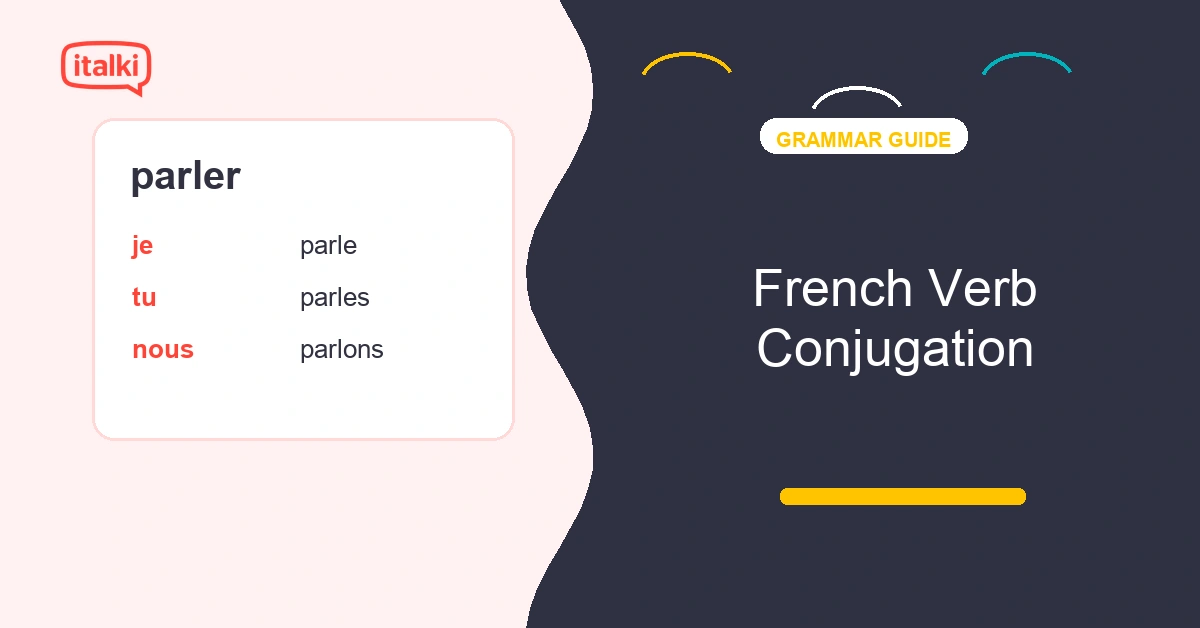
The -er group is the largest verb category in French, which is why mastering it first gives you immediate access to an enormous productive vocabulary. Take parler (to speak). Remove -er to get the stem parl-, then add the endings below.
| Pronoun | Ending | Full form | Pronunciation |
|---|---|---|---|
| je | -e | parle | “parl” |
| tu | -es | parles | “parl” |
| il/elle | -e | parle | “parl” |
| nous | -ons | parlons | “par-LOH” |
| vous | -ez | parlez | “par-LAY” |
| ils/elles | -ent | parlent | “parl” |
Notice that je, tu, il, and ils all sound identical in speech: “parl.” Only nous and vous have audibly distinct endings. This silent-ending pattern is a feature of French pronunciation that catches many beginners off guard when they first try to understand spoken French.
Two common -er verbs worth drilling early: manger (to eat) and habiter (to live/reside). Manger takes a spelling change in the nous form: nous mangeons, not nous mangons, to preserve the soft “zh” sound of the g.
Want live correction on your -er verb pronunciation and spelling? A French teacher online on italki can catch the small errors that written drills cannot.
Find Your Perfect Teacher
French becomes easier when you can practice the examples, get correction, and hear how a real speaker would say it.
Book a trial lesson with a French tutor
How do -ir and -re verbs differ from -er verbs?
-ir verbs split into two subgroups. Regular -ir verbs like finir (to finish) add -is, -is, -it, -issons, -issez, -issent to the stem fin-.
| Pronoun | Full form | Pronunciation |
|---|---|---|
| je | finis | “fee-NEE” |
| tu | finis | “fee-NEE” |
| il/elle | finit | “fee-NEE” |
| nous | finissons | “fee-nee-SOH” |
| vous | finissez | “fee-nee-SAY” |
| ils/elles | finissent | “fee-NEES” |
The second subgroup, which includes verbs like partir (to leave) and dormir (to sleep), drops two letters from the stem in the singular. Partir becomes par- for je/tu/il (pars, pars, part) and part- for the plural (partons, partez, partent). These must be learned individually.
-re verbs use a different set of endings. Take vendre (to sell), stem vend-: je vends, tu vends, il vend, nous vendons, vous vendez, ils vendent. The il form has no ending at all, which is the clearest difference from -er and -ir patterns.
The guide to er verbs French covers the -er group in more detail if you want to consolidate that group first before moving to -ir and -re.
Which irregular verbs do beginners need to learn first?
Four irregular verbs appear so frequently that no French conversation is possible without them: être (to be), avoir (to have), aller (to go), and faire (to do/make). None of them follow any standard pattern.
Être (to be): je suis, tu es, il est, nous sommes, vous êtes, ils sont (“swee / ay / ay / SOM / et / soh”)
Avoir (to have): j’ai, tu as, il a, nous avons, vous avez, ils ont (“zhay / ah / ah / ah-VOH / ah-VAY / oh”)
Aller (to go): je vais, tu vas, il va, nous allons, vous allez, ils vont (“vay / vah / vah / ah-LOH / ah-LAY / voh”)
Faire (to do/make): je fais, tu fais, il fait, nous faisons, vous faites, ils font (“fay / fay / fay / fuh-ZOH / fet / foh”)
A key fact: avoir and être both function as helper verbs in compound tenses, so every gap in your knowledge of them creates errors far beyond the present tense.
One italki tutor explains that the most reliable way to retain irregular forms is to use them inside sentences you actually need, not by reciting the paradigm alone. “Tell me where you’re going tomorrow” forces aller into real output; a conjugation table does not.
How does the passé composé work for past actions?
The passé composé is the tense you hear in everyday spoken French to talk about completed past events. It has two parts: a helper verb (avoir or être in the present tense) plus the past participle of the main verb.
For most verbs, the helper is avoir. The past participle of -er verbs ends in -é, -ir verbs in -i, and -re verbs in -u:
- parler → j’ai parlé (“zhay par-LAY”), I spoke
- finir → j’ai fini (“zhay fee-NEE”), I finished
- vendre → j’ai vendu (“zhay vahn-DU”), I sold
A specific group of verbs, mostly verbs of motion and all reflexive verbs, use être as the helper instead. The mnemonic “DR MRS VANDERTRAMP” lists them: devenir, revenir, monter, rester, sortir, venir, aller, naître, descendre, entrer, rentrer, tomber, retourner, arriver, mourir, partir. With être verbs, the past participle agrees in gender and number with the subject:
- Elle est allée (“et ah-LAY”), She went
- Ils sont partis (“soh par-TEE”), They (m.) left
The French past tense guide goes deeper into how the passé composé contrasts with the imperfect, which you will need for storytelling and descriptions.
For real-time feedback on which helper verb to use and whether your participle agreement is correct, book a French tutor online and practice narrating past events from your own life.
What does the simple future tense look like?
The French simple future tense is genuinely one of the easier verb systems for beginners because it builds directly on the infinitive. For most verbs, you take the infinitive as the stem and add the endings -ai, -as, -a, -ons, -ez, -ont.
Using parler as the example:
| Pronoun | Form | Pronunciation |
|---|---|---|
| je | parlerai | “par-luh-RAY” |
| tu | parleras | “par-luh-RAH” |
| il/elle | parlera | “par-luh-RAH” |
| nous | parlerons | “par-luh-ROH” |
| vous | parlerez | “par-luh-RAY” |
| ils/elles | parleront | “par-luh-ROH” |
The main exceptions are verbs with irregular future stems. The most important ones: être → ser- (je serai), avoir → aur- (j’aurai), aller → ir- (j’irai), faire → fer- (je ferai), venir → viendr- (je viendrai), pouvoir → pourr- (je pourrai).
French also uses a near future formed with aller plus an infinitive, directly parallel to English “going to”: Je vais manger (“zhuh vay mahn-ZHAY”) means “I am going to eat.” This construction is extremely common in casual speech and worth learning before the simple future.
The guide to the future tense French covers both constructions with more examples if you want to compare when each is used.
What are the most common conjugation mistakes beginners make?
Forgetting silent endings in speech. Learners who study from text often try to pronounce the final -ent in ils parlent (“parl”). The ending is completely silent. Producing it makes you sound like you’re reading aloud rather than speaking naturally.
**Mixing up être and avoir as helpers in the passé composé.** The tendency is to use avoir for everything. The result is errors like j’ai allé instead of je suis allé (I went). Because the être group is finite, it’s worth memorizing the list rather than trying to infer it from meaning.
Using infinitive forms instead of conjugated ones. This is very common at the start: saying je manger instead of je mange. French does not allow an uninflected verb after a subject pronoun the way English sometimes allows with auxiliaries.
**Neglecting the nous and vous forms in -er verbs.** Because je/tu/il/ils all sound the same in parler, learners sometimes underlearn parlons and parlez, which have genuinely different pronunciations and must be actively practiced.
italki has been connecting learners with live teachers since 2007, and the platform’s French conversation practice culture means these errors get caught in real time, not discovered months later on a test.
Ready to make French grammar usable in conversation?
Grammar matters most when you can use it under the pressure of a real answer, not only recognize it on a page.
Learn French with guided practice, then work with a French tutor to turn examples into confident answers.
Find Your Perfect Teacher
French becomes easier when you can practice the examples, get correction, and hear how a real speaker would say it.
Book a trial lesson with a French tutor
FAQ
What is the difference between the present tense of -er, -ir, and -re verbs in French?
Each group uses a different set of endings. The -er group (e.g., parler) uses -e, -es, -e, -ons, -ez, -ent. Regular -ir verbs (e.g., finir) insert -iss- before the plural endings: -is, -is, -it, -issons, -issez, -issent. The -re group (e.g., vendre) uses -s, -s, (no ending), -ons, -ez, -ent. The differences are most visible in the singular and most audible in the plural.
Do I need to memorize every irregular French verb?
Not all at once. Prioritize the four most frequent: être, avoir, aller, faire. After those, add verbs as they appear in real reading and conversation, not through lists.
**When do I use être instead of avoir in the passé composé?** Use être with the DR MRS VANDERTRAMP motion verbs and with all reflexive verbs (e.g., se lever, to get up). All other verbs take avoir. With être, the past participle must agree with the subject in gender and number.
Is the French future tense really regular?
Mostly, yes. The endings are the same for every verb: -ai, -as, -a, -ons, -ez, -ont. The only variation is in the stem, and only a handful of common verbs have irregular future stems. This makes the future tense one of the most accessible systems for a beginner who has already learned the irregular stems in the present.
How long does it take to feel confident with French verb conjugation?
With consistent practice, most beginners feel comfortable with the present tense of regular verbs within four to six weeks. Adding the passé composé and future tense to active use typically takes another two to three months. That timeline shortens significantly when you practice speaking with regular feedback from an online French tutor.
Start building real accuracy with a French tutor
French verb conjugation is a system, not a list of exceptions to memorize. Once you see how the three verb groups work in the present tense, the past and future patterns follow a recognizable logic. The genuine challenge is not understanding the rules but producing the right forms automatically in conversation, under time pressure, without consulting a table.
That kind of speed comes from speaking practice with someone who can catch your errors immediately. italki connects you with 30,000+ teachers across 150+ languages and has supported over 10 million learners since 2007. Book a trial lesson with a French teacher and start turning conjugation knowledge into real conversation ability.
Want to learn a language at italki?
Here are the best resources for you!