Key takeaways
- A Japanese business email follows a fixed structure: recipient name, opening greeting (お世話になっております), the purpose of the email, the main body, closing phrase, and sender signature.
- The opening phrase お世話になっております (osewa ni natte orimasu) does not translate directly into English. It signals professional respect and is used in almost all formal Japanese emails regardless of whether you actually know the person.
- Formal Japanese emails use a more distant, careful register than most emails in other languages. Even simple requests use structures like ご確認いただけますでしょうか (could you please confirm) rather than 確認してください (please confirm).
- Casual emails between close colleagues or friends can drop most of the formal structure, but knowing the formal structure lets you adjust up or down appropriately.
Writing an email in Japanese requires more than translation. The opening phrases, the closing lines, the level of politeness, and even the way you state your request all follow conventions that are specific to Japanese professional communication.
Copying the structure of an English email and translating it word for word produces something that sounds blunt or unnatural to a Japanese reader. italki connects learners with Japanese teachers who can review real emails you are writing and correct both the language and the register before you send them.
This guide covers the standard Japanese email structure, the essential opening and closing phrases, vocabulary for common email situations (requests, follow-ups, apologies, scheduling), and two complete example emails.

Find your perfect teacher
Build real speaking confidence with personalized lessons from a teacher who matches your goals, schedule, and learning style.
Book a trial lesson
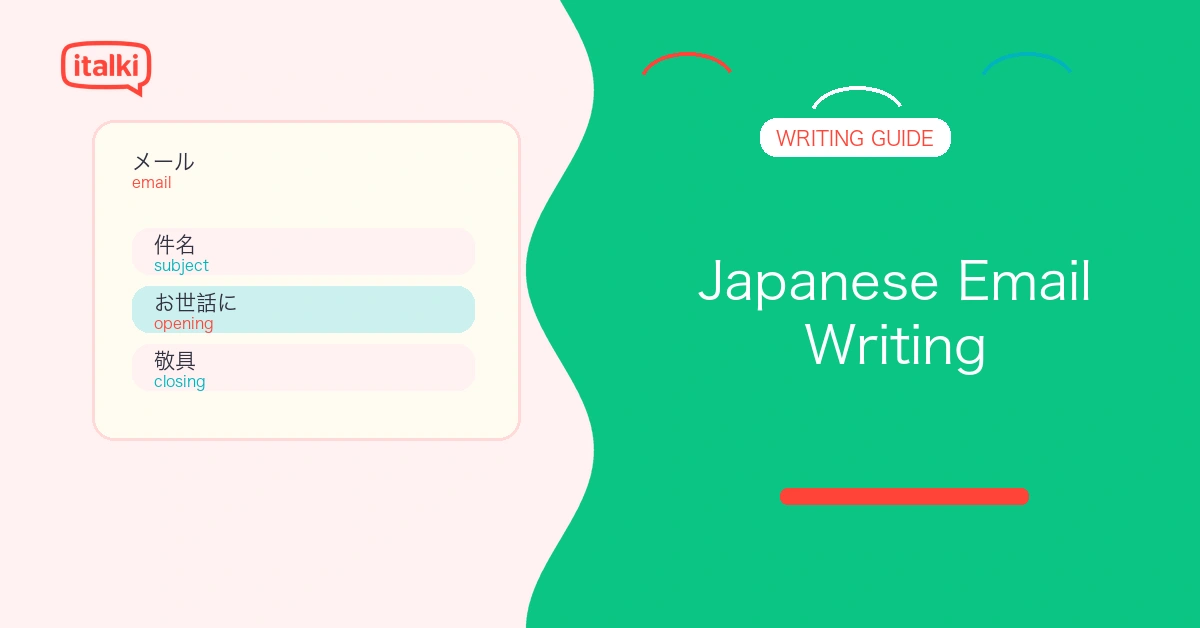
Standard Japanese email structure
A formal Japanese business email follows this sequence:
| Part | Japanese | Purpose |
|---|---|---|
| 1. Recipient name | 田中様 (Tanaka-sama) | Address the recipient with appropriate honorific |
| 2. Opening greeting | お世話になっております | Standard professional opening |
| 3. Self-introduction (first contact only) | 〜と申します | Introduce yourself if this is a first email |
| 4. Reason for writing | 〜の件でご連絡いたしました | State the purpose of the email |
| 5. Main body | Details, request, or information | |
| 6. Closing phrase | よろしくお願いいたします | Standard formal close |
| 7. Signature | 名前、会社名、連絡先 | Name, company, contact information |
The structure is more rigid than in English or many European languages. Skipping the opening greeting or the closing phrase reads as unprofessional in Japanese business contexts.
Work through email structure with a Japanese language tutor who can show you how the register adjusts between different professional relationships.
Opening phrases
| Japanese | Romaji | When to use |
|---|---|---|
| お世話になっております | osewa ni natte orimasu | Standard formal opening; almost all business emails |
| いつもお世話になっております | itsumo osewa ni natte orimasu | Thank you as always; ongoing professional relationship |
| お世話になります | osewa ni narimasu | First contact; slightly warmer than the standard form |
| はじめてご連絡いたします | hajimete go-renraku itashimasu | This is my first time contacting you; cold email opening |
| ご無沙汰しております | gobusata shite orimasu | I have not been in touch for a while; after a long gap |
| お疲れ様です | otsukaresama desu | Internal email to a colleague; acknowledges their work |
お世話になっております (osewa ni natte orimasu) is used in virtually all formal Japanese emails, including first-contact emails where you have never met the person. It is a fixed politeness formula, not a literal description of a close relationship.
お疲れ様です (otsukaresama desu) is used for internal communication within the same company. Using it to an external contact or client is usually too casual.
Find your perfect teacher
Build real speaking confidence with personalized lessons from a teacher who matches your goals, schedule, and learning style.
Book a trial lesson
Closing phrases
| Japanese | Romaji | Use |
|---|---|---|
| よろしくお願いいたします | yoroshiku onegai itashimasu | Standard formal close; most business emails |
| 何卒よろしくお願いいたします | nanitozo yoroshiku onegai itashimasu | Stronger formal close; important requests |
| お手数ですがよろしくお願いいたします | otesuu desu ga yoroshiku onegai itashimasu | Sorry to trouble you, but please… |
| ご確認のほどよろしくお願いいたします | go-kakunin no hodo yoroshiku onegai itashimasu | Please review/confirm |
| 引き続きよろしくお願いいたします | hikitsuzuki yoroshiku onegai itashimasu | Continued support appreciated; ongoing relationship |
| よろしくお願い申し上げます | yoroshiku onegai mōshiagemasu | Most humble/formal version; letters to superiors |
よろしくお願いいたします is the standard closing phrase for most formal Japanese emails. The variations above add nuance: gratitude for the effort required, a specific request for review, or acknowledgment of an ongoing relationship.
An online Japanese teacher can explain which closing phrase fits the specific professional relationship you are writing to, since the choice signals awareness of hierarchy and context.
Phrases for common email situations
Making a request
| Japanese | Romaji | English |
|---|---|---|
| ご確認いただけますでしょうか | go-kakunin itadakemasu deshō ka | Could you please confirm? |
| ご返信いただけますでしょうか | go-henshin itadakemasu deshō ka | Could you please reply? |
| お送りいただけますでしょうか | o-okuri itadakemasu deshō ka | Could you please send it? |
| ご検討いただけますでしょうか | go-kentō itadakemasu deshō ka | Could you please consider this? |
| ご都合はいかがでしょうか | go-tsugō wa ikaga deshō ka | How is your availability? |
Providing information
| Japanese | Romaji | English |
|---|---|---|
| ご連絡いたします | go-renraku itashimasu | I will contact you |
| 添付にてお送りします | tenpu nite o-okuri shimasu | I am sending this as an attachment |
| ご確認ください | go-kakunin kudasai | Please confirm/check |
| 以下の通りです | ika no tōri desu | It is as follows |
| ご参考までに | go-sankō made ni | For your reference |
Apologizing
| Japanese | Romaji | English |
|---|---|---|
| 返信が遅くなり申し訳ございません | henshin ga osoku nari mōshiwake gozaimasen | I apologize for the delayed reply |
| ご迷惑をおかけして申し訳ございません | go-meiwaku o okake shite mōshiwake gozaimasen | I apologize for the inconvenience |
| 誠に申し訳ございません | makoto ni mōshiwake gozaimasen | I sincerely apologize |
Scheduling
| Japanese | Romaji | English |
|---|---|---|
| ご都合のよい日時をお聞かせください | go-tsugō no yoi nichiji o okikase kudasai | Please let me know a time that works for you |
| 以下の日程はいかがでしょうか | ika no nittei wa ikaga deshō ka | How does the following schedule work for you? |
| 〜はいかがでしょうか | ~ wa ikaga deshō ka | How about [date/time]? |
Find your perfect teacher
Build real speaking confidence with personalized lessons from a teacher who matches your goals, schedule, and learning style.
Book a trial lesson
Complete example: formal business email
Below is a first-contact business email in formal Japanese.
件名 (kenmei: subject): 打ち合わせのお願いについて
山田部長様
はじめてご連絡いたします。 株式会社〇〇の田中と申します。
このたびは弊社のサービスにご興味をお持ちいただきましたことを、誠にありがとうございます。
一度、直接お話しできればと思い、ご連絡いたしました。 来週、ご都合のよい日時をお聞かせいただけますでしょうか。
ご多忙のところ恐れ入りますが、何卒よろしくお願いいたします。
株式会社〇〇 田中 一郎 [email protected] 03-XXXX-XXXX
Translation:
Subject: Regarding a request for a meeting
Dear Manager Yamada,
This is the first time I am contacting you. My name is Tanaka, from [Company Name] Co., Ltd.
Thank you very much for your interest in our services.
I am writing because I would like to have the opportunity to speak with you directly. Could you let me know a time next week that works for you?
I know you are busy, so I appreciate your consideration.
[Company Name] Co., Ltd. Ichiro Tanaka [email protected] 03-XXXX-XXXX
Complete example: semi-formal follow-up email
件名: 先日のミーティングについて
鈴木様
お世話になっております。〇〇の田中です。
先日はお時間をいただき、ありがとうございました。
ミーティングでご確認いただいた資料を添付にてお送りします。 ご不明な点がございましたら、お気軽にご連絡ください。
引き続きよろしくお願いいたします。
田中 一郎
Translation:
Subject: Regarding our meeting the other day
Dear Suzuki,
Thank you for your continued support. This is Tanaka from [Company].
Thank you for your time at our recent meeting.
I am sending the materials we discussed as an attachment. Please feel free to contact me if you have any questions.
I look forward to our continued relationship.
Ichiro Tanaka
Find your perfect teacher
Build real speaking confidence with personalized lessons from a teacher who matches your goals, schedule, and learning style.
Book a trial lesson
Subject line vocabulary
| Japanese | Romaji | English |
|---|---|---|
| 〜のご確認について | ~ no go-kakunin ni tsuite | Regarding confirmation of ~ |
| 〜のお願いについて | ~ no onegai ni tsuite | Regarding a request for ~ |
| 〜のご連絡 | ~ no go-renraku | Notice regarding ~ |
| 先日のミーティングについて | senjitsu no mītingu ni tsuite | Regarding our recent meeting |
| ご返信の件 | go-henshin no ken | Regarding your reply |
| 打ち合わせのお願い | uchiawase no onegai | Meeting request |
| 資料のご送付 | shiryō no go-sōfu | Sending materials |
Ready to write Japanese emails with confidence?
The structure and phrases in this guide cover the most common Japanese email situations. The larger challenge is developing a feel for register: knowing when よろしくお願いいたします is right and when 何卒よろしくお願い申し上げます is too formal, or when お疲れ様です is appropriate and when it sounds out of place.
That judgment comes from practice and feedback on real writing. With 30,000+ expert tutors trusted by over 10 million learners worldwide, italki connects you with Japanese tutors who can review actual emails you are writing and tell you exactly where the language or register needs adjusting. Book a trial lesson and bring a real email draft or email situation you need help with.
Find your perfect teacher
Build real speaking confidence with personalized lessons from a teacher who matches your goals, schedule, and learning style.
Book a trial lesson
FAQ
How do Japanese email conventions differ from LINE or messaging apps in a work context?
LINE and other messaging apps between colleagues use a much more casual register. Keigo is dropped or reduced, sentences are shorter, and emoji are common even in professional contexts on messaging apps. The formal email conventions in this guide apply to email specifically. Using email-level formality in LINE would seem stiff; using LINE-level casualness in email would seem unprofessional.
Is Japanese business email style changing among younger professionals?
Yes, gradually. Younger Japanese professionals sometimes skip or shorten the お世話になっております (osewa) opening in internal emails, and some companies have internal communication cultures that are more casual than traditional norms. However, external correspondence – to clients, partners, or people you do not know – still follows the formal conventions. When in doubt, default to formal.
What should I do if I receive a Japanese business email I do not fully understand?
Use a reliable translation tool for the overall meaning, but do not rely on machine translation alone for your reply. Errors in keigo or structure stand out clearly to a Japanese reader. Running your draft reply past a Japanese teacher or native speaker before sending – particularly for important business correspondence – is a worthwhile step before your written Japanese is fully confident.
Want to learn a language at italki?
Here are the best resources for you!