Key takeaways
- Board games to learn English work because they create real pressure to communicate: you cannot stay silent and pass a turn without consequence.
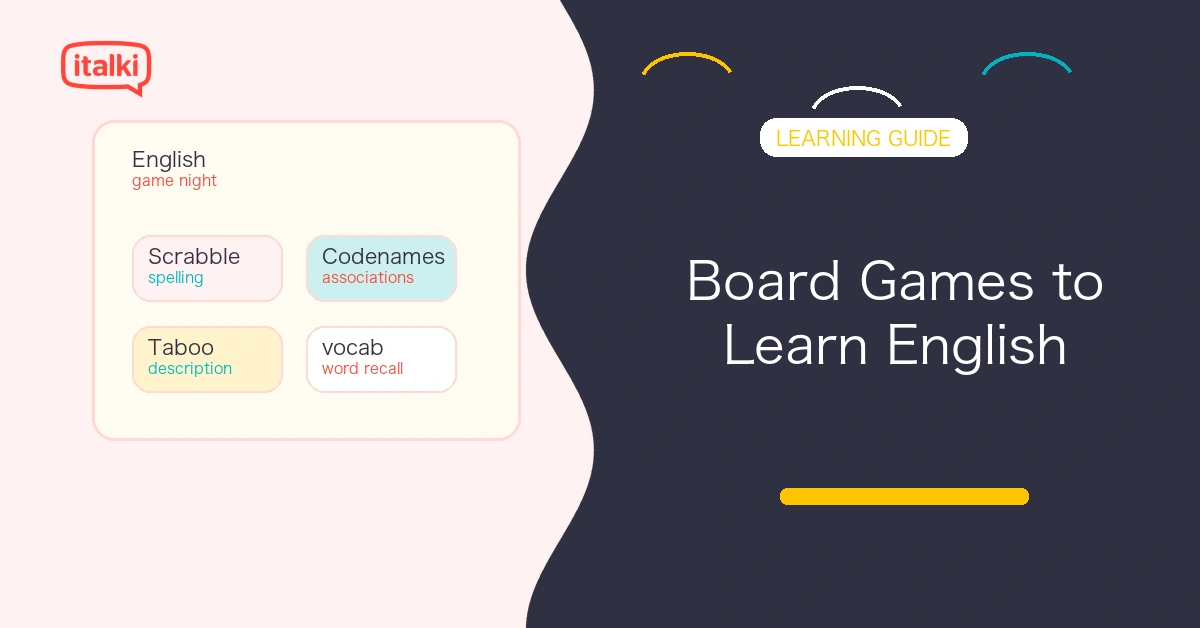
- Scrabble builds spelling and vocabulary, Codenames develops word association and category thinking, and Taboo trains circumlocution, the skill of describing a word without naming it.
- All three games are accessible to intermediate learners and enjoyable for mixed-level groups, including native and non-native speakers together.
- Pairing board game sessions with an English tutor who can debrief the vocabulary you encountered speeds up retention far more than playing alone.
Board games work for language learning because they disguise practice as play. When you are trying to win, your focus is on the game, not on monitoring your grammar. That pressure forces natural, spontaneous use of English in a way that vocabulary drills cannot replicate.
Board games to learn English also create social language: negotiation, persuasion, explanation, and vocabulary retrieval under mild time pressure.
The three games in this guide were chosen because they address different skill gaps. Scrabble pushes spelling and word recall. Codenames builds vocabulary range and category thinking. Taboo trains you to describe a word when you cannot remember the exact term, which is one of the most practical fluency skills in real conversation.
italki connects learners with English teachers who can run sessions around these games or debrief the vocabulary gaps you discovered.
This guide covers what each game teaches, who it is best for, how to use it in a study session, and one practical tip to get the most language value from each. To take that further, find an English teacher online who can run a game-based session with you directly.

Find your perfect teacher
Build real English confidence with personalized lessons from a teacher who matches your goals, schedule, and learning style.
Book a trial lesson
Why board games help you learn English
Traditional vocabulary study, including flashcards, word lists, and fill-in-the-blank exercises, is good for recognition: you see the word and remember the meaning. But recognition is only half of vocabulary knowledge. The other half is production: retrieving the word when you need it in a conversation, under time pressure, with no reference sheet.
Board games create exactly that condition. You need a seven-letter word from your tiles: your brain searches every English word you know. You need to describe hospital to your teammate without saying doctor or nurse: your brain finds synonyms, categories, and associations. You need a clue that connects ocean and wave: you think about relationships between words you already know.
This is exactly what makes vocabulary stick: being forced to find a word when you actually need it, not just recognizing it on a list. The game delivers that pressure naturally, without making it feel like studying. If you want a more structured vocabulary system alongside game practice, the guide to the best way to learn English vocabulary explains how to turn new words into active recall.
A second benefit is the social component. Playing with other learners or with native speakers exposes you to vocabulary in use, not in isolation. You hear someone play querulous and you either know it or you ask. That moment of asking in context, when you genuinely want to know the word, is when new vocabulary sticks.
Scrabble: vocabulary and spelling under pressure
Scrabble is the most direct vocabulary-building game on this list. Players draw seven letter tiles and must form words on a crossword-style board, combining tiles from their hand with letters already on the board. Each letter has a point value, and certain board squares multiply the score.
What it teaches:
- Spelling precision (a misspelled word scores zero)
- Vocabulary breadth (you quickly learn that knowing 5,000 words well is more useful than knowing 10,000 vaguely)
- Tile-based word construction, which trains pattern recognition in English spelling
Who it is best for: Intermediate to advanced learners. Beginners may find the vocabulary pressure overwhelming if playing in a competitive group. With other learners at the same level, the playing field is even and the game is more useful.
Difficulty: Intermediate and above
Study session tip: Keep a notebook beside the board. When someone plays a word you do not know, look it up immediately and write it down with a sentence example. The game context makes the word stick far better than a dictionary lookup outside the game.
Scrabble-specific vocabulary that rewards learning: Certain short words have disproportionate Scrabble value and are rarely learned in class: qi (a variant spelling of chi), za (informal for pizza), aa (a type of rough lava, pronounced ah-ah), and xu (Vietnamese currency). These are legal Scrabble words in standard English dictionaries. Learning them improves your game and shows you that English vocabulary is far larger and stranger than any course teaches.
Online version: Scrabble is available online through official apps, and some platforms offer multiplayer with players from around the world. An English language tutor who plays Scrabble can run sessions where the game debrief becomes the lesson.
Find your perfect teacher
Build real English confidence with personalized lessons from a teacher who matches your goals, schedule, and learning style.
Book a trial lesson
Codenames: word associations and category thinking
Codenames is a team game where one player (the Spymaster) gives a one-word clue to get their teammates to guess which cards on a 5×5 grid belong to their team. The clue must be one word and a number. Weather: 3 means three of the 25 words on the board relate to the clue weather. Teammates must figure out which three without selecting cards that belong to the other team or, worse, the assassin card (which loses the game instantly).
What it teaches:
- Vocabulary associations: what words connect to a shared concept?
- Category thinking: what categories does a given word belong to?
- Semantic precision: the difference between large, big, huge, and vast matters when giving a clue
- Active listening: as a guesser, you must interpret an ambiguous clue and debate the meaning with your team
Who it is best for: Intermediate learners and above. The word cards in standard Codenames use common to intermediate vocabulary. The challenge is in the relationships between words, not in understanding individual words.
Difficulty: Intermediate
Study session tip: As Spymaster, you must think through every word on the board before giving a clue, including the words you want your team to avoid. This forces you to think about whether your clue could accidentally apply to a word you did not intend. That kind of precise, comparative word thinking is a high-level vocabulary skill.
Why it is particularly good for English learners: English has a large number of polysemous words (words with multiple meanings) and words that overlap in meaning with subtle distinctions. Codenames surfaces these constantly. When you give cold: 2, does it capture ice and winter, or does a teammate think shoulder qualifies because of cold shoulder? Navigating these overlaps teaches you how English speakers actually use vocabulary.
Variant: Codenames Pictures removes language from the clue cards and replaces them with images. This is excellent for lower-level learners who want the same category-thinking practice with reduced vocabulary pressure.
Taboo: circumlocution and description skills
Taboo is the most practically useful game on this list for spoken English fluency. One player draws a card with a target word at the top and five forbidden words below it. The player must describe the target word to teammates without saying the target word, any of the five forbidden words, or any direct form of those words. Teammates must guess as many cards as possible within the time limit.
For example, if the target word is hospital, the forbidden words might be doctor, nurse, sick, emergency, and patient. You might say: This is a large building where you go when something has gone very wrong physically. You stay overnight in a bed, and people in white coats give you medication.
What it teaches:
- Circumlocution: describing what you cannot directly name (one of the most practical fluency skills in real conversation)
- Paraphrasing: explaining a concept in simpler or different words
- Vocabulary range: if your first word is forbidden, you need three backups
- Listening and real-time comprehension: teammates must follow a rapid description and guess under time pressure
Who it is best for: Upper-beginner and above. Intermediate learners benefit most. The cards are designed for native speakers, but learners can play with a house rule: if a player does not know the target word, they can skip without penalty.
Difficulty: Upper-beginner and above
Study session tip: After each card, regardless of whether your team guessed correctly, say the target word aloud and ask anyone who did not know it to write it down. The description you just gave, even if it failed, is already a memory anchor for that word.
Why circumlocution matters: In real conversations, you will regularly face a situation where you know what you mean but cannot remember the exact English word. Circumlocution is the skill of keeping the conversation moving anyway: the thing you use to stir coffee for spoon, the person who fixes pipes for plumber. Taboo trains this directly. Learners who play Taboo regularly become significantly more comfortable recovering from mid-sentence vocabulary gaps in real conversations.
Find your perfect teacher
Build real English confidence with personalized lessons from a teacher who matches your goals, schedule, and learning style.
Book a trial lesson
How to use board games in a structured study session
Playing casually is useful. Using games as a deliberate study tool is more effective. Here is how to get more language value from each session.
Before you play:
- Decide which vocabulary area you want to work on (academic vocabulary, everyday conversation, describing objects, categories and concepts).
- With Scrabble, choose a theme if playing with other learners (only words related to travel, food, or work are allowed). This constraint forces thematic vocabulary retrieval.
During play:
- Do not look words up mid-game if it slows play. Write them down and look them up after.
- If a word is played that you do not know, ask for a sentence example from the person who played it.
- For Taboo, notice which forbidden words cause you the most trouble. These are the words you know well enough to avoid but not well enough to quickly find synonyms for.
After play:
- Review every new word from the session. Write each one with a sentence you personally construct (not the dictionary example).
- For Codenames: review which clues failed and why. What did the words have in common that your clue missed? This post-game analysis is where vocabulary precision improves fastest.
A private English tutor can run game-based lessons where the debrief is the lesson: every word encountered in the game becomes a discussion point, and the teacher adds context, collocations, and usage examples that the game alone cannot provide.
Take the vocabulary further
Board games give you an encounter with vocabulary. What turns that encounter into retention is what you do next: reviewing new words in different contexts, using them in conversation, and getting feedback on whether your understanding is accurate.
Working through the vocabulary gaps you found in a Taboo session with a teacher, for example, is one of the most targeted vocabulary lessons possible. You already know exactly which words you needed and could not find. The lesson starts from a real gap rather than a generic word list.
italki’s 30,000+ expert tutors, trusted by over 10 million learners worldwide, include English teachers who work specifically on vocabulary development and spoken fluency. Book a trial lesson and bring the word list from your last board game session as the starting point.
Find your perfect teacher
Build real English confidence with personalized lessons from a teacher who matches your goals, schedule, and learning style.
Book a trial lesson
FAQ
Are these board games available in English or do I need to buy a specific version?
Scrabble, Codenames, and Taboo are all originally English-language games. Most versions sold in English-speaking countries use English vocabulary cards. There are translated versions for other languages; make sure you purchase the English version for language learning purposes.
Can beginners use board games to learn English?
Beginners can use Codenames Pictures (the image version), simplified Scrabble with a dictionary allowed, or a house-rule version of Taboo where skipping unknown words is allowed without penalty. Full competitive versions of all three games are better suited to intermediate learners.
What other board games work well for English learning?
Boggle (fast word finding from a letter grid), Apples to Apples (adjective-noun matching and debate), and Articulate (description under time pressure, similar to Taboo) are all useful. Scrabble, Codenames, and Taboo were chosen for this guide because each one targets a distinct skill.
How often should I play to see vocabulary improvement?
One 60-to-90-minute game session per week, combined with a review of new vocabulary afterward, produces noticeable improvement over 4 to 6 weeks. Frequency matters more than session length: weekly play over a month outperforms a single long session.
Can I use these games in a one-on-one lesson with a tutor?
Yes. Codenames and Taboo both have two-player variants. Scrabble is always two-player friendly. Many italki tutors are happy to build a game-based lesson format if you request it when booking.
Want to learn a language at italki?
Here are the best resources for you!