Key takeaways
- Daily French practice exercises to speak like a pro should train pronunciation, speed, rhythm, and real replies, not isolated word lists.
- The highest-value drills are mouth warmups, sentence ladders, question flips, shadowing, and short role-plays with register shifts.
- French sounds more natural when you practice liaison, silent letters, nasal vowels, and filler phrases like ben (well) and alors (so).
- A French tutor gives live correction on the exact sound or phrasing that solo practice cannot fix, turning repeated drills into genuinely better speech.
Daily French practice exercises to speak like a pro should make your spoken French clearer, faster, and more situation-ready. The goal is not to sound theatrical. It is to answer without translating, pronounce je voudrais (I would like) smoothly, and choose the right register for a café, work call, or friendly chat.
italki connects learners with teachers across 150+ languages, which matters here because daily pronunciation drills need a trained ear, not silent repetition.
Start today by bringing one of the exercises below to a French tutor who can hear your vowels, fix your liaison habits, and give you targeted speaking homework.

Find Your Perfect Teacher
Build real French confidence with personalized lessons from a teacher who can help with speaking, exam prep, grammar, and pronunciation.

What should daily French practice exercises train first?
Daily French speaking practice should train four skills: sound, speed, structure, and social fit. If one is missing, speech sounds hesitant even when the grammar is correct.
“Pro” French means practical French: clear pronunciation, quick replies, clean sentence endings, and phrases that match the situation.
| Skill | What to train | Example |
|---|---|---|
| Sound | Nasal vowels, final consonants, liaison | bon vin (bohn van, good wine) |
| Speed | Answering in chunks | Je pense que oui (I think so) |
| Structure | Reusable sentence frames | Ce que j’aime, c’est… (what I like is…) |
| Social fit | Formal, casual, polite, direct | Tu veux venir? (want to come?) vs Vous souhaitez venir? (would you like to come?) |
Social fit is where daily drills pay off most. Training Bonjour, vous allez bien? (hello, are you well?) alongside Salut, ça va? (hi, how’s it going?) teaches two social choices, not two translations of the same idea. The tu/vous distinction alone changes an entire sentence’s register, and choosing wrong at work creates real awkwardness.
A French language tutor spots which of these four skills is holding your speech back and adjusts the drill focus each week.
Find Your Perfect Teacher
Build real French confidence with personalized lessons from a teacher who can help with speaking, exam prep, grammar, and pronunciation.
How do you warm up your mouth for French sounds?
A French mouth warmup should target nasal vowels, rounded vowels, and silent final letters. Five minutes of sound work before conversation makes the rest of your practice cleaner.
Start with nasal pairs. Let the vowel resonate through the nose without adding an English “n” at the end.
- beau (boh, beautiful) vs bon (bohn, good)
- va (vah, goes) vs vin (van, wine)
- ma (mah, my) vs main (man, hand)
Next, train rounded vowels. Say si (see, if), keep your tongue position, and round your lips to say su (sü, known). Then move to sur (sür, on) and sûr (sür, sure). This helps with tu (tü, you) and plus (plü or plüs, more), which often sound too English at first.
Silent final letters need equal attention. In petit (puh-tee, small), the final t stays silent. In petite (puh-teet, small, feminine), it returns.
- Il est petit (he is small) vs Elle est petite (she is small)
- C’est grand (it is big) vs C’est grande (it is big, feminine)
The pattern is consistent: masculine forms drop the final consonant, feminine forms restore it. Training the pairs aloud builds the reflex faster than memorizing rules. For a deeper look at the vowel distinctions that shape these sounds, French vowels covers the full set.
An online French teacher can run a five-minute pronunciation check at the start of each lesson and assign the specific pairs you need between sessions.
Find Your Perfect Teacher
Build real French confidence with personalized lessons from a teacher who can help with speaking, exam prep, grammar, and pronunciation.
How do sentence ladders make French speech faster?
Sentence ladders turn one useful sentence into ten spoken variations, training speed because your brain stops rebuilding every sentence from zero.
Start with a plain sentence:
Je prends un café. (I am having a coffee.)
Then change one piece at a time:
- Je prends un café maintenant. (I am having a coffee now.)
- Je prends un café avec du lait. (I am having a coffee with milk.)
- Je prends souvent un café le matin. (I often have coffee in the morning.)
- Je vais prendre un café. (I am going to have a coffee.)
- Je voudrais prendre un café. (I would like to have a coffee.)
- Je viens de prendre un café. (I just had a coffee.)
- J’ai pris un café avant le travail. (I had a coffee before work.)
- Je prendrais bien un café. (I would not mind a coffee.)
- Si possible, je prendrais un café. (If possible, I would have a coffee.)
- Je prends un café ici ou à emporter? (Am I having a coffee here or to go?)
The ladder moves from basic action to polite request, past tense, conditional, and service interaction. One sentence becomes full speaking range.
This drill works well with daily-life verbs: prendre (to take/have), vouloir (to want), aller (to go), devoir (to have to), pouvoir (to be able to), and préférer (to prefer). Say each sentence three times: slow, normal, then with a natural pause.
After a week of daily ladder practice with prendre, switching from je prends to je voudrais prendre in conversation starts to feel automatic. Tense and register shifts become muscle memory rather than grammar study.
Bring a completed ladder to a session with a private French tutor and ask which variations sound unnatural. Live correction on steps 6 through 10, where tenses get complex, is where solo practice hits its limit.
Find Your Perfect Teacher
Build real French confidence with personalized lessons from a teacher who can help with speaking, exam prep, grammar, and pronunciation.
How do you answer in French without translating?
Practice question flips. Take a question, reuse its structure, and reply with a complete phrase before adding details. This trains automatic grammar and stops the long pause that happens when English word order interferes.
| French question | Fast answer frame | Natural answer |
|---|---|---|
| Tu fais quoi ce soir? (What are you doing tonight?) | Ce soir, je… | Ce soir, je dîne avec des amis. (Tonight, I’m having dinner with friends.) |
| Tu habites où? (Where do you live?) | J’habite… | J’habite près de la gare. (I live near the train station.) |
| Tu en penses quoi? (What do you think of it?) | Je pense que… | Je pense que c’est une bonne idée. (I think it’s a good idea.) |
| Vous avez besoin de quoi? (What do you need?) | J’ai besoin de… | J’ai besoin d’un reçu, s’il vous plaît. (I need a receipt, please.) |
| Pourquoi tu apprends le français? (Why are you learning French?) | Parce que… | Parce que je travaille avec des clients français. (Because I work with French clients.) |
Add filler phrases to sound less robotic:
- Ben… (beh, well…)
- Alors… (ah-lor, so…)
- Voyons… (vwah-yohn, let’s see…)
- Comment dire… (koh-mahn deer, how to put it…)
Try the 3-second rule: ask the question, count to three, then answer in French. A short correct reply beats a long translated one.
If your answers freeze after the first sentence, the fix is rapid-fire practice with someone who adjusts question difficulty live. An online French tutor can fire twenty prompts at your level in ten minutes, building retrieval speed solo drills cannot match.
Find Your Perfect Teacher
Build real French confidence with personalized lessons from a teacher who can help with speaking, exam prep, grammar, and pronunciation.
How does shadowing train French rhythm?
Shadowing trains rhythm by making you speak with French timing, not English timing. Copy short audio chunks until linking, stress, and pauses feel familiar.
Choose one line, no longer than eight words. Listen once. Speak with the audio once. Repeat without audio.
- Je ne sais pas encore. (I don’t know yet.)
- On y va maintenant? (Shall we go now?)
- J’en ai déjà parlé. (I already talked about it.)
- Il faut que je parte. (I have to leave.)
- Vous pouvez répéter, s’il vous plaît? (Please repeat.)
Pay attention to liaison. In on y va, on and y link: oh-nee. In vous avez (you have), the s links as z: voo zah-vay. In les amis (the friends), the s also links: lay zah-mee.
Do not shadow long monologues at first. Short lines reveal pronunciation problems faster. If il faut que je parte sounds off, slow down, tighten the vowel in je (zhuh), then speak the full phrase again.
French is syllable-timed, meaning each syllable gets roughly equal weight rather than the stress-heavy pattern of English. That flat rhythmic quality is what makes French sound “smooth,” and shadowing trains the feeling of it directly. For a tougher mouth workout after shadowing, French tongue twisters build control over r, ch, j, and tight vowel transitions.
Find Your Perfect Teacher
Build real French confidence with personalized lessons from a teacher who can help with speaking, exam prep, grammar, and pronunciation.
How do role-plays make daily French sound professional?
Role-plays train phrases in situations where tone matters. Polished French is less about rare vocabulary and more about choosing the right level of directness.
Practice three versions of the same message: friendly, polite, and professional.
| Meaning | Friendly French | Professional French |
|---|---|---|
| I need more time. | Il me faut un peu plus de temps. | J’aurais besoin d’un délai supplémentaire. (I would need an additional deadline.) |
| I disagree. | Je ne suis pas trop d’accord. | Je vois votre point, mais je ne partage pas entièrement cet avis. (I see your point, but I do not fully share that view.) |
| Please send it to me. | Tu peux me l’envoyer? | Pourriez-vous me l’envoyer, s’il vous plaît? (Would you send it to me, please?) |
| I did not understand. | J’ai pas compris. | Je n’ai pas bien compris ce point. (I did not quite understand this point.) |
Pick one daily role-play and speak both sides. Record yourself if possible.
Café role-play
- Bonjour, je voudrais un café allongé, s’il vous plaît. (Hello, I would like a long coffee, please.)
- Sur place ou à emporter? (For here or to go?)
- Sur place, merci. (For here, thank you.)
- Vous désirez autre chose? (Would you like anything else?)
- Non, ce sera tout. (No, that will be all.)
Work role-play
- Bonjour, avez-vous deux minutes? (Hello, do you have two minutes?)
- Je voulais vous parler du dossier. (I wanted to talk to you about the file.)
- D’accord, quel est le problème? (Okay, what is the issue?)
- Il manque une information importante. (An important piece of information is missing.)
Register mistakes in professional French create a worse impression than grammar mistakes. Saying Tu peux me l’envoyer? to a client sounds too casual, even if the grammar is perfect.
Turn these scripts into live scenarios with a French teacher online and ask the teacher to interrupt only when phrasing sounds unnatural or the register is wrong.
Find Your Perfect Teacher
Build real French confidence with personalized lessons from a teacher who can help with speaking, exam prep, grammar, and pronunciation.
Which daily French practice exercises fit into 20 minutes?
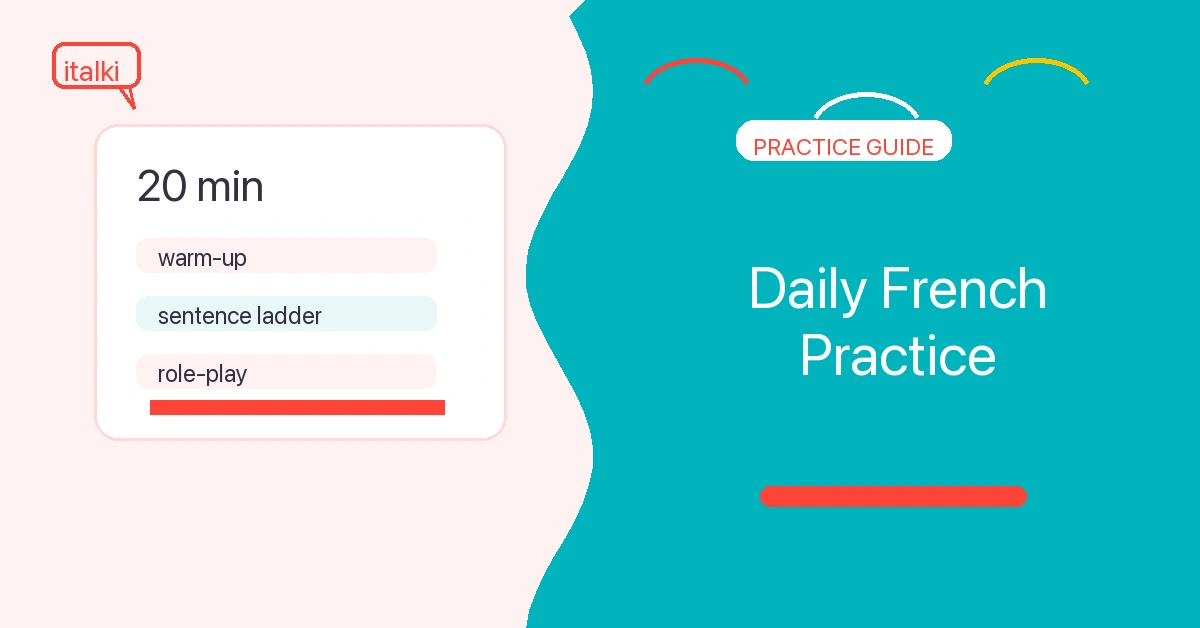
The best 20-minute routine uses one drill for sound, one for sentence speed, one for listening rhythm, and one for live-style response.
| Time | Exercise | What to do |
|---|---|---|
| 0 to 4 min | Mouth warmup | Nasal pairs: beau, bon, vin, pain, main |
| 4 to 8 min | Sentence ladder | Build 8 versions of Je voudrais… |
| 8 to 12 min | Question flips | Answer 10 prompts with Je pense que…, J’ai besoin de…, Parce que… |
| 12 to 16 min | Shadowing | Repeat 4 short lines with liaison |
| 16 to 20 min | Role-play | Speak both sides of one café, work, or travel scene |
Use the same routine for one week, then change the theme. A food week might use Je voudrais…, Vous avez…?, C’est combien? (How much is it?), and Ce sera tout (that will be all). A work week might use Je voulais vous demander… (I wanted to ask you…) and Pourriez-vous…? (Would you…?).
Keep a “pro phrase” list with ten reusable chunks:
- Je comprends votre point. (I understand your point.)
- Je vais vérifier. (I’ll check.)
- Ça me convient. (That works for me.)
- Ça dépend du contexte. (It depends on the context.)
- Je n’en suis pas sûr. (I’m not sure about that.)
- Pour être honnête… (To be honest…)
- À mon avis… (In my opinion…)
- Ce n’est pas exactement ce que je voulais dire. (That is not exactly what I meant.)
- Vous pourriez préciser? (Would you clarify?)
- Merci pour votre patience. (Thank you for your patience.)
Once a week, replace one solo session with a speaking lesson. Bring three recordings, one sentence ladder, and one role-play script so the lesson produces corrections you reuse the next day. A French lesson online structured this way turns twenty-minute daily drills into measurable progress instead of comfortable repetition.
Find Your Perfect Teacher
Build real French confidence with personalized lessons from a teacher who can help with speaking, exam prep, grammar, and pronunciation.
Ready to sound sharper in French every day?
Daily speaking practice works best when every drill has a spoken output: a cleaner vowel, a faster answer, a smoother liaison, or a phrase that fits the situation. Solo practice gives structure, but it cannot tell you whether your nasal vowels sound right or whether your register choice fits a professional context.
That gap is where a real teacher changes everything. italki has operated since 2007, connecting learners with teachers who specialize in focused speaking correction. Book a trial lesson and bring one daily drill to practice with real-time feedback.
Find Your Perfect Teacher
Build real French confidence with personalized lessons from a teacher who can help with speaking, exam prep, grammar, and pronunciation.
FAQ
How long should daily French speaking practice take?
Twenty minutes is enough for a focused session. Use short drills: pronunciation warmups, sentence ladders, question replies, shadowing, and one role-play.
What is the best French exercise for speaking faster?
Question flips. Reuse the question structure in your answer, as in Tu habites où? (Where do you live?) and J’habite près du centre (I live near the center). The 3-second answer rule builds retrieval speed.
How do French learners sound more natural?
Train liaison, silent letters, fillers like ben and alors, and register. Je voudrais… sounds more natural than Je veux… in polite service situations because it signals awareness of French social norms.
Is shadowing enough to speak French well?
Shadowing helps rhythm and pronunciation but does not train original answers. Pair it with question flips and role-plays for active speaking that builds real conversational ability.
Should beginners do these daily French practice exercises?
Yes, with shorter phrases and slower speech. Start with Bonjour, Je voudrais…, J’habite…, J’aime…, and Je ne comprends pas encore (I don’t understand yet), then add complexity each week.
Want to learn a language at italki?
Here are the best resources for you!