Key takeaways
- Difficult words in French often combine nasal vowels, silent final letters, the French r, and the rounded u sound.
- Words like écureuil, accueil, œil, and quincaillerie look longer than they sound, so syllable grouping matters.
- French pronunciation gets easier when you train mouth position first, then add speed.
- Practicing these words with a French tutor helps you hear mistakes in real time, especially in words with œ, ui, eu, and nasal vowels.
Difficult words in French usually feel hard because spelling hides sounds, adds sounds in connected speech, or points your mouth toward vowels that English speakers rarely use. This guide gives you 15 real French words, their IPA pronunciation, plain-English sound tips, and the exact mistake to avoid.
A French teacher can hear the small vowel and consonant slips that recordings miss, especially in words with œ, ui, eu, nasal vowels, and repeated French r sounds.

Find Your Perfect Teacher
Your French doesn’t have to sound like a textbook. Get personalized lessons from native tutors who’ll help you speak naturally, not just correctly.
Book a trial lesson
Why are difficult words in French hard to pronounce?
Difficult words in French are hard because the written word often gives you too much information. Your job is to find the sounded syllables, not to pronounce every letter.
French nasal vowels are one major reason. When a vowel is followed by m or n in the same syllable, the vowel is nasalized and the m or n does not receive its own full consonant release.
Silent endings add another problem. Many final consonants in French are not sounded in the isolated word form.
Then come three mouth-position issues:
- The French r is typically produced with friction near the uvula at the back of the mouth, rather than with the tongue curled as in English.
- French u is pronounced as /y/, with rounded lips and the tongue pushed forward.
- French liaison links a normally silent final consonant to the next word when that next word starts with a vowel sound, but only in certain grammatical contexts.
Practice note: Record yourself saying écureuil, accueil, and inconvénient. Then ask an online French tutor to mark the exact syllable where your mouth shifts too far toward English.
What are the 15 most difficult words in French for pronunciation?
The 15 words below are hard because each one hides a specific pronunciation trap. IPA transcriptions were checked against standard French pronunciation references, but the real teaching value is in the plain-English mouth-position notes beside each word.
| French word | Meaning | IPA | Why learners stumble | Approximate English hint |
|---|---|---|---|---|
| écureuil | squirrel | /e.ky.ʁœj/ | It packs é, u, r, and œil into one small word. | ay-kü-RUHY (round and push lips forward tightly on the middle syllable; the “ü” is not the English “oo”) |
| serrurerie | locksmithing, ironwork | /sɛ.ʁy.ʁə.ʁi/ | Three uvular r sounds spread across four syllables. | seh-RÜ-ruh-REE (keep r at the back of the throat throughout; do not skip the unstressed third syllable) |
| aujourd’hui | today | /o.ʒuʁ.dɥi/ | The d’hui ending compresses d plus the glide /ɥ/ plus i. | oh-zhoor-DWEE (the w-like sound is lighter and more rounded than English w) |
| grenouille | frog | /ɡʁə.nuj/ | The -ouille ending sounds like oo-y, not “oo-eel.” | gruh-NOOY |
| heureux | happy | /ø.ʁø/ | Both syllables use the rounded front vowel /ø/, which has no English equivalent. | Round your lips as if to say “oh” but produce the vowel from the front of your mouth. Both syllables use the same rounded shape. |
| œil | eye | /œj/ | It is one short syllable, not three letters sounded out. | Close to the vowel in English “hurl” (without the r) followed quickly by a y-glide. |
| accueil | welcome, reception | /a.kœj/ | The -cueil spelling looks bigger than the sound. | ah-KUHY (the ending rhymes with the sound in œil) |
| huit | eight | /ɥit/ | The opening /ɥ/ blends rounded lips with a y-like glide. | Like saying “weet” but with very rounded, tight lips and the tongue held forward |
| brouillard | fog | /bʁu.jaʁ/ | The -ill- does not sound like English “ill.” | broo-YAR (the final d is silent) |
| quincaillerie | hardware store | /kɛ̃.kɑ.jʁi/ | It begins with a nasal vowel and compresses into fewer syllables than the spelling suggests. | kaN-kah-YREE (the first syllable is nasal, no hard n at the end of it) |
| ailleurs | elsewhere | /a.jœʁ/ | The -ill- gives a y sound, then -eurs adds /œʁ/. | ah-YUHR (round your lips for the final syllable) |
| inconvénient | drawback | /ɛ̃.kɔ̃.ve.njɑ̃/ | It has three nasal vowels in a single word. | aN-koN-vay-nyaN (all three nasal sounds need air through the nose, no hard n or m) |
| coïncidence | coincidence | /kɔ.ɛ̃.si.dɑ̃s/ | The ï (tréma) separates co and ïn, creating a nasal in the second syllable. | koh-aN-see-daNs |
| œufs | eggs (plural) | /ø/ | The plural drops the /f/ of the singular œuf /œf/. One of the biggest spelling-to-sound gaps in French. | A single rounded vowel, like the vowel in heureux. No f, no s. |
| monsieur | sir, Mr. | /mə.sjø/ | The written -on- does not act like the usual nasal /ɔ̃/. The first syllable is a schwa /ə/. | muh-SYUH (the ending uses the same /ø/ as heureux) |
A note on œuf vs. œufs: The singular œuf is /œf/ (you hear the f). The plural œufs is /ø/ (the f and s both disappear). This is one of the few French nouns where the plural pronunciation changes so dramatically from the singular.
For spelling-to-sound basics, the guide to the French alphabet helps you separate letter names from word pronunciation.
Practice note: Pick five words from the table and say each one in a sentence. A French language teacher will help you move from isolated pronunciation to natural speech, which is where words like aujourd’hui and monsieur change most for learners.
Find Your Perfect Teacher
Your French doesn’t have to sound like a textbook. Get personalized lessons from native tutors who’ll help you speak naturally, not just correctly.
Book a trial lesson
How do you pronounce French nasal words without adding n or m?
To pronounce French nasal words, send air through your nose during the vowel, then stop before you add a full English n or m. The goal is not “in-kuh” or “on-nuh.” It is one nasal vowel held without the tongue touching the roof of the mouth.
Start with these three from the list:
- inconvénient /ɛ̃.kɔ̃.ve.njɑ̃/ means drawback or inconvenience. Three separate nasal vowels.
- quincaillerie /kɛ̃.kɑ.jʁi/ means hardware store. One nasal vowel in the opening syllable.
- coïncidence /kɔ.ɛ̃.si.dɑ̃s/ means coincidence. Two nasal vowels, in the second and fourth syllables.
Try this drill:
- Say the vowel only, with a relaxed jaw: “eh,” “oh,” “ah.”
- Let some air move through your nose while holding the vowel.
- Stop before your tongue rises to touch for n.
- Add the next syllable slowly: /ɛ̃/, /kɔ̃/, /njɑ̃/.
- Say the full word: inconvénient.
A good self-test is to hold the nasal vowel and pinch your nose. If the sound changes when you pinch, air was going through the nose correctly. If it does not change, you were not nasalizing.
In inconvénient, the first “in” is not “een” with a hard n, and the final “ent” is not pronounced as a separate syllable at all. It is part of the nasal /ɑ̃/.
The guide to French tongue twisters gives extra material if you want controlled repetition after these 15 words.
Practice note: Ask French tutors online to run a nasal minimal-pair drill with words like pain /pɛ̃/, pont /pɔ̃/, and pan /pɑ̃/.
How do you handle r, u, and eu in difficult French words?
For r, u, and eu, train the mouth shape before you train the whole word. These sounds fail when learners begin with an English sound and try to add a French accent afterward.
French r: Use serrurerie for concentrated practice. Say /sɛ.ʁy.ʁə.ʁi/ slowly, four syllables. Keep the tongue tip low and relaxed, resting behind the lower front teeth. Let the friction happen between the back of the tongue and the uvula area. Do not curl the tongue like English r. In serrurerie, you get three consecutive chances to feel the position. If you lose the throat position on any of them, slow down and isolate just the syllable that broke.
French u /y/: Use écureuil for practice. The middle syllable /ky/ needs rounded lips with the tongue forward. A practical trick: say “ee” (as in English “see”), keep the tongue exactly there, then round your lips as if to whistle. That gives you /y/. English speakers often substitute “oo” (/u/), which pulls the tongue back too far and sounds like a different French vowel entirely (the one in “vous”).
French eu /ø/ and œ /œ/: These two are closely related rounded front vowels. For heureux /ø.ʁø/, both syllables use /ø/. Round your lips gently, keep the tongue mid-high and forward, and produce a sound between English “uh” and “oh” but from the front of the mouth. For œil /œj/, the vowel /œ/ is slightly more open than /ø/. Think of the vowel in English “hurl” (without the r-coloring) but with rounded lips, then slide quickly into a y-glide.
The word accueil deserves its own note. The ending -cueil looks long, but /kœj/ is compact: it is the same vowel-plus-glide combination as œil, just preceded by /k/. Say “ah,” then “kuhy” as one smooth ending.
Practice note: Book 30 minutes with an online French teacher and focus only on r, u, eu, and œ. Short sound work pays off because these same mouth positions return in hundreds of everyday French words.
Find Your Perfect Teacher
Your French doesn’t have to sound like a textbook. Get personalized lessons from native tutors who’ll help you speak naturally, not just correctly.
Book a trial lesson
How do silent letters and liaison change French words?
Silent letters change French pronunciation because the spelling often preserves letters that you do not say in the isolated word. Liaison then brings some of those normally silent final consonants back before the next vowel in certain grammatical contexts.
œuf vs. œufs: The singular œuf is /œf/, so you hear the f clearly. The plural œufs is /ø/, with both the f and s silent. This means the singular and plural sound dramatically different. In a phrase like “des œufs” (some eggs), the s of des links as /z/ to the vowel of œufs, producing /de.z‿ø/. The f stays silent in the plural regardless.
Monsieur: The spelling suggests “mon” plus “sieur,” but the pronunciation /mə.sjø/ does not follow the usual nasal /ɔ̃/ pattern for “on.” The first syllable is a schwa /ə/. Treat it as one memorized sound shape: muh-syuh. This is simply an irregular pronunciation to learn by heart.
Aujourd’hui: The apostrophe does not mean you pause. The word moves quickly as /o.ʒuʁ.dɥi/, with the final portion d’hui compressed into a single syllable containing the glide /ɥ/. Practice placing it inside sentences:
- Aujourd’hui, il fait froid. (Today, it is cold.)
- Je travaille aujourd’hui. (I am working today.)
Liaison with œil: In a phrase like “mon œil” (used idiomatically to mean “yeah right”), the n of mon links to the vowel of œil, producing /mɔ̃.n‿œj/. The normally silent n appears because the next word starts with a vowel sound. This is a common mandatory liaison pattern with possessive adjectives.
Practice note: If connected speech feels confusing, schedule a short reading session with French language tutors. Bring five sentences that include œil, œufs, aujourd’hui, and monsieur, then ask for correction at slow and natural speed.
What practice routine works for these 15 difficult French words?
The best routine is short, out loud, and grouped by sound problem. Do not repeat all 15 words at full speed from day one. Split them by the specific mouth challenge.
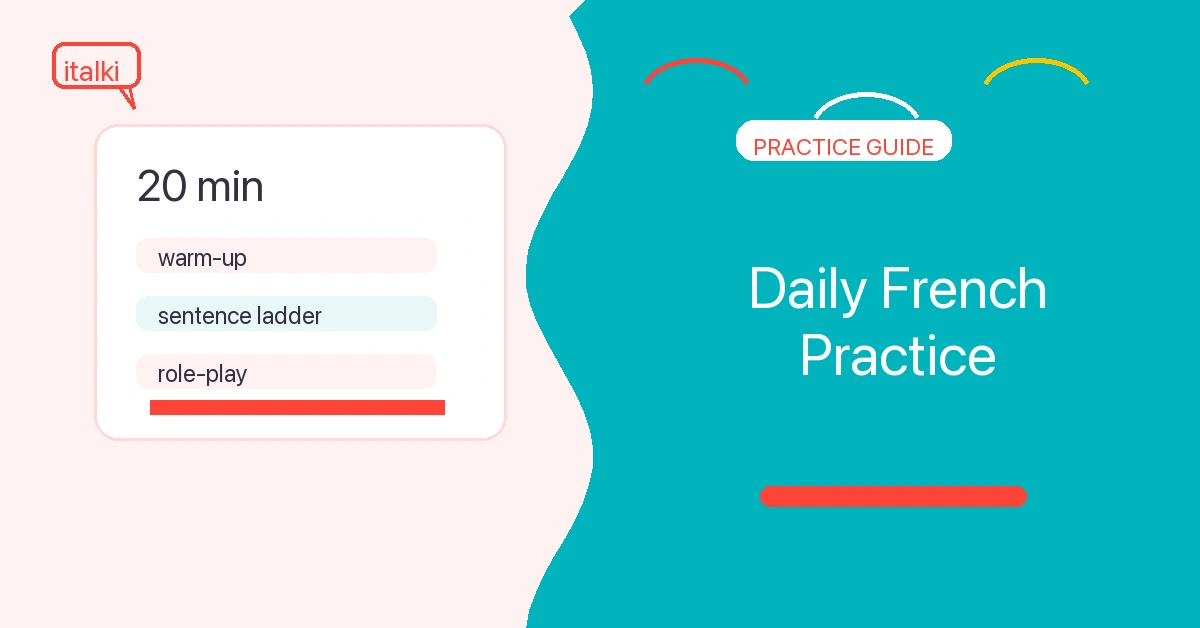
Use this 20-minute daily routine:
| Time | Task | Words to use |
|---|---|---|
| 3 min | Warm up rounded lips: hold /ø/ and /œ/ for 3 seconds each | heureux, œil, œufs |
| 4 min | Train French /y/ and the glide /ɥ/ | écureuil, aujourd’hui, huit |
| 4 min | Train uvular r in clusters | serrurerie, brouillard, ailleurs |
| 4 min | Train nasal vowels (no tongue contact for n) | quincaillerie, inconvénient, coïncidence |
| 3 min | Train -ill- and -ouille endings (y-glide, not “eel”) | grenouille, accueil, brouillard |
| 2 min | Say each word inside a full sentence | monsieur, aujourd’hui, inconvénient |
Use sentences, not word lists, at the end of each session:
- L’écureuil est dans le brouillard. (The squirrel is in the fog.)
- Monsieur, il y a un inconvénient. (Sir, there is a drawback.)
- Aujourd’hui, j’achète des œufs. (Today, I am buying eggs.)
- L’accueil est ailleurs. (The reception desk is elsewhere.)
- La grenouille est près de la quincaillerie. (The frog is near the hardware store.)
For more speaking structure, the guide to French conversation practice gives ways to turn pronunciation drills into live exchanges.
Practice note: Bring the sentence list above to a session with a private French tutor and ask for three passes: slow syllable-by-syllable, normal sentence rhythm, then a correction pass. This keeps your practice tied to real speech instead of isolated sounds.
Ready to pronounce difficult French words out loud?
Difficult words in French become less intimidating when you know the trap behind each one: nasal vowel, rounded front vowel, uvular r, silent ending, or liaison. The next step is live correction, because your ear often accepts a sound that a native or near-native speaker will catch right away.
Bring écureuil, serrurerie, accueil, œil, inconvénient, and your own trouble words to a lesson, then ask for targeted pronunciation feedback. Book a trial lesson and start turning difficult French words into words you say with confidence.
Find Your Perfect Teacher
Your French doesn’t have to sound like a textbook. Get personalized lessons from native tutors who’ll help you speak naturally, not just correctly.
Book a trial lesson
FAQ
What is the hardest French word to pronounce?
Écureuil /e.ky.ʁœj/ (squirrel) is commonly cited as one of the toughest because it combines the French u /y/, the uvular r, and the œil ending in just three syllables. Practice it as é, cu, reuil before joining the word at speed.
Why does French pronunciation differ so much from spelling?
French spelling preserves many letters from older stages of the language that are no longer sounded. Silent final consonants, nasal vowels written with full m or n, and irregular words like monsieur all reflect this gap. The best approach is to learn sound patterns rather than trying to pronounce every letter.
How do I pronounce the œ sound in French?
Round your lips gently and keep the tongue forward. For /œ/ (as in œil), the mouth is slightly more open, close to the vowel in English “hurl” without the r-coloring, but with rounded lips. For /ø/ (as in heureux or the plural œufs), the mouth is slightly more closed. Both sounds are front rounded vowels with no direct English equivalent.
Should I learn IPA to tackle difficult words in French?
Learning the handful of IPA symbols that differ most from English is worth the effort. Focus on /y/, /ʁ/, /œ/, /ø/, /ɥ/, and the nasal vowels /ɛ̃/, /ɔ̃/, /ɑ̃/. You do not need to memorize the full IPA chart; use the symbols here as a check while the pronunciation hints keep the work practical.
How long does it take to pronounce these 15 words correctly?
Most learners see strong improvement within one to two weeks of daily 10-to-20-minute practice. Mouth muscles need repeated short sessions rather than one long session, and live correction from a tutor speeds the process because your own ear often accepts sounds that a native speaker will flag.
Want to learn a language at italki?
Here are the best resources for you!