Key takeaways
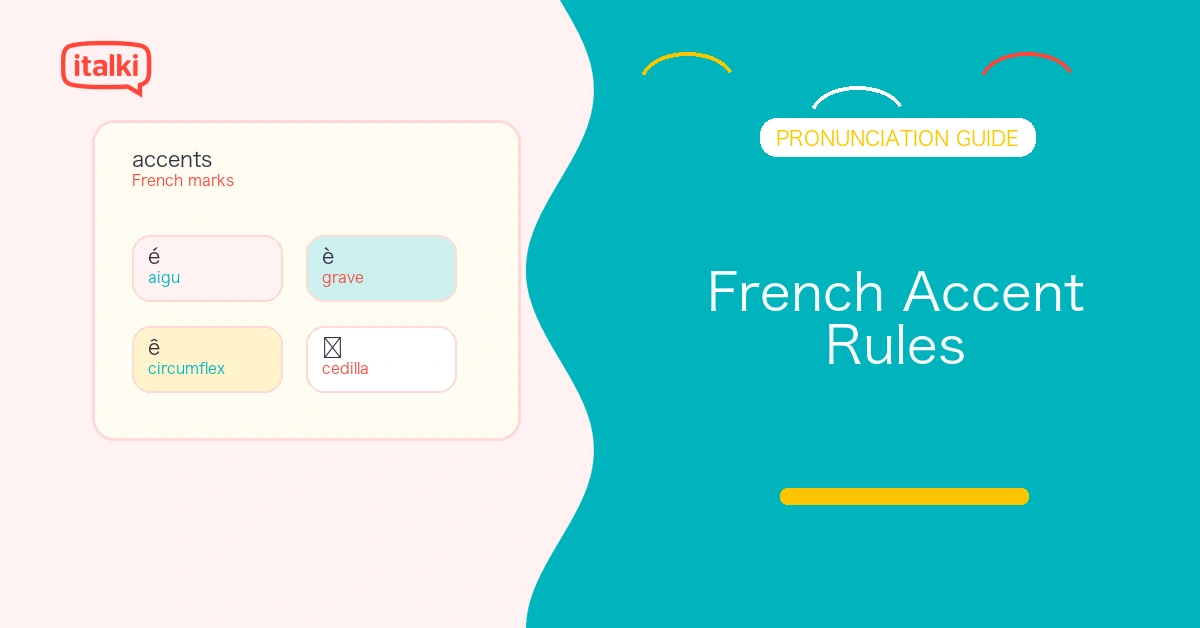
- French has five accent marks: accent aigu (é), accent grave (è, à, ù), accent circonflexe (â, ê, î, ô, û), tréma (ë, ï, ü), and cedilla (ç). Each serves a different purpose.
- The accent aigu (é) only appears on the letter e and signals a closed, bright /e/ sound, like the sound in the English word say but shorter and without a glide.
- The accent grave (è) on the letter e signals an open /ɛ/ sound, like the vowel in the English word bed. On à and ù it is a grammatical marker only and does not change pronunciation.
- The tréma (ë, ï, ü) signals that the marked vowel is pronounced separately from the vowel before it. Noël (Christmas) is pronounced NOH-el, not a single blended sound.
French accent marks are not decoration. Each one changes either the pronunciation, the meaning, or the grammatical category of the word. Typing or writing a French word without its correct accent produces a different word or an unreadable one.
italki connects learners with French teachers who can hear whether your pronunciation reflects the accent marks correctly and correct the specific vowel sounds that look similar but feel different in the mouth.
This guide covers all five French accent marks, what each one does to pronunciation and meaning, how to remember the rules, and the most common accent errors that learners make.

Find your perfect teacher
Build real French confidence with personalized lessons from a teacher who can help with speaking, exam prep, grammar, and pronunciation.
Book a trial lesson
The five French accent marks
| Accent | Name | Letters affected | Primary function |
|---|---|---|---|
| é | Accent aigu (acute accent) | e only | Changes vowel sound to closed /e/ |
| è, à, ù | Accent grave (grave accent) | e, a, u | Changes e pronunciation; distinguishes words for a and u |
| â, ê, î, ô, û | Accent circonflexe (circumflex) | a, e, i, o, u | Historical marker; affects pronunciation of â, ê, ô |
| ë, ï, ü | Tréma (diaeresis) | e, i, u | Signals the vowel is pronounced separately |
| ç | Cédille (cedilla) | c only | Changes /k/ sound to /s/ before a, o, u |
Accent aigu: é
The accent aigu appears only on the letter e. It signals a closed, tense /e/ sound: the mouth is half-open, the lips slightly spread, similar to the first part of the English ay but shorter and without the glide.
Sound: closed /e/ as in the French word été (ay-TAY: summer)
| French word | Pronunciation | English |
|---|---|---|
| café | ka-FAY | coffee/café |
| été | ay-TAY | summer |
| école | ay-KOL | school |
| étudiant | ay-tü-DYAHN | student |
| préférer | pray-fay-RAY | to prefer |
| vélo | VAY-lo | bicycle |
| médecin | MAY-duh-SAN | doctor |
Where it appears:
- At the start of words that historically began with es + consonant: école (was escole), étudiant (was estudiant)
- In the middle and end of words to mark the closed e sound
- In past participles of -er verbs: mangé (eaten), parlé (spoken), joué (played)
A French language tutor can hear whether your é sounds closed and tense or drifts toward the more open è sound, which is the most common learner error with this accent.
Find your perfect teacher
Build real French confidence with personalized lessons from a teacher who can help with speaking, exam prep, grammar, and pronunciation.
Book a trial lesson
Accent grave: è, à, ù
The accent grave appears on three letters but has a different role on each one.
è (on the letter e)
The è signals an open /ɛ/ sound, like the vowel in the English word bed. The mouth opens more than for é.
| French word | Pronunciation | English |
|---|---|---|
| père | PEHR | father |
| mère | MEHR | mother |
| frère | FREHR | brother |
| très | TREH | very |
| près | PREH | near |
| après | ah-PREH | after |
à (on the letter a)
The accent grave on a does not change the sound. A and à are pronounced identically. The accent serves only to distinguish two words that would otherwise be spelled the same.
| à | a |
|---|---|
| à (preposition: at, to, in) | a (third person singular of avoir: has) |
| Il va à Paris. (He is going to Paris.) | Il a faim. (He is hungry.) |
ù (on the letter u)
Similarly, the accent grave on u does not change pronunciation. It appears only in the word où (where), distinguishing it from ou (or).
| ou | où |
|---|---|
| ou (or) | où (where) |
| Café ou thé? (Coffee or tea?) | Où est la gare? (Where is the station?) |
Accent circonflexe
The circumflex (the hat accent) appears on all five vowels. Its effects vary by vowel.
| Letter | Pronunciation effect | Examples |
|---|---|---|
| â | Longer, more open /ɑ/ (back of the mouth) | château, pâte, théâtre |
| ê | Open /ɛ/ like è | forêt (forest), fête (party), tête (head) |
| î | No pronunciation change in modern French | île (island), naître (to be born) |
| ô | Rounder, more closed /o/ | hôtel, côte (coast), rôle |
| û | No pronunciation change in modern French | sûr (sure), flûte (flute) |
Historical note: The circumflex often marks the location where an s was present in Old French. Forêt was once forest (which is why English kept the s), hôpital was hospital, and fête was feste. The circumflex is a historical marker as much as a pronunciation marker.
In modern spoken French, many native speakers do not reliably distinguish â from a or û from u in casual speech. The distinction matters more in formal speech and careful pronunciation.
Find your perfect teacher
Build real French confidence with personalized lessons from a teacher who can help with speaking, exam prep, grammar, and pronunciation.
Book a trial lesson
Tréma
The tréma (two dots over a vowel) signals that the marked vowel is pronounced separately from the preceding vowel, not as a blended sound.
| With tréma | Pronunciation | Without tréma (hypothetical blend) |
|---|---|---|
| Noël | NO-el (two syllables) | would sound like nowel |
| naïf | na-EEF (two syllables) | would sound like nyeef |
| Citroën | Si-tro-EN | the brand name |
| haïr | ha-EER (to hate) | |
| Israël | Is-ra-EL | |
| aiguë | ai-GÜ (sharp/acute, feminine) |
The most common learner error with the tréma is pronouncing the two vowels as a single blended sound. Noël sounds like no + el in two clear beats, not like a diphthong.
New rule (2016 French spelling reform): The 2016 reform moved the tréma to the letter that actually needs separating in words like oignon (now sometimes written as ognon) and some others, but most textbooks and formal writing still follow traditional spelling.
Cedilla: ç
The cedilla appears only under the letter c. It signals that the c is pronounced /s/ rather than /k/.
Without cedilla: c before a, o, u = /k/ sound
- Cabane (ka-BAN: cabin), corps (KOR: body), culture (kül-TÜR: culture)
With cedilla: ç before a, o, u = /s/ sound
- Ça (SA: that/it), garçon (gar-SOHN: boy/waiter), reçu (ruh-SÜ: received), façade (fa-SAD: facade)
Before e and i, regular c already makes the /s/ sound (France, cinéma), so ç is never needed there.
| With ç | English |
|---|---|
| français | French |
| garçon | boy/waiter |
| ça va? | How are you? / Is it okay? |
| façon | way/manner |
| leçon | lesson |
| reçu | receipt/received |
Find your perfect teacher
Build real French confidence with personalized lessons from a teacher who can help with speaking, exam prep, grammar, and pronunciation.
Book a trial lesson
How accents change meaning between words
| Pair | Difference | Meaning |
|---|---|---|
| ou / où | No accent vs. grave | or / where |
| a / à | No accent vs. grave | has / to, at |
| la / là | No accent vs. grave | the (feminine) / there |
| du / dû | No accent vs. circumflex | of the / owed (past participle of devoir) |
| sur / sûr | No accent vs. circumflex | on / sure/certain |
| cote / côte | No accent vs. circumflex | rating/level / coast/rib |
Accent marks are easier to remember when you see them inside the most common French words, where spelling and pronunciation patterns repeat often.
Common accent mistakes learners make
| Mistake | Correct form | Issue |
|---|---|---|
| eté (no accent) | été | Missing accent aigu; é is part of the word |
| ou / ou | ou / où | Confusing or and where |
| a Paris | à Paris | Missing accent changes meaning (has Paris vs. to Paris) |
| Noel (no accent) | Noël | Missing tréma; word is now mispronounced as one syllable |
| garcon (no cedilla) | garçon | c without cedilla would be /k/: incorrect sound |
| chateau (no accent) | château | Missing circumflex; affects both vowel quality and spelling |
Find your perfect teacher
Build real French confidence with personalized lessons from a teacher who can help with speaking, exam prep, grammar, and pronunciation.
Book a trial lesson
Typing French accents on different keyboards
| System | Method |
|---|---|
| Mac | Option + e, then the vowel for aigu. Option + ` for grave. Option + i for circumflex. Option + u for tréma. |
| Windows | Alt codes (Alt + 130 for é, Alt + 138 for è) or use a French keyboard layout |
| iPhone/Android | Long-press the vowel to see accent options |
| All systems | Install a French keyboard layout for the most reliable input |
Ready to master French pronunciation?
French accent marks are a reliable system once you understand what each one does. É and è are distinct sounds. À and ù are grammatical markers. The circumflex has historical weight. The tréma separates vowels. The cedilla softens the c.
Knowing the rules in writing is the start. Hearing them in speech and producing the correct vowel sounds under conversational pressure is where practice with a real speaker matters. italki has 30,000+ expert tutors trusted by over 10 million learners worldwide, with French tutors who can train your ear and correct your pronunciation on the specific sounds these accents represent. Book a trial lesson and bring a French text with accent marks you want to practice reading aloud.
Find your perfect teacher
Build real French confidence with personalized lessons from a teacher who can help with speaking, exam prep, grammar, and pronunciation.
Book a trial lesson
FAQ
Do I need to use accent marks in informal writing?
In formal writing, academic work, and publishing, accents are required. In informal digital communication, French speakers sometimes skip accents, particularly accent graves. Learners should use correct accents at all times – it builds the right spelling habits and prevents accidentally writing a different word (a instead of à, ou instead of où).
Do French speakers always pronounce accented vowels distinctly in casual speech?
Not always. The distinction between â and a, and between û and u, is often blurred in everyday informal speech, particularly in Paris and among younger speakers. The distinction matters more in formal speech, news broadcasting, and careful reading. For learners, aiming for the correct pronunciation builds the right base even if native speakers sometimes relax it.
Were French accent rules always the same, or have they changed?
They have changed. The 2016 spelling reform recommended dropping the circumflex from î and û in most words, changing the spelling of words like oignon to ognon, and regularizing some other spellings. However, most schools, publishers, and formal institutions still follow traditional spelling. The reform is optional, not mandatory – both spellings are acceptable under current rules.
Want to learn a language at italki?
Here are the best resources for you!