Key takeaways
- The French alphabet has the same 26 letters as English but almost every vowel is pronounced differently, and several consonants have sounds with no English equivalent.
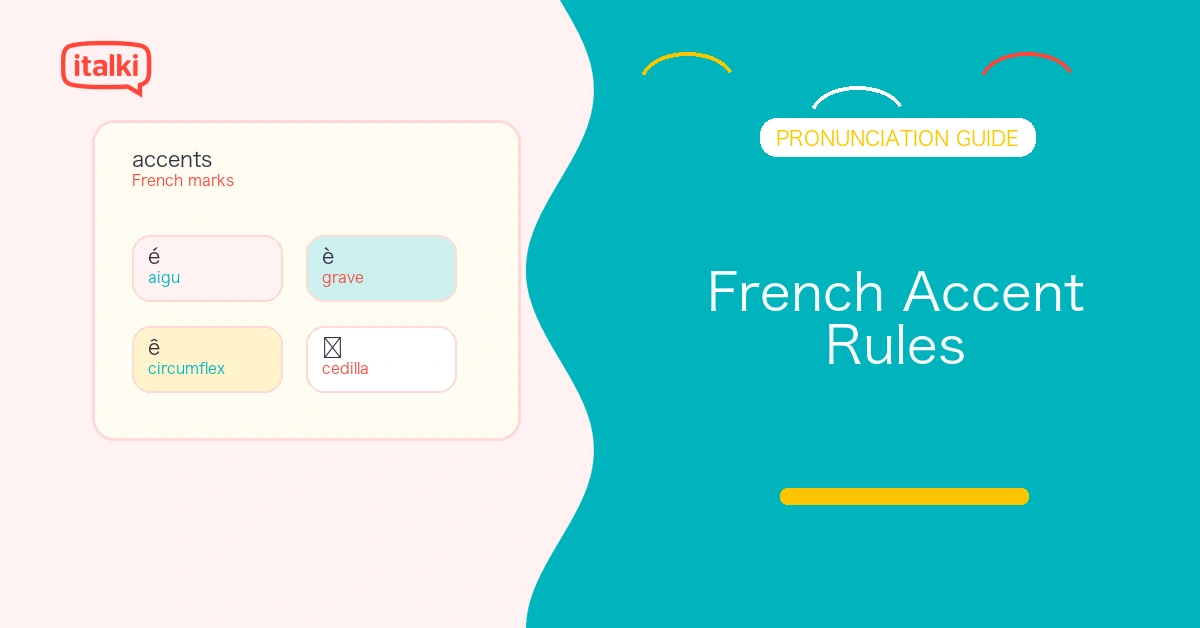
- French has five accent marks that change pronunciation or distinguish meaning: l’accent aigu (é), l’accent grave (è, à, ù), l’accent circonflexe (â, ê, î, ô, û), le tréma (ë, ï), and la cédille (ç).
- Silent letters are a defining feature of French: the final consonant is silent in most words (grand, petit, vous), and many vowel combinations produce single sounds (eau = /o/, ou = /u/).
- Liaison connects the final consonant of one word to the initial vowel of the next: les enfants is pronounced /le-ZAN-faN/, not /le AN-faN/.
One of the most common early frustrations in French is the gap between how words look and how they sound. French spelling is largely historical: it preserves letters that were once pronounced but are now silent, and it uses vowel combinations that bear no obvious relationship to their pronunciation.
Understanding the system behind these patterns makes reading French aloud far less unpredictable.
This guide covers every letter of the French alphabet with its name and pronunciation, the accent marks and what they do, the key sounds that have no English equivalent, the silent letter rules, and how liaison works in practice.
italki has connected 10M+ learners with teachers across 150+ languages since 2007, including French teachers who focus specifically on pronunciation and help learners hear the difference between sounds before they can produce them. Find a French tutor and spend a lesson just on the sounds that are blocking your French from sounding natural.

Find your perfect teacher
Build real French confidence with personalized lessons from a teacher who can help with speaking, exam prep, grammar, and pronunciation.

The French alphabet: names and sounds
The French alphabet has 26 letters. The names of the letters (how you say them when reciting the alphabet) differ significantly from English.
| Letter | French name | Approximate sound of letter name |
|---|---|---|
| A | a | ah |
| B | bé | bay |
| C | cé | say |
| D | dé | day |
| E | e | uh (like the e in butter) |
| F | effe | eff |
| G | gé | zhay |
| H | ache | ash |
| I | i | ee |
| J | ji | zhee |
| K | ka | kah |
| L | elle | ell |
| M | emme | em |
| N | enne | en |
| O | o | oh |
| P | pé | pay |
| Q | ku | kew |
| R | erre | air (with the French r) |
| S | esse | ess |
| T | té | tay |
| U | u | like German ü, no English equivalent |
| V | vé | vay |
| W | double vé | doo-bluh vay |
| X | ixe | eeks |
| Y | i grec | ee grek |
| Z | zède | zed |
The French u is one of the most important sounds to practise early: it is produced by shaping the mouth to say ee but then rounding the lips as if to say oo. No English sound is equivalent.
Vowels and vowel combinations
French has more vowel sounds than English, and many are produced from vowel combinations rather than single letters.
Single vowels
| Letter | Sound | Example |
|---|---|---|
| a | ah (open, at the back of the mouth) | chat (cat) |
| e | depends on position: uh mid-word, silent at end | le, me, que |
| é | closed ay sound | café, été |
| è, ê | open e, like e in bed | père, fête |
| i | ee | livre, midi |
| o | oh (can be open or closed) | mot, porte |
| u | no English equivalent (ee-shape, oo-lips) | lune, rue |
| y | usually ee, like i | style, dynamique |
Vowel combinations (the most important)
| Combination | Sound | Example |
|---|---|---|
| ai, ei | open e, like e in bed | faire, neige |
| au, eau | oh | chaud, beau, eau |
| eu, oeu | no English equivalent (round lips, say ay) | feu, coeur |
| ou | oo (like in moon) | vous, tout |
| oi | wah | moi, voix |
| ui | wee | nuit, suite |
| in, im, ain, ein, un | nasal vowel (see nasal vowels section) | vin, main, un |
| on, om | nasal vowel | bon, ombre |
| an, am, en, em | nasal vowel | dans, temps |
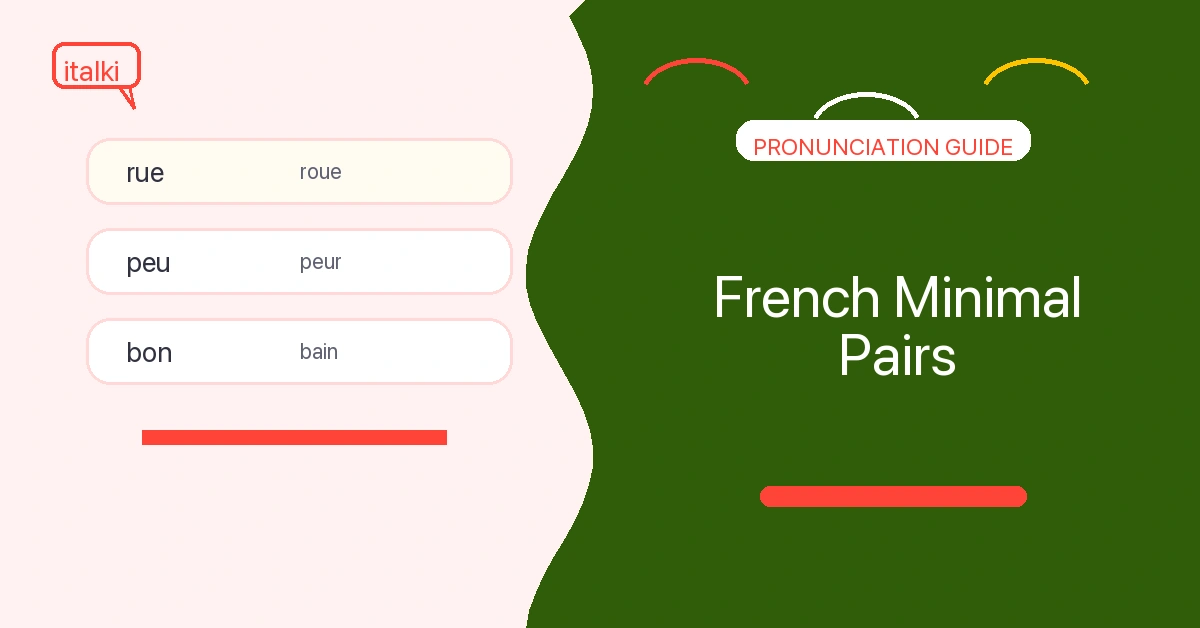
The ou/u distinction is critical: vous (you, formal) has the ou sound (/vu/); vu (seen) has the French u sound. Confusing them produces different words.
A French language tutor can make the difference between these sounds audible in real time. Learners often cannot hear u vs. ou at first because English does not distinguish them, and a teacher can produce minimal pair drills until the distinction becomes clear.
Find your perfect teacher
Build real French confidence with personalized lessons from a teacher who can help with speaking, exam prep, grammar, and pronunciation.
Consonants that differ from English
Most French consonants are similar to English, but several have important differences.
| Consonant | French behaviour | Example |
|---|---|---|
| c | /s/ before e, i, y; /k/ before a, o, u | ceci (say-see), café (ka-fay) |
| ç | always /s/ | garçon, façade |
| ch | /sh/ (never /ch/ as in English chair) | chocolat, chambre |
| g | /zh/ before e, i, y; /g/ before a, o, u | genre (zhon-ruh), gare (gar) |
| gn | /ny/ (like Spanish ñ) | agne, champagne |
| h | always silent in French | hôtel, homme |
| j | /zh/ (like the s in measure) | je, jardin |
| ll | usually /y/ (after ill); sometimes /l/ | famille (fa-MEE-yuh) |
| q (qu) | /k/ (the u is silent) | que, qui |
| r | guttural, produced at the back of the throat | rue, rouge |
| s | /s/ between consonant/vowel; /z/ between vowels | sac vs. maison |
| th | /t/ (not /th/ as in English) | thé, théâtre |
| w | /v/ in French words; /w/ in imported words | wagon vs. week-end |
| x | /gz/ or /ks/ depending on position | exact, taxi |
The French r is the consonant that requires the most specific production practice. It is produced by vibrating the back of the tongue against the soft palate, a position that feels counterintuitive to English speakers who produce an English /r/ with the tip of the tongue. Describing the sound is less useful than hearing and reproducing it in conversation with a teacher, especially because the same pronunciation pressure appears in many difficult words in French.
Accent marks and special characters
French uses five accent marks, each with a specific role.
| Accent | Name | Function | Example |
|---|---|---|---|
| é | accent aigu | marks the closed /e/ sound | café, été, bébé |
| è | accent grave (on e) | marks the open /e/ sound | père, mère, après |
| à, ù | accent grave (on a, u) | distinguishes meaning, not pronunciation | à (to) vs a (has) |
| â, ê, î, ô, û | accent circonflexe | historically marked a lost s; sometimes changes vowel quality | fête, hôtel, île |
| ë, ï | tréma | marks vowels that are pronounced separately | Noël, naïf |
| ç | cédille | makes c produce /s/ before a, o, u | garçon, français |
The tréma (ë, ï) indicates that two adjacent vowels are not a combination but are pronounced separately: Noël is /no-EL/, not a blended diphthong. Naïf is /na-EEF/.
Find your perfect teacher
Build real French confidence with personalized lessons from a teacher who can help with speaking, exam prep, grammar, and pronunciation.
Silent letters: the main rules
French has a large number of silent letters, particularly at the ends of words. The rules are consistent enough to become predictable.
Final consonants are usually silent:
Most words ending in a consonant do not pronounce that consonant:
- grand /graN/, the d is silent
- petit /puh-TEE/, the t is silent
- vous /vu/, the s is silent
- beaucoup /bo-KU/, the p is silent
Exceptions: The consonants C, R, F, and L are often pronounced at the end of words. The mnemonic CaReFuL captures these four.
- lac /lak/, c pronounced
- mer /mair/, r pronounced
- chef /shef/, f pronounced
- sel /sel/, l pronounced
Silent h: The h in French is always silent. However, there is a distinction:
- Aspirate h: the word behaves as if it starts with a consonant (no liaison, no elision): le hibou (not l’hibou)
- Mute h: the word behaves as if it starts with a vowel (liaison and elision apply): l’homme, les hommes /le-ZOM/
Silent e (e caduc / e muet): The final e in French words is generally silent: rose /roz/, table /tabl/. Within words, an unstressed e in a non-final syllable is often dropped in spoken French.
Nasal vowels
French nasal vowels are produced by allowing air to pass through the nose while the mouth is in a vowel position. They are one of the most distinctive features of French sound, and no English equivalent exists.
| Written form | Nasal vowel | Example |
|---|---|---|
| an, am, en, em | /aN/ (like on in bond, nasalised) | dans, temps, enfant |
| in, im, ain, aim, ein, un | /aN/ or /EN/ (the two are merging in modern French) | vin, main, un, pain |
| on, om | /oN/ | bon, ombre, maison |
Important: When nasal vowels are followed by another vowel or a double n/m, the nasalisation disappears:
- bon /boN/ is nasal
- bonne /bon/ is not nasal (double n removes nasalisation)
- une /yn/, the u is nasal
- une idée, the liaison adds a /n/ sound but the u is still nasalised
Find your perfect teacher
Build real French confidence with personalized lessons from a teacher who can help with speaking, exam prep, grammar, and pronunciation.
Liaison
Liaison is the pronunciation of an otherwise silent final consonant when the next word begins with a vowel or mute h. It is one of the features that makes French sound like a continuous flow rather than separate words.
Obligatory liaison (always required):
| Context | Example | Pronunciation |
|---|---|---|
| Article + noun | les enfants | /le-ZAN-faN/ |
| Adjective + noun | les petits enfants | /le puh-TEE-ZAN-faN/ |
| Pronoun + verb | nous avons | /nu-ZA-voN/ |
| One-syllable preposition + noun | en Angleterre | /AN-nAN-gluh-tair/ |
Forbidden liaison (never made):
| Context | Example | No liaison |
|---|---|---|
| Noun singular + verb | le chat aime | no liaison on chat |
| et (and) + vowel | Paul et Anna | never liaison after et |
| Before words with aspirate h | les haricots | no liaison |
The liaison consonant changes sound: a final s or x is pronounced /z/ in liaison (les enfants); a final d is pronounced /t/ (grand ami = /graN-ta-MEE/). These links between spelling and connected speech are also part of why French listening practice matters: learners have to recognise the sound that is actually spoken, not only the letters on the page.
Getting pronunciation right before bad habits form
Pronunciation errors in French tend to become permanent if they are not corrected early. The French r, the vowel u, the nasal vowels, and silent letter patterns are the four areas where early learners form habits that are extremely difficult to undo later.
italki has 30,000+ teachers across 150+ languages, including qualified French teachers who specialize in pronunciation work for English speakers. Find an online French pronunciation tutor and spend the first lesson recording yourself and comparing your production to a native model.
Find your perfect teacher
Build real French confidence with personalized lessons from a teacher who can help with speaking, exam prep, grammar, and pronunciation.
FAQ
How many letters are in the French alphabet?
26 letters, the same as English. However, French also uses five accent marks (accent aigu, accent grave, accent circonflexe, tréma, cédille) that modify certain letters.
Is H always silent in French?
Yes, h is always silent as a consonant. However, there is a distinction between mute h (which allows liaison and elision: l’homme, les hommes /le-ZOM/) and aspirate h (which blocks them: le hibou, not l’hibou). Both are phonetically silent, the difference is grammatical.
Why are so many letters silent at the end of French words?
French spelling largely reflects medieval pronunciation. Many final consonants that were once pronounced have become silent over centuries, but the spelling was not updated to reflect this. The result is a spelling system that is largely historical rather than phonetic.
What is the French r?
The French r is a voiced uvular fricative: produced by allowing the back of the tongue to vibrate against the uvula (the soft palate at the very back of the mouth). It sounds like a gentle gargling. It has no equivalent in English and requires specific production practice.
What is liaison in French?
Liaison is the pronunciation of an otherwise silent final consonant when the following word begins with a vowel or mute h. Les enfants is pronounced /le-ZAN-faN/ because the s of les becomes /z/ before the vowel of enfants. Some liaisons are obligatory, some optional, and some forbidden.
Want to learn a language at italki?
Here are the best resources for you!