Key takeaways
- French minimal pairs are word pairs with one sound difference, such as tu (you) and tout (all), that train your ear to hear meaning-changing sounds.
- Beginners should start with the contrasts that cause the most confusion: u vs ou, é vs è, oral vs nasal vowels, and s vs z.
- Mouth position matters more than IPA: rounded lips, tongue height, and nasal airflow often decide the word.
- Practicing minimal pairs with a French tutor turns guesswork into targeted correction, because a tutor hears whether your /y/ sounds like /u/ and adjusts your lip shape on the spot.
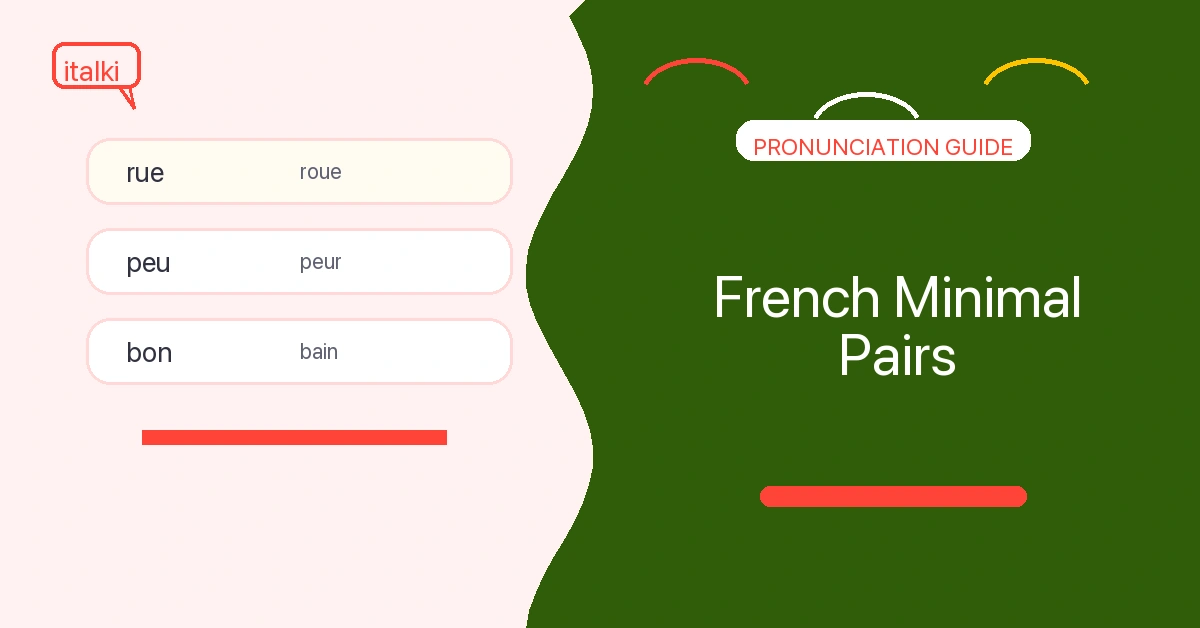
French minimal pairs are pairs of French words that differ by one sound and have different meanings, such as rue /ʁy/ (street) and roue /ʁu/ (wheel). They matter because French spelling hides sound differences that English speakers miss, especially u vs ou, nasal vowels, and silent final letters.
A recording can model correct pronunciation, but it cannot tell you that your tongue is too far back or that air is escaping through your nose at the wrong moment. That is why minimal pair work improves fastest with a real person listening.
italki, with 10M+ learners since 2007, makes it simple to book a pronunciation-focused session with a teacher who spots the exact error behind each confused pair.
Start by testing the pairs in this guide aloud, then bring the hardest ones to a French tutor who can hear the difference in real time.

Find Your Perfect Teacher
Build real French confidence with personalized lessons from a teacher who can help with speaking, exam prep, grammar, and pronunciation.

What are French minimal pairs?
French minimal pairs are two words that sound almost the same except for one sound, and that one sound changes the meaning. Beau /bo/ (beautiful) and bon /bɔ̃/ (good) differ only in whether the vowel is oral or nasal. Tu /ty/ (you) and tout /tu/ (all) differ only in tongue position during the vowel.
Minimal pairs train two skills at once: hearing and speaking. First, you learn to hear that tu and tout are not the same word. Then you train your lips and tongue to produce /y/ and /u/ on purpose.
Spelling alone is not enough. French has silent letters, nasal vowels, accent marks, and sound links between words. A learner who studies only written French might read dessous /dəsu/ (underneath) and dessus /dəsy/ (on top) correctly on paper, then say both with the same vowel.
Minimal pair practice works best when each word appears in a short phrase, because phrases reveal how the sound behaves in real speech:
| Minimal pair | Pronunciation | Meaning | Practice phrase |
|---|---|---|---|
| rue | /ʁy/ | street | dans la rue (in the street) |
| roue | /ʁu/ | wheel | une roue de vélo (a bike wheel) |
| dessus | /dəsy/ | on top | C’est dessus. (It is on top.) |
| dessous | /dəsu/ | underneath | C’est dessous. (It is underneath.) |
Find Your Perfect Teacher
Build real French confidence with personalized lessons from a teacher who can help with speaking, exam prep, grammar, and pronunciation.
Which French vowel minimal pairs should beginners learn first?
Start with u /y/ vs ou /u/, because English speakers often pronounce both like “oo.”
For French u /y/, round your lips as if saying “oo,” then keep the tongue high and forward, close to the position of “ee.” For ou /u/, keep the tongue farther back, closer to the vowel in “food,” but shorter and cleaner.
| Sound contrast | Word 1 | Word 2 | What changes |
|---|---|---|---|
| u /y/ vs ou /u/ | tu /ty/ (you) | tout /tu/ (all) | tongue forward vs back |
| u /y/ vs ou /u/ | vu /vy/ (seen) | vous /vu/ (you, formal) | single syllable, different register |
| u /y/ vs ou /u/ | dessus /dəsy/ (on top) | dessous /dəsu/ (underneath) | meaning flips completely |
| eu /ø/ vs ou /u/ | deux /dø/ (two) | doux /du/ (soft) | front rounded vs back rounded |
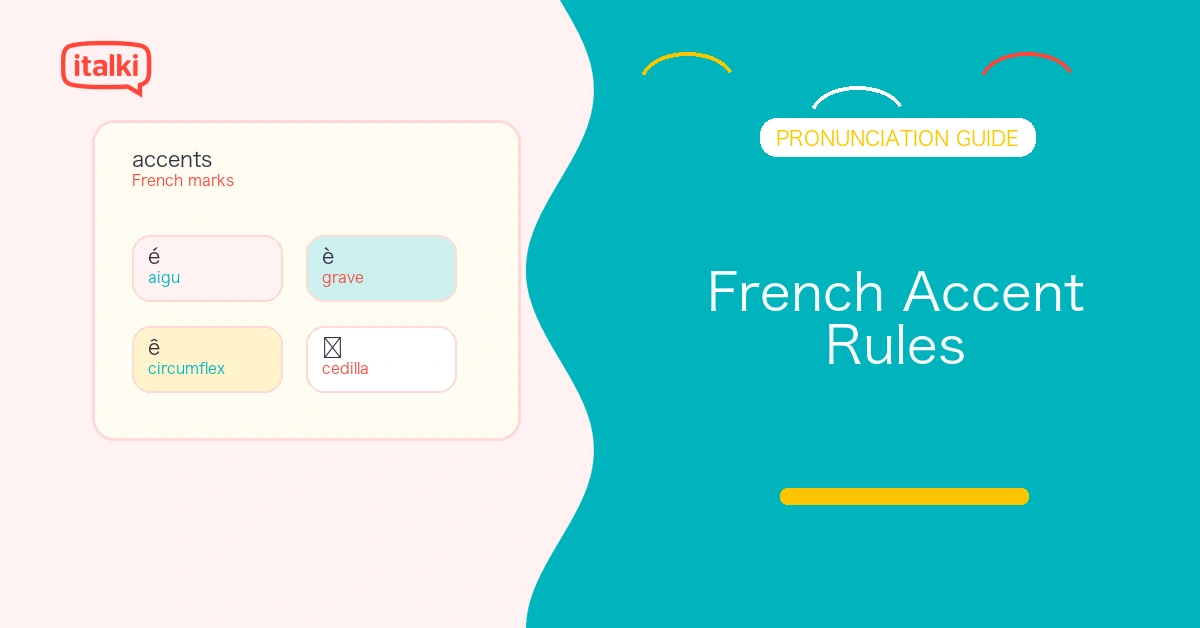
Next, practice é /e/ and è /ɛ/. These appear in high-frequency words, especially with accent marks and verb endings. É /e/ is more closed, like the vowel in été /ete/ (summer). È /ɛ/ is more open, like the vowel in père /pɛʁ/ (father).
| Sound contrast | Word 1 | Word 2 | Meaning |
|---|---|---|---|
| é /e/ vs è /ɛ/ | pré /pʁe/ | près /pʁɛ/ | meadow vs near |
| é /e/ vs è /ɛ/ | mes /me/ | mais /mɛ/ | my vs but |
| é /e/ vs è /ɛ/ | fée /fe/ | fait /fɛ/ | fairy vs fact, done |
Do not turn French vowels into English-style glides. In English, “say” often moves from one vowel position to another. French é /e/ stays steady from start to finish. The full set of sixteen French vowels builds useful context for these contrasts.
Record yourself on pré vs près. If both recordings sound identical, that is the signal to bring this pair into a lesson with a French language tutor who can tell you whether the problem is in your ear or your mouth.
Find Your Perfect Teacher
Build real French confidence with personalized lessons from a teacher who can help with speaking, exam prep, grammar, and pronunciation.
Which nasal vowel minimal pairs cause beginner mistakes?
Nasal vowel pairs cause mistakes because the mouth shape and airflow change simultaneously. A nasal vowel sends air through both the mouth and nose, while an oral vowel sends air through the mouth only.
Nasal vowels appear in small, frequent words: un (a, one), on (one, people), en (in), dans (in), bon (good), bien (well). Saying the final n too strongly gives the word an English sound and can obscure the meaning entirely.
| Oral word | Nasal word | Pronunciation | Meaning change |
|---|---|---|---|
| beau | bon | /bo/ vs /bɔ̃/ | beautiful vs good |
| bas | banc | /ba/ vs /bɑ̃/ | low vs bench |
| peau | pont | /po/ vs /pɔ̃/ | skin vs bridge |
| mais | main | /mɛ/ vs /mɛ̃/ | but vs hand |
| fait | faim | /fɛ/ vs /fɛ̃/ | fact, done vs hunger |
| va | vent | /va/ vs /vɑ̃/ | goes vs wind |
The beginner trap is adding a clear n sound at the end. Bon is not “bone.” Main is not “man.” The nasal quality belongs to the vowel itself, not to a fully pronounced final consonant.
Try this three-step drill:
- Say beau /bo/ with a plain oral vowel.
- Say bon /bɔ̃/ and let air pass through the nose while keeping the tongue away from the roof of the mouth.
- Keep the final n silent unless the next word begins with a vowel sound in a linking pattern.
Nasal vowels are hard to self-check because learners often hear the intended word, not the spoken one. A focused session with an online French tutor on oral vs nasal contrasts gives instant correction on pairs like bon, banc, and bain, where self-recording often masks the problem.
Find Your Perfect Teacher
Build real French confidence with personalized lessons from a teacher who can help with speaking, exam prep, grammar, and pronunciation.
Which French consonant minimal pairs change the meaning?
French consonant minimal pairs matter because a tiny voicing change often creates an entirely different word. The biggest beginner pairs are s vs z, ch vs j, p vs b, t vs d, and f vs v.
Voicing means the vocal cords vibrate. Put two fingers on your throat. With /s/, as in poisson /pwasɔ̃/ (fish), there is no vibration. With /z/, as in poison /pwazɔ̃/ (poison), there is vibration. That single difference separates fish from poison.
| Sound contrast | Word 1 | Word 2 | Meaning |
|---|---|---|---|
| s /s/ vs z /z/ | poisson /pwasɔ̃/ | poison /pwazɔ̃/ | fish vs poison |
| s /s/ vs z /z/ | dessert /dɛsɛʁ/ | désert /dezɛʁ/ | dessert vs desert |
| ch /ʃ/ vs j /ʒ/ | chou /ʃu/ | joue /ʒu/ | cabbage vs cheek, plays |
| p /p/ vs b /b/ | pain /pɛ̃/ | bain /bɛ̃/ | bread vs bath |
| t /t/ vs d /d/ | ton /tɔ̃/ | don /dɔ̃/ | your, tone vs gift |
| f /f/ vs v /v/ | faux /fo/ | vaux /vo/ | false vs am worth |
The r /ʁ/ and l /l/ contrast also matters. French r comes from the back of the mouth, while l touches near the upper teeth. Try riz /ʁi/ (rice) and lit /li/ (bed). The vowel stays /i/, so the first consonant carries all the contrast.
Short isolation drills build accuracy. Say only the first sound a few times, then add the rest of the word:
- /s/ /s/ /s/, poisson
- /z/ /z/ /z/, poison
- /ʃ/ /ʃ/ /ʃ/, chou
- /ʒ/ /ʒ/ /ʒ/, joue
French tongue twisters stack these consonant patterns into full phrases, forcing accurate voicing at conversational speed.
Find Your Perfect Teacher
Build real French confidence with personalized lessons from a teacher who can help with speaking, exam prep, grammar, and pronunciation.
How do silent letters and liaison affect minimal pair practice?
Silent letters and liaison affect minimal pairs because the same written consonant might be silent in one context and pronounced in another. Beginners need to practice words alone and inside short sentences.
Take petit /pəti/ (small, masculine) and petite /pətit/ (small, feminine). The final t is silent in petit but pronounced in petite. That final consonant changes both the sound and the grammar.
| Pair | Pronunciation | Meaning |
|---|---|---|
| petit | /pəti/ | small, masculine |
| petite | /pətit/ | small, feminine |
| grand | /ɡʁɑ̃/ | tall, big, masculine |
| grande | /ɡʁɑ̃d/ | tall, big, feminine |
| vert | /vɛʁ/ | green, masculine |
| verte | /vɛʁt/ | green, feminine |
Liaison adds another layer. Les amis (the friends) is pronounced /lezami/, with a /z/ linking les and amis. Les chats (the cats) is /le ʃa/, with no /z/ before the consonant /ʃ/. The French alphabet gives a baseline for which letters correspond to which sounds, but phrases reveal where those sounds appear and disappear.
Practice les in pairs to hear the difference:
- les amis /lezami/ (the friends)
- les enfants /lezɑ̃fɑ̃/ (the children)
- les livres /le livʁ/ (the books)
- les chats /le ʃa/ (the cats)
Silent letters and liaison are why pronunciation practice requires phrases, not just isolated words. If these patterns feel unpredictable, bring a short list of confusing pairs to a French tutoring session and ask for phrase-level correction.
Find Your Perfect Teacher
Build real French confidence with personalized lessons from a teacher who can help with speaking, exam prep, grammar, and pronunciation.
How should beginners practice French minimal pairs?
Practice in three passes: hear the difference, say the difference, then use the words in a phrase. Skipping the listening step often leads to repeating the same wrong sound louder.
Use this routine with one contrast at a time:
| Step | What to do | Example |
|---|---|---|
| 1. Listen | Play or hear two words without looking | tu, tout |
| 2. Identify | Point to the word you heard | tu /ty/ |
| 3. Repeat | Say the word after the model | tu |
| 4. Contrast | Say both words back to back | tu, tout, tu, tout |
| 5. Phrase | Put each word in a short sentence | Tu viens. Tout va bien. |
Keep first sessions short. Ten pairs with careful listening beat fifty pairs read too quickly. A good beginner set:
- vu /vy/ (seen), vous /vu/ (you, formal)
- beau /bo/ (beautiful), bon /bɔ̃/ (good)
- paix /pɛ/ (peace), pain /pɛ̃/ (bread)
- poisson /pwasɔ̃/ (fish), poison /pwazɔ̃/ (poison)
- chou /ʃu/ (cabbage), joue /ʒu/ (cheek, plays)
- ton /tɔ̃/ (your, tone), don /dɔ̃/ (gift)
Record yourself after the phrase step. Listen for one target sound only. If the target is u /y/, ignore grammar, speed, and accent. Ask one question: did tu sound different from tout?
Minimal pairs also belong in conversation, not only drills. Words like tu, vous, bon, bien, mais, and main appear constantly in speech, and getting them right under conversational pressure differs from getting them right in isolation. Practicing Tout va bien (Everything is fine) and Tu viens bien (You are coming, right) back to back reveals whether the contrast holds at natural speed.
Find Your Perfect Teacher
Build real French confidence with personalized lessons from a teacher who can help with speaking, exam prep, grammar, and pronunciation.
How does working with a tutor improve minimal pair accuracy?
A tutor improves minimal pair accuracy by diagnosing the exact sound that breaks the word. Two learners might say rue wrong for different reasons: one substitutes the English “oo,” while another gets the vowel right but weakens the French r.
Live feedback separates listening problems from mouth-position problems. If you cannot hear tu vs tout, the lesson should start with identification drills. If you hear the contrast but still say both as tout, the lesson should move to tongue and lip placement.
A focused 30-minute minimal pair lesson might include:
- A quick listening test with 10 pairs.
- A mouth-position check for the hardest contrast.
- Slow repetition of word pairs.
- Short phrase practice with both words side by side.
- Correction inside a mini conversation where both words could appear.
Choosing the right teacher matters because one learner might need slow phonetic drilling, while another needs conversation-speed correction. Searching for profiles that mention pronunciation, phonetics, or accent reduction helps match the lesson to the problem. When one contrast keeps causing trouble, working with a private French tutor lets you dedicate an entire session to just that pair until the mouth position becomes automatic.
Find Your Perfect Teacher
Build real French confidence with personalized lessons from a teacher who can help with speaking, exam prep, grammar, and pronunciation.
Ready to make French sounds clearer?
French minimal pairs turn vague pronunciation trouble into a clear checklist: u vs ou, é vs è, oral vs nasal vowels, s vs z, ch vs j, and silent vs pronounced final consonants. Work through the pairs slowly, record yourself on the hardest ones, then test them in short sentences.
For errors that recordings cannot catch, a teacher who hears the exact mistake and adjusts your technique in real time makes the difference between repeating the same error and fixing it permanently. Book a trial lesson and bring a specific request: “Help me with u vs ou and nasal vowels.” That focus turns a single session into measurable progress.
Find Your Perfect Teacher
Build real French confidence with personalized lessons from a teacher who can help with speaking, exam prep, grammar, and pronunciation.
FAQ
What are French minimal pairs?
French minimal pairs are two words that differ by one sound and have different meanings. Rue /ʁy/ (street) and roue /ʁu/ (wheel) are a typical example, where the vowel change turns one word into another.
What are the hardest French minimal pairs for beginners?
The hardest pairs are usually u /y/ vs ou /u/, oral vs nasal vowels (beau vs bon), and s /s/ vs z /z/ (poisson vs poison). These contrasts do not exist in English, so both hearing and producing them takes targeted practice.
How do you practice French minimal pairs alone?
Listen first, identify the word, repeat it, then use it in a short phrase. Record yourself and check one sound contrast at a time. If both words sound the same in the recording, that contrast needs live feedback.
Do accent marks always show pronunciation differences in French?
Accent marks often help, as in pré /pʁe/ (meadow) and près /pʁɛ/ (near), but spelling is not fully reliable. Silent letters, nasal vowels, and liaison also affect pronunciation in ways accent marks do not indicate.
How often should beginners practice minimal pairs?
Five to ten minutes a day on one sound contrast is enough. Short, accurate sessions build the ear and muscle memory better than long sessions where the same wrong sound gets repeated.
Want to learn a language at italki?
Here are the best resources for you!