Key takeaways
- Qui replaces the subject of a relative clause; que replaces the direct object
- Dont replaces any complement introduced by the preposition de, including possession
- Où signals place or time in a relative clause
- Lequel and its forms follow prepositions other than de and agree in gender and number with their antecedent
Connecting two ideas into a single, smooth sentence is one of the most visible signs of French fluency. You might know your vocabulary cold, but the moment you try to combine clauses, the question becomes: which pronoun goes where? Is it qui or que? When does dont take over?
italki connects learners with French teachers who give real-time grammar feedback so you can stop second-guessing every relative clause.
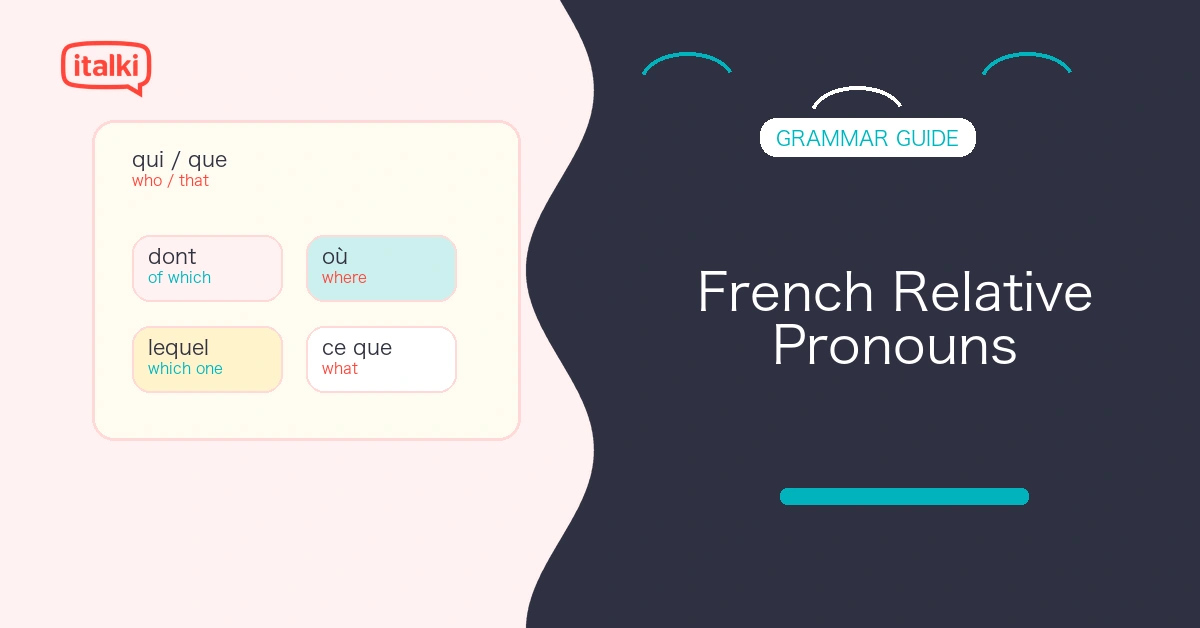
This guide covers what relative pronouns are, how each one works (qui, que, dont, où, and the lequel family), the special compound forms ce qui, ce que, and ce dont, a full comparison table, and the most common errors learners make.

Find your perfect teacher
Build real French confidence with personalized lessons from a teacher who can help with speaking, exam prep, grammar, and pronunciation.
Book a trial lesson
What are relative pronouns?
A relative pronoun introduces a subordinate clause that adds information about a noun already mentioned (the antecedent). English uses who, which, that, and whose. French uses a parallel system, but the pronoun you choose depends on the grammatical role the replaced noun plays inside the relative clause, not simply on whether it refers to a person or a thing.
Consider this example:
- English: The book that I read was fascinating.
- French: Le livre que j’ai lu était fascinant.
The antecedent is le livre. Because the book is the direct object of I read, French requires que. If the book were performing the action, que would become qui.
Qui: the subject pronoun
Qui (who / which / that) replaces the subject of the relative clause. It works for both people and things.
- La femme qui chante est ma mère. (The woman who is singing is my mother.)
- Le train qui arrive a du retard. (The train that is arriving is delayed.)
Because qui is the subject, the verb in the clause agrees with the antecedent in person and number:
- Les enfants qui jouent dehors sont fatigués. (The children who are playing outside are tired.)
Quick test: If you can replace the pronoun with il, elle, ils, or elles and the sentence still makes sense, you need qui.
French subject pronouns give you the subject-side grammar that relative clauses build on.
Working regularly with a French language tutor is one of the most effective ways to internalize this distinction through spoken practice.
Find your perfect teacher
Build real French confidence with personalized lessons from a teacher who can help with speaking, exam prep, grammar, and pronunciation.
French tutors
Que: the direct object pronoun
Que (whom / which / that) replaces the direct object of the relative clause. Like qui, it works for people and things alike.
- Le film que j’ai regardé était excellent. (The movie that I watched was excellent.)
- La personne que tu cherches est ici. (The person you are looking for is here.)
Past participle agreement: In compound tenses such as the passé composé, the past participle must agree in gender and number with que because the direct object precedes the verb. Passé composé in French explains the agreement rules that make this point easier to apply.
- Les lettres que j’ai écrites sont sur la table. (The letters I wrote are on the table.) écrites is feminine plural to agree with lettres.
Elision: Que becomes qu’ before a vowel or silent h:
- L’homme qu’elle aime est médecin.
Quick test: If you can replace the pronoun with le, la, or les, you need que.
Dont: replacing de
Dont replaces any complement introduced by the preposition de. This covers three main situations:
Possession (whose):
- C’est l’étudiant dont j’ai lu le livre. (That is the student whose book I read.) The underlying phrase is j’ai lu le livre de l’étudiant.
Verbs that take de: Many French verbs are followed by de: avoir besoin de, parler de, se souvenir de, avoir peur de, rêver de.
- Voici le sujet dont il parle. (Here is the topic he is talking about.)
- C’est la chose dont j’ai besoin. (That is the thing I need.)
Adjectives and nouns that take de:
- Le prix dont il est fier est immense. (The prize he is proud of is enormous.)
Mandatory word order: After dont, the order is always subject + verb + rest of clause. Placing the object directly after dont is a common error.
- Correct: C’est l’enfant dont la mère travaille ici.
- Incorrect: C’est l’enfant dont travaille la mère ici.
Find your perfect teacher
Build real French confidence with personalized lessons from a teacher who can help with speaking, exam prep, grammar, and pronunciation.
French tutors online
Où: place and time
Où (where / when) replaces a noun of place or time.
Place:
- La ville où je suis né s’appelle Lyon. (The city where I was born is called Lyon.)
- C’est le café où nous nous sommes rencontrés. (That is the café where we met.)
Time:
- Le jour où il est arrivé, tout a changé. (The day when he arrived, everything changed.)
- À l’époque où j’étais enfant, il n’y avait pas d’internet. (At the time when I was a child, there was no internet.)
With prepositions: When direction is needed, a preposition can appear before où:
- La maison d’où il vient est ancienne. (The house he comes from is old.)
Lequel and its forms
Lequel and its variants follow prepositions other than de. They agree in gender and number with the antecedent noun.
| Singular | Plural | |
|---|---|---|
| Masculine | lequel | lesquels |
| Feminine | laquelle | lesquelles |
- La chaise sur laquelle tu t’assieds est cassée. (The chair you are sitting on is broken.)
- Les raisons pour lesquelles il est parti sont claires. (The reasons for which he left are clear.)
Contractions with à:
- à + lequel = auquel
- à + lesquels / lesquelles = auxquels / auxquelles
- C’est le projet auquel je travaille. (That is the project I am working on.)
Contractions with de:
- de + lequel = duquel
- de + lesquels / lesquelles = desquels / desquelles
Note: When the antecedent is a person, qui is preferred after most prepositions: L’ami avec qui je voyage is more natural than avec lequel.
Find your perfect teacher
Build real French confidence with personalized lessons from a teacher who can help with speaking, exam prep, grammar, and pronunciation.
online French teacher
Ce qui, ce que, and ce dont
When the antecedent is not a specific noun but an entire idea or clause, use the compound forms:
- Ce qui (subject): Ce qui m’étonne, c’est sa patience. (What surprises me is his patience.)
- Ce que (direct object): Je ne comprends pas ce que tu veux dire. (I don’t understand what you mean.)
- Ce dont (de + idea): C’est ce dont j’avais besoin. (That is what I needed.)
These appear frequently in indirect questions and exclamations:
- Tu sais ce qui se passe? (Do you know what is happening?)
- Ce que c’est beau! (How beautiful it is!)
Comparison table
| Pronoun | Role in clause | Refers to | Example |
|---|---|---|---|
| Qui | Subject | People or things | La fille qui chante |
| Que | Direct object | People or things | Le film que j’ai vu |
| Dont | De-complement | People or things | Le livre dont j’ai besoin |
| Où | Place or time | Places, time nouns | La ville où j’habite |
| Lequel/laquelle | Object of preposition | Usually things | La raison pour laquelle |
| Ce qui | Subject (idea) | Idea or clause | Ce qui m’intéresse |
| Ce que | Direct object (idea) | Idea or clause | Ce que tu dis |
| Ce dont | De-complement (idea) | Idea or clause | Ce dont il parle |
Find your perfect teacher
Build real French confidence with personalized lessons from a teacher who can help with speaking, exam prep, grammar, and pronunciation.
French teacher
Common mistakes to avoid
Choosing based on meaning, not grammar. The choice between qui and que depends on grammatical role (subject vs. object), not on whether the noun is a person or a thing. Both pronouns work for either.
Forgetting past participle agreement with que. In compound tenses, the participle agrees with the direct object when que precedes the verb.
Using dont after compound prepositions. Dont only works with a simple de. After compound prepositions ending in de (à cause de, en face de, à côté de), use the correct form of duquel:
- La maison en face de laquelle il habite. (Not: en face de dont.)
Wrong word order after dont. Subject + verb + complement is mandatory after dont.
Skipping elision. Que becomes qu’ before a vowel or silent h; failing to elide is marked as an error in formal French.
French question words share several structural patterns with relative clauses, and most common French words help you build the vocabulary that appears inside them.
Practice tips
Reading French texts and underlining every relative pronoun is a highly effective active technique. Note which pronoun was used and why. Start with short news articles or children’s books, then move to literary texts.
You can also practice by writing a simple sentence and then combining it with each pronoun in turn to see how meaning and structure shift.
Find your perfect teacher
Build real French confidence with personalized lessons from a teacher who can help with speaking, exam prep, grammar, and pronunciation.
French tutor
Start building complex French sentences today
Mastering relative pronouns takes you from short, choppy sentences to fluid, connected French. Once you can link clauses naturally, your writing and speech feel noticeably more advanced. italki has 30,000+ expert tutors and is trusted by over 10 million learners worldwide. private French tutor with a French tutor and get personalized grammar feedback today.
Find your perfect teacher
Build real French confidence with personalized lessons from a teacher who can help with speaking, exam prep, grammar, and pronunciation.
Find a French tutor
FAQ
How do I quickly decide between qui and que?
Ask yourself whether the replaced noun is the subject or the direct object of the relative clause. If it performs the action and could be replaced by il, elle, ils, or elles, use qui. If it receives the action and could be replaced by le, la, or les, use que.
Can I always use dont instead of duquel?
No. Dont only substitutes for a simple de. For compound prepositions that end in de, such as à côté de or en face de, you must use the correct form of duquel (duquel, de laquelle, desquels, desquelles) rather than dont.
Do native French speakers actually use lequel in everyday conversation?
In spoken French, lequel and its forms are mostly formal and appear mainly in writing or careful speech. Casual French often restructures the sentence to avoid these forms. Learning both registers helps you understand native speakers and write accurately in formal contexts.
Want to learn a language at italki?
Here are the best resources for you!