Key takeaways
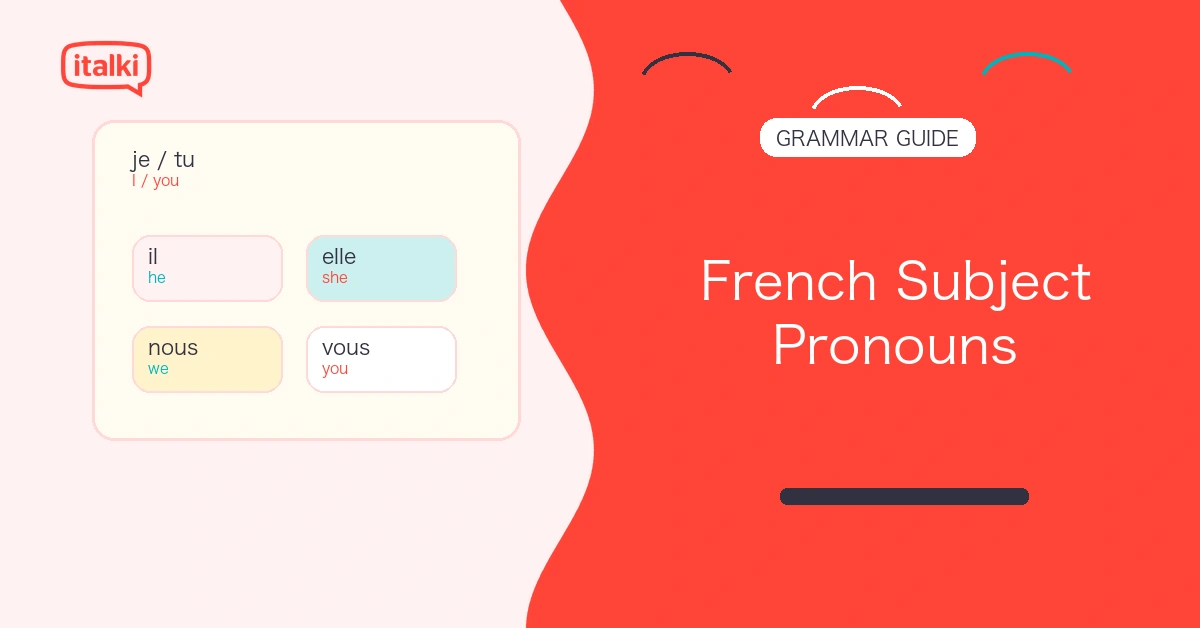
- French has eight subject pronouns: je, tu, il, elle, on, nous, vous, ils, elles
- Tu and vous both mean you but carry different social registers
- On is increasingly used as the informal equivalent of nous in everyday speech
- Stressed (disjunctive) pronouns moi, toi, lui, elle, nous, vous, eux, elles serve different grammatical functions from subject pronouns
One of the first things you notice when starting French is that the language has far more pronoun choices than English does. Which you do you use? Is the group masculine or feminine? What about that mysterious on you keep hearing in French conversation?
italki connects learners with French teachers who explain these distinctions clearly and give you immediate feedback when you slip up.
This guide covers all eight French subject pronouns with examples, the tu vs. vous distinction, on as an informal we, the difference between ils and elles, stressed pronouns and when to use them, and the most common errors English speakers make.

Find your perfect teacher
Build real French confidence with personalized lessons from a teacher who can help with speaking, exam prep, grammar, and pronunciation.
Book a trial lesson
What are subject pronouns?
Subject pronouns replace the subject of a sentence, the noun that performs the verb’s action. In English, they are I, you, he, she, it, we, and they. In French, the system is richer because verbs change their ending to match the subject, and the pronouns carry social meaning (tu vs. vous) and grammatical gender (il vs. elle, ils vs. elles).
French subject pronouns also differ from English in one important way: they cannot be dropped. While Spanish or Italian speakers often omit the subject pronoun, French requires it in almost every sentence.
French relative pronouns are the next pronoun system to study once subject pronouns feel automatic.
Je: I
Je (I) is the first-person singular subject pronoun.
- Je parle français. (I speak French.)
- Je suis étudiant. (I am a student.)
Elision: Je becomes j’ before a vowel or silent h:
- J’aime le café. (I like coffee.)
- J’habite à Paris. (I live in Paris.)
This elision is mandatory in writing and speech. Saying je aime is a clear error.
Find your perfect teacher
Build real French confidence with personalized lessons from a teacher who can help with speaking, exam prep, grammar, and pronunciation.
French tutors
Tu and vous: the two forms of “you”
This distinction is one of the most socially significant choices in French grammar.
Tu is singular and informal. Use it with:
- Friends and family members
- Children
- Peers your own age in casual settings
- Animals
Vous is used in two ways:
- As the formal singular: when speaking to strangers, older people, authority figures, or in professional contexts
- As the plural: when speaking to more than one person of any register
| Context | Pronoun | Example |
|---|---|---|
| Friend | Tu | Tu veux un café? |
| Colleague (formal) | Vous | Vous avez un rendez-vous? |
| Group of friends | Vous | Vous venez demain? |
| Shopkeeper | Vous | Vous avez cette taille? |
Tutoyer vs. vouvoyer: These verbs describe the act of using tu and vous respectively. Getting this wrong can come across as rude (too familiar) or cold (overly formal). When in doubt, start with vous and follow the other person’s lead.
Verb agreement: Tu takes the -s ending in most regular verbs (tu parles, tu finis), while vous takes -ez (vous parlez, vous finissez). Note that vous always takes the -ez ending and plural verb agreement even when referring to a single person.
Il and elle: he and she
Il (he / it) and elle (she / it) are the third-person singular pronouns. Unlike English, they assign grammatical gender based on the noun they replace, not biological sex.
- Le livre est intéressant. Il est intéressant. (The book is interesting. It is interesting.)
- La porte est ouverte. Elle est ouverte. (The door is open. It is open.)
This means a table (une table) is elle and a chair (une chaise) is also elle, regardless of any natural gender association.
Find your perfect teacher
Build real French confidence with personalized lessons from a teacher who can help with speaking, exam prep, grammar, and pronunciation.
French tutors online
On: the versatile third-person singular
On is officially the indefinite pronoun (one / people / someone) but in everyday spoken French it almost entirely replaces nous.
Formal / general meaning:
- On ne sait jamais. (One never knows.)
- On parle français ici. (French is spoken here / People speak French here.)
Informal we (the most common use today):
- On va au cinéma ce soir. (We’re going to the cinema tonight.)
- On est arrivés. (We arrived.)
Key grammar note: On always takes the third-person singular verb form (like il/elle), even when it means we:
- On est heureux. (We are happy.)
In formal writing, nous remains preferred. In conversation and informal writing, on is dominant among native speakers, so learners who rely exclusively on nous may sound stiff.
An online French tutor can help you get comfortable using on naturally, since it rarely receives much attention in textbooks.
Nous: we
Nous (we) is the first-person plural. It takes the -ons verb ending:
- Nous parlons français. (We speak French.)
- Nous allons au marché. (We are going to the market.)
Nous remains standard in formal writing, business communication, and careful speech. It is also used in the royal we and in academic writing to avoid the passive voice.
Find your perfect teacher
Build real French confidence with personalized lessons from a teacher who can help with speaking, exam prep, grammar, and pronunciation.
online French teacher
Ils and elles: they
Ils (they, masculine or mixed group) and elles (they, feminine) are the third-person plural pronouns.
Key rule: If a group contains even one masculine noun or person, use ils.
- Un homme et deux femmes = ils parlent (masculine wins)
- Trois femmes = elles parlent (all feminine)
This rule frustrates many learners because it means a group of 99 women and 1 man is referred to with ils. This is a feature of grammatical gender in French and is important to memorize.
- Les étudiants (ils) étudient beaucoup. (The students study a lot.)
- Les fleurs (elles) sont belles. (The flowers are beautiful.)
Verb endings for ils and elles are identical in regular verbs (-ent), which means the pronoun is essential for identifying the subject.
Stressed (disjunctive) pronouns
Stressed pronouns (also called disjunctive pronouns) are a separate set that cannot replace subject pronouns in most contexts. They are used for emphasis, after prepositions, in comparisons, and when the pronoun stands alone.
| Subject pronoun | Stressed pronoun |
|---|---|
| je | moi |
| tu | toi |
| il | lui |
| elle | elle |
| nous | nous |
| vous | vous |
| ils | eux |
| elles | elles |
Emphasis:
- Moi, je n’aime pas ça. (I, for one, don’t like that.)
- C’est lui qui a gagné. (He is the one who won.)
After prepositions:
- C’est pour toi. (This is for you.)
- Elle est venue avec nous. (She came with us.)
In comparisons:
- Il est plus grand que moi. (He is taller than me.)
Standing alone:
- Qui a fait ça? Moi. (Who did that? Me.)
Notice that elle and nous and vous are identical in both sets. Context determines function.
Most common French words give you the vocabulary that often surrounds pronouns, while French question words show another structure where pronoun choice matters.
Find your perfect teacher
Build real French confidence with personalized lessons from a teacher who can help with speaking, exam prep, grammar, and pronunciation.
French teacher
Common errors English speakers make
1. Dropping the subject pronoun. English speakers influenced by Spanish or Italian sometimes omit the pronoun. French requires it:
- Incorrect: Suis étudiant. Correct: Je suis étudiant.
2. Using tu with strangers. In France especially, using tu with someone you’ve just met can seem presumptuous. When in doubt, start with vous.
3. Forgetting to use on instead of nous in conversation. Native speakers almost always say on in informal speech. Using nous exclusively sounds bookish.
4. Making ils/elles errors with mixed groups. Always use ils when at least one member of the group is masculine.
5. Confusing il/elle with stressed lui/elle. Il parle uses subject il; c’est lui uses stressed lui. These are different forms.
6. Not eliding je before vowels. Je aime is always wrong; it must be j’aime.
Practice tips
Practice replacing nouns in sentences with the correct pronoun out loud. Then try the reverse: look at a pronoun and identify whether it is subject, object, or stressed. Reading aloud short French paragraphs and pausing on each pronoun to name its type is also helpful.
Conversations with native speakers are the fastest way to internalize the tu/vous distinction and the everyday use of on. A private French tutor can flag your errors in real time and explain the social context behind each pronoun choice.
Find your perfect teacher
Build real French confidence with personalized lessons from a teacher who can help with speaking, exam prep, grammar, and pronunciation.
French tutor
Take your French pronoun skills further
Getting subject pronouns right removes one of the most persistent sources of errors for English-speaking learners. From here, the next step is mastering object pronouns, relative pronouns, and the stressed forms in context. italki has 30,000+ expert tutors and is trusted by over 10 million learners worldwide. French language tutor with a French tutor and practise using every pronoun naturally.
Find your perfect teacher
Build real French confidence with personalized lessons from a teacher who can help with speaking, exam prep, grammar, and pronunciation.
Find a French tutor
FAQ
Is it ever acceptable to use both nous and on in the same text?
Yes, but you should be consistent within a single register. In formal writing, stick with nous throughout. In informal writing or transcribed speech, on is natural. Mixing them in the same sentence or paragraph can look inconsistent unless you are deliberately shifting registers for effect.
How do French speakers signal politeness if vous is dropped in casual settings?
Politeness in informal French contexts is carried more by tone, word choice, and conditional verb forms (such as je voudrais instead of je veux) than by the tu/vous distinction. Once both parties have established that tu is appropriate, politeness comes through vocabulary and intonation.
Do stressed pronouns ever appear as subjects?
Stressed pronouns can appear alongside a subject pronoun for strong emphasis (Moi, je veux partir) but they do not replace the subject pronoun grammatically. The sentence still needs the standard subject pronoun for the verb agreement to be correct.
Want to learn a language at italki?
Here are the best resources for you!