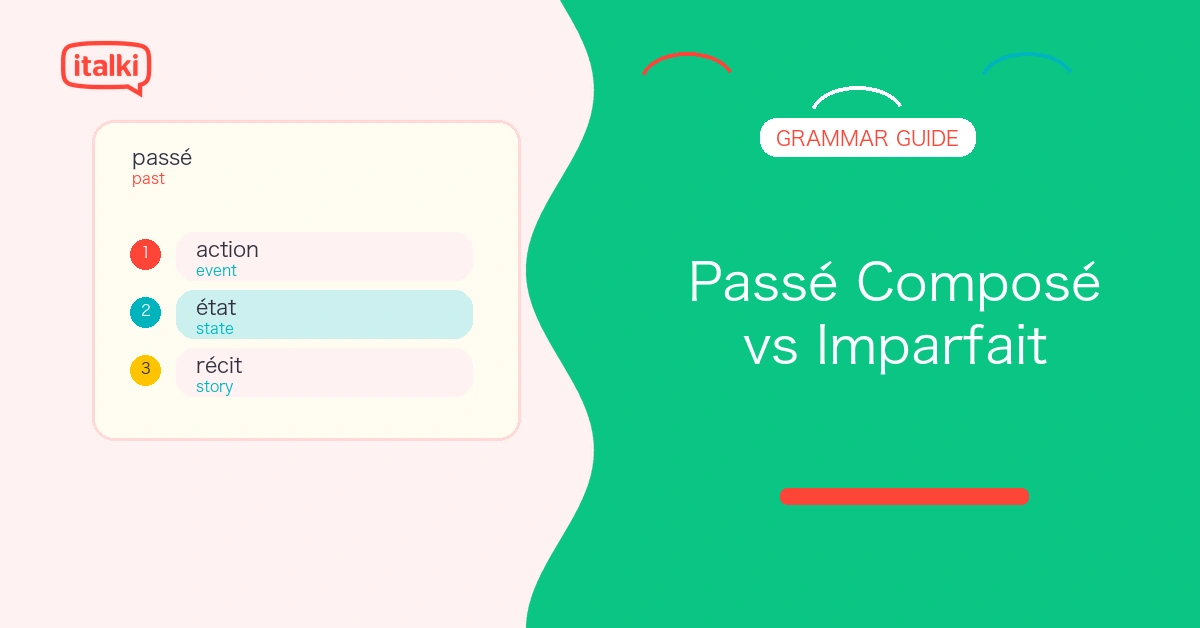
Key takeaways
- The core distinction is not simple past vs continuous past (as English might suggest) but rather perspective on the action: passé composé presents an action as a completed, bounded event; imparfait presents a state, background condition, or repeated/ongoing situation without a defined end point.
- Signal words help identify which tense to use. Passé composé often accompanies: soudain (suddenly), un jour (one day), puis (then), d’abord (first), enfin (finally). Imparfait often accompanies: toujours (always), souvent (often), parfois (sometimes), quand j’étais enfant (when I was a child), tous les jours (every day).
- In narrative, the two tenses work together: imparfait sets the scene and provides background; passé composé advances the plot. In the classic pattern she was reading (imparfait) when Pierre arrived (passé composé), the imparfait describes the ongoing activity that was interrupted, and the passé composé describes the interrupting event.
- Several important verbs change meaning depending on which tense is used: savoir (savait = knew; a su = found out), connaître (connaissait = was acquainted with; a connu = met), pouvoir (pouvait = was able to; a pu = managed to), vouloir (voulait = wanted; a voulu = tried/decided to), être and avoir also shift meaning between these tenses.
The passé composé vs imparfait distinction is one of the most discussed challenges in French grammar, and for good reason: it does not map neatly onto any single English distinction. Getting it right is what separates intermediate French that sounds choppy from French that tells a story naturally.
italki connects learners with French tutors who can listen to your stories in French, identify where tense choice sounds off, and explain the underlying logic in the way that makes the most sense to you specifically. This guide covers the core distinction, signal words, narrative patterns, the meaning-shifting verbs, and the most common mistakes.
Work with a French tutor online to practice past tense storytelling with real-time feedback and develop the tense intuition that comes from genuine conversation.

Find your perfect teacher
Build real French confidence with personalized lessons from a teacher who can help with speaking, exam prep, grammar, and pronunciation.
Book a trial lesson
The core distinction: completed event vs background state
The fundamental question is not about how long an action lasted, but about how the speaker frames it:
Passé composé = the action is presented as a complete, bounded unit. It happened; it is done. The beginning and end are both implied, even if not stated. The event is a brick in the wall of the story.
Imparfait = the action is presented as ongoing, open-ended, habitual, or descriptive at the time of the story. There is no implied endpoint. The action is the backdrop or wallpaper of the story.
A useful mental image: Think of a film. The imparfait is like a camera showing a continuous scene (the weather, the mood, what was normally happening). The passé composé is like a cut to a new scene (something happened, changed, or completed).
Il faisait beau. (Imparfait – it was beautiful weather, scene-setting) Soudain, il a plu. (Passé composé – suddenly, it rained, event)
Both sentences describe rain. The imparfait sentence describes the weather as background; the passé composé sentence describes the rain as a sudden event. The difference is entirely about framing, not about the duration.
Passé composé: what it expresses
Use passé composé for:
1. A single completed action at a specific time:
- Hier, j’ai mangé une pizza. (Yesterday, I ate a pizza.)
- Il est arrivé à 9h. (He arrived at 9 o’clock.)
- Elle a dit non. (She said no.)
2. A series of sequential events (plot advancement):
- Je me suis levé, j’ai pris une douche et j’ai pris le métro.
- (I got up, I took a shower, and I took the metro.)
3. An action that happened a specific number of times:
- J’ai visité Paris trois fois. (I visited Paris three times.)
4. An action with a defined duration that is now over:
- Il a habité à Lyon pendant cinq ans. (He lived in Lyon for five years.) [and then he left]
- Compare: Il habitait à Lyon. (He was living in Lyon.) [no specific endpoint implied]
5. A sudden change of state:
- Il a eu peur. (He became afraid. / Fear struck him.)
- Elle a été malade pendant deux jours. (She was sick for two days.) [defined period, now over]
For a complete guide to forming the passé composé including auxiliary choice (être vs avoir) and past participle agreement, the guide to passé composé in French covers the full formation system.
Find your perfect teacher
Build real French confidence with personalized lessons from a teacher who can help with speaking, exam prep, grammar, and pronunciation.
Book a trial lesson
Imparfait: what it expresses
Use imparfait for:
1. Background description (setting the scene):
- Il faisait froid et il pleuvait. (It was cold and it was raining.)
- La salle était sombre. (The room was dark.)
- Les enfants jouaient dans le jardin. (The children were playing in the garden.)
2. Habitual or repeated actions in the past:
- Quand j’étais enfant, je mangeais toujours des céréales le matin.
- (When I was a child, I always ate cereal in the morning.)
- Tous les étés, on allait à la mer. (Every summer, we went to the sea.)
3. An action in progress when something else happened:
- Je dormais quand le téléphone a sonné.
- (I was sleeping when the phone rang.)
4. States of mind, feelings, beliefs:
- Je voulais partir mais je ne pouvais pas. (I wanted to leave but I couldn’t.)
- Elle pensait que c’était vrai. (She thought it was true.)
- Il croyait en lui. (He believed in him.)
5. Age, weather, time in the past:
- Il avait vingt ans. (He was twenty years old.)
- Il était midi. (It was noon.)
6. Description of appearance:
- Elle portait une robe bleue. (She was wearing a blue dress.)
- Il avait les cheveux noirs. (He had dark hair.)
Signal words table
Signal words are not guarantees (context always matters), but they are strong indicators.
| Tense | Common signal words | French examples |
|---|---|---|
| Passé composé | soudain | soudain, il est tombé (suddenly, he fell) |
| Passé composé | tout à coup | tout à coup, la lumière s’est éteinte (all of a sudden, the light went out) |
| Passé composé | un jour | un jour, elle a décidé de partir (one day, she decided to leave) |
| Passé composé | enfin | enfin, il a compris (finally, he understood) |
| Passé composé | d’abord | d’abord, j’ai mangé (first, I ate) |
| Passé composé | ensuite / puis | ensuite, il est parti (then, he left) |
| Passé composé | hier / la semaine dernière | hier soir, j’ai vu un film (last night, I watched a film) |
| Passé composé | pendant + duration | pendant une heure, j’ai lu (for one hour, I read) |
| Imparfait | toujours / souvent | je fumais toujours après dîner (I always used to smoke after dinner) |
| Imparfait | parfois | parfois, on prenait le train (sometimes, we would take the train) |
| Imparfait | d’habitude | d’habitude, il arrivait tôt (usually, he would arrive early) |
| Imparfait | quand j’étais… | quand j’étais enfant… (when I was a child…) |
| Imparfait | tous les jours / chaque année | chaque été, il nageait (every summer, he would swim) |
| Imparfait | autrefois / jadis | autrefois, on vivait différemment (in the old days, people lived differently) |
Find your perfect teacher
Build real French confidence with personalized lessons from a teacher who can help with speaking, exam prep, grammar, and pronunciation.
Book a trial lesson
The narrative pattern: scene-setting and plot advancement
The most revealing context for the passé composé / imparfait distinction is narrative. In a story, the two tenses serve different narrative functions simultaneously.
Extended example:
Ce soir-là, il faisait nuit noire. (Imparfait: scene-setting, it was pitch dark) Un vent froid soufflait dans la rue. (Imparfait: ongoing condition) Marie marchait seule vers la station. (Imparfait: action in progress) Soudain, elle a entendu un bruit. (Passé composé: event interrupts the ongoing scene) Elle s’est retournée. (Passé composé: sequential event) Personne n’était là. (Imparfait: description of what was the case) Son cœur battait vite. (Imparfait: ongoing physical state) Elle a couru jusqu’au métro. (Passé composé: completed action)
Notice the pattern: each imparfait clause describes what was ongoing, and each passé composé clause advances what happened. The story would lose its texture if everything were in one tense.
The interruption pattern (classic combined sentence): Structure: [ongoing action in imparfait] + quand + [interrupting event in passé composé]
- Je lisais quand Pierre est arrivé. (I was reading when Pierre arrived.)
- Elle dormait quand le réveil a sonné. (She was sleeping when the alarm went off.)
- Nous dînions quand il a appelé. (We were eating dinner when he called.)
The imparfait shows what was in progress; the passé composé shows what cut into it.
Verbs that change meaning between tenses
Certain verbs have distinctly different meanings in imparfait vs passé composé. These are among the most important patterns to learn because mistaking them produces genuine misunderstandings.
| Verb | Imparfait | Passé composé |
|---|---|---|
| savoir | savait (knew, was aware of) | a su (found out, learned for the first time) |
| connaître | connaissait (was acquainted with) | a connu (met, made the acquaintance of) |
| pouvoir | pouvait (was able to, had the ability) | a pu (managed to, succeeded in doing) |
| vouloir | voulait (wanted, was wishing) | a voulu (tried to, made the attempt; or decided to) |
| devoir | devait (was supposed to, was obligated) | a dû (had to, was forced to; or must have) |
| être | était (was, describing state) | a été (was, completed episode; or was and is no longer) |
| avoir | avait (had, state of possession) | a eu (got, received; had and the episode ended) |
Examples in context:
- Il savait la réponse. (He knew the answer.) vs Il a su la vérité hier. (He found out the truth yesterday.)
- Je connaissais bien Paris. (I knew Paris well.) vs Je l’ai connu à Paris. (I met him in Paris.)
- Elle pouvait nager. (She could swim / was able to swim.) vs Elle a pu finir à temps. (She managed to finish in time.)
- Il voulait partir. (He wanted to leave.) vs Il a voulu partir, mais on l’a arrêté. (He tried to leave, but he was stopped.)
Find your perfect teacher
Build real French confidence with personalized lessons from a teacher who can help with speaking, exam prep, grammar, and pronunciation.
Book a trial lesson
Common mistakes and how to avoid them
Mistake 1: Using passé composé for everything English learners often use passé composé for every past action because English simple past (I went, she said) is used for both completed events and habitual actions. In French, every day I went requires imparfait: Chaque jour, j’allais.
Mistake 2: Treating imparfait as past continuous Imparfait is not simply the French equivalent of English past continuous (was doing). It covers habitual past actions, background states, and descriptions that have no equivalent continuous form in English. Elle aimait la musique (she liked music, habitual state) requires imparfait even though liked in English is not continuous.
Mistake 3: Relying only on duration Duration is not the deciding factor. A long action can be in passé composé if it is bounded: il a dormi pendant dix heures (he slept for ten hours, specific bounded event). A short action can be in imparfait if it was habitual: il dormait souvent le matin (he often slept in the morning).
Mistake 4: Forgetting the scene-setting function In writing and storytelling, forgetting to use imparfait for background descriptions makes the story choppy and removes all atmospheric detail. A well-told French story uses imparfait generously for setting, state, and habit.
Practice: which tense?
Try to identify which tense fits each sentence, then check the explanation:
- Quand j’étais petit, je [jouer] au foot tous les week-ends.
- Imparfait (jouer – jouais): habitual repeated past action with tous les week-ends.
- Hier soir, elle [téléphoner] à sa mère pendant une heure.
- Passé composé (téléphoner – a téléphoné): specific bounded event with hier soir and specific duration.
- Il [lire] le journal quand son ami [arriver].
- Lisait (imparfait) / est arrivé (passé composé): ongoing action interrupted by event.
- Je [savoir] pas qu’il [partir] déjà.
- Je ne savais pas (imparfait): ongoing state of not knowing / Il était déjà parti (plus-que-parfait, but the point is savais for the knowing state).
- Soudain, le chien [aboyer].
- A aboyé (passé composé): sudden event with soudain.
Find your perfect teacher
Build real French confidence with personalized lessons from a teacher who can help with speaking, exam prep, grammar, and pronunciation.
Book a trial lesson
Practice past tense storytelling with a tutor
The passé composé / imparfait distinction is one of those aspects of French grammar that becomes intuitive only through consistent production practice, not just analysis. You need to tell stories in French, have a native speaker catch the moments where your tense choice breaks the natural flow, and understand in the moment why one felt more natural than the other.
italki’s 30,000+ expert tutors include native French speakers who can engage you in storytelling conversation, correct tense errors in real time, and help you develop the tense instinct that makes French narrative sound natural. Trusted by over 10 million learners worldwide, the platform lets you find a tutor who specializes in grammar and conversation practice. Book a trial lesson and start telling stories in French with the tense confidence that makes you sound fluent.
Find your perfect teacher
Build real French confidence with personalized lessons from a teacher who can help with speaking, exam prep, grammar, and pronunciation.
Book a trial lesson
FAQ
What is the main difference between passé composé and imparfait?
Passé composé presents a past action as a completed, bounded event. Imparfait presents a past state, habitual action, or ongoing situation without a defined endpoint. In a story, passé composé advances the plot (what happened); imparfait sets the scene (what was going on). The distinction is about perspective and framing, not just about how long an action lasted.
Can you use both tenses in the same sentence?
Yes, and this is one of the most important patterns in French narrative. The classic combination is: [action in progress, imparfait] + quand (when) + [interrupting event, passé composé]. For example: Je dormais (imparfait) quand le téléphone a sonné (passé composé): I was sleeping when the phone rang.
What does savoir mean in each tense?
In imparfait, je savais means I knew (was in a state of knowing). In passé composé, j’ai su means I found out / I learned (the moment of coming to know something). This is one of several French verbs whose meaning shifts depending on tense: connaître, pouvoir, vouloir, and devoir all have similar meaning shifts between imparfait and passé composé.
Do signal words always determine the tense?
Signal words are strong indicators but not absolute rules. Tous les jours (every day) nearly always accompanies imparfait because it signals habitual action. Soudain (suddenly) nearly always accompanies passé composé because it signals a sudden event. However, context always overrides signal words. If you say tous les jours j’ai décidé de partir (Every day I decided to leave), the context would make clear you mean something unusual, and the passé composé is correct despite tous les jours.
What about the plus-que-parfait?
The plus-que-parfait (pluperfect) is a third past tense used for actions that happened before another past action: j’avais déjà mangé quand il est arrivé (I had already eaten when he arrived). It is formed with the imparfait of avoir or être + past participle. While not covered in depth here, understanding when an event is even further back in the past requires the plus-que-parfait rather than passé composé or imparfait.
Want to learn a language at italki?
Here are the best resources for you!