Key takeaways
- Reflexive verbs use a reflexive pronoun (me, te, se, nous, vous, se) to show the subject acts on itself
- In the passé composé, all reflexive verbs take être as the auxiliary verb
- Many French verbs change meaning when used reflexively vs. non-reflexively
- Reciprocal verbs use the same structure but express a mutual action between multiple subjects
Learning how to talk about your daily routine in French means wrestling with reflexive verbs almost immediately: se lever, se laver, s’habiller. These verbs look strange at first because they include a pronoun that has no direct equivalent in English.
italki connects learners with French teachers who can correct your reflexive verb errors in real time and make the patterns feel natural faster.
This guide covers what reflexive verbs are, the full set of reflexive pronouns, how to conjugate reflexive verbs in the present tense and the passé composé, negation and question forms, a table of 30 common reflexive verbs, reciprocal verbs, and verbs that shift meaning when used reflexively.

Find your perfect teacher
Build real French confidence with personalized lessons from a teacher who can help with speaking, exam prep, grammar, and pronunciation.
Book a trial lesson
What are reflexive verbs?
A reflexive verb describes an action that the subject performs on itself. In French, they are formed with the prefix se (or s’ before a vowel) in the infinitive: se lever, s’appeler, se souvenir.
In English, we sometimes express the same idea with myself, yourself, etc.: I wash myself. But many French reflexive verbs have no clean English equivalent. Je m’ennuie (I am bored) and Je me souviens (I remember) do not contain any reflexive sense in their English translations.
Reflexive verbs are extremely common in French and essential for talking about:
- Daily routines (se réveiller, se brosser les dents, se coucher)
- Emotions and feelings (se sentir, se fâcher, s’inquiéter)
- Reciprocal actions (se parler, se voir, s’aimer)
Reflexive pronouns
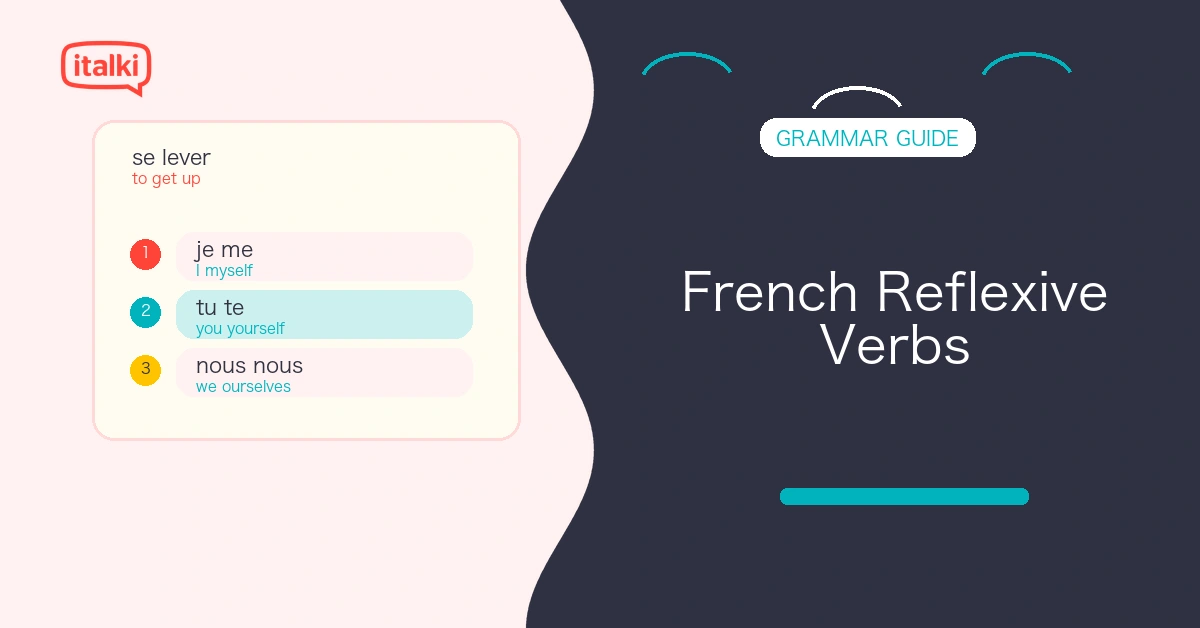
Each subject pronoun pairs with a specific reflexive pronoun:
| Subject | Reflexive pronoun | Example |
|---|---|---|
| je | me (m’) | je me lève |
| tu | te (t’) | tu te lèves |
| il / elle / on | se (s’) | il se lève |
| nous | nous | nous nous levons |
| vous | vous | vous vous levez |
| ils / elles | se (s’) | ils se lèvent |
The reflexive pronoun always comes directly before the verb (or before the auxiliary verb in compound tenses). Me, te, and se elide to m’, t’, and s’ before a vowel:
- Je m’appelle Marie. (My name is Marie.)
- Tu t’habilles vite. (You get dressed quickly.)
French subject pronouns matter here because every reflexive form changes with the subject.
Find your perfect teacher
Build real French confidence with personalized lessons from a teacher who can help with speaking, exam prep, grammar, and pronunciation.
French tutors
Present tense conjugation
Conjugating a reflexive verb in the present tense follows regular conjugation rules for the verb stem, with the reflexive pronoun added in front.
Example: se lever (to get up): base verb lever is an -er verb with a stem change.
| Subject | Form |
|---|---|
| je | me lève |
| tu | te lèves |
| il / elle / on | se lève |
| nous | nous levons |
| vous | vous levez |
| ils / elles | se lèvent |
Example: s’appeler (to be called): stem-changing -er verb.
| Subject | Form |
|---|---|
| je | m’appelle |
| tu | t’appelles |
| il / elle / on | s’appelle |
| nous | nous appelons |
| vous | vous appelez |
| ils / elles | s’appellent |
Working through these conjugations with an online French teacher helps you catch stem changes and elisions that are easy to miss when studying alone.
Passé composé conjugation
This is where reflexive verbs differ sharply from most other verbs: all reflexive verbs use être as their auxiliary in the passé composé, never avoir. Avoir conjugation in French is still useful for comparing auxiliary patterns.
Structure: reflexive pronoun + être (conjugated) + past participle
The past participle agrees in gender and number with the subject when the reflexive pronoun is the direct object, which is the case for most reflexive verbs.
Example: se lever (to get up)
| Subject | Passé composé |
|---|---|
| je (m.) | je me suis levé |
| je (f.) | je me suis levée |
| tu (m.) | tu t’es levé |
| tu (f.) | tu t’es levée |
| il / on | il s’est levé |
| elle | elle s’est levée |
| nous (m.) | nous nous sommes levés |
| nous (f.) | nous nous sommes levées |
| vous (m. sg.) | vous vous êtes levé |
| vous (f. pl.) | vous vous êtes levées |
| ils | ils se sont levés |
| elles | elles se sont levées |
Exception: When the reflexive pronoun is the indirect object (usually with a body part as the direct object), the past participle does not agree.
- Elle s’est lavé les mains. (She washed her hands.) les mains is the direct object; se is indirect, so no agreement on lavé.
Passé composé in French explains the tense rules behind these reflexive past-tense forms.
Find your perfect teacher
Build real French confidence with personalized lessons from a teacher who can help with speaking, exam prep, grammar, and pronunciation.
French tutors online
Negation with reflexive verbs
In the negative, ne comes before the reflexive pronoun, and pas (or another negative word) comes after the verb:
Present tense:
- Je ne me lève pas tôt. (I don’t get up early.)
- Il ne se souvient pas de toi. (He doesn’t remember you.)
Passé composé:
- Elle ne s’est pas réveillée à l’heure. (She didn’t wake up on time.)
Ne…pas wraps around the pronoun + auxiliary unit, not the past participle.
Questions with reflexive verbs
Inversion: The subject pronoun and auxiliary invert, but the reflexive pronoun stays before the verb:
- Se lève-t-il tôt? (Does he get up early?)
- Vous êtes-vous levés? (Did you get up?)
Est-ce que: Simply add est-ce que before the statement. No word order changes:
- Est-ce que tu te réveilles tôt?
Find your perfect teacher
Build real French confidence with personalized lessons from a teacher who can help with speaking, exam prep, grammar, and pronunciation.
Find a French tutor
30 common reflexive verbs
| Infinitive | Meaning | Example sentence |
|---|---|---|
| se lever | to get up | Je me lève à sept heures. |
| se coucher | to go to bed | Elle se couche tard. |
| se réveiller | to wake up | Nous nous réveillons tôt. |
| se laver | to wash oneself | Il se lave les mains. |
| se brosser (les dents) | to brush (one’s teeth) | Tu te brosses les dents. |
| s’habiller | to get dressed | Je m’habille en cinq minutes. |
| se déshabiller | to get undressed | Il se déshabille avant de dormir. |
| se raser | to shave | Mon père se rase chaque matin. |
| se maquiller | to put on makeup | Elle se maquille rapidement. |
| se peigner | to comb one’s hair | Je me peigne devant le miroir. |
| s’appeler | to be called | Je m’appelle Sophie. |
| se souvenir (de) | to remember | Tu te souviens de lui? |
| s’asseoir | to sit down | Asseyez-vous, s’il vous plaît. |
| se dépêcher | to hurry | Dépêche-toi! |
| s’ennuyer | to be bored | Je m’ennuie en cours. |
| se promener | to go for a walk | Nous nous promenons le dimanche. |
| se reposer | to rest | Elle se repose après le travail. |
| s’amuser | to have fun | Les enfants s’amusent au parc. |
| se fâcher | to get angry | Il se fâche facilement. |
| se sentir | to feel | Comment tu te sens? |
| s’inquiéter | to worry | Ne t’inquiète pas! |
| se tromper | to make a mistake | Je me suis trompé de route. |
| se moquer (de) | to make fun of | Il se moque de tout. |
| se passer | to happen | Qu’est-ce qui se passe? |
| s’en aller | to leave / go away | Il s’en est allé sans un mot. |
| se retrouver | to meet up | On se retrouve à midi? |
| se marier | to get married | Ils se marient en juin. |
| se disputer | to argue | Ils se disputent souvent. |
| se perdre | to get lost | Je me suis perdu dans la ville. |
| s’occuper (de) | to take care of | Je m’occupe des enfants. |
Verbs that change meaning when reflexive
Some French verbs have a different meaning in their reflexive form. Knowing both versions prevents confusion.
| Non-reflexive | Meaning | Reflexive | Meaning |
|---|---|---|---|
| appeler | to call | s’appeler | to be named |
| aller | to go | s’en aller | to leave |
| passer | to pass / spend | se passer | to happen |
| perdre | to lose | se perdre | to get lost |
| trouver | to find | se trouver | to be located |
| mettre | to put | se mettre | to start doing / put oneself |
| battre | to beat | se battre | to fight |
| occuper | to occupy | s’occuper de | to take care of |
Find your perfect teacher
Build real French confidence with personalized lessons from a teacher who can help with speaking, exam prep, grammar, and pronunciation.
French teacher
Reciprocal verbs
Reciprocal verbs use the same reflexive structure but describe a mutual action between two or more subjects. They always appear in the plural (nous, vous, ils, elles) or with on as informal we.
- Ils se parlent chaque jour. (They talk to each other every day.)
- Nous nous voyons souvent. (We see each other often.)
- Elles se sont aimées. (They loved each other.)
The structure is identical to reflexive verbs, but the meaning is each other or one another rather than oneself.
Practice tips
Writing out your own morning routine entirely in French using reflexive verbs is an excellent first exercise. Include every step from waking up to leaving home.
Next, practice converting sentences between the present tense and the passé composé, paying close attention to auxiliary être and past participle agreement.
A private French tutor on italki can walk through any confusion with agreement rules and give you spoken practice so reflexive verb usage becomes automatic.
Find your perfect teacher
Build real French confidence with personalized lessons from a teacher who can help with speaking, exam prep, grammar, and pronunciation.
French tutor
Master French reflexive verbs with expert guidance
Reflexive verbs show up in virtually every French conversation that involves daily life, feelings, or relationships. Once the structure clicks, they become one of the most natural-feeling parts of French. italki has 30,000+ expert tutors and is trusted by over 10 million learners worldwide. French language tutor to get personalized help with conjugation, agreement, and the verbs that give you the most trouble.
Find your perfect teacher
Build real French confidence with personalized lessons from a teacher who can help with speaking, exam prep, grammar, and pronunciation.
French lessons online
FAQ
Why do all reflexive verbs use être in the passé composé?
Reflexive verbs were historically classified as intransitive verbs of motion or state, the same grammatical group that uses être. The reflexive pronoun was seen as redirecting the action back to the subject, which linguistically aligned with the être group. Today this is simply a rule to memorize: all reflexive verbs, without exception, take être in compound tenses.
How can I tell if a verb is reflexive in a French dictionary?
Reflexive verbs are listed in French dictionaries with the prefix se (or s’) before the infinitive: se lever, s’habiller. The entry may appear under the base verb with a reflexive section, or as a separate headword. The abbreviation v. pron. (verbe pronominal) indicates a reflexive or pronominal verb.
Are there reflexive verbs that native speakers avoid in conversation?
Some reflexive verbs sound very formal or literary in spoken French. S’enquérir (to inquire) and se plaindre (to complain) are both standard, but native speakers often prefer more casual constructions in everyday speech. Watching French films and listening to podcasts gives you a sense of which reflexive verbs are common in natural conversation vs. formal writing.
Want to learn a language at italki?
Here are the best resources for you!