Key takeaways
- Spanish has five pure vowels, a, e, i, o, u, each with one consistent sound regardless of position. There are no silent vowels or vowel shifts.
- The letters b and v sound identical in Spanish. The letters c and g each have two sounds depending on what follows them. The letter h is always silent.
- Stress in Spanish follows predictable rules: words ending in a vowel, -n, or -s are stressed on the second-to-last syllable; words ending in any other consonant are stressed on the last syllable. A written accent mark (´) overrides both rules.
- Spanish in Spain and Latin America differs mainly in the pronunciation of c/z and ll/y; these are the variations most learners notice first.
Spanish is called phonetic because words are spelled as they sound, but that description assumes you already know how the sounds work. The vowel system is simpler than English, but the rolled rr, the silent h, the soft b/v, and the guttural j all require articulations English speakers have never trained.
This guide maps the full system: the five Spanish vowels, the consonants that work differently from English, the r/rr distinction, stress rules and accent marks, regional differences between Spain and Latin America, and the errors most English speakers make first.
italki, operating since 2007 with 10M+ learners, connects Spanish learners with pronunciation-focused teachers who can hear exactly which sounds need work and assign targeted drills after just a few minutes of listening. Search for a Spanish tutor who lists pronunciation correction as a specialty.

Find your perfect teacher
Build real speaking confidence with personalized lessons from a teacher who matches your goals, schedule, and learning style.
Book a trial lesson
The five Spanish vowels
Every Spanish vowel has one sound. Unlike English, where the letter a alone appears in “cat,” “cake,” “care,” “calm,” and “comma” with five different pronunciations, Spanish vowels are consistent.
| Vowel | Sound | Like the vowel in… | Example word | Meaning |
|---|---|---|---|---|
| a | “ah” | “father” | casa | house |
| e | “eh” | “bed” | mesa | table |
| i | “ee” | “feet” | libro | book (the i is li-) |
| o | “oh” | “go” | sol | sun |
| u | “oo” | “boot” | luna | moon |
These sounds stay constant whether the vowel appears at the start, middle, or end of a word. Banana in Spanish is banana, and each a sounds the same: bah-NAH-nah.
Spanish vowels are also short. English speakers often stretch vowels (“gooo” instead of “go”) or add a glide (“bay-uh” instead of “be”). In Spanish, each vowel is clipped and clean. This is the single biggest shift for English speakers, training shorter, purer vowels.
When two vowels appear together, they usually blend into a single syllable called a diphthong. Bien (byehn, good) combines i + e. Bueno (BWEH-no, good) combines u + e. Seis (says, six) combines e + i. In each case, both vowel sounds are present but compressed together, not split across syllables.
Practice vowels by reading aloud in word pairs:
- casa / cesa / cisa / cosa / cusa, same consonants, five different vowels, five clean distinct sounds
- A Spanish teacher can confirm whether your vowels are landing with native clarity, register for a trial lesson on italki and use the first ten minutes for a vowel diagnostic.
Consonants that differ from English
Most Spanish consonants behave like their English counterparts, but a cluster of common letters follow different rules.
b and v, identical sounds
In Spanish, b and v are pronounced the same. Both produce a soft bilabial sound, lips together with slightly less force than the English “b.” The word vino (wine) and bino would sound the same to a Spanish speaker. Native speakers know which spelling to use because they learned the words in childhood, not because the sounds differ.
c and g, two sounds each
| Letter | Before… | Sound | Example | Meaning |
|---|---|---|---|---|
| c | a, o, u | “k” as in “cat” | casa, coche, Cuba | house, car, Cuba |
| c | e, i | “s” (Latin America) or “th” (Spain) | ciudad, cine | city, cinema |
| g | a, o, u | hard “g” as in “go” | gato, gordo, gusto | cat, fat, taste |
| g | e, i | like Spanish j, back-of-throat “h” | gente, gitano | people, gypsy |
The g before e/i and the j in words like jamón (ham) and jugar (to play) produce the same sound: a raspy “h” made in the back of the throat, similar to the ch in Scottish “loch.”
h, always silent
The h in Spanish is never pronounced. Hola sounds exactly like ola (wave). Hablar starts with the “ah” vowel, not an English “h” sound. Hotel begins with “oh.” This catches English speakers who want to aspirate h whenever they see it.
ll and y
In standard Latin American Spanish, ll (llamar, to call) and y (yo, I) sound the same, like the English “y” in “yes.” In some regions (Argentina, Uruguay), both sound more like “sh” or “zh.” In traditional Castilian Spanish, ll was a distinct palatalized “ly” sound, but this is less common now.
ñ
The ñ (España, mañana, niño) sounds like “ny”, similar to the “ni” in “onion.” It is a single letter in Spanish, not n + something else. Año (year) sounds like “AH-nyo”; mañana (tomorrow/morning) sounds like “mah-NYAH-nah.”
A Spanish tutor who can hear live output is especially useful for the g/j sound and the ñ, both require mouth positions English speakers have no muscle memory for, and a correction in the moment lands faster than any written description.
Find your perfect teacher
Build real speaking confidence with personalized lessons from a teacher who matches your goals, schedule, and learning style.
Book a trial lesson
The Spanish r and rr sounds
The Spanish r has two pronunciations: a single tap and a trill.
Single r (tapped r): When r appears in the middle or end of a word, it is a quick tap of the tongue tip against the ridge behind the upper teeth, similar to the flap in American English “butter” or “better.” pero (but), para (for), comer (to eat).
Double rr (trilled r): The rr requires multiple rapid tongue taps, a trill. Perro (dog), carro (car), arroz (rice). The same trill applies to single r at the start of a word: rojo (red), rápido (fast), río (river).
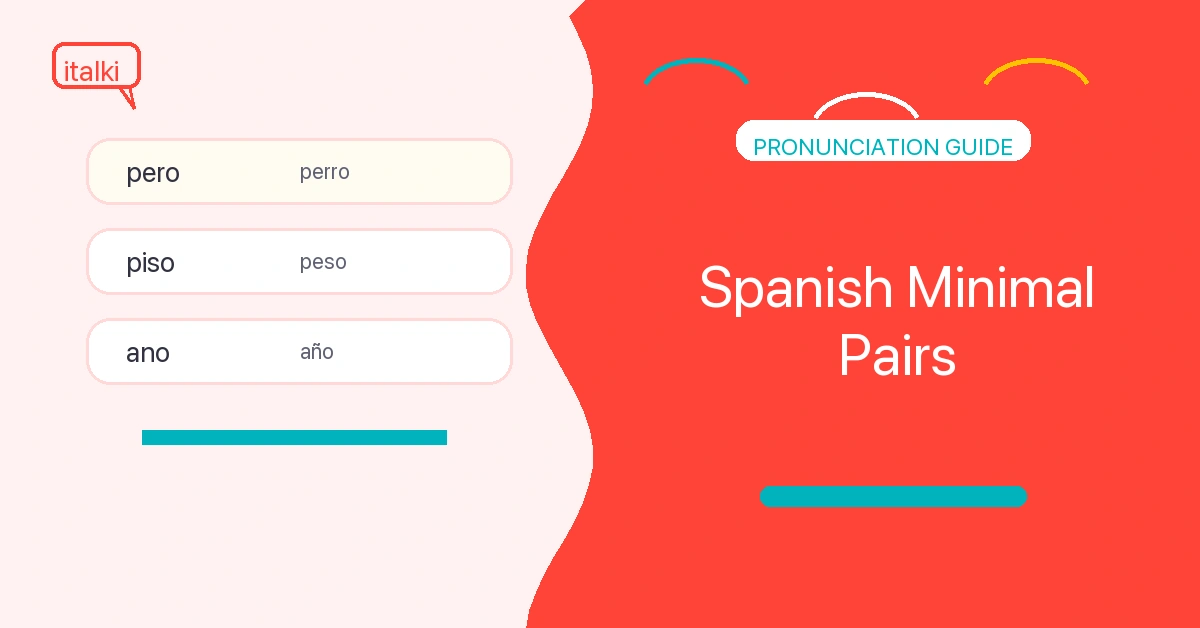
The minimal pair pero (but) vs perro (dog) is the classic test. They differ only in r vs rr, but the meaning changes completely.
Most English speakers find the trill difficult at first. Useful starting points:
- Practice the voiced “d” or “t” tap first (like the d in “ladder” spoken quickly)
- Try saying “butter” fast until the tt becomes a single tap
- Move from the tap to multiple taps by keeping the tongue loose
Expect two to four weeks of daily drilling before the trill sounds natural. Working with a Spanish teacher who uses minimal pair drills (pero / perro, caro / carro, pera / perra) makes the distinction stick faster than self-study alone.
Stress rules and accent marks
Spanish stress is rule-governed. Two rules cover almost all words, and the written accent mark signals every exception.
Rule 1: Words ending in a vowel, -n, or -s are stressed on the second-to-last syllable (the penultimate).
- casa → CA-sa | hablan → HA-blan | libros → LI-bros
Rule 2: Words ending in any consonant other than -n or -s are stressed on the last syllable.
- hablar → ha-BLAR | ciudad → ciu-DAD | papel → pa-PEL
The accent mark (´) overrides both rules:
- café → ca-FÉ (would normally be CA-fe by Rule 1, the accent moves stress to the last syllable)
- fácil → FÁ-cil (would normally be fa-CIL by Rule 2, accent moves stress earlier)
- mamá → ma-MÁ | papá → pa-PÁ
Accent marks also distinguish between words spelled identically:
- el (the) vs él (he)
- mi (my) vs mí (me, after prepositions)
- sí (yes) vs si (if)
- té (tea) vs te (you, object pronoun)
These distinctions matter in writing, not in speech, pronunciation does not change. But in reading, missing an accent mark means misreading the stress.
Find your perfect teacher
Build real speaking confidence with personalized lessons from a teacher who matches your goals, schedule, and learning style.
Book a trial lesson
Regional pronunciation differences
Two differences stand out most for learners encountering both Spain and Latin American Spanish.
Ceceo vs seseo (the c/z split)
In most of Spain, the letters c (before e/i) and z are pronounced like the “th” in English “think.” Gracias = “GRAH-thyahs.” Zapato (shoe) = “thah-PAH-toh.”
In Latin America (and southern Spain), the same letters produce an “s” sound. Gracias = “GRAH-syahs.” Zapato = “sah-PAH-toh.”
Neither is wrong; they are regional standards. Learners should pick one and be consistent. Mixing both in the same conversation sounds unnatural.
ll and y in the Río de la Plata region
In Argentina and Uruguay, ll and y produce a “sh” or “zh” sound rather than the standard “y.” Yo me llamo in Buenos Aires sounds like “Zho meh ZHAH-mo.” This is distinctive enough that Buenos Aires Spanish is immediately recognizable.
Beyond these two differences, rhythm and vocabulary vary significantly, but the pronunciation rules in this guide apply across all major Spanish-speaking regions.
Common pronunciation mistakes English speakers make
| Mistake | What happens | Correction |
|---|---|---|
| Stretching vowels | “goood” instead of “go” | Keep vowels short and pure |
| Pronouncing h | “Hotel” with English h | Always silent, begin with the vowel |
| Confusing b and v | Trying to produce two different sounds | They are the same, soft b for both |
| Using English r in the middle of words | Retroflexed r instead of a tap | Quick single tap, tongue to ridge |
| Not trilling rr | pero and perro sound identical | Build trill from repeated taps |
| English stress patterns | Stressing the wrong syllable | Apply the two stress rules; watch for accent marks |
| Weak ñ | Saying “n” instead of “ny” | Round the tongue to the hard palate |
Find your perfect teacher
Build real speaking confidence with personalized lessons from a teacher who matches your goals, schedule, and learning style.
Book a trial lesson
How to practice Spanish pronunciation effectively
Minimal pair drilling builds the distinctions that matter most: pero / perro, caro / carro, masa / maza. Say each pair 10 times, alternating.
Read aloud with audio. Read a Spanish text while listening to a native speaker read the same passage. Pause after each sentence and repeat. Focus on matching the rhythm and vowel length, not just the individual sounds.
Record yourself. Play back recordings and compare to native speakers. The gap between what you think you sound like and what is actually on the recording is often significant, especially for vowels and r.
Work with a teacher for targeted feedback. Recording identifies the problem; a live correction fixes it. A Spanish tutor who specializes in pronunciation can identify within minutes which sounds are consistently off and assign targeted drills, something generic listening practice cannot do. Search italki for tutors who list pronunciation correction as a specialty.
Sound like the Spanish you actually want to speak
Pronunciation is the part of Spanish that dictionaries and conjugation tables cannot fix. Rules explain the patterns, a teacher hears whether you are producing them. The rr trill, the soft intervocalic b, the guttural j: these take muscle memory that builds through feedback, not through reading about it.
italki has matched 10M+ learners with teachers across 150+ languages since 2007. A pronunciation-focused session with a Spanish tutor can identify your top two or three problem sounds in minutes and give you drills that target exactly those. Book a trial lesson and start the session by reading the vowel pairs and minimal pairs in this guide aloud.
Find your perfect teacher
Build real speaking confidence with personalized lessons from a teacher who matches your goals, schedule, and learning style.
Book a trial lesson
FAQ
Is Spanish pronunciation difficult for English speakers?
Spanish vowels are simpler than English vowels because each has one consistent sound. The main challenges are the trilled rr, the ñ, and the back-of-throat g/j sound, none of which exist in English. Most learners get comfortable with Spanish pronunciation faster than they expect.
What is the difference between b and v in Spanish?
None. Both letters produce the same sound, a soft bilabial consonant. Native Spanish speakers know the correct spelling for each word, but the sounds are identical in pronunciation.
Why do some Spanish words have accent marks?
Accent marks serve two purposes: they indicate that the stress falls somewhere unexpected (overriding the default stress rules), and they distinguish between pairs of words that are otherwise spelled identically, like el (the) and él (he).
What is ceceo and seseo?
Seseo (Latin America, Canary Islands) pronounces c/z as “s.” Ceceo (parts of Spain) pronounces c/z as “th.” Both are standard regional varieties. Learners should choose one and stay consistent.
How long does it take to get a Spanish accent?
For most English speakers, basic intelligibility comes within weeks of focused practice. A natural, region-appropriate accent takes longer, months to years of immersion and spoken practice. Pronunciation tutoring significantly speeds up the early stages.
Want to learn a language at italki?
Here are the best resources for you!