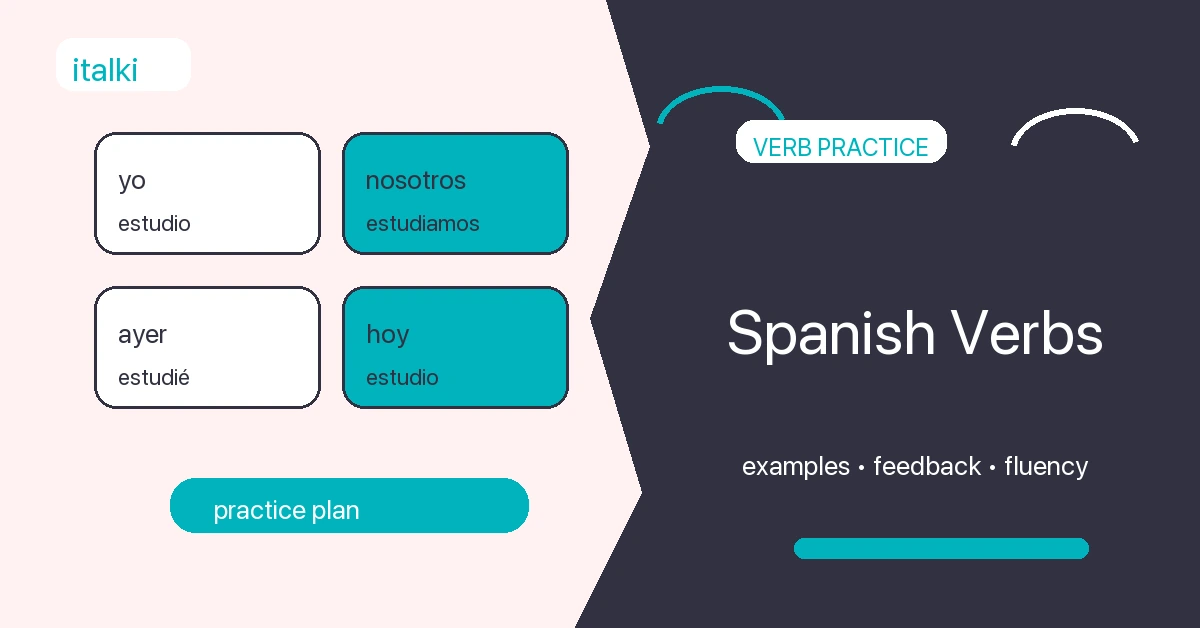
Spanish verb conjugation exercises help only when they train you to build real sentences, not just complete charts.
This guide gives you patterns, exercises, mistakes, and speaking practice ideas so conjugation becomes something you can use in conversation.
italki is useful when conjugation drills stop transferring into speech. A tutor can ask real questions, catch verb errors as they happen, and help you practice the tense you actually need for conversation.

Find Your Perfect Teacher
Conjugation finally sticks when you use verbs in answers, stories, and corrections. Practice with a tutor who can turn tables into conversation.
Practice with a Spanish tutor
Key takeaways
- Spanish conjugation practice should move from chart patterns to real sentences and spoken answers.
- Practice regular verbs, irregular patterns, tense contrasts, and common learner mistakes separately.
- Timed question drills help verb forms become faster in conversation.
- A tutor can correct verb errors in context instead of only checking written charts.
Table of contents
- Spanish Verb Conjugation Practice: Complete Guide with Exercises
- How should you practice Spanish verb conjugation?
- What present-tense conjugation patterns should beginners know?
- How do you practice irregular Spanish verbs without memorizing chaos?
- What exercises help you move from conjugation drills to speaking?
- What conjugation mistakes should you fix first?
- How can a Spanish tutor make conjugation practice less mechanical?
- What Spanish conjugation exercises should you do each week?
- How do you practice preterite and imperfect without confusion?
- How can you practice Spanish verbs in context?
- FAQs
How should you practice Spanish verb conjugation?
Practice Spanish verb conjugation by connecting each ending to a subject, a time frame, and a sentence you might actually say.
The problem with many conjugation exercises is that they train recognition, not speech. You fill in hablo, hablas, habla, then freeze when someone asks what you did yesterday. Useful practice moves from pattern to sentence to conversation.
| Step | Task | Example |
|---|---|---|
| Pattern | Conjugate one verb across subjects. | hablo, hablas, habla, hablamos, hablan |
| Sentence | Use one form in a real sentence. | Hablo con mi hermana los domingos. I speak with my sister on Sundays. |
| Variation | Change the subject or time. | Hablamos ayer. We spoke yesterday. |
| Output | Answer a question aloud. | ¿Con quién hablas? Hablo con mi profesor. |
What present-tense conjugation patterns should beginners know?
Beginners should first master regular -ar, -er, and -ir patterns in the present tense.
| Infinitive | Yo | Tú | Él/Ella/Usted | Nosotros | Ellos/Ustedes | Learner note |
|---|---|---|---|---|---|---|
| hablar | hablo | hablas | habla | hablamos | hablan | Use for speaking, talking, or discussing. |
| comer | como | comes | come | comemos | comen | Use for eating or having meals. |
| vivir | vivo | vives | vive | vivimos | viven | Use for living somewhere. |
| estudiar | estudio | estudias | estudia | estudiamos | estudian | Use for studying. |
| aprender | aprendo | aprendes | aprende | aprendemos | aprenden | Use for learning. |
| escribir | escribo | escribes | escribe | escribimos | escriben | Use for writing. |
If you need a deeper explanation of patterns before doing exercises, the existing Spanish verb conjugation article is useful background. This article focuses on practice and output.
How do you practice irregular Spanish verbs without memorizing chaos?
Group irregular verbs by behavior instead of trying to memorize them one by one.
| Pattern | Common verbs | Example | Practice sentence |
|---|---|---|---|
| Yo-go verbs | tener, hacer, decir, salir | tengo, hago, digo, salgo | Tengo una pregunta. I have a question. |
| Stem-changing e to ie | querer, pensar, empezar | quiero, pienso, empiezo | Quiero practicar hoy. I want to practice today. |
| Stem-changing o to ue | poder, volver, dormir | puedo, vuelvo, duermo | No puedo ir hoy. I cannot go today. |
| Ser and estar | ser, estar | soy, estoy | Soy estudiante. Estoy cansado. I am a student. I am tired. |
| Ir | ir | voy, vas, va | Voy al mercado. I am going to the market. |
The learner mistake is treating every irregular verb as a separate emergency. Patterns reduce the load. You still memorize, but you memorize with categories.
What exercises help you move from conjugation drills to speaking?
Use exercises that force you to choose a verb form while expressing your own meaning.
- Write five true sentences about today using present tense.
- Change each sentence from yo to nosotros.
- Turn three sentences into questions.
- Answer each question aloud without looking.
- Ask a teacher or partner to correct only verb form and word order.
| Step | Example |
|---|---|
| Original | Yo estudio español por la mañana. |
| Change subject | Nosotros estudiamos español por la mañana. |
| Question | ¿Cuándo estudias español? |
| Answer | Estudio español por la mañana. |
| English | I study Spanish in the morning. |
What conjugation mistakes should you fix first?
Fix mistakes that change who did the action, when it happened, or whether the sentence sounds natural.
| Mistake | Weak sentence | Better sentence | Why it matters |
|---|---|---|---|
| Using yo with third-person verbs | Yo habla español. | Yo hablo español. | The verb ending must match the subject. |
| Forgetting stem changes | Yo penso. | Yo pienso. | Some verbs change inside the stem. |
| Translating English directly | Estoy tener hambre. | Tengo hambre. | Spanish often uses tener where English uses be. |
| Overusing infinitives | Yo hablar español. | Yo hablo español. | Infinitives do not carry the subject. |
| Skipping accent marks | El hablo ayer. | Él habló ayer. | Accent marks can separate present from past. |
How can a Spanish tutor make conjugation practice less mechanical?
A tutor can turn verb forms into real answers, follow-up questions, and corrections.
This is where italki solves a specific problem. Conjugation tables do not tell you whether you can use the verb under pressure. A Spanish tutor can ask questions that force the tense naturally: What do you do on weekends? What did you do yesterday? What are you going to do tomorrow?
Bring one verb group to a lesson and ask for a ten-minute question drill. The goal is not perfect grammar explanation. The goal is faster, cleaner choices when speaking.
What Spanish conjugation exercises should you do each week?
Each week should include one pattern drill, one tense contrast, one speaking drill, and one correction pass.
A balanced week stops conjugation from becoming either pure grammar or pure guessing. Pattern drills build accuracy. Speaking drills build speed. Corrections show which errors are becoming habits.
| Exercise | Example | What it trains |
|---|---|---|
| Pattern drill | conocer: conozco, conoces, conoce | Subject endings and irregular yo forms. |
| Tense contrast | Hoy estudio. Ayer estudié. | Time meaning, not only endings. |
| Question drill | ¿Qué comes? ¿Qué comiste? | Fast retrieval in conversation. |
| Story drill | Ayer fui al mercado y compré pan. | Several verbs in connected speech. |
| Correction pass | Mark every verb and check subject/time. | Accuracy after communication. |
If you only have 20 minutes, choose one verb family and one real topic. For example, use food verbs to describe what you eat, what you bought yesterday, and what you want to cook tomorrow.
How do you practice preterite and imperfect without confusion?
Practice preterite for completed events and imperfect for background, habits, or ongoing situations.
Many learners memorize both past tenses but cannot choose between them. The practical fix is to pair each tense with a story function.
| Function | Tense | Example | Meaning |
|---|---|---|---|
| Completed action | Preterite | Compré pan. | I bought bread. |
| Background | Imperfect | Hacía frío. | It was cold. |
| Habit | Imperfect | Iba al parque cada sábado. | I used to go to the park every Saturday. |
| Interrupting event | Preterite | Me llamó mi amigo. | My friend called me. |
| Ongoing state | Imperfect | Estaba cansado. | I was tired. |
A simple practice story is: background first, action second. Hacía frío y estaba cansado. Fui a una cafetería y pedí un café. English: It was cold and I was tired. I went to a cafe and ordered a coffee.
How can you practice Spanish verbs in context?
Use an error hunt when you can fill in charts but still make mistakes in real sentences. Write a short paragraph with intentional verb errors, then correct it by checking the subject, tense, verb type, and meaning.
| Part | Example |
|---|---|
| Original with mistakes | Ayer yo voy al mercado, compro pan y hablo con mi amigo. |
| Corrected version | Ayer fui al mercado, compré pan y hablé con mi amigo. |
| English | Yesterday I went to the market, bought bread, and spoke with my friend. |
| What changed | Present forms became preterite forms because the action happened yesterday. |
Error hunts help because learners often understand conjugation rules in isolation but miss mistakes inside connected speech. When you scan a paragraph, you have to ask better questions: What is the time frame? Who is the subject? Is the verb regular, stem-changing, or irregular? Does the accent mark change meaning?
| Practice focus | Question to ask | Example |
|---|---|---|
| Subject | Who is doing the action? | Nosotros hablamos, not nosotros habla. |
| Time | When did it happen? | Ayer compré, not ayer compro. |
| Verb type | Is the verb regular? | Tener becomes tengo in yo form. |
| Meaning | Does Spanish use a different verb? | Tengo hambre, not estoy hambre. |
For speaking, keep correction narrow. If you ask someone to correct every mistake, the drill becomes exhausting. For one week, ask only for verb corrections. The following week, add pronouns or word order. Narrow correction makes progress visible.
A final practice layer is speed. Give yourself 30 seconds to answer a simple question using a target tense. ¿Qué hiciste ayer? ¿Qué haces normalmente los domingos? ¿Qué vas a hacer mañana? The time limit is not for stress. It trains retrieval. In conversation, you rarely have time to search a mental chart slowly.
You can also practice by tense families. Spend one day on present routines, one day on yesterday’s completed actions, one day on childhood or repeated past habits, and one day on future plans. This keeps the meaning of each tense clear. If you mix every tense too early, practice becomes guessing. If you isolate a tense forever, you cannot tell stories. The goal is controlled contrast.
A simple weekly prompt is to move through four time frames with the same topic. This keeps tense choice tied to meaning instead of chart memorization.
| Prompt | Spanish example | English |
|---|---|---|
| Today I usually… | Normalmente estudio por la noche. | I usually study at night. |
| Yesterday I… | Ayer estudié por la mañana. | Yesterday I studied in the morning. |
| When I was younger, I used to… | Cuando era niño, estudiaba después de la escuela. | When I was a child, I used to study after school. |
| Tomorrow I am going to… | Mañana voy a estudiar con un amigo. | Tomorrow I am going to study with a friend. |
Ready to make Spanish verbs usable in conversation?
Conjugation matters because it lets you say who did what, when, and with whom. The goal is not to recite a chart; it is to choose the right verb form while answering a real question.
Learn Spanish with guided verb practice, then use feedback from Spanish tutors to turn correct forms into confident answers.
Find Your Perfect Teacher
Spanish verb practice becomes more useful when someone helps you turn correct forms into natural answers.
Practice with Spanish tutors
FAQs
What is the best way to practice Spanish conjugation?
Combine short written drills with spoken answers. A form you can write but cannot say quickly is not active yet.
Should I memorize Spanish conjugation tables?
Use tables to see patterns, but do not stop there. Turn each form into a personal sentence.
Which tense should beginners practice first?
Start with the present tense, then add the near future, preterite, and imperfect as your sentence needs grow.
Why do I know conjugations but still speak slowly?
You may recognize forms but lack retrieval practice. Timed questions and role-plays help you choose forms faster.
How many verbs should I practice at once?
Practice a small set deeply. Six verbs used in many sentences are more useful than fifty verbs copied once.
Want to learn a language at italki?
Here are the best resources for you!