Key takeaways
- French is spoken by 396 million people across five continents, making it the fourth most spoken language in the world
- Speaking French opens access to the UN, European Union, NATO, International Red Cross, and International Olympic Committee as working languages
- Up to 45% of English vocabulary has French origins, making it one of the most accessible languages for English speakers to learn
- Learning a new language like French has been linked in research to stronger problem-solving skills, sharper attention, and delayed cognitive decline
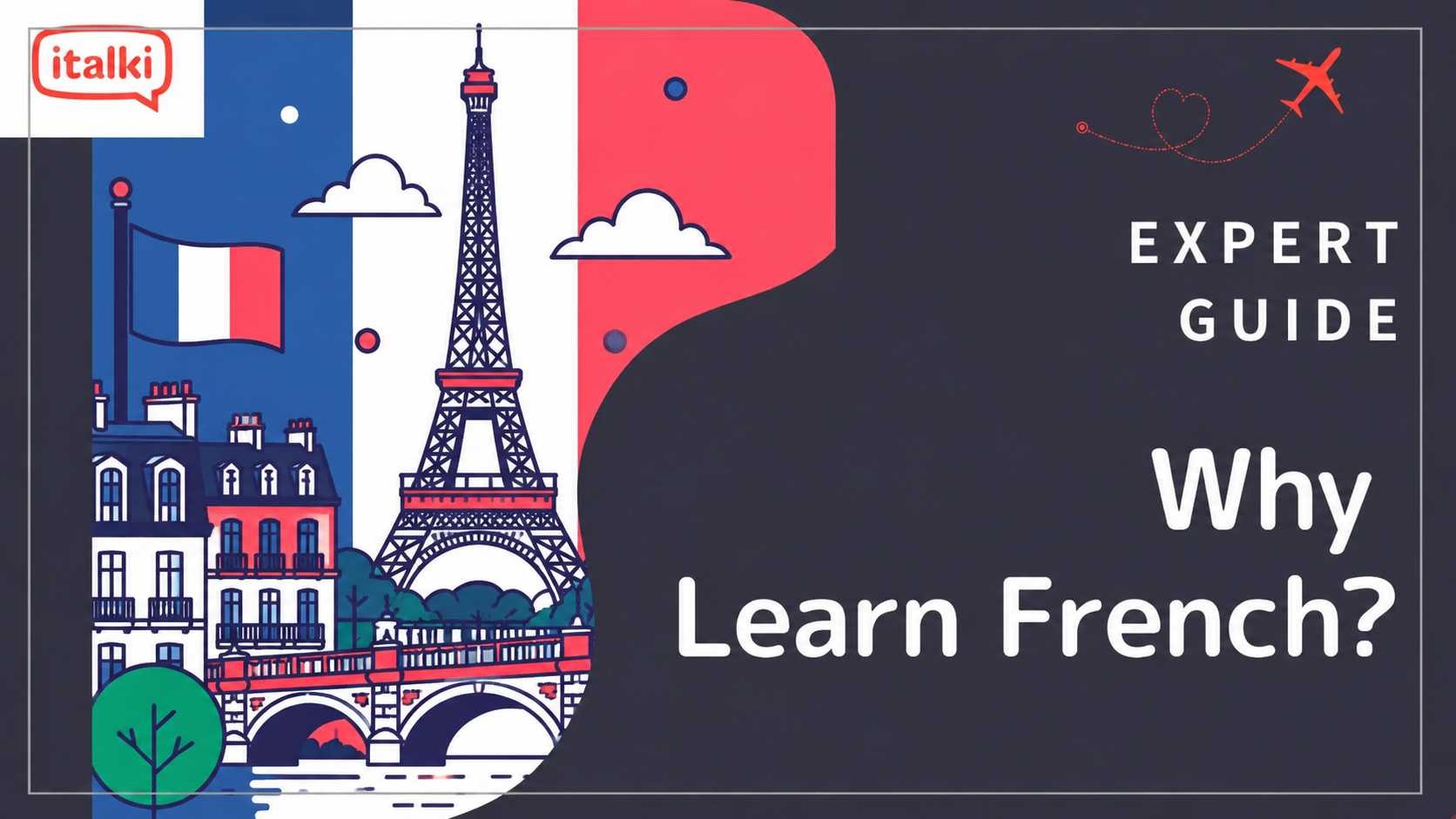
Most people who ask why learn French are not looking for a list of clichés about France. They want to know whether it is worth the time. The honest answer is yes, and the many benefits are more practical than most people realize.
According to the Organisation internationale de la Francophonie, 396 million people now speak the French language worldwide, making it the fourth most spoken language on the planet. French is an official language of the United Nations, the EU, NATO, and the International Olympic Committee. It is growing, not shrinking, and if you already speak English, you are closer to reading French than you think.
italki connects learners with 30,000+ teachers across 150+ languages, including French tutors who teach the version of the language people actually use in conversation. Over 10 million learners have used it since 2007. French is consistently one of the most studied languages on the platform, with learners from over 100 countries working on everything from conversational fluency to business French to exam preparation.
A French tutor who teaches from real conversational context helps you build usable French faster than a classroom course that spends weeks on grammar before you say a full sentence out loud.

Find Your Perfect Teacher
Your French doesn’t have to sound like a textbook. Get personalized lessons from native tutors who’ll help you speak naturally, not just correctly.
Book a trial lesson
How widely spoken is French, and where will it actually take you?
French is the official language in over 25 countries on five continents, and most of its 396 million speakers live in Africa, not Europe. Countries like the Democratic Republic of Congo, Côte d’Ivoire, Cameroon, and Senegal have tens of millions of French speakers each. The French-speaking world around the world is more geographically diverse than most learners expect before they start.
French also builds access to a global network that extends well beyond France. The full picture of French speaking countries includes Canada, Haiti, Belgium, Switzerland, Madagascar, and much of North and West Africa. Understanding the everyday life and culture of French people across these regions, not just in Paris, is what makes French genuinely useful rather than a school subject.
France itself is the world’s most visited country, and French remains the primary language for most commercial, cultural, and government interactions there. Tourists who rely entirely on English miss a significant portion of what France actually offers in terms of access, warmth, and depth of connection with French people.
French remains a growing language. According to the OIF’s 2026 report on the French language, French is projected to be spoken by 590 million people by 2050, with 9 out of 10 of those speakers living in Africa. Learning it now means entering a language that is gaining global reach, not losing it.
A French teacher with experience in French-speaking regions helps you build the cultural awareness that makes French genuinely useful across specific real-world contexts, not just in France.
Find Your Perfect Teacher
Your French doesn’t have to sound like a textbook. Get personalized lessons from native tutors who’ll help you speak naturally, not just correctly.
Book a trial lesson
Can French realistically help your career?
French is one of the official working languages of the United Nations, the European Union, NATO, the International Olympic Committee, and the International Red Cross. If you want to work in international diplomacy, development, or any intergovernmental organization, speaking French is not optional for many roles. It is a baseline requirement.
Career opportunities and job opportunities extend well beyond institutions. France has one of the top five economies in the world. French luxury goods brands, pharmaceutical companies, aerospace firms, and financial institutions regularly need staff who can work in French across other country markets. In Canada, federal positions and many provincial roles require French. In global business contexts across Belgium, Switzerland, and Francophone Africa, French is the language deals are done in.
On italki, the most common goals French learners bring to their first session are career advancement, relocation to a French-speaking country, and preparation for French proficiency exams like the DELF and TCF. The pattern is consistent: people learn French because it opens specific doors their other language skills cannot.
The table below shows where French gives the clearest career advantage compared to other widely studied languages:
Professionals who need specific Business French vocabulary for negotiations, presentations, or international communication need more than conversational fluency. They need the register and precision that professional practice builds.
italki connects you with tutors who have professional backgrounds in law, finance, and international relations, so you can develop language skills matched to your field rather than a generic course curriculum.
French tutors who have experience in business or institutional environments can prepare you for the specific professional situations that matter in your career, whether that is a negotiation in Paris or a report for an international organization.
Find Your Perfect Teacher
Your French doesn’t have to sound like a textbook. Get personalized lessons from native tutors who’ll help you speak naturally, not just correctly.
Book a trial lesson
Why is French easier to learn than most people expect?
French is considered one of the easiest foreign languages for English speakers to learn. The Foreign Service Institute classifies French as a Category I language, requiring 600 to 750 hours to reach professional working proficiency, one of the shorter timelines for native English speakers.
The reason comes down to vocabulary. If you speak English, you already know more French words than you realize. According to Wikipedia’s list of English words of French origin, up to 45% of English vocabulary has French origins. English words like “government”, “justice”, “art”, “literature”, “cuisine”, and “police” came directly from French after the Norman Conquest in 1066. When you start language learning in French, you are not starting from zero.
French grammar has a consistent internal logic. Once you understand how verb conjugation and gender agreement work, the same patterns repeat across thousands of words. French remains one of the most structured Romance languages to learn systematically, and that structure rewards time spent inside it.
French is also a gateway to other romance languages. Learning French first makes Spanish, Italian, and Portuguese considerably more accessible later, because the underlying grammar patterns and vocabulary share the same Latin roots. Many learners who start French find that other languages follow faster than expected.
The most common difficulty italki French learners report in the early weeks is the gap between written French and spoken French: text and audio feel like two different languages at first. Regular speaking sessions with a native tutor close that gap faster than self-study. The learn French free resources available today mean you can begin your learning journey before committing to a structured course.
A French teacher can move you through the pronunciation adjustment faster by focusing on the high-frequency patterns that carry most of the weight in actual conversation, rather than abstract grammar rules you rarely use in speech.
What does speaking French open up culturally?
French offers some of the richest cultural enrichment of any language you could choose to learn. The French literature of Victor Hugo, Camus, and Flaubert, the French poetry of Baudelaire and Rimbaud, the short stories of Maupassant: all of these exist in English translation. But you get a different and deeper understanding of what they actually say and mean when you read them in the original language.
The specific rhythm of Hugo’s prose, the weight of the words Camus chooses, the way French poetry depends on sound: much of this does not survive translation intact. Prestigious universities around the world teach French literature courses that require students to read in the original French for precisely this reason. The language is not just a vehicle for the content. It is part of what the content is.
French history and French culture are woven into the language itself. The word “protocol” is French. The structure of international diplomatic communication was shaped by France over centuries. If you follow current events in international relations, political philosophy, or European history, reading primary sources in French changes how you understand events.
The depth of French culture, from film and music to food and design, is accessible at a surface level in English. When you understand French on its own terms, that surface access becomes something different: a genuine connection with the people and the history behind the work.
Many people call French a beautiful language. The reputation is not accidental. French phonetics, the rhythm of its sentences, and the precision of its vocabulary all contribute to a language that rewards the time you spend learning to understand it.
French tutoring with a native who understands French history and literature helps you move from functional French toward the kind of cultural depth that makes the language genuinely interesting to use, not just useful.
Find Your Perfect Teacher
Your French doesn’t have to sound like a textbook. Get personalized lessons from native tutors who’ll help you speak naturally, not just correctly.
Book a trial lesson
Does learning French change how you think?
Learning languages changes how you think. French specifically, because of its different grammar, sentence structure, and cultural assumptions, creates a kind of perspective shift that English alone cannot produce. Speaking two languages means building two slightly different frameworks for organizing experience.
A review of bilingualism research from St. Augustine University found that bilingual individuals consistently outperform monolinguals on tasks requiring attention control, cognitive flexibility, and problem-solving skills in situations that require switching between competing mental frameworks. Research has also linked regular bilingual language use to a delay in the onset of dementia symptoms by an average of four to five years, through a mechanism called cognitive reserve, which is the brain’s ability to maintain function as it ages.
These are not effects limited to people who grew up bilingual. Adults who learn a second language and use it regularly for social interaction, reading current events, or professional work show similar cognitive patterns. The key is regular active use, not passive study.
Personal growth through language learning tends to be underestimated because it is hard to measure. When you learn French, you encounter a culture that handles politeness, formality, and social distance quite differently from English-speaking norms. That encounter changes how you read people, how you navigate unfamiliar social situations, and how you approach problems that do not have obvious solutions. Many learners describe it as the unexpected benefit of their learning journey that they value most.
The French conversation practice that produces these effects is not passive listening. It is active: reading French news, engaging in social interaction in French, using the language in everyday situations where you cannot fall back on English.
French language tutors who push you to think in French rather than translate from English help develop that shift faster than any app or self-study routine can.
Ready to start learning French?
Learning French opens doors professionally, culturally, and cognitively that most people do not fully appreciate until they are on the other side of them. The language is growing, it is institutionally embedded in global business and international organizations, and it is more accessible for English speakers than most assume.
Learn French faster with personal guidance from experienced French teachers trusted by over 10 million learners worldwide. italki connects you with tutors who teach real-world French across every variety and level, from beginner conversation to advanced business French. Book a trial lesson today.
Find Your Perfect Teacher
Your French doesn’t have to sound like a textbook. Get personalized lessons from native tutors who’ll help you speak naturally, not just correctly.
Book a trial lesson
FAQs
Is French still worth learning?
Yes. French is the fourth most spoken language in the world and is growing, not declining. The OIF’s 2026 report projects 590 million French speakers by 2050, with the vast majority living in Africa. Learning it now gives you a language with expanding global influence and deep institutional presence in international organizations.
Is French hard to learn for English speakers?
Less hard than most people expect. The Foreign Service Institute classifies French as a Category I language, estimating 600 to 750 hours to reach professional proficiency, one of the shorter timelines for English speakers among foreign languages. The main adjustment is the gap between written and spoken French, which improves quickly with regular speaking practice. For practical first steps, best way to learn French covers the approaches that produce the fastest long-term results.
How does French compare to Spanish for career value?
Both are valuable but they open different doors. Spanish is dominant in Latin America and Spain. French covers sub-Saharan Africa, the Maghreb, parts of Southeast Asia, Canada, and most of the international institutional world, including the UN, EU, and NATO. If your career goals involve those regions or institutions, French has no close substitute.
Does learning French help if you already speak English?
Yes, more than most people realize. In Belgium, Switzerland, and Canada, French is essential for real professional and social integration. English alone leaves significant gaps. In many African French-speaking countries, English proficiency varies widely, and French is the language of government, business, and education. Depending on English limits your reach in those markets.
How long does it take to become conversational in French?
Most learners reach a conversational level in French within 12 to 18 months of consistent study, based on FSI data showing 600 to 750 total hours needed for professional proficiency. Regular speaking practice with a native speaker shortens that timeline noticeably compared to self-study alone.
Want to learn a language at italki?
Here are the best resources for you!