Key takeaways
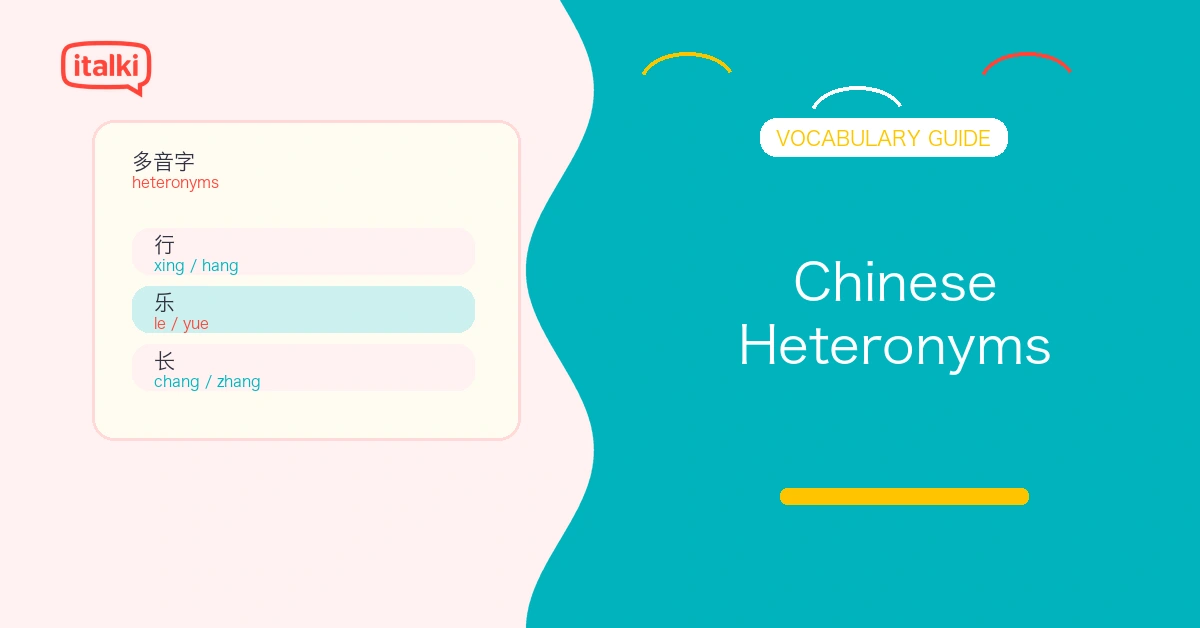
- Chinese heteronyms (多音字, duōyīnzì: multi-pronunciation characters) are characters that have two or more different pronunciations with different meanings or grammatical functions.
- Context determines which pronunciation is correct; there is no marking system in standard text to indicate which reading applies.
- Common heteronyms include 乐 (yuè: music / lè: happy), 行 (xíng: to walk / háng: a row), and 好 (hǎo: good / hào: to like/love doing).
- Many heteronyms follow predictable patterns: one pronunciation is a verb or adjective, another is a noun or occurs in set compound words.
- Chinese learners at all levels encounter heteronyms; knowing the most common ones prevents persistent mispronunciation.
If you have studied Chinese for any length of time, you have probably encountered a character you were confident you knew, heard it pronounced differently by a native speaker, and been confused. Chinese heteronyms, characters with multiple pronunciations and different meanings, are a regular feature of the written language and one of the sources of mispronunciation that persists even at intermediate and advanced levels.
This guide covers what heteronyms are, how they work grammatically, the most common Chinese heteronyms with their pronunciations and meanings, how to identify the right reading from context, and strategies for learning them effectively. italki connects you with Chinese teachers online who can help you hear the difference between heteronym readings and develop the context sensitivity to choose correctly without hesitation.

Find your perfect teacher
Build real speaking confidence with personalized lessons from a teacher who matches your goals, schedule, and learning style.
Book a trial lesson
What are chinese heteronyms?
In Chinese linguistics, heteronyms are called 多音字 (duōyīnzì: characters with multiple sounds). A single character can have two, three, or even four distinct pronunciations, each with a different meaning, and sometimes a different grammatical role.
This is different from homonyms (characters that sound the same but look different and mean different things). Heteronyms are the reverse: they look the same but sound different.
The difficulty is that standard printed Chinese text does not mark which pronunciation applies. Pinyin annotations (like those in children’s books or language learning materials) sometimes help, but in most adult Chinese text and all digital text, you must infer the pronunciation from context.
Learn to predict heteronym readings from surrounding words with online Chinese lessons.
How context determines pronunciation
For most heteronyms, the context cue is one of:
- The compound word the character forms with neighbouring characters
- The grammatical role of the character in the sentence
- Fixed phrase or proper noun patterns
For example, 行 (the most versatile heteronym) is pronounced xíng when it means to be OK or to walk and háng when it refers to a row, a column, a trade, or appears in profession words like 银行 (yínháng: bank). Seeing 银行 in text, you know immediately it is háng because the compound is fixed.
Build context awareness by creating sentences around heteronyms and get immediate feedback from an online Chinese tutor.
Find your perfect teacher
Build real speaking confidence with personalized lessons from a teacher who matches your goals, schedule, and learning style.
Book a trial lesson
Common chinese heteronyms
乐 (music / happy)
| Pronunciation | Pinyin | Meaning | Examples |
|---|---|---|---|
| Music | yuè | music | 音乐 (yīnyuè: music), 乐器 (yuèqì: musical instrument), 乐队 (yuèduì: band/orchestra) |
| Happy | lè | happy, joyful | 快乐 (kuàilè: happy), 乐趣 (lèqù: pleasure), 可乐 (kělè: cola) |
行 (walk / row/trade)
| Pronunciation | Pinyin | Meaning | Examples |
|---|---|---|---|
| Walk/OK | xíng | to walk; to be OK/workable | 行走 (xíngzǒu: to walk), 可以,行 (xíng: that’s fine) |
| Row/trade | háng | row, line; trade, profession | 银行 (yínháng: bank), 行业 (hángyè: industry), 一行人 (yī háng rén: a group of people in a row) |
好 (good / to love doing)
| Pronunciation | Pinyin | Meaning | Examples |
|---|---|---|---|
| Good | hǎo | good, well, OK | 好的 (hǎo de: OK), 好看 (hǎokàn: good-looking), 你好 (nǐ hǎo: hello) |
| To love doing | hào | to love/be fond of (a habit or passion) | 好奇 (hàoqí: curious), 好学 (hàoxué: eager to learn), 爱好 (àihào: hobby) |
长 (long / to grow)
| Pronunciation | Pinyin | Meaning | Examples |
|---|---|---|---|
| Long | cháng | long (adjective) | 长城 (Chángchéng: the Great Wall), 长度 (chángdù: length), 长时间 (cháng shíjiān: a long time) |
| To grow / head of | zhǎng | to grow; leader, head | 成长 (chéngzhǎng: to grow up), 班长 (bānzhǎng: class monitor), 生长 (shēngzhǎng: to grow) |
重 (heavy / again)
| Pronunciation | Pinyin | Meaning | Examples |
|---|---|---|---|
| Heavy | zhòng | heavy; important | 重要 (zhòngyào: important), 重量 (zhòngliàng: weight) |
| Again / repeat | chóng | again, repeated, double | 重新 (chóngxīn: again/anew), 重复 (chóngfù: to repeat), 重新开始 (chóngxīn kāishǐ: to start again) |
中 (middle / to hit)
| Pronunciation | Pinyin | Meaning | Examples |
|---|---|---|---|
| Middle | zhōng | middle, central, China | 中国 (Zhōngguó: China), 中文 (Zhōngwén: Chinese language), 中间 (zhōngjiān: in the middle) |
| To hit target | zhòng | to hit (a target); to be affected | 中奖 (zhòngjiǎng: to win a prize), 中毒 (zhòngdú: to be poisoned) |
发 (to send / hair)
| Pronunciation | Pinyin | Meaning | Examples |
|---|---|---|---|
| To send/happen | fā | to send, to happen, to develop | 发现 (fāxiàn: to discover), 发展 (fāzhǎn: to develop), 出发 (chūfā: to set off) |
| Hair | fà | hair (on the head) | 头发 (tóufa: hair), 理发 (lǐfà: haircut), 白发 (báifà: white hair) |
Review these 7 core heteronyms aloud with a Chinese tutor until you can instantly recognise which pronunciation applies in context.
Additional common heteronyms at a glance
| Character | Pronunciation 1 | Meaning 1 | Pronunciation 2 | Meaning 2 |
|---|---|---|---|---|
| 数 | shù | number | shǔ | to count |
| 还 | hái | still, also | huán | to return/give back |
| 都 | dōu | all, both | dū | capital city |
| 为 | wèi | for (the sake of) | wéi | to be; to do |
Find your perfect teacher
Build real speaking confidence with personalized lessons from a teacher who matches your goals, schedule, and learning style.
Book a trial lesson
Learning strategies for heteronyms
1. Learn words in compounds, not in isolation. When you encounter 好, do not memorise it as hǎo alone. Learn 你好 (nǐ hǎo: hello), 好看 (hǎokàn: attractive), and 爱好 (àihào: hobby) as complete units. The compound reveals the pronunciation.
2. Flag known heteronyms when reading. When you see 行, 乐, or 好, pause and check which compound it is in before assuming the familiar pronunciation.
3. Use a Chinese teacher to correct mispronunciations in real time. Heteronym errors are difficult to self-correct because you often do not realise you are using the wrong reading.
Heteronyms are a challenge that exposure alone rarely fixes. Even when you hear 爱好 (àihào: hobby) pronounced correctly multiple times, you might still mentally store it as àihǎo without realizing your mistake. The problem is that heteronym errors are invisible to you until someone corrects them in real time. A teacher who flags these mistakes during conversation or reading accelerates your learning dramatically.
Book a trial lesson on italki and get immediate feedback on your pronunciation.
##
Find your perfect teacher
Build real speaking confidence with personalized lessons from a teacher who matches your goals, schedule, and learning style.
Book a trial lesson
FAQ
How many heteronyms are there in Chinese?
Estimates vary depending on the source and definition, but commonly cited figures range from approximately 400 to 800 characters that have two or more distinct pronunciations in modern Mandarin. Of these, the most frequently encountered in everyday text number around 100-150. The ones covered in this guide represent the highest frequency examples that cause the most errors in learner speech.
Is it correct to say that 的 (de) is a heteronym?
Technically yes. 的 has three pronunciations: de (grammatical particle for possession and adjective modification), dí (used in set words like 的确, díquè: indeed), and dì (used in 目的, mùdì: purpose/goal). However, the vast majority of 的 occurrences are the particle de, and the other readings appear only in specific compound words that can be memorised as fixed units. In practice, 的 is taught as de with the other readings noted separately.
Do heteronyms exist in Cantonese or other Chinese dialects?
Heteronyms as a feature of the writing system exist across Chinese dialects because all dialects share the same written characters. However, the specific pronunciations and which reading is used for which meaning differ between Mandarin and Cantonese. For example, 行 in Cantonese has different tonal readings (hàahng for walking, hòhng for industry) that reflect Cantonese phonology rather than Mandarin. Learners of multiple Chinese dialects need to track heteronym readings separately for each dialect.
Want to learn a language at italki?
Here are the best resources for you!