Key takeaways
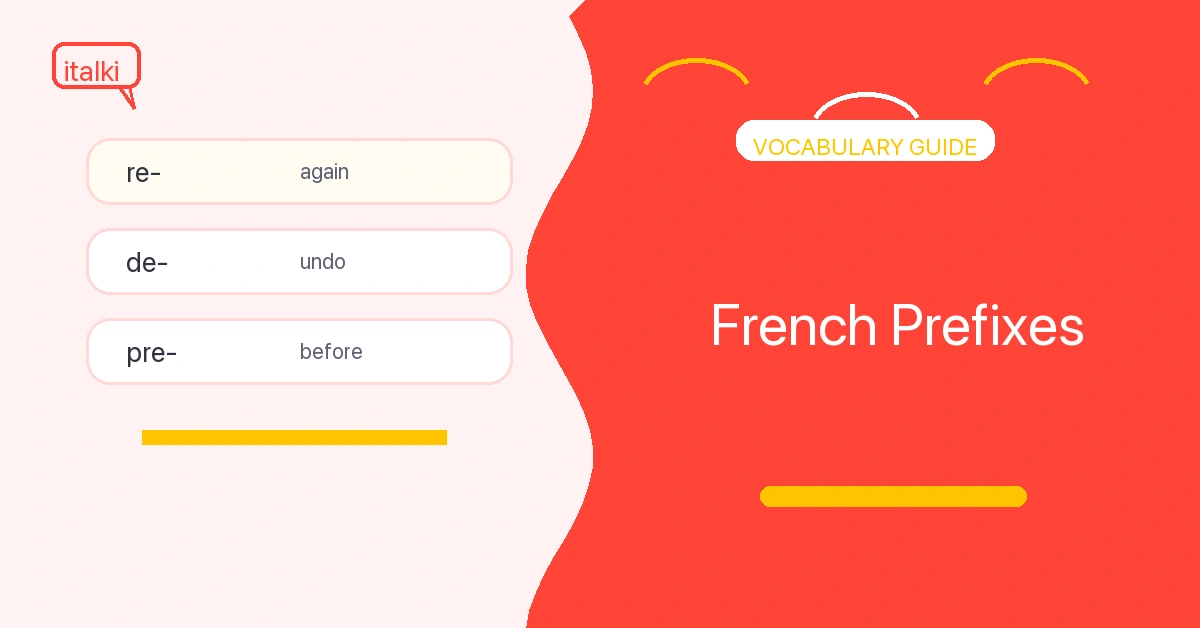
- French prefixes sit at the beginning of a word and change its meaning, as in faire (to do) becoming refaire (to redo) or défaire (to undo).
- The most useful French prefixes for learners are re-, dé-, in-/im-, anti-, pré-, sur-, sous-, and number prefixes like bi- and tri-.
- Some prefixes change spelling before certain letters, such as in- becoming im- before p, b, and m in impossible (impossible).
- Practicing prefix pronunciation with a French tutor prevents the flat English stress patterns that make words like irrégulier and sous-estimer hard for native speakers to understand.
French prefixes are word beginnings that change the meaning of a base word, often signaling repetition, opposition, time, position, quantity, or intensity. Once a learner spots re- in refaire (to redo), dé- in défaire (to undo), and pré- in prévoir (to foresee), new vocabulary stops feeling random.
The challenge is that prefix pronunciation follows nasal vowel rules and liaison patterns that look nothing like English, so reading these words is far easier than saying them correctly. italki connects learners with native French speakers who correct prefix pronunciation in real time, turning pattern recognition into spoken confidence.
Find French teachers online who give live correction on prefix pronunciation, word choice, and natural sentence building.

Find Your Perfect Teacher
Build real French confidence with personalized lessons from a teacher who can help with speaking, exam prep, grammar, and pronunciation.

What are French prefixes?
A French prefix is a letter group added to the front of a base word that shifts the word’s meaning without changing its broad family. Start with faire (to do). Add re- and it becomes refaire (to redo). Add dé- and it becomes défaire (to undo). The base idea stays linked to faire, but the prefix redirects the action.
| Prefix | Meaning | French word | Pronunciation | English meaning |
|---|---|---|---|---|
| re- | again, back | refaire | ruh-fehr | to redo |
| dé- | undo, remove | défaire | day-fehr | to undo |
| pré- | before | prévoir | pray-vwahr | to foresee |
| anti- | against | antibruit | ahn-tee-brwee | noise-reducing |
| sous- | under | sous-sol | soo-sol | basement |
| sur- | over, above | surcharge | soor-sharzh | overload |
Prefixes work best when studied with word families. Écrire (to write), réécrire (to rewrite), inscription (registration), and description (description) all cluster around written language but take different directions.
This matters for reading. When a learner sees inconnu (unknown), the in- signals negation and connu (known) gives the base meaning, making the whole word possible to guess before reaching for a dictionary.
Prefix study pairs naturally with French nouns because many prefixed words appear first as nouns in everyday reading: désaccord (disagreement), préavis (notice period), surcharge (extra charge), sous-titre (subtitle).
Find Your Perfect Teacher
Build real French confidence with personalized lessons from a teacher who can help with speaking, exam prep, grammar, and pronunciation.
Which French prefixes mean again or back?
The prefix re- or ré- typically means again, back, or return to a previous state. It appears in many high-frequency French verbs, making it one of the first prefixes worth learning.
The spelling shifts depending on the next sound. Re- usually appears before consonants, as in refaire (to redo). Ré- often appears before vowels, as in réécrire (to rewrite).
| French verb | Pronunciation | Meaning | Example sentence |
|---|---|---|---|
| refaire | ruh-fehr | to redo | Je dois refaire l’exercice. (I have to redo the exercise.) |
| relire | ruh-leer | to reread | Relis la phrase. (Reread the sentence.) |
| revoir | ruh-vwahr | to see again | Il faut revoir ce point. (This point needs review.) |
| rentrer | rahn-tray | to go back in | Je rentre à huit heures. (I go home at eight.) |
| réécrire | ray-ay-kreer | to rewrite | Elle réécrit son texte. (She rewrites her text.) |
| réchauffer | ray-shoh-fay | to reheat | Tu peux réchauffer la soupe. (You may reheat the soup.) |
Not every re- word means “again.” Regarder (to look at) is not “to look again” in everyday use. Recevoir (to receive) does not behave like a transparent re- word either. The useful test is whether the base word stands on its own. Faire and refaire clearly match. But garder (to keep) and regarder (to look at) do not pair neatly in modern spoken French.
For verb-heavy word families, French infinitive patterns help because learners meet prefixes before conjugation adds another layer: refaire, relire, revoir, reprendre, recommencer.
Find Your Perfect Teacher
Build real French confidence with personalized lessons from a teacher who can help with speaking, exam prep, grammar, and pronunciation.
Which French prefixes create opposites or removal?
French uses dé-/dés-, in-/im-/il-/ir-, non-, and anti- to express negation, opposition, reversal, or removal. These prefixes appear constantly in signs, emails, forms, and news articles.
The prefix dé- typically means undo, remove, or reverse:
| Base word | With prefix | Meaning |
|---|---|---|
| brancher (to plug in) | débrancher | to unplug |
| coller (to stick) | décoller | to unstick, to take off |
| monter (to assemble) | démonter | to take apart |
| faire (to do) | défaire | to undo |
| charger (to load) | décharger | to unload |
Dés- appears before vowels or silent h: désagréable (unpleasant), désorganisé (disorganized), déshabiller (to undress). The s in désagréable sounds like z between the vowels: day-zah-gray-ahbl.
In-/im-/il-/ir- typically mean not:
| Prefix form | Example | Pronunciation | Meaning |
|---|---|---|---|
| in- | inconnu | ahn-koh-new | unknown |
| im- | impossible | ahm-poh-see-bluh | impossible |
| il- | illégal | ee-lay-gal | illegal |
| ir- | irrégulier | ee-ray-gew-lyay | irregular |
The spelling changes because French prefers smoother sound combinations. Im- replaces in- before p, b, and m: impossible (impossible), imbuvable (undrinkable), immoral (immoral).
Non- stays neutral and often keeps a hyphen: non-fumeur (non-smoker), non-respect (failure to respect). Anti- means against: antirides (anti-wrinkle), antibruit (noise-reducing). Both appear on product labels and in media language.
The tricky part is pronunciation. English speakers tend to stress the prefix and flatten the rest. In French, impossible carries a nasal vowel on im- (ahm, not “im”), and the stress lands lightly on the final syllable. Working with a French language tutor on these sound patterns prevents fossilized mispronunciations that are hard to fix later.
Find Your Perfect Teacher
Build real French confidence with personalized lessons from a teacher who can help with speaking, exam prep, grammar, and pronunciation.
Which French prefixes show time, place, and degree?
Prefixes such as pré-, post-, sous-, sur-, inter-, intra-, extra-, hyper-, and super- indicate time, location, relationship, or intensity. They help learners handle formal French and everyday compound words.
Time prefixes:
Pré- means before: prévoir (to foresee), préchauffer (to preheat), préinscription (pre-registration), préavis (notice period). Pronounce pré- like pray.
Post- means after and appears mostly in written or formal French: postnatal (postnatal), postuniversitaire (postgraduate), postproduction (post-production).
Position prefixes:
Sous- means under or lower: sous-sol (basement), sous-titre (subtitle), sous-estimer (to underestimate), sous-vêtements (underwear). Pronounce sous like soo.
Sur- means over, above, or extra: surnom (nickname), surcharge (extra charge), survoler (to fly over), surestimer (to overestimate). Sur also exists as a standalone preposition meaning on, but as a prefix it adds “over” or “too much.”
Inter- means between: international (international), interurbain (between cities), interligne (line spacing). Intra- means within: intramuros (within the walls, used in city language), intraveineux (intravenous).
Intensity prefixes:
Hyper- and super- add force. Hyperactif (hyperactive), hypersensible (highly sensitive), supermarché (supermarket), and superpuissance (superpower) all appear regularly. In casual speech, super doubles as a standalone adjective: C’est super (That’s great).
Learners who already know French prepositions will recognize the logic behind sous-sol, survoler, entretenir, and avant-goût (foretaste), because many position prefixes share roots with prepositional words.
Find Your Perfect Teacher
Build real French confidence with personalized lessons from a teacher who can help with speaking, exam prep, grammar, and pronunciation.
Which number prefixes appear in everyday French?
French uses number prefixes in school, media, technical, and daily vocabulary. Bi-, tri-, uni-, mono-, multi-, semi-, and demi- are the most practical.
Uni- and mono- point to one: uniforme (uniform), unilingue (using one language), monochrome (one color), monosyllabe (one-syllable word).
Bi- points to two: bilingue (bilingual), bimensuel (twice monthly), bicentenaire (bicentennial), bicolore (two-colored).
Tri- points to three: tricolore (three-colored, closely associated with the French flag), triangle (triangle), trimestre (three-month period, used in school and work calendars), trilingue (trilingual).
Multi- means many: multicolore (multicolored), multinational (multinational), multimédia (multimedia), multilingue (multilingual). These words look close to English, but French pronunciation shifts the rhythm. Multilingue sounds like mul-tee-lahng, not “multilingual.”
Semi- and demi- both reference half, but they do not behave identically. Demi- dominates everyday French: une demi-heure (half an hour), un demi-frère (half-brother), une demi-finale (semifinal). Semi- feels more technical: semi-automatique (semi-automatic), semi-professionnel (semi-professional).
| Prefix | Meaning | French example | English meaning |
|---|---|---|---|
| uni- | one | unilingue | using one language |
| mono- | one | monosyllabe | one-syllable word |
| bi- | two | bilingue | bilingual |
| tri- | three | trimestre | three-month period |
| multi- | many | multilingue | multilingual |
| demi- | half | demi-heure | half hour |
| semi- | half, partly | semi-finaliste | semifinalist |
Even though these prefixes look familiar, pronunciation still trips up English speakers. Bilingue (bee-lahng) does not sound like “bilingual,” and trimestre (tree-mestruh) has a French r and a final-e rhythm that takes practice.
Practice these pronunciation differences with a private French tutor who can model the nasal vowels and syllable stress that number-prefix words require.
Find Your Perfect Teacher
Build real French confidence with personalized lessons from a teacher who can help with speaking, exam prep, grammar, and pronunciation.
When do French prefixes change spelling or use a hyphen?
French prefixes change form for sound flow, clarity, and established tradition. The most useful pattern is the in- family, which shifts before certain consonants.
| Base sound | Prefix form | Example | Meaning |
|---|---|---|---|
| p, b, m | im- | impossible, imbuvable, immoral | impossible, undrinkable, immoral |
| l | il- | illisible, illégal | unreadable, illegal |
| r | ir- | irréel, irrégulier | unreal, irregular |
| most others | in- | injuste, inconnu, invisible | unfair, unknown, invisible |
Some prefixes attach directly: refaire, impossible, prévenir. Others often take a hyphen, especially demi-, ex-, non-, sous-, and some formal compounds: demi-journée (half day), ex-mari (ex-husband), non-fumeur (non-smoker), sous-sol (basement).
Hyphens are not always predictable from meaning alone. The 1990 French spelling reforms recommended simplifying some hyphenated compounds, but many traditional spellings remain in wide use. Reading real French texts builds a stronger sense of which forms look right than memorizing isolated rules.
Prefixes also affect pronunciation. In impossible, im- carries a nasal vowel, not a crisp English “im.” In illégal, the double l does not produce the English “ill” sound. In réécrire, two vowel sounds meet clearly: ray-ay-kreer.
Spelling and pronunciation work on prefixes connects naturally to French vowels, because prefix sounds depend heavily on nasals, the closed é, and the French r.
Find Your Perfect Teacher
Build real French confidence with personalized lessons from a teacher who can help with speaking, exam prep, grammar, and pronunciation.
How should learners practice French prefixes with a tutor?
The most effective way to practice French prefixes is to group words by their base, then build short sentences that show the meaning shift.
Start with five word families:
- faire, refaire, défaire (do, redo, undo)
- lire, relire (read, reread)
- connu, inconnu (known, unknown)
- possible, impossible (possible, impossible)
- estimer, sous-estimer, surestimer (estimate, underestimate, overestimate)
Turn each family into sentence pairs highlighting the prefix contrast:
- C’est possible. (It’s possible.) / C’est impossible aujourd’hui. (It’s impossible today.)
- Je lis le texte. (I read the text.) / Je relis le texte lentement. (I reread the text slowly.)
- Il estime le prix. (He estimates the price.) / Il sous-estime le problème. (He underestimates the problem.)
Then add a pronunciation pass. Say the base word first, then the prefixed word: connu, inconnu. Possible, impossible. This trains meaning and sound at the same time.
Working through these pairs alone builds recognition. But the gap between recognizing prefix meaning on a page and producing smooth prefixed sentences in conversation is where a live tutor adds the most value. A tutor catches English stress patterns, flattened nasal vowels, and hesitation points that self-study cannot surface.
Prefix study also supports broader French grammar work because word building reduces the number of vocabulary items that feel unrelated.
Start French lessons online and ask for a prefix-focused session built around words from your own reading material, work emails, exam prep, or travel vocabulary.
Find Your Perfect Teacher
Build real French confidence with personalized lessons from a teacher who can help with speaking, exam prep, grammar, and pronunciation.
Build French vocabulary from smaller word pieces
French prefixes give learners a practical way to read longer words without translating every letter. A word like irrégulier becomes less intimidating when ir- signals not and régulier means regular.
The goal is not to memorize every prefix at once. Start with re-, dé-, in-/im-, pré-, sous-, sur-, and anti-. Those seven appear frequently enough to change how French reading and listening feel within weeks of focused attention.
For speaking, prefixes need correction from a real person. Refaire, réécrire, sous-estimer, and irrégulier all carry nasal vowels and syllable patterns that English speakers routinely flatten or misplace. A tutor who hears the mistake and models the correct sound is the fastest path from reading prefix patterns to producing them in conversation.
Book a trial lesson with a French teacher and bring a short list of prefixed words from your current studies. One focused session on pronunciation and sentence use turns passive prefix knowledge into active vocabulary.
Find Your Perfect Teacher
Build real French confidence with personalized lessons from a teacher who can help with speaking, exam prep, grammar, and pronunciation.
FAQ
What are the most common French prefixes?
The most useful for learners are re- (again), dé- (undo/remove), in-/im- (not), pré- (before), sous- (under), sur- (over), anti- (against), non- (not), and multi- (many). These appear across verbs, nouns, and adjectives in everyday French.
What does re- mean in French?
Re- typically means again or back: refaire (to redo), relire (to reread), revoir (to see again). Some re- words are not transparent, such as regarder (to look at), where the prefix does not carry a clear “again” meaning.
What is the difference between in- and im- in French?
Both mean not. Im- replaces in- before p, b, and m for smoother pronunciation: impossible (impossible), imbuvable (undrinkable), immoral (immoral). Before other consonants and vowels, in- stays: inconnu (unknown), injuste (unfair).
Do French prefixes always use hyphens?
No. Many prefixes attach directly, as in refaire and impossible. Some words traditionally take hyphens: demi-heure (half hour), non-fumeur (non-smoker), sous-sol (basement), ex-mari (ex-husband).
How do French prefixes help vocabulary learning?
Prefixes let learners break unfamiliar words into meaningful parts. Inconnu is easier to guess when in- means not and connu means known. This reduces reliance on dictionaries and makes reading French faster.
Want to learn a language at italki?
Here are the best resources for you!