Key takeaways:
- Spanish and French are both Category I languages for English speakers, meaning the Foreign Service Institute estimates roughly 600-750 hours to reach professional proficiency in either.
- Spanish is spoken by 500 million native speakers across 21 countries; French is an official language in 29 countries and spoken by 320 million people worldwide.
- Your best choice depends on your goals: Spanish for the Americas and everyday career applications, French for business in Africa, Europe, and international institutions.
- italki connects you with native Spanish and French tutors from $4/lesson, letting you build real speaking confidence with someone from the region that matters to you.
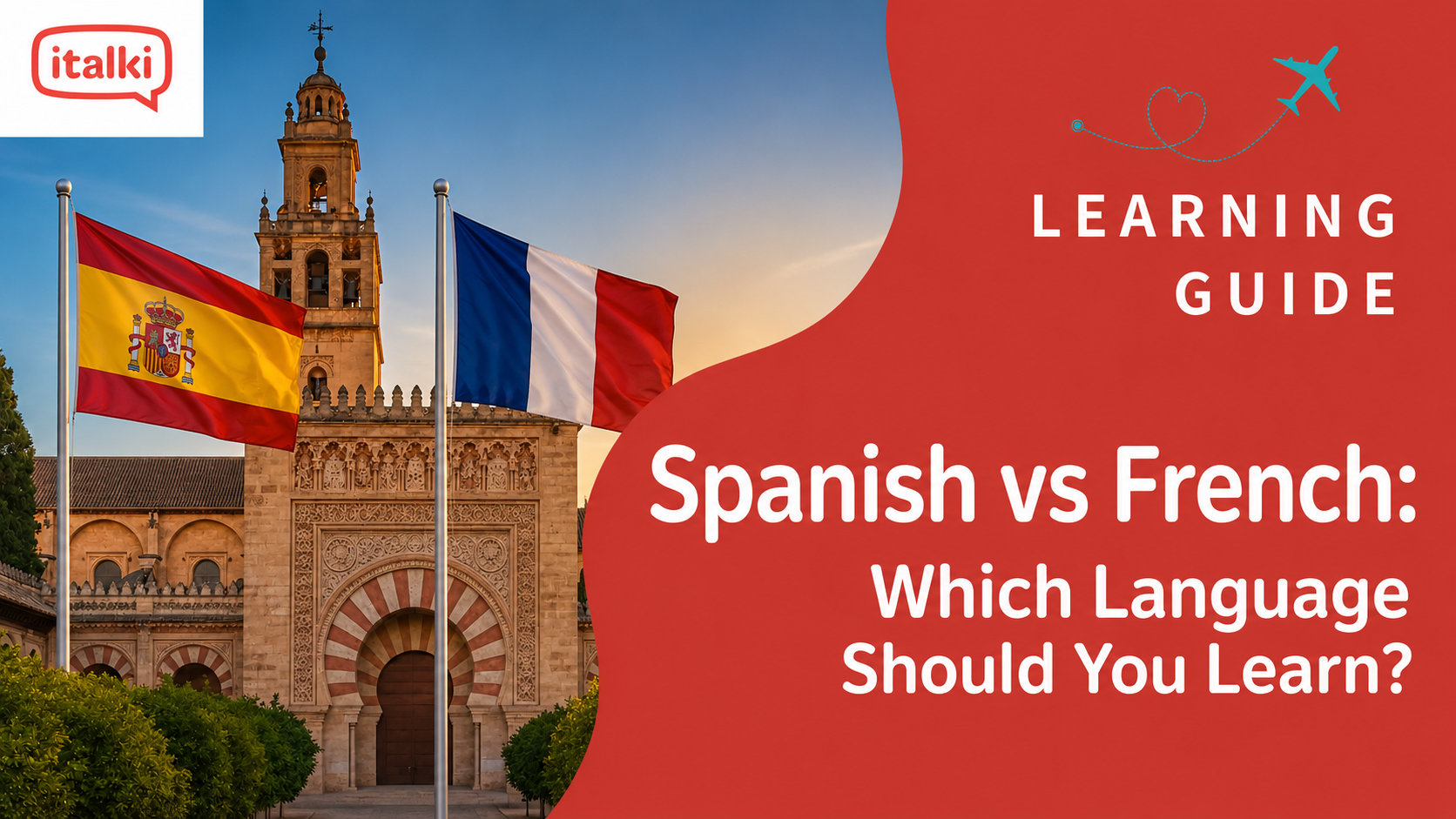
If you’re deciding between Spanish and French, italki is where over 10 million learners have worked through exactly this kind of choice, pairing with native tutors to test both languages before committing. Both are Romance languages with strong global reach, rich cultures, and real career value.
The difference comes down to your specific goals, your geography, and what you plan to do with the language once you have it. This article breaks down Spanish vs French across the dimensions that actually matter: difficulty for English speakers, travel utility, career value, and cultural reach.
Still deciding? Book a 30-minute trial in both languages this week on italki. From $4/lesson, with no long-term commitment, you’ll know which one clicks after a single conversation.
Want to learn a language on italki?
Here are the best resources for you!
Is Spanish or French easier for English speakers?
Both Spanish and French are categorized as Group I languages by the Foreign Service Institute, meaning they require approximately 600-750 class hours for an English speaker to reach professional working proficiency. Neither language is dramatically harder than the other, but they present different challenges at different stages.
Spanish pronunciation is more consistent. Words are spelled roughly how they sound, and the vowel system is straightforward with just five pure vowel sounds.
French pronunciation is considerably more irregular. Silent letters, nasal vowels, and liaison, where word-ending consonants blend into the next word, make reading aloud feel unpredictable until you’ve had significant listening exposure.
On the grammar side, both languages use gendered nouns and require verb conjugation across multiple tenses. French has a slightly more complex verb system and stricter rules around formal vs. informal registers. Spanish has two verbs for “to be” (ser and estar), which trips up most beginners but becomes intuitive with practice.
Most learners find Spanish pronunciation easier to master in the first three months, while French rewards patience with a more phonologically layered system. If pronunciation feedback is your bottleneck, working with a Spanish tutor online or an online French tutor from week one will close that gap faster than any app.
Spanish vs French language: what are the key differences?
Spanish and French share roughly 75% of their vocabulary through Latin roots, which means learners of one language get a significant head start on the other. The structural differences, though, matter.
- Writing system: Spanish uses a phonetic alphabet with a few additions (ñ, accent marks). French uses the same Roman alphabet but with more diacritical marks and far more silent letters. The word “beaucoup” (a lot) is pronounced “boh-koo”, nothing like how it looks.
- Verb conjugation: French has more irregular verbs in common use, and the spoken forms of many conjugations sound identical even when written differently. Spanish conjugation is more predictable, and regional variation (Latin American vs. Castilian) affects vocabulary more than grammar.
- Gender: Both languages assign masculine and feminine gender to all nouns. French has no reliable pattern for predicting gender; Spanish offers slightly more consistent rules.
- Regional spread: Spanish is the dominant language across Latin America, making it the working language of 21 countries. French is official in 29 countries, with significant populations across West and Central Africa, the Caribbean, Southeast Asia, and parts of Belgium, Switzerland, and Canada.
If you need to connect with French-speaking countries specifically for work or family, French is the obvious choice. If your world is oriented toward the Americas, Spanish reaches further.
Ready to hear the difference firsthand? A French language tutor on italki can walk you through the phonetic quirks in a single trial lesson.

Find Your Perfect Teacher
Your French doesn’t have to sound like a textbook. Get personalized lessons from native tutors who’ll help you speak naturally, not just correctly.
Book a trial lesson
Which language is more useful for travel?
Spanish is more practical for the Americas. If you travel frequently to Mexico, Colombia, Argentina, Peru, Spain, or anywhere across Central America, Spanish pays off immediately. It’s the native language of over 21 countries, and even basic conversational ability changes your experience significantly compared to relying on tourist English.
French unlocks a different world. Paris is only one reason to learn French. Morocco, Senegal, Ivory Coast, Madagascar, Belgium, Switzerland, and Quebec all reward French speakers. For travelers who want depth in Francophone Africa or who move between European cultural centers, French is more strategically valuable.
Before a trip to a Spanish-speaking country, 50-100 hours of focused practice is enough to handle restaurants, directions, accommodation, and social situations with confidence. Learning useful phrases to travel in Spain is a realistic short-term goal even for complete beginners.
For either language, nothing prepares you for real travel conversations faster than practicing with a native speaker from the specific region you’re visiting. A tutor from Buenos Aires speaks differently from one in Madrid, and differently again from one in Mexico City. Book a Spanish tutor online from your target country for the most relevant pre-trip practice.
Find Your Perfect Teacher
Your Spanish doesn’t have to sound like a textbook. Get personalized lessons from native tutors who’ll help you speak naturally, not just correctly.
Which language opens more career opportunities?
Both languages have strong career markets, but in different industries and geographies.
Spanish is the second most studied language in US schools, according to the Modern Language Association. Spanish-English bilingualism is particularly valued in healthcare, education, social services, and customer-facing roles across the United States. LinkedIn’s 2023 Workforce Insights report identified Spanish as one of the top three languages that improve hiring outcomes for bilingual candidates in the Americas.
French holds official status in the United Nations, NATO, the European Union, the African Union, and the International Red Cross. For roles in diplomacy, international development, or trade with Francophone Africa, French is a genuine competitive advantage. The British Council’s Languages for the Future report ranked French as the most important language for UK business after Mandarin.
If your career is US-based and client-facing, Spanish likely pays off sooner. If you’re working internationally or in institutions with a global mandate, French carries distinct institutional weight.
Start building your career-relevant language skills today with an online Spanish tutoring session or a French tutor online on italki, from $4/lesson.
Want to learn a language on italki?
Here are the best resources for you!
How do you decide which one to learn?
The answer is almost always the one you have a personal reason for. Motivation drives consistency, and consistency is what separates people who reach B2 from people who plateau at A2.
Ask yourself:
- Where are you going? If you have a trip planned, family in a Spanish-speaking country, or a job opportunity in a Francophone region, that’s your answer.
- What content do you want to consume? If you love Latin music, Spanish cinema, or telenovelas, Spanish immersion will feel natural. If French cinema, literature, or international news interest you, French will sustain your attention longer.
- Who do you want to speak with? Think about the people in your life or career who speak these languages. The language that connects you to real people you care about is always the better choice.
- What’s your timeline? Both require real commitment. If you have 6-12 months of consistent study planned, either is achievable to a conversational level. If you want results in 3 months or fewer, Spanish’s more phonetic nature may make early wins more accessible.
Once you’ve decided, the fastest path to real conversational ability is practicing with a native speaker who can correct your mistakes in real time. italki has Spanish tutoring online and French tutors across every accent and variety, with lessons from $4. A weekly lesson is enough to make measurable progress alongside independent study.
How to start learning with a native tutor
The fastest way to move past the question of “which language” is to spend a single hour in each one with a native speaker. No amount of research replaces that experience.
italki has tutors for both Spanish and French across every region, learning goal, and budget. Whether you want conversational practice, grammar fundamentals, or targeted preparation for a proficiency test like DELF or DELE, you can filter specifically for your needs and book a trial lesson at minimal cost.
The platform has been operating for over 15 years, with more than 10 million learners and 30,000+ teachers across 150+ languages. Both Spanish and French are among the most-booked languages, with hundreds of community tutors and professional teachers available at any hour.
If you’re still weighing the decision, book a 30-minute trial in Spanish and one in French within the same week. Your gut reaction after each conversation will tell you more than any comparison article can.
Want to learn a language on italki?
Here are the best resources for you!
FAQ
Is Spanish or French more widely spoken?
Spanish has more native speakers globally, with approximately 500 million, according to Ethnologue. French has around 320 million native or official-language speakers but functions as an official language in more countries (29 vs. 21), giving it broader institutional reach in international organizations.
Which language is harder for English speakers?
Both are classified as Category I (easiest tier) for English speakers by the Foreign Service Institute, requiring around 600-750 hours for professional proficiency. Spanish tends to be slightly more accessible early on due to more consistent pronunciation, while French rewards patience with a richer phonological system once pronunciation clicks.
Can you learn both Spanish and French at the same time?
Not recommended for beginners. The languages share significant vocabulary, which creates confusion when you’re still building foundations in either. Most learners reach at least B1 in one before adding the other. If you want to learn both eventually, pick Spanish or French first and give it 12-18 months of focused study.
Is French useful in Africa?
Yes, significantly. French is an official language across 21 African countries, including major economies like Senegal, Ivory Coast, Cameroon, and the Democratic Republic of Congo. For anyone working in international development, trade, or humanitarian sectors with ties to Sub-Saharan Africa, French is often more valuable than Spanish.
Where can I find a native Spanish or French tutor?
italki has native tutors for both languages with lessons starting from $4. You can filter by accent, specialty, availability, and price, and book a trial lesson with no long-term commitment.
Want to learn a language at italki?
Here are the best resources for you!