Key takeaways
- The imperfect tense in French, l’imparfait (lam-par-FEH), describes past habits, background details, ongoing actions, emotions, age, time, and weather.
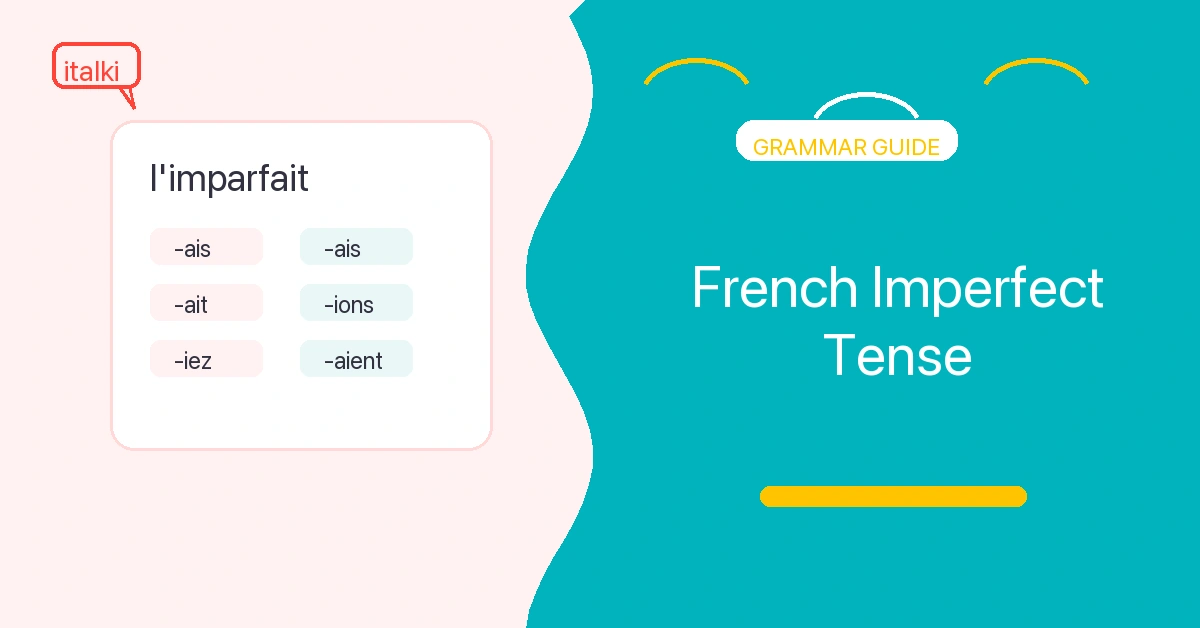
- Form l’imparfait from the present tense nous form, remove -ons, then add -ais, -ais, -ait, -ions, -iez, -aient.
- Être (to be) is the main irregular verb in l’imparfait, with the stem ét-, as in j’étais (I was).
- The hardest part is not the endings, it is choosing between l’imparfait and le passé composé in real stories.
- A French tutor helps you turn rule knowledge into natural past narration through correction, story retelling, and spoken drills.
The imperfect tense in French is the past tense for “used to,” “was doing,” and background description: Quand j’étais petit, je jouais au foot tous les jours (When I was little, I used to play soccer every day).
It is called l’imparfait, one of the main tools for telling stories without making every past action sound finished and separate.
italki has operated since 2007, which matters here because l’imparfait often needs live correction: a learner has to hear why je regardais (I was watching) fits one sentence while j’ai regardé (I watched) fits another.
Practice l’imparfait in short stories, childhood memories, and travel recaps with a French tutor who corrects tense choice as you speak.

Find Your Perfect Teacher
Build real French confidence with personalized lessons from a teacher who can help with speaking, exam prep, grammar, and pronunciation.

What is the imperfect tense in French?
The imperfect tense in French describes past situations that were ongoing, repeated, unfinished, or part of the background. In English, it often matches “was doing,” “used to do,” or “would do.”
The French name is l’imparfait. “Imperfect” does not mean “wrong.” It means the action is not shown as a single completed event.
| French | Pronunciation | English | Meaning |
|---|---|---|---|
| Je lisais. | zhuh lee-ZEH | I was reading. | The reading was in progress. |
| Je lisais tous les soirs. | zhuh lee-ZEH too leh swahr | I used to read every evening. | It was a habit. |
| Il faisait froid. | eel fuh-ZEH frwah | It was cold. | This gives background. |
L’imparfait is a storytelling tense. It sets the scene before something happens: Il pleuvait, les enfants dormaient, et la maison était silencieuse (It was raining, the children were sleeping, and the house was quiet).
Learners who already know one past tense benefit from comparing l’imparfait with the wider French past tense system. L’imparfait paints the background; other past forms move the action forward.
Find Your Perfect Teacher
Build real French confidence with personalized lessons from a teacher who can help with speaking, exam prep, grammar, and pronunciation.
How do you form l’imparfait in French?
Take the present tense nous form, remove -ons, and add the imperfect endings. This rule works for nearly every French verb.
- Start with the present tense nous form.
- Remove -ons.
- Add the l’imparfait ending.
| Subject | Ending | Parler, nous parlons | Finir, nous finissons | Prendre, nous prenons |
|---|---|---|---|---|
| je | -ais | je parlais | je finissais | je prenais |
| tu | -ais | tu parlais | tu finissais | tu prenais |
| il, elle, on | -ait | il parlait | elle finissait | on prenait |
| nous | -ions | nous parlions | nous finissions | nous prenions |
| vous | -iez | vous parliez | vous finissiez | vous preniez |
| ils, elles | -aient | ils parlaient | elles finissaient | ils prenaient |
Parler (to speak) becomes je parlais (I was speaking). Finir (to finish) becomes je finissais (I was finishing). Prendre (to take) becomes je prenais (I was taking).
The guide to er verbs French supports the ER verb base, especially for common verbs like aimer (to like), habiter (to live), and regarder (to watch).
Être (to be) is the main exception. It uses ét- as the stem:
| Subject | Être in l’imparfait | English |
|---|---|---|
| j’ | j’étais | I was |
| tu | tu étais | you were |
| il, elle, on | il était | he was |
| nous | nous étions | we were |
| vous | vous étiez | you were |
| ils, elles | ils étaient | they were |
Turn the rule into spoken reflexes with a French teacher online who prompts forms quickly: hier, je…, quand tu étais enfant, tu…, à l’université, nous…
Find Your Perfect Teacher
Build real French confidence with personalized lessons from a teacher who can help with speaking, exam prep, grammar, and pronunciation.
Which l’imparfait verbs need spelling changes?
Some verbs keep a spelling marker in l’imparfait so the sound stays correct. These are not new endings, only spelling adjustments.
For -ger verbs, keep e before a and o endings to preserve the soft “zh” sound.
| Verb | Nous form | L’imparfait | English |
|---|---|---|---|
| manger | nous mangeons | je mangeais | I was eating |
| voyager | nous voyageons | tu voyageais | you were traveling |
| changer | nous changeons | elle changeait | she was changing |
Je mangeais is pronounced zhuh mahn-ZHEH. The e keeps the g soft.
For -cer verbs, ç appears before a and o endings to keep the soft “s” sound.
| Verb | Nous form | L’imparfait | English |
|---|---|---|---|
| commencer | nous commençons | je commençais | I was starting |
| avancer | nous avançons | tu avançais | you were moving forward |
| lancer | nous lançons | il lançait | he was throwing |
Je commençais is pronounced zhuh koh-mahn-SEH. Without ç, the c would sound like k.
Verbs ending in -ier have double i in nous and vous forms:
- étudier (to study), nous étudiions (we were studying)
- oublier (to forget), vous oubliiez (you were forgetting)
These forms look heavy on the page, but in speech they are normal. Nous étudiions sounds like noo zay-too-DYON, with a clear y sound before the ending.
Find Your Perfect Teacher
Build real French confidence with personalized lessons from a teacher who can help with speaking, exam prep, grammar, and pronunciation.
When do you use the imperfect tense in French?
Use l’imparfait for past habits, repeated actions, ongoing actions, descriptions, age, time, weather, feelings, and states of mind. If the sentence answers “what was going on?” l’imparfait is often the right choice.
Past habits and repeated actions
- Quand j’étais enfant, je jouais dehors tous les jours. (When I was a child, I used to play outside every day.)
- Nous allions chez mes grands-parents le dimanche. (We used to go to my grandparents’ house on Sundays.)
- Elle buvait du thé chaque matin. (She used to drink tea every morning.)
Signal words that point toward l’imparfait: souvent (often), toujours (always), tous les jours (every day), chaque été (every summer), d’habitude (usually), à l’époque (back then).
Background and description
- Il faisait nuit. (It was nighttime.)
- La rue était vide. (The street was empty.)
- Les gens parlaient doucement. (People were speaking quietly.)
This is the tense for describing what the camera would show before the main action begins.
Ongoing actions
- Je regardais un film quand tu as appelé. (I was watching a movie when you called.)
- Elle dormait pendant que nous préparions le dîner. (She was sleeping while we were preparing dinner.)
The ongoing action uses l’imparfait. The interrupting action often uses passé composé.
Feelings, thoughts, and physical states
- J’avais peur. (I was scared.)
- Il voulait partir. (He wanted to leave.)
- Nous étions fatigués. (We were tired.)
- Tu pensais à ton examen. (You were thinking about your exam.)
Search for French tutors when this tense feels clear in writing but harder in speech, especially for childhood memories and travel stories.
Find Your Perfect Teacher
Build real French confidence with personalized lessons from a teacher who can help with speaking, exam prep, grammar, and pronunciation.
How is l’imparfait different from passé composé?
L’imparfait describes the scene or habit; passé composé presents a completed event. Many French stories use both in the same sentence.
| French | English | Tense logic |
|---|---|---|
| Je lisais quand Marie est arrivée. | I was reading when Marie arrived. | lisais = background, est arrivée = event |
| Il pleuvait, alors nous sommes restés à la maison. | It was raining, so we stayed home. | pleuvait = condition, sommes restés = result |
| Quand j’étais étudiant, j’ai rencontré mon meilleur ami. | When I was a student, I met my best friend. | étais = life period, ai rencontré = one event |
A useful test: if English uses “was doing” or “used to,” try l’imparfait first. If English says “did,” “went,” or “finished” as one completed event, passé composé often fits.
Some verbs change meaning depending on the tense:
| Verb | L’imparfait | Passé composé |
|---|---|---|
| savoir | Je savais. (I knew.) | J’ai su. (I found out.) |
| connaître | Je connaissais Paris. (I knew Paris.) | J’ai connu Paris en 2010. (I got to know Paris in 2010.) |
| vouloir | Il voulait partir. (He wanted to leave.) | Il a voulu partir. (He tried/decided to leave.) |
| pouvoir | Elle pouvait venir. (She was able to come.) | Elle a pu venir. (She managed to come.) |
This contrast is why many learners need spoken correction. The grammar rule is short, but choosing the tense inside a real story takes practice.
Retell yesterday, last summer, or a childhood memory with an online French tutor and ask for one thing: every time l’imparfait should replace passé composé, stop and repeat the corrected sentence.
Find Your Perfect Teacher
Build real French confidence with personalized lessons from a teacher who can help with speaking, exam prep, grammar, and pronunciation.
How do negatives and questions work in l’imparfait?
Negatives and questions in l’imparfait follow normal French sentence patterns. The verb changes tense, but the structure stays familiar.
For negatives, place ne and pas around the imperfect verb:
- Je ne savais pas. (I didn’t know.)
- Elle ne voulait pas parler. (She didn’t want to speak.)
- Nous n’étions pas prêts. (We were not ready.)
With jamais (never), plus (no longer), and rien (nothing), use them in the second negative position:
- Tu ne venais jamais. (You never used to come.)
- Il ne travaillait plus ici. (He no longer worked here.)
- Je ne comprenais rien. (I understood nothing.)
For questions, intonation is the easiest spoken pattern:
- Tu habitais à Lyon ? (Did you live in Lyon?)
- Vous travailliez le week-end ? (Did you use to work on weekends?)
Est-ce que also works:
- Est-ce que tu jouais d’un instrument ? (Did you play an instrument?)
- Est-ce qu’elle était malade ? (Was she sick?)
Inversion sounds more formal:
- Étiez-vous souvent en retard ? (Were you often late?)
- Avait-il peur ? (Was he afraid?)
italki helps learners get started with live grammar correction. The learning task stays focused: ask your tutor to ask questions in l’imparfait about your past and answer in full sentences.
Find Your Perfect Teacher
Build real French confidence with personalized lessons from a teacher who can help with speaking, exam prep, grammar, and pronunciation.
What does l’imparfait sound like in real speech?
Most singular and third-person plural l’imparfait endings sound the same: -ais, -ait, and -aient all sound like eh. Je parlais, tu parlais, il parlait, and ils parlaient sound alike in normal speech.
| Form | Pronunciation | English |
|---|---|---|
| je parlais | zhuh par-LEH | I was speaking |
| tu parlais | too par-LEH | you were speaking |
| il parlait | eel par-LEH | he was speaking |
| ils parlaient | eel par-LEH | they were speaking |
The subject tells you who did the action. The ending alone often does not.
Nous and vous sound different:
- nous parlions, noo par-LYON (we were speaking)
- vous parliez, voo par-LYAY (you were speaking)
- nous finissions, noo fee-nee-SYON (we were finishing)
- vous finissiez, voo fee-nee-SYAY (you were finishing)
Pay attention to the difference between l’imparfait and infinitive sounds. Je parlais sounds like par-LEH, while parler (to speak) sounds like par-LAY. The vowel is close, and some accents make the contrast subtle.
The guide to French vowels is useful here because tense endings sound easier once the vowel system feels less random.
Find Your Perfect Teacher
Build real French confidence with personalized lessons from a teacher who can help with speaking, exam prep, grammar, and pronunciation.
How should learners practice l’imparfait?
Practice l’imparfait by telling short past stories, not by filling pages of isolated verb charts. The tense becomes natural when it sits inside real scenes.
Use this three-step drill:
- Describe the background with three l’imparfait sentences.
- Add one completed event with passé composé.
- Finish with one feeling or reaction in l’imparfait.
Example:
- Il faisait froid. (It was cold.)
- J’attendais le bus. (I was waiting for the bus.)
- Les gens marchaient vite. (People were walking quickly.)
- Soudain, j’ai vu mon ami. (Suddenly, I saw my friend.)
- J’étais content. (I was happy.)
For childhood memories:
- Quand j’étais petit(e), j’habitais… (When I was little, I lived…)
- Tous les étés, nous allions… (Every summer, we used to go…)
- Mon plat préféré était… (My favorite dish was…)
- Je voulais toujours… (I always wanted…)
For travel stories:
- Il faisait beau / mauvais. (The weather was nice / bad.)
- Nous cherchions… (We were looking for…)
- Je ne comprenais pas… (I didn’t understand…)
- J’avais faim / soif / peur. (I was hungry / thirsty / scared.)
Rules make sense alone, then disappear during speech. Use French tutoring for targeted correction and ask the tutor to mark each tense choice as “background,” “habit,” “ongoing,” or “event.”
Find Your Perfect Teacher
Build real French confidence with personalized lessons from a teacher who can help with speaking, exam prep, grammar, and pronunciation.
Ready to tell better stories in French?
L’imparfait lets French stories sound natural: the weather, the mood, the habits, the ongoing action, and the memory all need this tense. Learn the endings first, then practice choosing between je parlais (I was speaking) and j’ai parlé (I spoke) until the contrast feels automatic.
italki has 30,000+ teachers across 150+ languages, so learners studying l’imparfait can find grammar-focused help, conversation practice, or pronunciation feedback in one place.
Book a trial lesson and practice l’imparfait through childhood stories, travel memories, and real past conversations.
Find Your Perfect Teacher
Build real French confidence with personalized lessons from a teacher who can help with speaking, exam prep, grammar, and pronunciation.
FAQ
What is the imperfect tense in French?
The imperfect tense in French, l’imparfait, describes past habits, ongoing actions, background details, feelings, weather, age, and time. Example: Je travaillais (I was working, I used to work).
How do you form l’imparfait?
Take the present nous form, remove -ons, and add -ais, -ais, -ait, -ions, -iez, -aient. Example: nous parlons becomes je parlais (I was speaking).
Is être irregular in l’imparfait?
Yes. Être uses the stem ét-: j’étais, tu étais, il était, nous étions, vous étiez, ils étaient.
What is the difference between imparfait and passé composé?
L’imparfait gives background, habits, or ongoing action. Passé composé gives a completed event. Je dormais quand il a appelé means I was sleeping when he called.
What are common l’imparfait signal words?
Often, l’imparfait appears with souvent (often), toujours (always), d’habitude (usually), tous les jours (every day), chaque été (every summer), and à l’époque (back then).
Want to learn a language at italki?
Here are the best resources for you!