Key takeaways:
- italki connects over 10 million learners with 30,000+ teachers across 150+ languages for personalized one-on-one lessons
- italki price for most lessons starts from $4, depending on the type of teacher you choose.
- Research shows 71.6% of italki students improved oral proficiency by at least one level after two months of study Getting Smart
- Both professional teachers (certified) and community tutors (conversation practice) are available on the platform
- What is italki?
- italki pros, cons and key features
- What types of teachers are on italki?
- Does italki actually work for learning languages?
- italki Reviews from language learners
- italki Reddit: What Reddit users say
- How do you find a good teacher on italki?
- How does italki compare to other platforms?
- Is italki worth it?
- FAQ
If you’ve been looking for a way to practice speaking with native tutors, this italki review breaks down whether the popular platform is worth your time and money.
italki connects over 10 million learners with 30,000+ professional teachers and community tutors across 150+ languages, from popular options like Spanish and Japanese to obscure languages like Welsh or Esperanto.
With more than 15 years in operation, italki boasts a platform designed to help you improve listening comprehension and build confidence through one-on-one lessons.
In this review, you’ll discover how italki lessons work, the cost, and the difference between professional teachers and community tutors. We’ve also included real student experiences and research data on effectiveness, so you can decide if this approach fits your learning style.
Language enthusiasts often love italki for its flexibility and access to great teachers. Ready to start speaking? Browse Spanish tutors, Japanese tutors, French tutors and more to get started.
What is italki?
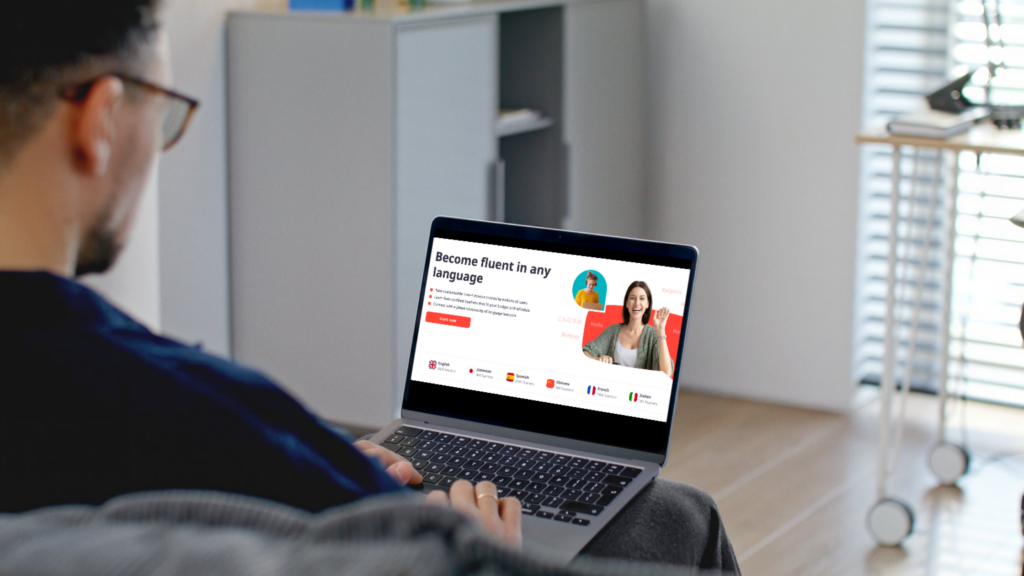
italki is the leading online platform for personalized language learning that connects students with tutors for one-on-one lessons.
Since launching in 2007, the platform has connected over 10 million learners with more than 30,000 teachers across 150+ languages. italki
Unlike language learning apps that rely on gamification and pre-recorded lessons, italki connects you with real teachers for live video sessions. You choose your teacher, schedule lessons around your availability, and work on goals specific to your needs.
How the platform works:
You create a free italki account and search for teachers by language, price, location, and availability. Each teacher profile includes:
- Introduction video showing their teaching style
- Student reviews and ratings
- Completed lesson count
- Teaching credentials (for professional teachers)
- Hourly rate and trial lesson price
Lessons happen via italki Classroom (the platform’s built-in video tool), Zoom, Skype, or Google Meet. Most teachers offer 30-minute trial lessons at discounted rates so you can evaluate fit before committing to more classes.

From Hello to Fluent
Your next language adventure is one click away. Sign up for free and connect with a native tutor who makes learning fun and personalized!
Sign up free
What makes italki different from traditional classes:
Traditional language schools typically charge $200-500 monthly for group classes with fixed schedules. italki operates on a pay-per-lesson model where you control frequency, budget, and learning focus.
The platform doesn’t teach languages directly. Instead, it provides the infrastructure for independent teachers to offer their services. Teachers set their own rates, create their availability, and design their lesson approach.
Ready to explore your options? Browse teachers in your target language and book a trial lesson to get started.
Want to learn a language at italki?
Find your tutor today!
italki pros, cons and key features
Pros:
- Largest teacher selection (30,000+ teachers)
- Flexible pricing. Lessons typically start from $4, making quality instruction accessible at almost any budget
- No subscription required. Pay per lesson with no monthly fees or package commitments.
- Huge language variety (150+ languages).
- Complete scheduling freedom. Book lessons whenever works for you, no fixed class times or weekly commitments.
- Tutor variety. Access to professional teachers and community tutors
- Trial lessons. Test different teachers before committing.
- Personalized one-on-one lessons tailored to your goals
- Specialized instruction. Option to find teachers who speak your native language
Cons:
- Learning requires self-discipline and practice outside lessons
- italki credits may expire after a year if unused
Key features:
- italki Classroom with screen sharing, chat, and lesson recording
- Mobile app and web platform access
- Teacher search filters (language, specialty, price, availability, native language)
- Community features (writing corrections, discussion forums, language exchange)
- italki Plus integration (AI-generated notes, progress tracking, quizzes)
- Multiple video platform options (italki classroom, Zoom, Skype, Google Meet)
What types of teachers are on italki?
italki offers two categories of teachers, each serving different learning needs and budgets. With many teachers across many languages, you can find native speakers who match your specific goals.
Professional teachers
Who they are: Certified teachers with teaching credentials, language education degrees, or equivalent professional qualifications verified by italki.
Best for:
- Complete beginners who need structured curriculum
- Students preparing for standardized exams (IELTS, TOEFL, DELE, JLPT, etc)
- Learners who want detailed grammar explanations
- Anyone studying foreign languages with different writing systems (Arabic, Japanese, Chinese)
Average cost: $10-40 per lesson for most languages
What they offer: Professional teachers typically provide structured lesson plans, homework assignments, progress tracking, and can explain grammatical concepts in detail. They understand how to break down complex language rules for learners at different levels.
Community tutors
Who they are: Native speakers or advanced learners who offer conversation practice without formal teaching certification.
Best for:
- Intermediate and advanced students who need speaking practice
- Learners maintaining existing language skills
- Students wanting to learn slang, idioms, and cultural context
- Anyone on a tight budget who still wants regular practice
Average cost: $4-20 per hour for most languages
What they offer: Community tutors focus on natural conversation, cultural insights, and practical language use. Their teaching approaches vary based on their experience and your goals.
Not sure which type is right for you? See our guide on how to choose an italki tutor.
Want to learn a language at italki?
Find your tutor today!
Finding bilingual teachers
For beginners, learning is easier when you can ask questions in your native language. italki lets you filter for teachers who speak both your target language and your native language.
This is particularly helpful for complex grammar explanations. When stuck on a confusing point, your teacher can clarify in your language before guiding you back to practicing your target language.
Popular bilingual teacher categories:
Learning English:
- English tutors for Spanish speakers– Teachers who can explain English grammar in Spanish
- English tutors for Chinese speakers – Teachers familiar with challenges Chinese learners face
- English tutors for Korean speakers– Tutors experienced with Korean learners’ needs
- English tutors for Japanese speakers – Teachers who understand Japanese-English differences
- English tutors for French speakers – Bilingual tutors who switch to French for complex topics
- English tutors for Arabic speakers – Teachers familiar with Arabic speakers’ learning patterns
- English tutors for Russian speakers – Tutors who can explain in Russian when needed
Learning other languages:
- French tutors for English speakers – Teachers who explain French grammar in English
- French tutors for Arabic speakers – Tutors who clarify lessons in Arabic
- Spanish tutors for English speakers – Teachers who explain Spanish concepts in English
- Spanish tutors for Portuguese speakers – Bilingual teachers switching to Portuguese when needed
- Japanese tutors for English speakers – Tutors breaking down Japanese grammar in English
This approach works particularly well for CEFR levels A1-B1 (beginner to intermediate), where foundational grammar concepts require clear explanation.
Does italki actually work for learning languages?
Yes, but only if you show up consistently and practice between lessons. Here’s what the data actually says.
The numbers don’t lie
An independent study tracking 125 italki users over two months found measurable improvements in both speaking and writing. The results:
71.6% improved their speaking ability by at least one proficiency level
Breaking that down:
- 49% jumped one level
- 19% jumped two levels
- 4% improved by more than two levels
Students who put in 14-17 hours total saw real gains in speaking confidence, vocabulary recall, and grammar accuracy. The study used standardized testing, not self-reported feelings.
Why one-on-one conversation helps:
Sure, apps help you learn grammar and vocabulary, but they won’t get you talking like a real person. Speaking a language takes more than knowing rules; you need to:
- Put words together on the fly
- Understand cultural context
- React naturally in conversation
This is where italki lessons shine. Speaking with native speakers gives you real-life practice, not just memorized phrases. A 2017 study even found learners improved faster when practicing real conversations versus drills alone.
Basically, grammar is the foundation, but conversation is where your fluency actually grows. Mix both, and you’ll start feeling confident speaking faster than you expect.
What italki won’t do
italki lessons are powerful, but they’re not magic. You won’t improve if you only show up for lessons and do nothing else. To get results, avoid these common mistakes:
- Don’t just book lessons and hope the language sticks.
- Don’t expect to magically absorb a new language.
- Don’t skip your vocabulary and rely only on conversation.
Here’s what actually works:
- Practice vocabulary on your own.
- Review grammar between lessons.
- Listen and read in your target language: podcasts, videos, articles.
- Use the language outside lessons whenever you can.
Think of italki lessons as your weekly scrimmage; you still need to practice the fundamentals to win the game. Pair your practice with lessons from a native speaker and you’ll start seeing real progress fast.
How long until you see results?
Progress depends on your language level, lesson frequency, and effort outside class. Realistic timelines for students taking one weekly lesson plus self-study:
- 3 months – Better pronunciation, more confident speaking, expanded vocabulary
- 6 months – Able to handle everyday conversations, make fewer grammar mistakes, understand native speakers better
- 12 months – Comfortable discussing a variety of topics, follow movies or podcasts, start thinking in the target language
Conversational fluency typically develops in 1–2 years of regular practice. Academic-level or professional proficiency takes 4–7 years. Digital Promise. Anyone promising faster results is likely overstating what’s realistic.
Find an italki teacher who matches your learning style and book your first lesson to get started.
Find Your Perfect Teacher
Get personalized lessons from native tutors who’ll help you speak naturally, not just correctly.
Book a trial lesson
italki Reviews from language learners
Students consistently leave positive feedback highlighting how regular practice with great teachers transformed their language abilities.
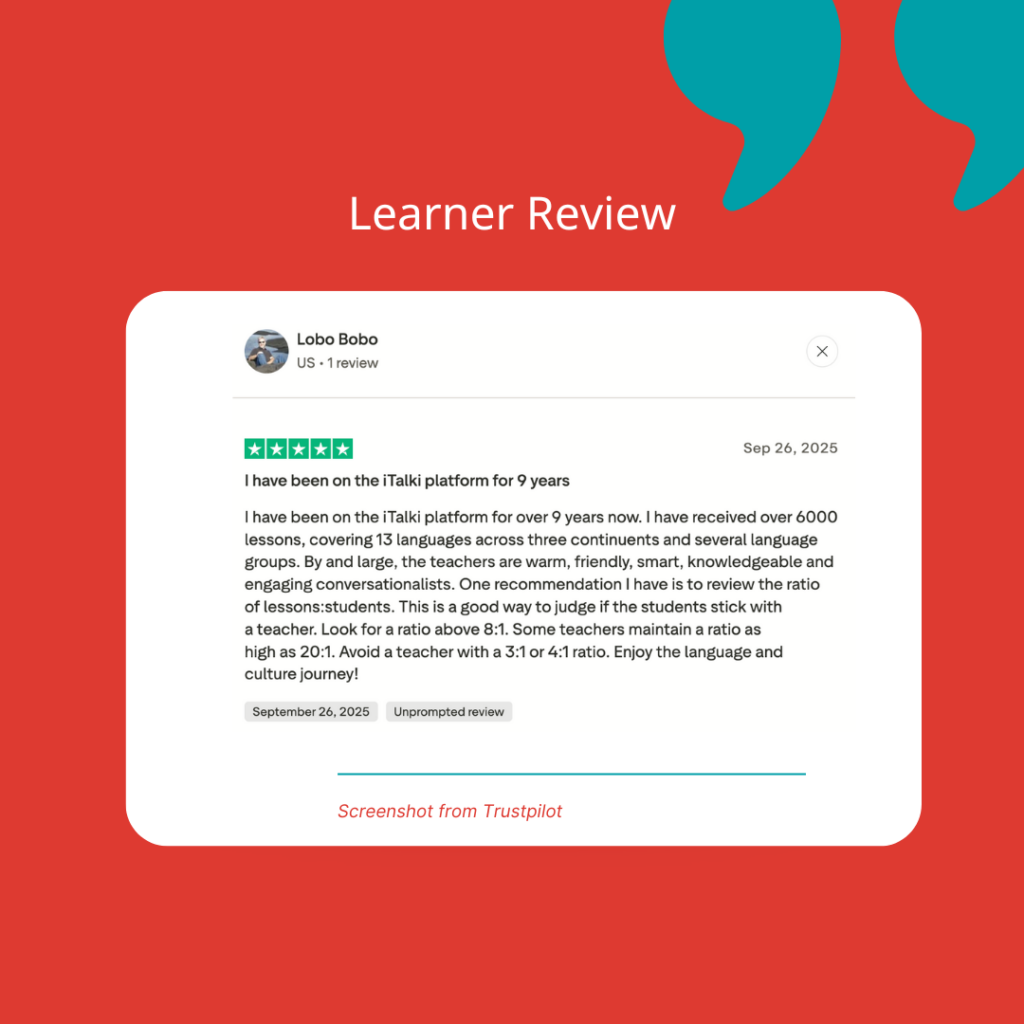
9 years, 6,000+ lessons, 13 languages
Lobo Bobo has been on italki since 2018, taking lessons across continents and language groups. Their advice: look for teachers with student-to-lesson ratios above 20:1 – it means students keep coming back. This metric filters quality better than star ratings alone.
“Easy to navigate and find your tutor”
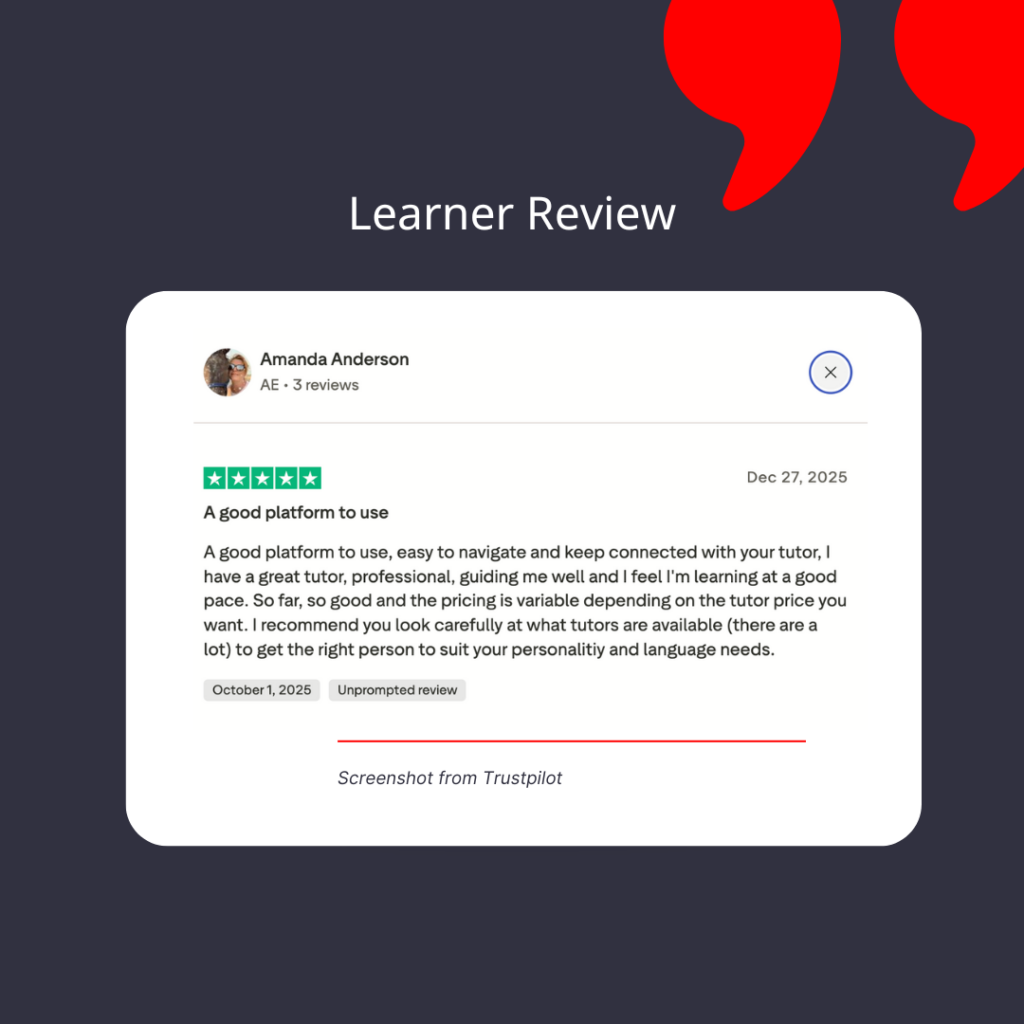
Amanda Anderson calls out what beginners need: simple navigation and tutor variety. Her advice: spend time reviewing tutor profiles to match your personality and learning style.
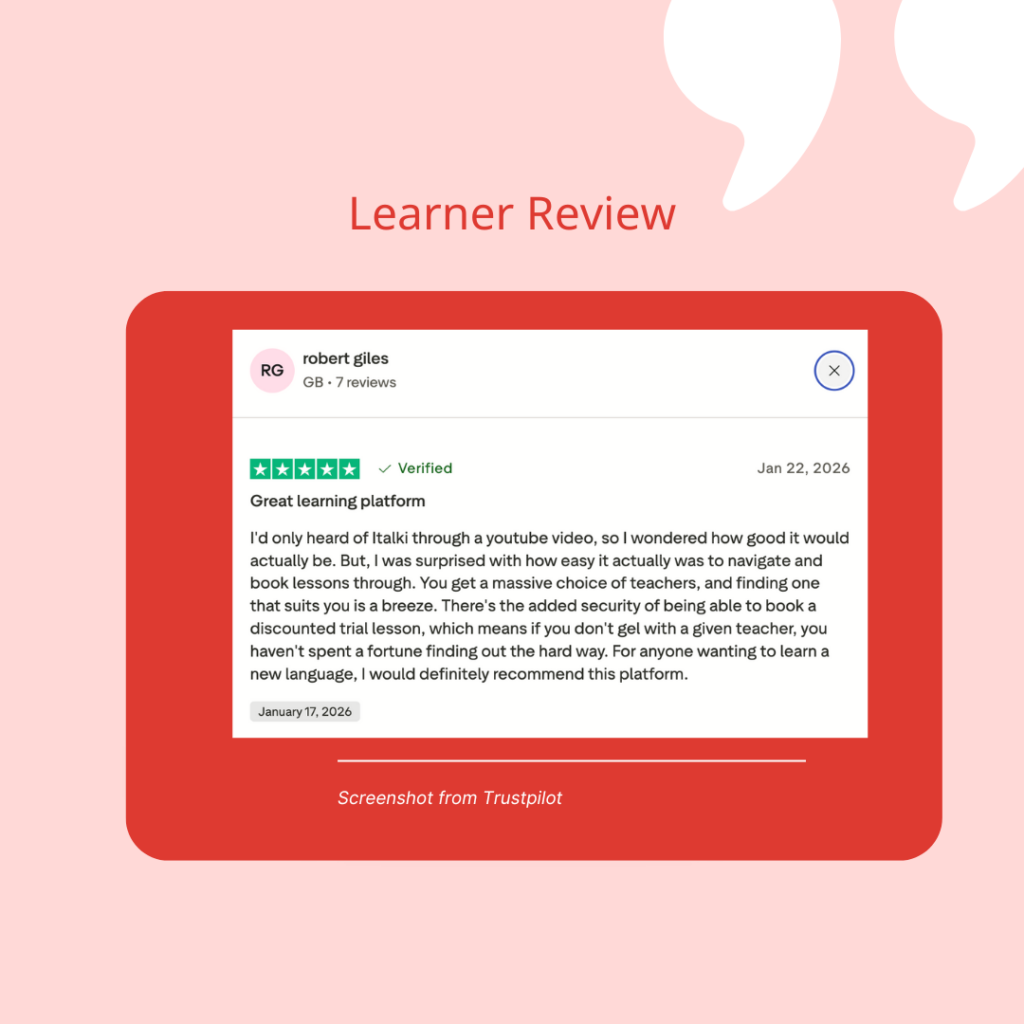
“Easy to navigate and finding a teacher is a breeze”
Robert Giles discovered italki through YouTube and was skeptical about whether it would live up to the hype. His takeaway: the platform’s ease of use and trial lesson system remove the risk. You can test teachers without “spending a fortune finding out the hard way” if they’re not the right fit.
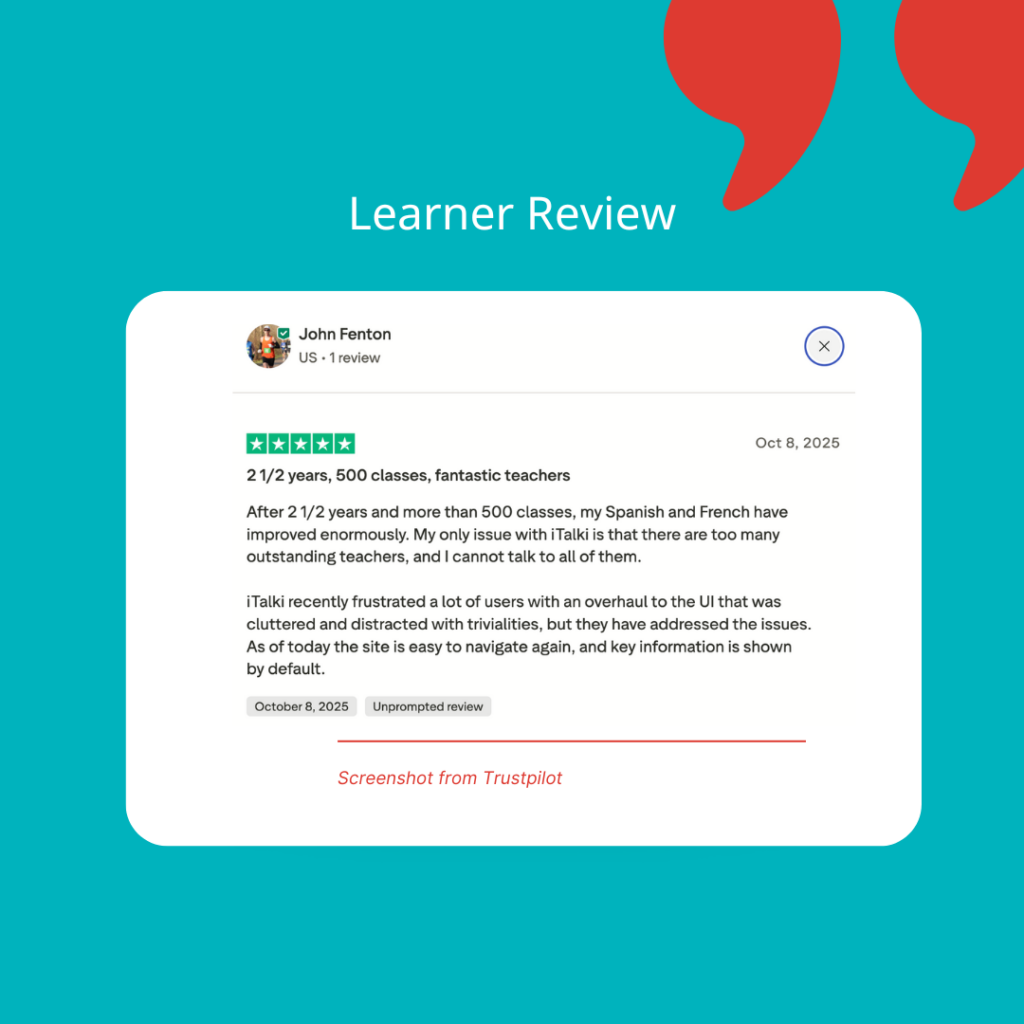
“My Spanish and French have improved enormously”
After 500 classes over 2.5 years, John Fenton’s biggest complaint is “there are too many outstanding teachers.” He’s honest about platform frustrations (UI changes, cluttered interface), but kept going because teacher quality outweighed the annoyances.
italki Reddit: What Reddit users say
People searching “italki Reddit”, “italki review Reddit”, or “is italki worth it Reddit” usually want one thing: honest feedback from real learners before spending money on lessons. Across r/languagelearning threads, he same conclusion appears repeatedly: italki is widely considered worth it for speaking practice, but your results depend heavily on finding the right tutor.
Reddit verdict at a glance
Key takeaways from Reddit
1. italki gives you more speaking time than group classes
Reddit consensus: The most upvoted reason learners recommend italki is simple: you spend more time actively speaking. In a group class, speaking time is divided among students. In a one-on-one lesson, every minute belongs to you. Reddit users describe this as the clearest reason to switch.
“I get to speak more per hour than group classes. The cost per minute of tutoring is cheaper than group classes since you have to divide the teacher by X students in the class. The teacher can focus on my strengths and weaknesses.”
— r/languagelearning, Is italki worth it? (68 upvotes)
“I did a cost benefit analysis and decided that private tutors were far more effective in terms of both money and time. My university class had 8 students sharing two hours. Each student had at most roughly 9 minutes to talk, probably under 5 in practice. For those few minutes I paid twice what I paid for one hour of private lessons.”
— r/languagelearning, italki, is it useful? (11 upvotes)
“italki classes are generally way more affordable and convenient. And the classes that work best are the classes you actually do.”
What this means for you: If your current class has more than three students, you are almost certainly getting less speaking time per dollar than an italki lesson would give you. The cost comparison only works against italki if you book sporadically rather than consistently.
2. The platform is only as good as the tutor you choose
Reddit consensus: This is the most repeated caveat across every italki thread. italki is a marketplace, not a school. Different teachers have different teaching styles, materials, experience levels, and personalities. As a result, one learner’s experience may be completely different from another’s. The solution Reddit consistently gives is the same: use trial lessons aggressively before committing.
“My italki experience has varied and it all depended on how well I meshed with my instructor and their teaching style. You have nothing to lose but time and a little money to try it, but you may want to try out several instructors to find one who works best for you.”
— r/languagelearning, italki, is it useful? (12 upvotes)
“italki consists of thousands of teachers, so it’s impossible to say if the whole italki is good. Some teachers are good, some probably kinda suck. Depends on their education, experience, attitude, materials they provide and everything else.”
— r/languagelearning, Is italki worth it? (13 upvotes)
One learner described their trial and error process in detail:
“I tried 3 different tutors. One was too advanced, he asked if I knew the difference between conditional and subjunctive when I just needed more structure. The second was better, more structured with listening exercises. I got better each time. Then she could no longer join due to her job assignment. In the fall I found another tutor but the time was more casual and less beneficial.”
What this means for you: Use trial lessons. Most experienced users recommend budgeting for 2–3 trial lessons before deciding whether italki works for you.
3. italki works best as part of a routine, not a shortcut
Reddit consensus: The learners who report the strongest results use italki as the speaking layer of a broader study routine, not as their only method. Reddit consistently warns against treating lessons as a substitute for self-study.
“I strongly recommend it, but not over other learning options, in addition to them. To really learn a language, you need to commit at least 30 minutes a day. That could get pricey with italki alone. For my budget it makes more sense to use italki for an hour two or three times a week and use other means on the other days.”
— r/languagelearning, Is italki worth it? (16 upvotes)
“I’m low B2 in Japanese and used around 55 hours on italki to develop my speaking alongside self-study over the past two years. It’s the best if you’re serious. If you’re going to lean on the teacher to spoonfeed you the language though, it’s going to be a different experience.”
— r/languagelearning, Is italki worth it? (9 upvotes)
“I use italki for guided one-on-one conversation practice and it’s amazing. Many of my courses aren’t heavily speaking-based and I don’t live near other speakers of my target language. I was surprised by how well I actually used the language once I was given the opportunity to really speak.”
What this means for you: italki is most valuable as the speaking layer on top of vocabulary work, grammar study, and comprehensible input. Learners who use it that way consistently report faster progress. Learners who use it as their only method consistently report slower results for the money spent.
4. Intermediate learners get the most value
Reddit consensus: Multiple threads flag the same pattern. italki delivers more value once you have a basic foundation. Complete beginners often find lessons frustrating because conversation stalls without vocabulary. Intermediate learners, roughly A2 and above, tend to report the strongest results.
“I got a lot of benefit after I had a good base. If you are still learning A2/B1 vocabulary, it can still be helpful but not delivering as much bang for the buck.”
— r/languagelearning, Is italki worth it? (16 upvotes)
“Depends on your level and budget. If you are a beginner (A1-A2): probably not worth it yet. You need more foundation first. If you are intermediate (B1-B2): can be helpful. I saved probably $500 by doing self-practice first for 2-3 months, then using italki occasionally for polish.”
One learner described a concrete outcome that shows what the intermediate threshold looks like in practice:
“I used Duolingo for a month and watched Dreaming in Spanish, then took italki lessons for 4 months with 2 lessons per week. My main goal was comfort when travelling to South America. I reached maybe A2 on average and had lots of positive compliments when making conversations. Take a few trial lessons to see what style or vibe matches you.”
What this means for you: If you are a complete beginner, book a Professional Teacher rather than a community tutor. Professional Teachers on italki are trained to build structure from zero, which is exactly what beginners need. Community tutors are better suited to learners who already have a foundation and want conversation practice
Bottom line from Reddit
Across the Reddit discussions reviewed, italki is the more recommended option for learners who want live speaking practice, with tutor fit and consistency identified as the two factors that determine the outcome
Sources reviewed: r/languagelearning: “Is italki worth it?” · r/languagelearning: “italki, is it useful?”
Find Your Perfect Teacher
Get personalized lessons from native tutors who’ll help you speak naturally, not just correctly.
Book a trial lesson
How do you find a good teacher on italki?
Finding the right italki teacher is simple if you follow these steps:
- Filter teachers to match your goals
Narrow by price, native language, availability, tutor type, and specialization (conversation, grammar, exam prep, etc.). This instantly helps you focus on teachers who fit your needs. - Watch introduction videos
Every italki teacher has a 60–90 second intro video. Watch to get a sense of their teaching style, accent, energy, and whether their personality clicks with yours. - Read reviews
Student reviews give insight into how lessons are structured, how constructive feedback is, and what learning outcomes others have achieved. - Book a trial lesson
Start with a trial lesson to test compatibility. You can try up to three trial lessons to find the best fit.
Pro tip: A good tutor adapts lessons to your goals, maximizes speaking practice, and tracks progress. If the first teacher isn’t the perfect match, try another.
Location-specific teachers
One of italki’s biggest advantages is that you can learn a language with tutors who understand your local context and goals. While all lessons take place online, many learners prefer tutors who are familiar with their city, time zone, or cultural needs.
For example, students looking for French classes in Montreal often want help with real-life conversations used in Quebec, while learners searching for Spanish classes in Chicago may focus on workplace communication or travel. Similarly, those interested in Japanese classes in New York often want flexible lesson times that fit a busy city schedule.
This local focus makes lessons feel more relevant and practical, even though you’re learning online. No matter where you live, you can find tutors who match your lifestyle, availability, and learning goals.
Looking to find a tutor in a location near you?
Connect with a tutor from these popular timezones.
How does italki compare to other platforms?
Want deeper comparisons?
If you’re deciding between specific platforms, checkout:
- italki vs Preply:Pricing, Tutors, and Flexibility Compared
- italki vs Verbling:Teachers, Languages, and Cost Compared
- italki vs Cambly: Lessons, Tutors, and Cost Compared
- italki vs Lingoda: Lesson Style, Scheduling, and Costs Compared
Key takeaways
- Flexibility. italki offers the most flexibility, with pay-per-lesson pricing and no subscriptions.
- Language variety. italki supports 150+ languages, making it strong beyond English, French, or Spanish.
- Structured learning. Subscription platforms like Preply, Cambly, and Lingoda work best for learners who want routine and fixed schedules.
- Teacher quality. Platforms with stricter vetting (like Verbling) offer more consistent quality, but often at higher prices.
- Learning format. One-on-one lessons (italki, Preply, Verbling) are more effective for speaking practice than group-based courses.
- Choosing the platform. Decide based on your style; flexibility vs structure, budget vs credentials, conversation vs curriculum.
Is italki worth it?
Yes, if you need speaking practice. italki gives you affordable access to native speakers for real conversations, something apps can’t replicate and language schools charge $300-600/month for.
Who benefits most:
- Intermediate learners who understand grammar but struggle to speak fluently
- Beginners who want one-on-one attention instead of competing for airtime in group classes
- Professionals needing flexible scheduling around work commitments
- Budget learners practicing weekly from $4 /lesson instead of $200+ monthly school fees
- Exam preppers working with specialized teachers on DELE, JLPT, TOEFL, or IELTS
- Travelers needing specific vocabulary for upcoming trips
- Cultural learners wanting to understand idioms, slang, customs, and everyday culture from native speakers
- Pronunciation-focused learners wanting to reduce accent and correct specific sounds
- Heritage speakers or expats maintaining fluency when they can’t practice in daily life
Recommended readings:
- italki Spanish Review: Is It Worth It for Learning Spanish?
- italki French review: A detailed learner’s experience
- italki Japanese Review: Is It Worth It?
Students who commit to regular lessons with the right teacher see progress. Students treating it like a magic bullet or booking sporadic lessons without practice feel disappointed.
Don’t overthink it. The trial lesson system means you risk little by trying. Book three trial lessons with different teachers this week. See which one makes you excited to practice. Then commit to weekly lessons for three months.
Start speaking the language you’ve always wanted to learn. Browse 30,000+ expert teachers trusted by over 10 million learners worldwide and book a trial lesson today.
Find Your Perfect Teacher
Get personalized lessons from native tutors who’ll help you speak naturally, not just correctly.
Book a trial lesson
FAQ
How long does it take to see results on italki?
Most students notice improved confidence and vocabulary after 10-15 lessons (typically 2-3 months with weekly practice). Research shows 71.6% of learners improve oral proficiency by at least one level after two months of consistent study. However, reaching conversational fluency typically takes 6-18 months depending on the language and your starting level.
Can I use italki if I’m a complete beginner?
Yes, but book lessons with professional teachers rather than community tutors. Professional teachers have structured approaches for teaching absolute beginners and can explain fundamental grammar concepts. Start with 30-45 minute lessons and expect to supplement with self-study apps or textbooks for vocabulary building.
What happens if I’m not happy with my teacher?
Simply don’t book another lesson with them. You’re not locked into packages. Use the trial lesson system to test 2-3 teachers before committing to regular sessions. If a teacher doesn’t show up or the lesson has major problems, contact italki support for a credit refund.
Is italki better than Duolingo or Babbel?
They serve different purposes. Duolingo and Babbel are self-paced apps building vocabulary and basic grammar. italki provides conversation practice with real people, which apps cannot replicate. Most effective learners use apps for vocabulary building and italki for speaking practice.
Do italki lessons work on mobile devices?
Yes. italki offers mobile apps for iOS and Android where you can search teachers, book lessons, and access italki Classroom. However, most students prefer taking actual lessons on laptops or desktops for better video quality, screen size for shared materials, and easier typing in the chat feature.
How expensive is italki?
italki lessons range from $4, depending on teacher type. Community tutors typically charge $4-20/lesson for conversation practice, while professional teachers charge around $10-40/lesson for structured lessons. Trial lessons are 30-50% off, usually $3-10. You only pay per lesson with no subscription fees, making it significantly cheaper than traditional language schools that charge $300-600 monthly.
Want to learn a language at italki?
Here are the best resources for you!