Key takeaways
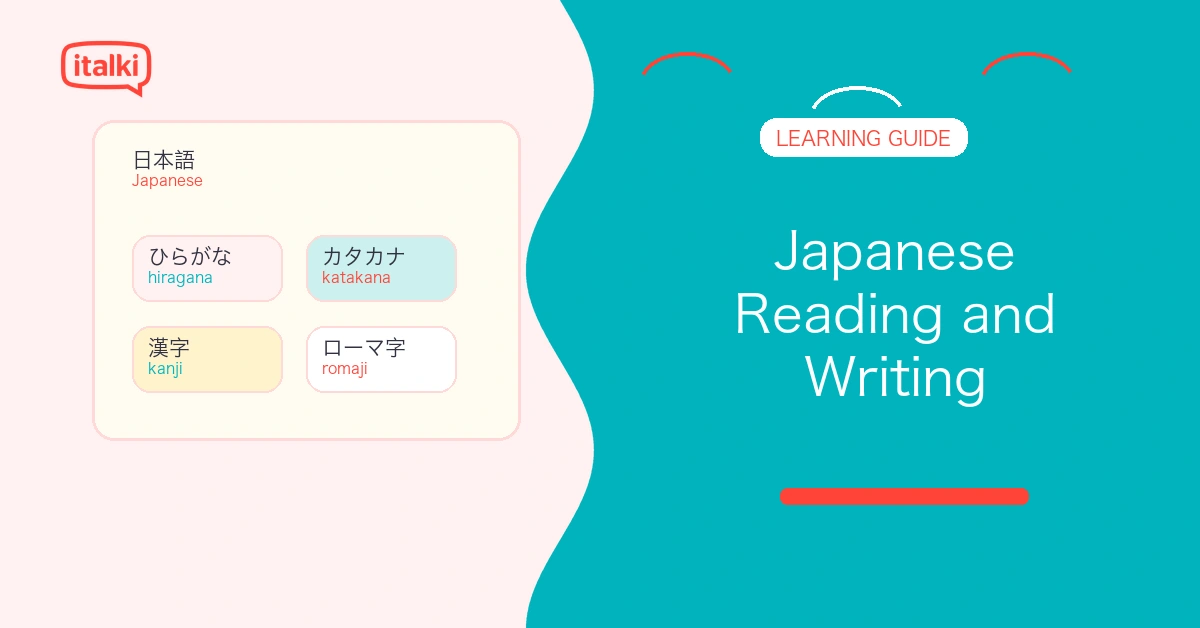
- Japanese uses three writing systems: hiragana, katakana, and kanji. All three are used simultaneously in a single sentence of normal Japanese text. Literacy in Japanese requires knowing all three.
- Hiragana and katakana are both syllabic scripts (syllabaries), not alphabets in the strict sense. Each character represents a syllable sound, not a single consonant or vowel. Hiragana has 46 basic characters; katakana has 46 characters representing the same sounds.
- Katakana is used primarily for foreign loanwords, foreign names, scientific and technical terms, and emphasis. If you see a Japanese word for coffee (コーヒー, koohii) or television (テレビ, terebi), the katakana characters are the visual signal that the word comes from another language.
- Kanji are logographic characters adopted from Chinese. The Japanese Ministry of Education designates 2,136 joyo kanji (common-use characters) that educated adults are expected to know. Each kanji can have multiple readings depending on context.
The writing system is one of the most discussed challenges in learning Japanese, but it is also one of the most learnable once the logic is understood. Hiragana and katakana are learned in a few weeks of focused practice.
Kanji take years, but recognition builds steadily and vocabulary growth accelerates once the kanji for common words become recognizable.
Understanding how the three systems work together is the key. italki connects you with Japanese teachers who can structure your reading and writing practice in a sequence that matches your level, from hiragana to complex kanji combinations.
This guide covers how each of the three writing systems works, what each is used for, how they appear together in real Japanese text, and the most practical order in which to learn them.
A Japanese tutor can teach you hiragana and katakana with reading and writing drills, introduce kanji through vocabulary you are already learning, and explain the logic behind how the three systems combine in everyday Japanese writing.

Find your perfect teacher
Build real speaking confidence with personalized lessons from a teacher who matches your goals, schedule, and learning style.

Hiragana: the foundation of Japanese writing
Hiragana (ひらがな) is the fundamental Japanese syllabary. It represents all possible sounds in Japanese and is the first writing system Japanese children learn. Every Japanese word can be written in hiragana.
The basic hiragana chart:
| Row | a | i | u | e | o |
|---|---|---|---|---|---|
| Vowels | あ | い | う | え | お |
| k | か | き | く | け | こ |
| s | さ | し | す | せ | そ |
| t | た | ち | つ | て | と |
| n | な | に | ぬ | ね | の |
| h | は | ひ | ふ | へ | ほ |
| m | ま | み | む | め | も |
| y | や | ゆ | よ | ||
| r | ら | り | る | れ | ろ |
| w | わ | を | |||
| n | ん |
What hiragana is used for:
- Native Japanese words that do not have a kanji form or where the kanji is rarely used
- Grammatical particles (は wa, が ga, を wo, に ni, で de)
- Verb and adjective endings (okurigana): the hiragana at the end of a verb that shows conjugation
- Children’s books and furigana (small hiragana printed above kanji to show pronunciation)
- Informal writing where using kanji would be unnecessarily formal
Example: たべます (tabemasu, I eat): written entirely in hiragana.
Katakana: for loanwords and emphasis
Katakana (カタカナ) represents the same sounds as hiragana but uses different character shapes. It is visually more angular.
The basic katakana chart:
| Row | a | i | u | e | o |
|---|---|---|---|---|---|
| Vowels | ア | イ | ウ | エ | オ |
| k | カ | キ | ク | ケ | コ |
| s | サ | シ | ス | セ | ソ |
| t | タ | チ | ツ | テ | ト |
| n | ナ | ニ | ヌ | ネ | ノ |
| h | ハ | ヒ | フ | ヘ | ホ |
| m | マ | ミ | ム | メ | モ |
| y | ヤ | ユ | ヨ | ||
| r | ラ | リ | ル | レ | ロ |
| w | ワ | ヲ | |||
| n | ン |
What katakana is used for:
- Foreign loanwords: コーヒー (koohii, coffee), テレビ (terebi, television), スマホ (sumaho, smartphone)
- Foreign names: アメリカ (Amerika, America), マリア (Maria), トム (Tomu, Tom)
- Scientific and technical terms: メートル (meetoru, metre), ウイルス (uirusu, virus)
- Sound effects in manga and comics (onomatopoeia)
- Emphasis, similar to italics in English: ダメ (dame, no good) written in katakana for emphasis
- Names of animals and plants in scientific contexts
Example: コーヒーを飲みます (koohii wo nomimasu, I drink coffee): コーヒー is in katakana because it is a loanword from the English word coffee.
For how Japanese nouns, including the loanwords written in katakana, function grammatically in sentences, the guide to Japanese nouns covers noun forms and how they combine with particles throughout Japanese.
Find your perfect teacher
Build real speaking confidence with personalized lessons from a teacher who matches your goals, schedule, and learning style.
Kanji: characters with meaning
Kanji (漢字) are logographic characters: each character carries a meaning, not just a sound. They were adopted from Chinese writing over many centuries and modified in Japan. A single kanji can be read in multiple ways depending on whether it appears alone or in combination with other characters.
The two main reading types:
- On’yomi (音読み): The Chinese-derived pronunciation, used when kanji appear in compound words: 日 (nichi/jitsu in compounds)
- Kun’yomi (訓読み): The Japanese pronunciation, used when kanji appear alone or with hiragana endings: 日 (hi, day / sun, when read alone)
Common kanji by category:
Numbers:
| Kanji | Romaji | English |
|---|---|---|
| 一 | ichi | one |
| 二 | ni | two |
| 三 | san | three |
| 十 | juu | ten |
| 百 | hyaku | hundred |
| 千 | sen | thousand |
Time:
| Kanji | Romaji | English |
|---|---|---|
| 日 | nichi / hi | day / sun |
| 月 | getsu / tsuki | month / moon |
| 年 | nen / toshi | year |
| 時 | ji / toki | time / hour |
| 今 | kon / ima | now / present |
People:
| Kanji | Romaji | English |
|---|---|---|
| 人 | jin / hito | person |
| 女 | jo / onna | woman |
| 男 | dan / otoko | man |
| 子 | ko / shi | child |
Common verbs (used with hiragana endings):
| Kanji + hiragana | Romaji | English |
|---|---|---|
| 食べる | taberu | to eat |
| 飲む | nomu | to drink |
| 行く | iku | to go |
| 見る | miru | to see |
| 来る | kuru | to come |
The joyo kanji: The Japanese government’s list of 2,136 commonly-used kanji. School children learn these progressively from grade 1 (80 kanji) through high school. A learner who knows 500-600 kanji can read a large proportion of everyday Japanese text including newspapers and general websites.
How the three systems work together
Normal Japanese text mixes all three writing systems in the same sentence. Each system serves a specific role:
Example sentence: 私はコーヒーを毎日飲みます。 (Watashi wa koohii wo mainichi nomimasu.: I drink coffee every day.)
| Part | Script | Role |
|---|---|---|
| 私 | Kanji | I (the word for the first-person pronoun) |
| は | Hiragana | Topic particle (grammatical) |
| コーヒー | Katakana | Coffee (foreign loanword) |
| を | Hiragana | Object particle (grammatical) |
| 毎日 | Kanji | Every day (compound kanji word) |
| 飲みます | Kanji + hiragana | Drink (verb stem in kanji, ending in hiragana) |
This sentence uses all three writing systems naturally. Recognizing which system each character belongs to becomes automatic quickly since the visual styles are distinct.
For how Japanese pronouns, names, and the particles written in hiragana function in this mixed-script system, the guide to Japanese pronouns covers which words appear in hiragana, which in kanji, and how each is used in natural sentences.
Find your perfect teacher
Build real speaking confidence with personalized lessons from a teacher who matches your goals, schedule, and learning style.
Which to learn first and how
Recommended order:
- Hiragana first. 46 characters, learnable in 1-2 weeks with daily practice. Essential for reading everything else.
- Katakana second. 46 characters, same sounds as hiragana but different shapes. Learnable in another 1-2 weeks. Useful immediately for reading loanwords.
- Basic kanji alongside vocabulary. Learn kanji as part of vocabulary rather than in isolation. Start with numbers, common nouns (日、月、人), and verbs you are already learning.
Practical tips:
- Write each hiragana and katakana character by hand repeatedly. The muscle memory supports recognition.
- Use furigana (small hiragana above kanji) as a support while learning: most beginner materials include it.
- Flashcard apps with spaced repetition (SRS) make kanji review efficient: recognition of high-frequency kanji accumulates steadily with daily practice.
- Read real Japanese with the characters you know: manga, apps, and children’s books all use a natural mix that reinforces all three systems simultaneously.
Practice Japanese reading with a teacher
Reading and writing Japanese develops faster when you have someone to check your pronunciation, explain kanji readings, and give you real texts to read at your level. The writing system is the part of Japanese most learners underestimate in time investment.
italki connects learners with Japanese teachers who specialize in reading and writing instruction from beginner hiragana to advanced kanji. Book a trial lesson and ask your teacher to run a reading session using material at your current level: the feedback on your reading, stroke order, and character recognition will accelerate progress beyond what solo self-study achieves.
Find your perfect teacher
Build real speaking confidence with personalized lessons from a teacher who matches your goals, schedule, and learning style.
FAQ
How many characters are in the Japanese alphabet?
There is no single Japanese alphabet. Hiragana has 46 basic characters. Katakana has 46 characters representing the same sounds. Kanji has 2,136 characters on the official joyo (common-use) list, and many thousands more in total. Most everyday text uses all three systems together.
How long does it take to learn hiragana?
With consistent daily practice, most learners can read and write all 46 hiragana characters within 1-2 weeks. The key is active recall, not passive review: write each character, cover it, recall it, check it. Apps and writing practice reinforce the process.
What is the difference between hiragana and katakana?
Both represent the same 46 sounds, but with different character shapes. Hiragana is rounder and used for native Japanese words and grammatical elements. Katakana is more angular and used for foreign loanwords, foreign names, and emphasis. Learning both is required from the beginning of serious Japanese study.
Do Japanese people use kanji every day?
Yes. Kanji are present throughout everyday life: street signs, menus, newspapers, phone screens, product packaging. While typed text on phones often uses hiragana input with kanji suggestions, reading requires recognizing the characters without assistance.
Is Japanese written left to right or right to left?
Modern Japanese is written both ways depending on context. Horizontal text (as in most websites, emails, and modern books) is written left to right, top to bottom. Traditional vertical text (used in literature, newspapers, and formal documents) is written top to bottom, right to left across columns.
Want to learn a language at italki?
Here are the best resources for you!