What are Japanese heteronyms?
Most Japanese kanji can be read in more than one way depending on the word they appear in. The same written character carries a different pronunciation and a different meaning based on context. Learners often call these “Japanese heteronyms,” and the term is widely used in English-language study materials.
The core challenge is the same regardless of the label: a reader cannot look at a kanji alone and know how to pronounce it without knowing which word it belongs to.
Key takeaways
- Japanese kanji have multiple readings because when Japan borrowed Chinese characters, both the Chinese pronunciation (on’yomi) and the original Japanese word (kun’yomi) were kept for the same character.
- High-frequency kanji like 日, 人, 行, and 生 each appear in dozens of common words with different readings; these are the most important to learn early.
- The reading used in any given word is determined by the word itself, not by a rule a learner can apply on the fly; vocabulary exposure is the only reliable solution.
- Reading kanji aloud with a tutor who can confirm correct pronunciation is more effective than text-based self-study alone, since reading errors are nearly impossible to catch silently.
A learner looking at a menu sees 生ビール and needs to know that 生 reads なま (nama, meaning draft or raw), not せい (sei) as in 先生 (teacher), and not いき as in 生きる (to live). Three different pronunciations, three different words, all using the same written character.
This kind of reading ambiguity appears constantly in everyday Japanese text. Knowing the most common patterns reduces reading hesitation and builds confidence with real-world materials.
italki connects learners with native Japanese teachers who can provide live pronunciation correction for heteronyms in real reading and listening practice.
Book a trial lesson and bring a text with words the learner is unsure how to read aloud.

Find Your Perfect Teacher
Build real speaking confidence with personalized lessons from a teacher who matches your goals, schedule, and learning style.

Why do Japanese kanji have multiple readings?
Japanese writing uses kanji, characters borrowed from Chinese. When Japan adopted Chinese characters, words that already existed in Japanese were matched to Chinese characters for their meaning, and the Chinese pronunciations were also imported. This created two reading systems for most kanji:
- On’yomi (音読み): the Chinese-derived pronunciation, usually used in compound words
- Kun’yomi (訓読み): the original Japanese pronunciation, usually used when the kanji stands alone or in native Japanese words
Many common kanji have at least one on’yomi and one kun’yomi, and some have multiple of each. 生, for example, has at least six common readings in everyday use. The reading used in any given word is determined by the word itself, not a rule a learner can apply on the fly. Vocabulary exposure and memorization are the only reliable solutions.
Find Your Perfect Teacher
Build real speaking confidence with personalized lessons from a teacher who matches your goals, schedule, and learning style.
日: the most versatile kanji
日 is one of the most common kanji in Japanese and appears with at least four distinct readings.
| Word | Reading | Meaning |
|---|---|---|
| 日本 | にほん (Nihon) or にっぽん (Nippon) | Japan |
| 日曜日 | にちようび (Nichiyōbi) | Sunday |
| 今日 | きょう (Kyō) | Today |
| 三日 | みっか (Mikkā) | 3rd of the month / three days |
| 日 | ひ (hi) | Day / sun |
| 一日 | いちにち (ichinichi) | One day (duration) |
| 明日 | あした / あす (ashita / asu) | Tomorrow |
The same character 日 reads as にち (nichi), にっ (ni-), きょ (kyo), みっ (mi-), ひ (hi), or parts of longer patterns. Context and fixed word forms determine which reading applies.
A practical approach: learn 日 readings as vocabulary groups rather than as standalone readings. 日曜日 is learned as a fixed word, not as “three characters each needing a reading decision.”
人: hito, nin, and jin
人 means “person” and appears with three common readings.
| Word | Reading | Meaning |
|---|---|---|
| 人 | ひと (hito) | Person / human (standalone) |
| 人気 | にんき (ninki) | Popularity (person + spirit/energy) |
| 外国人 | がいこくじん (gaikokujin) | Foreigner |
| 一人 | ひとり (hitori) | One person |
| 二人 | ふたり (futari) | Two people |
| 人口 | じんこう (jinkō) | Population |
| 日本人 | にほんじん (nihonjin) | Japanese person |
| 殺人 | さつじん (satsujin) | Murder / murderer |
The pattern for 人:
- Standalone or in counting (一人, 二人): kun’yomi → ひと/ひとり/ふたり
- In compound nouns with nationality or category: jin (じん)
- In more abstract or statistical compounds: nin (にん)
一人 (hitori) and 二人 (futari) are irregular; they use native Japanese counting words, not the standard いちにん (ichinin) and ふたにん forms.
Find Your Perfect Teacher
Build real speaking confidence with personalized lessons from a teacher who matches your goals, schedule, and learning style.
行: going in different directions
行 is read as い (i-, from いく iku, to go), こう (kō), ぎょう (gyō), or おこな (okona-, from 行う okonau, to carry out / perform).
| Word | Reading | Meaning |
|---|---|---|
| 行く | いく (iku) | To go |
| 銀行 | ぎんこう (ginkō) | Bank |
| 旅行 | りょこう (ryokō) | Travel |
| 行動 | こうどう (kōdō) | Action / behavior |
| 一行 | いちぎょう (ichigyō) | One line (of text) |
| 行う | おこなう (okonau) | To carry out / perform |
| 大阪行き | おおさかゆき (Ōsaka-yuki) | Bound for Osaka (train/direction) |
行き (yuki/iki) as in 大阪行き uses a directional suffix reading that differs from standard iku. Regional variation between ゆき (yuki) and いき (iki) exists for this suffix.
生: life, birth, and raw
生 has more readings than almost any other common kanji. The most important ones for everyday use:
| Word | Reading | Meaning |
|---|---|---|
| 生きる | いきる (ikiru) | To live |
| 先生 | せんせい (sensei) | Teacher |
| 学生 | がくせい (gakusei) | Student |
| 生まれる | うまれる (umareru) | To be born |
| 生放送 | なまほうそう (namahoosō) | Live broadcast |
| 芝生 | しばふ (shibafu) | Lawn / grass |
| 生地 | きじ (kiji) or なまじ | Fabric / raw dough (context-dependent) |
| 一生 | いっしょう (isshō) | Lifetime / one’s whole life |
生 as なま (nama) means “raw” or “live” and appears on menus (生ビール, nama-biiru, draft beer) and in broadcast contexts (生放送, live broadcast). As せい (sei) and しょう (shō) it appears in compounds related to life and study. As き (ki) it appears in some compound words with native Japanese origins.
For learners at N4 and above, 生 should be learned in clusters by reading: all the せい words (先生, 学生, 一生), all the なま words (生ビール, 生放送), and the う/い forms for the verbs.
上: above, up, and skilled
上 reads as うえ (ue), かみ (kami), うわ (uwa), じょう (jō), のぼ (nobo-), or あ (a-), depending on the word.
| Word | Reading | Meaning |
|---|---|---|
| 上 | うえ (ue) | Above / on top of |
| 上手 | じょうず (jōzu) | Skilled / good at |
| 川上 | かわかみ (kawakami) | Upstream |
| 上着 | うわぎ (uwagi) | Jacket / outer garment |
| 上る | のぼる (noboru) | To climb / go up |
| 上がる | あがる (agaru) | To rise / go up |
| 目上 | めうえ (meue) | Superior / senior (person above) |
| 以上 | いじょう (ijō) | Or more / that’s all |
上手 (jōzu) is one of the most common words learners learn early, but its reading (じょうず rather than うえて) surprises beginners who expect the kun’yomi. It is a fixed compound that must be learned as a vocabulary item.
Find Your Perfect Teacher
Build real speaking confidence with personalized lessons from a teacher who matches your goals, schedule, and learning style.
Drills for reading heteronyms correctly
Drill 1: Context reading Write a sentence using 行 three times in the same paragraph, each time with a different reading. Read the paragraph aloud without pausing. The goal is automatic selection of the correct reading based on context.
Example: 銀行に行く。その後、旅行の計画を行う。(Ginkō ni iku. Sono go, ryokō no keikaku wo okonau.) – Heading to the bank. After that, carrying out travel plans.
Drill 2: Minimal pair cards Create card pairs for each kanji with multiple readings. Front: the word in kanji only. Back: reading and meaning. Practice reading the front before checking the back.
Drill 3: Sentence completion Given a sentence with a blank, choose the correct reading from two options. Example: 今日は___日です。(___) ひ / にち, Answer: ひ (reading for a standalone day reference) or にち depending on context.
Drill 4: Live reading with correction Read a paragraph of native Japanese text aloud with a Japanese tutor online who corrects mispronounced heteronyms in real time. This is the fastest method for internalizing which reading applies where.
Find Your Perfect Teacher
Build real speaking confidence with personalized lessons from a teacher who matches your goals, schedule, and learning style.
Where do learners go from here?
Multiple kanji readings are one of the features of Japanese that text-based self-study handles poorly. Knowing the correct reading on the page and being able to produce it accurately in speech are two different skills. Learners who read aloud regularly with a native speaker or experienced teacher build accurate reading habits faster than those who study silently.
For over 15 years, italki has connected learners with experienced Japanese tutors . A tutor can run reading drills on real texts, correct heteronym errors as they occur, and explain the pattern logic behind specific word forms.
Learn Japanese online with personal guidance from qualified Japanese tutors trusted by over 10 million learners worldwide. Book a trial lesson with a Japanese tutor online and experience the difference personalized learning makes.
Find Your Perfect Teacher
Build real speaking confidence with personalized lessons from a teacher who matches your goals, schedule, and learning style.
FAQ
What is the difference between a heteronym and a homophone in Japanese?
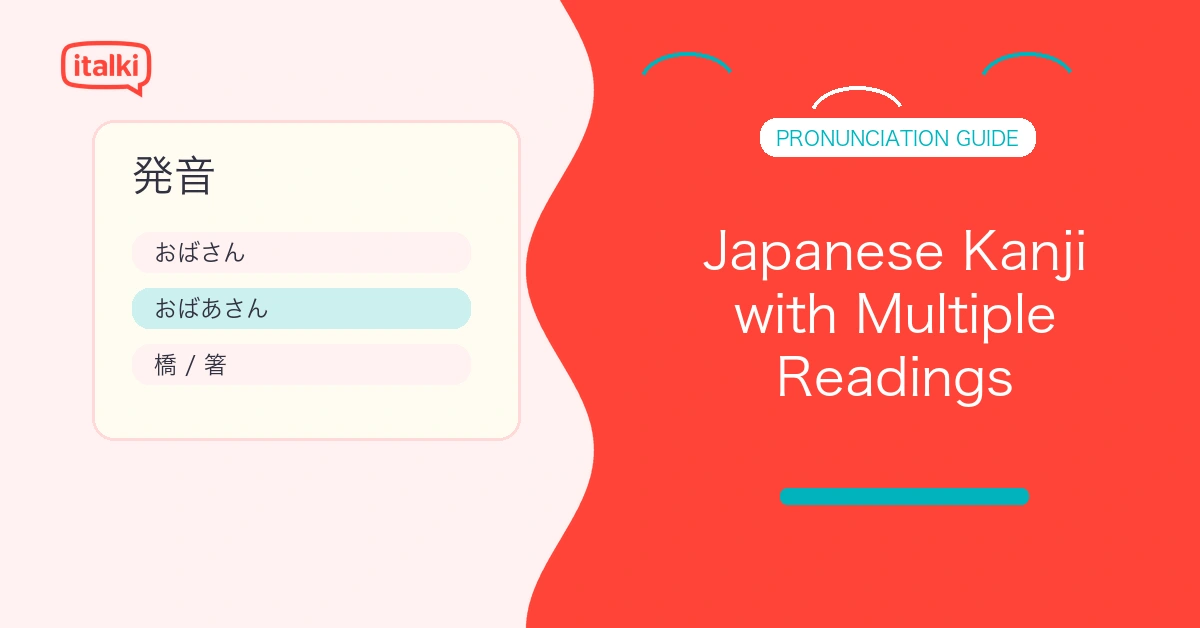
A heteronym is spelled the same but pronounced differently. A homophone is pronounced the same but spelled or written differently. Japanese has both. 橋 (hashi, bridge) and 箸 (hashi, chopsticks) are homophones; same pronunciation, different kanji. 生 is a heteronym; same kanji, multiple readings.
How many readings can a kanji have?
Common kanji typically have two to four readings (one or two on’yomi and one or two kun’yomi). Some high-frequency kanji like 生 and 日 have significantly more. Rare on’yomi readings exist for many kanji but appear only in specific fixed words.
Is there a way to know which reading to use without memorizing every word?
Some patterns help: standalone kanji and native Japanese verb stems usually use kun’yomi; Chinese-origin compound nouns usually use on’yomi. But these are tendencies, not rules, and exceptions are frequent enough that vocabulary learning remains the most reliable method.
Do Japanese children struggle with heteronyms too?
Yes. Elementary school reading education in Japan spends significant time on kanji readings, and furigana (small phonetic guides above kanji) are used in children’s books and beginner materials precisely because heteronyms are a genuine reading challenge even for native speakers learning to read.
What is the best resource for learning kanji readings?
Graded readers and real-world texts in combination with a teacher or tutor provide the most useful exposure. Reading isolated kanji lists teaches readings out of context; reading them in sentences and texts builds the contextual memory needed to select the correct reading automatically.
Want to learn a language at italki?
Here are the best resources for you!