Key takeaways
- Difficult words in Japanese usually feel hard because of long vowels, small っ, similar sounds, pitch accent, or kanji readings, and each problem type has a specific fix.
- Words like 病院, 美容院, 暖かかった, and 失礼します need slow mouth practice before full-speed conversation.
- Kanji words often have several readings, so learning the word as a full unit with a sentence works better than memorizing one character at a time.
- A Japanese tutor catches the exact problems self-study misses, including collapsed long vowels, vanished double consonants, and polite phrases at the wrong formality level.
Difficult words in Japanese are hard for practical reasons, not because the words are impossible, and a word list alone cannot tell you whether your pitch or vowel length landed correctly. The main traps are vowel length, small っ, similar kana combinations, pitch accent, and kanji with more than one reading.
italki connects learners with 30,000+ teachers across 150+ languages and has helped over 10 million people get live correction on exactly this kind of targeted pronunciation work.
Practice words such as 病院, 美容院, and お疲れ様でした out loud with a Japanese tutor before using them in real conversations.

Find Your Perfect Teacher
Practice difficult words in japanese with a Japanese tutor who can correct pronunciation, phrasing, listening speed, and natural replies in real time.

What makes difficult words in Japanese hard?
Difficult words in Japanese usually break down into five problems: sound length, double consonants, blended sounds, pitch accent, and kanji readings, and identifying the type tells you exactly what to practice.
Japanese uses kana, two syllabaries (hiragana and katakana) that represent the sounds of the language. That phonetic system helps with pronunciation, but kanji adds another layer because one character often appears in several words with completely different readings, the way 今日 is written with “now” and “day” but pronounced kyou in daily speech, not kon-nichi.
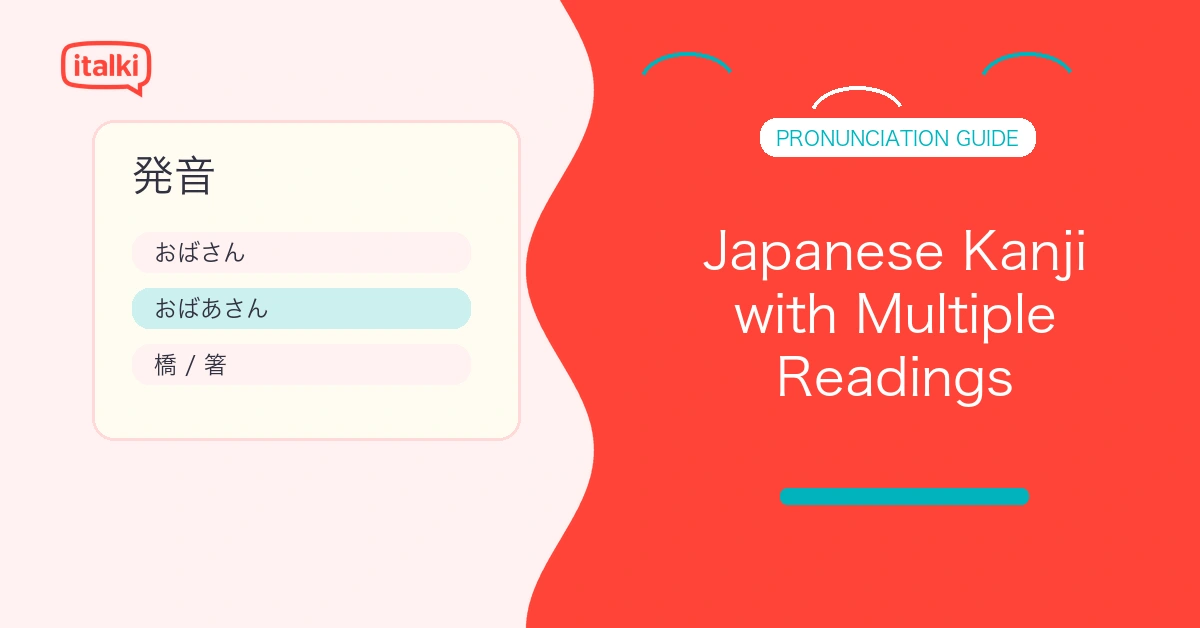
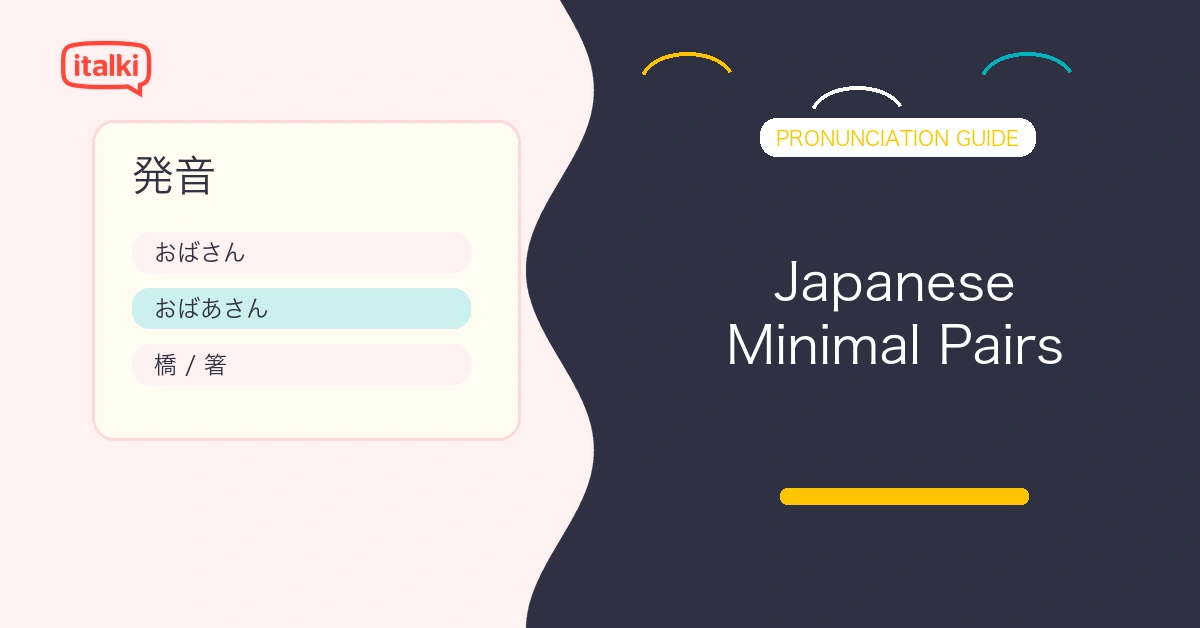
Learning to hear small differences matters just as much: おばさん (obasan) means aunt or middle-aged woman, while おばあさん (obaasan) means grandmother or elderly woman. The extra あ is not decoration, and native speakers hear the difference immediately.
A quick reference for how each problem type shows up in real words:
- Long vowel: おばあさん (obaasan, grandmother). Cutting the second あ short turns grandmother into aunt.
- Small っ: 切手 (kitte, stamp). Without the pause after き, it sounds like きて (kite, “come here”).
- Blended sound: 旅行 (ryokou, travel). Saying ri-yo-kou adds a syllable that does not exist in the word.
- Similar sound: 病院 (byouin, hospital). Separate び and よう and it sounds like 美容院, hair salon.
- Kanji reading: 今日 (kyou, today). The reading cannot be predicted from the individual kanji.
Japanese alphabet covers the sound foundation needed before tackling words like しゅっちょう, りょこう, and びょういん.
Which pronunciation words trip up beginners first?
Beginner-level difficult words often look short, but one small sound changes everything, so the highest-payoff practice targets long vowels, small っ, and blended combinations like りょ, しゅ, and ちょ.
学校 (gakkou, school): Do not say ga-ko. The small っ after が creates a stop, and the こう needs a long vowel: gak (stop), then kou (long). Try it in a sentence: 学校に行きます (gakkou ni ikimasu, “going to school”).
切手 (kitte, stamp): The っ before て creates a brief silence before て releases. Compare it with 来て (kite, “come here”), which has no pause at all. Say both back to back: kitte, kite, kitte, kite.
旅行 (ryokou, travel): The り slides directly into よ as one motion. Saying ri-yo-kou as three separate chunks adds an extra beat that changes the rhythm of the word.
練習 (renshuu, practice): The んし transition is where learners stumble, since the tongue has to reset fast after ん for しゅう. Record yourself saying 日本語を練習します (nihongo wo renshuu shimasu, “practicing Japanese”) and check whether the しゅう sounds distinct or mushy.
After these words feel stable, practicing them at full speed inside sentences keeps mistakes from hiding behind slow, careful speech.
Find Your Perfect Teacher
Practice difficult words in japanese with a Japanese tutor who can correct pronunciation, phrasing, listening speed, and natural replies in real time.
Which similar Japanese words change meaning with one sound?
Some difficult Japanese words sound close enough to another word that one collapsed vowel or shifted rhythm sends the listener to a completely different meaning, and context does not always save you.
The most important pair for anyone visiting Japan is 病院 (byouin, hospital) and 美容院 (biyouin, hair salon). Getting this wrong in a taxi means arriving at the wrong building. In 病院, the mouth starts with び and slides directly into ょう as one blended sound; in 美容院, び finishes completely and よう starts as a separate syllable, so the jaw resets between them.
おじさん (ojisan) vs. おじいさん (ojiisan): The first means uncle or a middle-aged man, the second grandfather or an elderly man, and the difference is the length of the い vowel. Calling a 40-year-old man おじいさん will not offend, but it will get a reaction.
ここ (koko, here) vs. 高校 (koukou, high school): Both use こ sounds, but 高校 has two long vowels. Saying koko when you mean koukou turns 高校に行きます (koukou ni ikimasu, “going to high school”) into something that sounds like “going to here.”
雪 (yuki, snow) vs. 勇気 (yuuki, courage): Short き versus long うき. In a sentence like 勇気がある (yuuki ga aru, “having courage”), a short ゆき turns courage into snow.
Standard Japanese also uses pitch accent to distinguish words that share the same sounds but carry different meanings, such as はし (hashi) for both chopsticks and bridge. Hearing the rise and fall of pitch in native speech helps avoid flat, unclear delivery.
A short contrast drill works for any risky pair: say each word five times slowly, alternate them back to back, then drop each into a short sentence and record yourself. Run that drill with an online Japanese teacher and ask them to signal the moment one word starts sounding like the other, a correction recordings alone cannot provide.
Which kanji words are hard because of readings?
Kanji words feel difficult because the same character changes sound depending on which word it appears in. The fix: learn the full word as a unit, not the character in isolation. Most kanji carry at least two reading types, a Chinese-derived on’yomi and a native Japanese kun’yomi, since the writing system absorbed Chinese characters in waves over centuries.
生 is the classic example, appearing in words about life, students, birth, raw food, and growing things, with six different readings: 先生 (sensei, teacher) and 学生 (gakusei, student) use せい, 生まれる (umareru, to be born) uses う, 生きる (ikiru, to live) uses い, 生ビール (nama biiru, draft beer) uses なま, and 一生 (isshou, whole life) uses しょう.
Do not memorize every reading of 生 in a list. Instead, learn each word with a sentence, such as 先生に聞きます (sensei ni kikimasu, “asking the teacher”), the way native speakers learned these words as children.
Everyday words also surprise learners with unexpected readings. 今日 (kyou, today) is written with the kanji for “now” and “day,” so beginners expect こんにち (kon-nichi), but daily speech always uses kyou. 大人 (otona, adult) means “big person” in kanji, but the reading follows no pattern and simply has to be memorized. 上手 (jouzu, skillful) and 下手 (heta, unskillful) are compliment words learners hear constantly, as in 日本語が上手ですね (nihongo ga jouzu desu ne, “Your Japanese is good”), even though 上 and 手 shift completely from their normal readings here. And 一人 (hitori) and 二人 (futari) use old counting readings with no modern logic, though the pattern turns regular from three people onward (三人, sannin).
The Japanese kanji guide fits well at this stage, since kanji readings need a structured approach instead of random flash-card memorization that strips away context.
Which long Japanese words are hard to say smoothly?
Long Japanese words become hard when grammar endings attach to an already tricky base, and sounds start collapsing into each other. The fix is chunking: break the word into two or three pieces, practice each piece, then rebuild.
暖かかった (atatakakatta, “was warm”): Five か-row sounds in a row make learners lose the middle か or rush the double っ before た. Split it as あたたか (atataka, warm) plus かった (katta), practice each half, then combine.
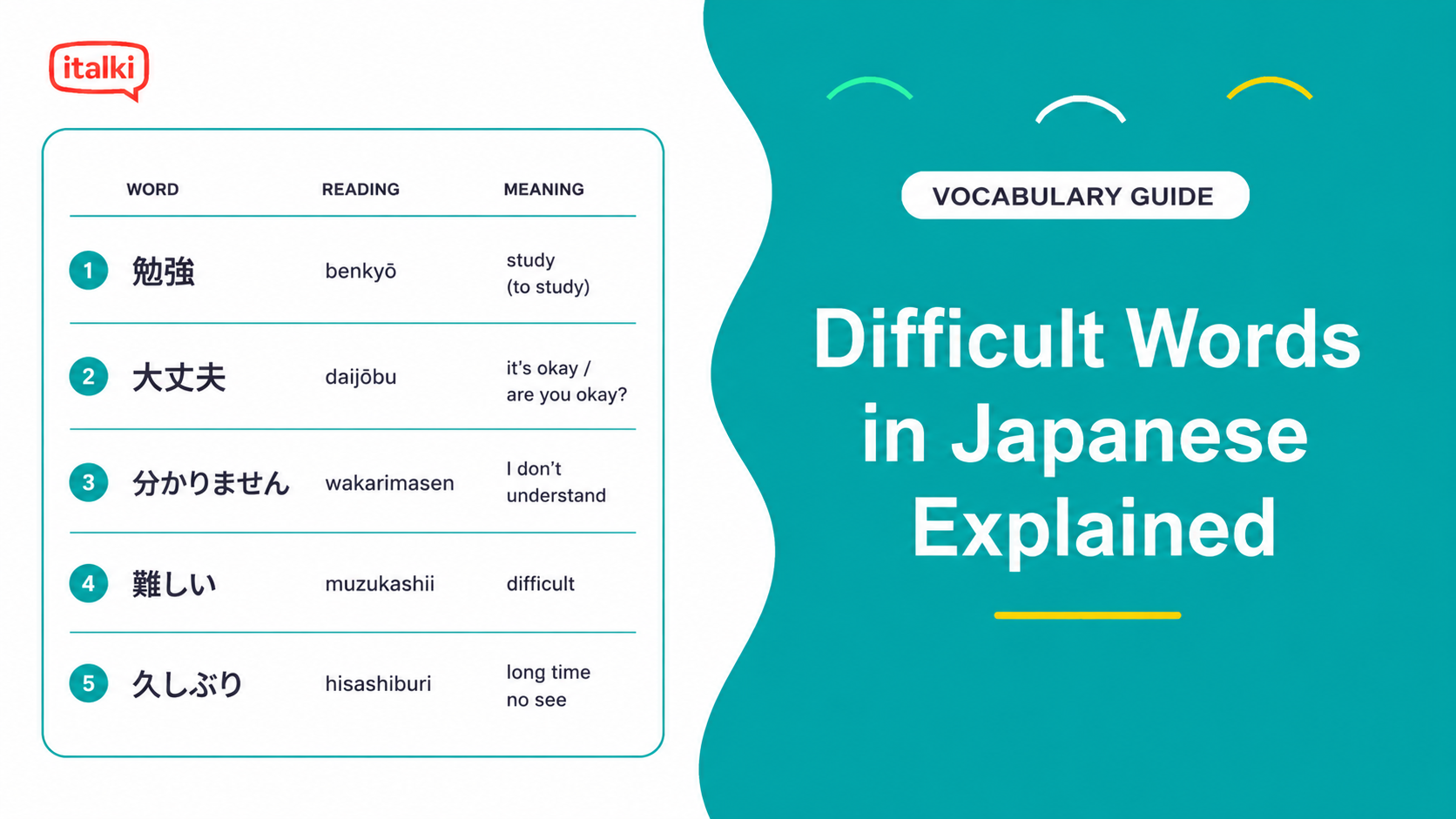
難しかった (muzukashikatta, “was difficult”): Start with むずかしい (muzukashii, difficult), drop the final い, and add かった, slowing down at the しか transition where the tongue moves from the sh-position directly into か.
お疲れ様でした (otsukaresama deshita, “thank you for your work”): Use it after a meeting or when recognizing someone’s effort. Split the practice into お, つかれ, さま, でした. It has no clean English translation, but carries warmth and makes you sound like you belong in a Japanese workplace.
よろしくお願いします (yoroshiku onegaishimasu): This phrase shifts meaning by situation, from “nice to meet you” to “thank you in advance” in a work email. Practice よろしく and おねがいします separately, then connect them.
申し訳ございません (moushiwake gozaimasen, “a sincere apology”): More formal than すみません. ございません needs all five syllables distinct; rushing it into “gozaimas” strips the formality.
Japanese for work covers the broader context of keigo and office communication for vocabulary like this.
Find Your Perfect Teacher
Practice difficult words in japanese with a Japanese tutor who can correct pronunciation, phrasing, listening speed, and natural replies in real time.
Which polite Japanese phrases are hard to use naturally?
Polite Japanese phrases are difficult because pronunciation is only half the problem: timing, situation, and social distance determine which phrase fits, and saying the right words at the wrong moment sounds just as off as mispronouncing them.
失礼します (shitsurei shimasu, “excuse me/pardon me”): Use it when entering a room or passing someone in a narrow space. It literally means “I will be rude.” 失礼しました (past tense) works after a small mistake.
少々お待ちください (shoushou omachi kudasai, “please wait a moment”): Customer-service Japanese heard on the phone and at reception desks. しょうしょう needs two long vowels held clearly; rushing it to “shosho” sounds clipped.
恐れ入ります (osoreirimasu, “sorry to trouble you/thank you”): More formal than すみません, used when a request inconveniences someone, as in 恐れ入りますが、ご確認お願いします (osoreirimasu ga, gokakunin onegaishimasu, “sorry to trouble you, but please confirm”).
お世話になっております (osewa ni natte orimasu, “thank you for your continued support”): The standard opening line in Japanese business emails, closer to “Thank you for your ongoing business relationship” than any literal translation, and worth learning as a fixed formula. The pronunciation challenge is なって, where the small っ creates a stop before て.
Japanese greetings covers the foundational casual phrases that form the base layer before formal speech like this. Choosing between 恐れ入ります and すみません is the kind of judgment call a Japanese tutor for difficult words in japanese helps you calibrate through role-play in realistic scenarios.
How should you practice difficult Japanese words?
Practice difficult Japanese words in layers: sound, rhythm, sentence, then conversation, since jumping straight to conversation hides the exact sound that needs repair. Start with isolated sound, slow kana chunks like びょう, いん, then full word at natural speed, checking that びょう stays blended and いん does not collapse into ん alone, then one sentence such as 病院に行きます (byouin ni ikimasu, “going to the hospital”), then a question and answer like どこに行きますか (doko ni ikimasu ka, “where are you going?”). If a word falls apart at any layer, go back one step before moving forward again.
Record one contrast pair per day, such as 病院 and 美容院 or おじさん and おじいさん, since short focused drills train the ear better than long unfocused reading. For pitch accent, listen first and imitate second: pick one sentence from a podcast, mark where your voice rises or falls, then compare with the original audio, treating it as a long-term project.
Japanese learning resources helps you choose tools for reading, listening, and vocabulary review beyond word lists. When self-recording stops showing what to fix, a Japanese language instructor who hears both your attempt and the target word in the same session can pinpoint the exact tongue position or timing that closes the gap.
Ready to say difficult Japanese words clearly?
Difficult Japanese words become manageable once each has a clear sound target, a meaning tied to a real situation, and a sentence that puts it to work. Start with the highest-value words here, 病院 and 美容院 for travel safety, お疲れ様でした for work, 上手 and 下手 for daily compliments, then apply the same process to any new word: identify the problem type, isolate the tricky part, drill it in chunks, then rebuild it inside a sentence.
What self-study cannot replicate is the moment a native speaker hears your 病院 and says “that sounded like 美容院,” a correction worth more than a week of solo recording. italki has 30,000+ teachers across 150+ languages, including tutors who specialize in Japanese pronunciation and keigo. Book a trial lesson and bring five difficult words from this article, asking for slow pronunciation, natural-speed pronunciation, and one correction sentence for each.
Find Your Perfect Teacher
Practice difficult words in japanese with a Japanese tutor who can correct pronunciation, phrasing, listening speed, and natural replies in real time.
FAQ
What are the hardest Japanese words for beginners?
Words with long vowels, small っ, and blended sounds cause the most trouble. Start with 学校, 切手, 旅行, 病院, 美容院, おじさん, and おじいさん, since each trains a different problem type.
Why is 病院 hard to pronounce?
病院 (byouin, hospital) is hard because びょう works as one blended sound with a long vowel. Separating it into び and よう accidentally produces 美容院 (biyouin, hair salon). Keep the jaw in one position through the entire びょう.
Why do kanji words have different readings?
Most kanji carry multiple readings because Chinese characters were adopted into Japanese across several historical periods, layering a Chinese-derived on’yomi onto the native kun’yomi. Learn words like 今日, 大人, and 上手 as full compounds with sentence context, not as reading rules.
How many difficult Japanese words should a beginner practice daily?
Three to five words per day is enough if each gets pronunciation drilling, meaning review, and one sentence. Pairs like 病院 and 美容院 work especially well since the drill trains production and listening at the same time.
Want to learn a language at italki?
Here are the best resources for you!