What are Japanese minimal pairs?
Japanese minimal pairs are two words that differ by exactly one sound; one phoneme; but carry different meanings. Mastering minimal pairs trains the ear to hear distinctions that do not exist in many learners’ native languages, and trains the mouth to produce those distinctions consistently.
In Japanese, the most important minimal pair categories are long versus short vowels, voiced versus unvoiced consonants, and geminate (double consonant) sounds.
Key takeaways
- Japanese minimal pairs reveal the phoneme distinctions that most non-native speakers conflate: short and long vowels, single and double consonants, and voiced and unvoiced obstruents.
- The long vowel difference is especially important because it changes meaning: おじさん (ojisan, uncle) versus おじいさん (ojiisan, grandfather) differ by one vowel length.
- Geminate consonants (っ, small tsu) signal a full stop or held consonant that changes both pronunciation and meaning: 来て (kite, come) versus 切って (kitte, cut).
- Pitch accent differences create additional minimal pairs in Japanese, and these are the hardest to hear without trained listening practice with a native speaker or tutor.
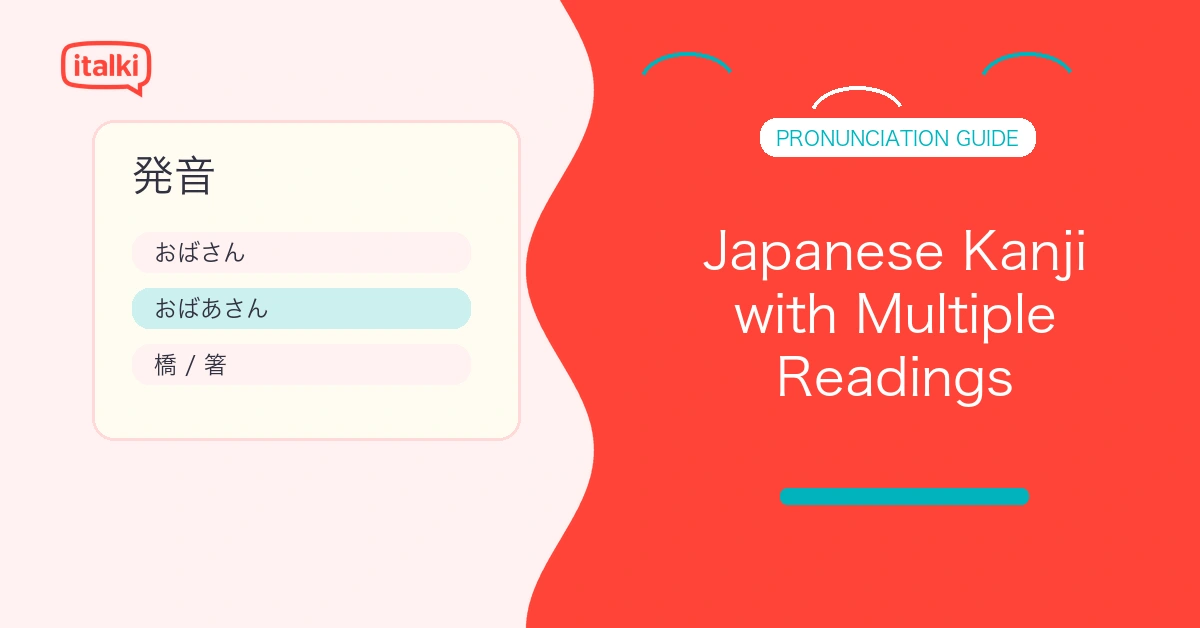
A learner who says おばさん (obasan, aunt) when intending おばあさん (obaasan, grandmother) creates a moment of confusion or amusement in conversation. Getting the vowel length right is not a stylistic detail in Japanese: it is the difference between two different words with different meanings.
italki connects learners with native Japanese tutors who can train phoneme distinctions through listening drills and live pronunciation correction.
Book a trial lesson and ask for a pronunciation diagnostic focused on minimal pair accuracy.

Find Your Perfect Teacher
Build real speaking confidence with personalized lessons from a teacher who matches your goals, schedule, and learning style.

Long versus short vowels
Japanese distinguishes between short and long vowels. A long vowel lasts approximately twice as long as a short one. This distinction changes meaning.
| Short vowel word | Reading | Meaning | Long vowel word | Reading | Meaning |
|---|---|---|---|---|---|
| おじさん | ojisan | Uncle | おじいさん | ojiisan | Grandfather |
| おばさん | obasan | Aunt | おばあさん | obaasan | Grandmother |
| ここ | koko | Here | こうこう | kōkō | High school |
| 住所 | jūsho | Address | ちゅうしょ | chūsho | Abstract (concept) |
| 道 | michi | Road | 未知 | michi | Unknown (same pronunciation, different kanji) |
| 切符 | kippu | Ticket | 機会 | kikai | Opportunity |
How to practice long vowels
Say the short vowel version and hold the final vowel sound for an extra beat. おじさん becomes お–じ–い–さん, where the い sound is clearly a full syllable, not a glide or trail-off. Japanese syllables are evenly weighted (mora-timed), so every mora gets equal duration.
A common mistake is making the long vowel slightly longer rather than doubling it. The distinction must be clear enough that a native speaker hears two syllables where a long vowel appears.
Find Your Perfect Teacher
Build real speaking confidence with personalized lessons from a teacher who matches your goals, schedule, and learning style.
Voiced versus unvoiced consonants
Japanese has voiced and unvoiced pairs in its consonant system. The distinction is marked in hiragana and katakana by the dakuten (゛), a small mark added to the upper right of a character.
| Unvoiced | Voiced | English parallel |
|---|---|---|
| か (ka) | が (ga) | k vs. g |
| さ (sa) | ざ (za) | s vs. z |
| た (ta) | だ (da) | t vs. d |
| は (ha) | ば (ba) | h vs. b |
| は (ha) | ぱ (pa) | h vs. p |
Minimal pairs using voiced vs. unvoiced:
| Word | Reading | Meaning | Voiced pair | Reading | Meaning |
|---|---|---|---|---|---|
| 貸す | かす (kasu) | To lend | 下す | くだす (kudasu) | To hand down / administer |
| 橋 | はし (hashi) | Bridge | 箸 | はし (hashi) | Chopsticks (same pronunciation, different kanji; homophone) |
| 机 | つくえ (tsukue) | Desk | 続く | つづく (tsuzuku) | To continue |
| 竿 | さお (sao) | Pole | 座 | ざ (za) | Seat / troupe |
For most learners coming from English and European languages, the voiced/unvoiced distinction in Japanese is manageable because these contrasts exist in the native language. The challenge is the unaspirated nature of Japanese consonants: Japanese か (ka) is not the same as English “ka”; the k sound is not followed by a puff of air.
Find Your Perfect Teacher
Build real speaking confidence with personalized lessons from a teacher who matches your goals, schedule, and learning style.
Geminate consonants: the double stop
The small tsu (っ/ッ) signals a geminate or double consonant. A geminate is produced by holding the mouth in position for the consonant for an extra mora before releasing it. To native English ears, it sounds like a slight pause or stop before the consonant.
| Without geminate | Reading | Meaning | With geminate | Reading | Meaning |
|---|---|---|---|---|---|
| 来て | きて (kite) | Come (te-form of くる) | 切って | きって (kitte) | Cut (te-form of 切る) |
| 一家 | いっか (ikka) | Family / household | 医科 | いか (ika) | Medical science |
| 各 | かく (kaku) | Each / every | 確 | かっく (kakku) | (less common, but distinction applies) |
| 持て | もて (mote) | Popular / to hold ability | 持って | もって (motte) | Holding (te-form of 持つ) |
How to produce a geminate
Stop the airflow completely for the consonant position; for きって (kitte), stop at the t position for one full mora, then release with the second t. For はっきり (hakkiri, clearly), stop at k for one mora, then release.
A common error is producing geminates as slightly elongated consonants rather than full stops. This makes きって sound like kite with emphasis rather than kitte with a held stop.
Find Your Perfect Teacher
Build real speaking confidence with personalized lessons from a teacher who matches your goals, schedule, and learning style.
Pitch accent minimal pairs
Japanese uses pitch accent rather than stress accent. A word’s pitch pattern (high or low on each mora) is part of its pronunciation and can distinguish meaning between words that are otherwise identical.
The Tokyo dialect recognizes pitch accent as meaningful for the following pairs among others:
| Word | Pitch pattern | Meaning |
|---|---|---|
| はし (LH) | Low-High | Chopsticks |
| はし (HL) | High-Low | Bridge |
| はし (HH) | High-High | Edge |
| あめ (LH) | Low-High | Rain |
| あめ (HL) | High-Low | Candy |
| かき (LH) | Low-High | Oyster |
| かき (HL) | High-Low | Fence |
In the table above, L = low pitch, H = high pitch. The pattern applies mora by mora.
Pitch accent is the hardest minimal pair category for self-study because:
- It cannot be reliably seen in standard written Japanese (no accent marks in ordinary text)
- It varies by dialect (Tokyo, Kyoto, and Osaka accents differ significantly)
- It requires audio feedback to verify
In practice, many non-native speakers of Japanese are understood without perfect pitch accent. However, learners who aim for near-native pronunciation or work in media, teaching, or formal public contexts should work on pitch with a tutor who can provide live auditory feedback.
Find Your Perfect Teacher
Build real speaking confidence with personalized lessons from a teacher who matches your goals, schedule, and learning style.
The N sound
Japanese ん (n) is a syllabic nasal; it counts as a full mora (syllable weight) on its own. This creates a distinction between words where n appears as part of a syllable and words where it is a separate mora.
| Word | Reading | Meaning | Contrasting word | Reading | Meaning |
|---|---|---|---|---|---|
| 鼻 | はな (hana) | Nose | 花 | はな (hana) | Flower (same pronunciation) |
| 沼 | ぬま (numa) | Swamp | 温 | ぬく (nuku) | Warmth |
More relevant for minimal pair training is the nasalization before different consonant sounds: ん before p/b/m nasalizes to m-like; ん before k/g nasalizes to ng-like; ん before n/t/d is a plain n. Learners who produce ん as always being a plain n create mispronunciations that native speakers notice.
Find Your Perfect Teacher
Build real speaking confidence with personalized lessons from a teacher who matches your goals, schedule, and learning style.
Drills for minimal pair accuracy
Drill 1: Listen and identify Listen to a native speaker say one word from a minimal pair. Identify which word was said. Use audio resources or have a Japanese tutor read words aloud without indicating which one. Record accuracy over multiple sessions.
Drill 2: Minimal pair reading Read these sentences aloud, paying careful attention to vowel length and geminate stops:
- おじいさんとおじさんが来ています。(Ojiisan to ojisan ga kite imasu.) – Grandfather and uncle have come.
- 切手を切って、ここに貼ってください。(Kitte wo kitte, koko ni hatte kudasai.) – Cut the stamp and paste it here.
- 雨が降って、飴が溶けた。(Ame ga futte, ame ga toketa.) – Rain fell and the candy melted. [same pronunciation, different meaning in context]
Drill 3: Recording self-check Record 10 minimal pairs read aloud. Send the recording to a Japanese language tutor for feedback. Request that the tutor identify which distinctions are not yet consistent.
Drill 4: Shadowing with geminate focus Find a Japanese recording that contains several geminate words. Shadow the audio, pausing at each geminate to check that the stop is fully produced before continuing.
Find Your Perfect Teacher
Build real speaking confidence with personalized lessons from a teacher who matches your goals, schedule, and learning style.
Where do learners go from here?
Minimal pair accuracy develops through listening and production practice in that order. Learners who can hear the distinction reliably are ready to practice producing it. Learners who cannot yet hear it should focus on listening exercises before moving to speaking drills.
italki has connected learners with Japanese teachers since 2007. A Japanese teacher online can run perception tests, provide live production feedback, and assign targeted audio practice between sessions.
Learn Japanese faster with personal guidance from native Japanese teachers trusted by over 10 million learners worldwide. Book a trial lesson and ask for a minimal pair assessment at the start of the session.
Find Your Perfect Teacher
Build real speaking confidence with personalized lessons from a teacher who matches your goals, schedule, and learning style.
FAQ
Why do vowel length distinctions matter so much in Japanese?
Because Japanese uses mora timing, where each unit of sound gets equal time, vowel length is phonemically contrastive. Making a long vowel short or a short vowel long produces a different word. The system is consistent, so learning to hear and produce length distinctions opens up the entire phonology.
Do native Japanese speakers always notice minimal pair errors?
Context usually prevents misunderstanding in full sentences. If someone says おじさん (uncle) when meaning おじいさん (grandfather), surrounding words usually clarify the meaning. But isolated pronunciations or low-context situations make errors more likely to cause genuine confusion.
How is Japanese pitch accent different from tones in Chinese?
Chinese tonal languages assign a tone contour to each syllable. Japanese pitch accent assigns a high or low pitch to each mora, and the pattern is word-level rather than syllable-level. Japanese pitch accent is generally considered less prominent than Chinese tones and more forgiving for non-native speakers.
What is the easiest minimal pair category to master first?
Long versus short vowels, because they involve duration rather than a new sound category. Learners who already speak a language with long and short vowels (Finnish, Hungarian, or Arabic, for example) adapt to Japanese vowel length quickly. For speakers of English and most European languages, training duration as meaningful takes deliberate practice but is achievable at early intermediate level.
How do you know if your geminate pronunciation is correct?
The best check is live feedback from a native speaker or experienced tutor. Self-recording and listening back helps, but learners often cannot hear their own errors without a comparison reference. A brief session focused specifically on geminate production gives the most reliable assessment.
Want to learn a language at italki?
Here are the best resources for you!