Key takeaways
- Most English learners practice grammar passively, reading rules and reviewing notes. Quizzes force active retrieval, which is what actually transfers to real speech and writing.
- When you review your results, the explanation for a wrong answer matters more than the score.
- Most learners have one or two persistent error types that account for a disproportionate share of their mistakes. Quizzes help you find them.
- Speaking prompts with a time limit reveal fluency gaps that written quizzes alone cannot show.
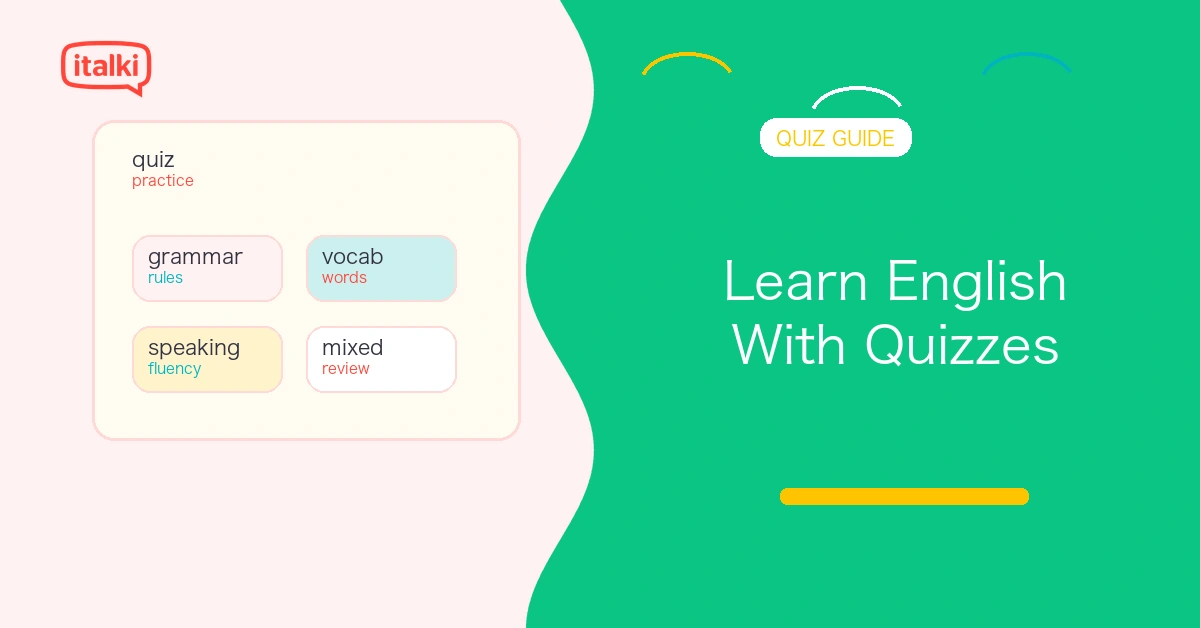
This guide gives you 50 quizzes across four sections: 15 grammar questions, 15 vocabulary questions, 10 speaking prompts, and 10 mixed questions that combine skills. Work through them, check the answers, and pay attention to which patterns keep catching you. Those are the areas worth drilling next.
italki connects you with English teachers who can take your specific quiz results and build a lesson around exactly what you got wrong.

Find your perfect teacher
Build real English confidence with personalized lessons from a teacher who matches your goals, schedule, and learning style.

Grammar quiz: 15 questions
Choose the correct option or correct the error. Answers follow each section.
1. She ___ to the gym every morning before work. a) go b) goes c) going d) is go
2. By the time we arrived, the film already ___. a) started b) has started c) had started d) was starting
3. Correct this sentence: He don’t understand the question.
4. I wish I ___ more time to study last week. a) have b) had c) had had d) would have
5. ___ interesting documentary was on last night. Did you see it? a) A b) An c) The d) no article
6. Neither the manager nor the employees ___ aware of the change. a) was b) were c) is d) are
7. She suggested that he ___ earlier to avoid traffic. a) leaves b) left c) leave d) would leave
8. I look forward to ___ from you soon. a) hear b) heard c) hearing d) have heard
9. Correct the error: She is more taller than her sister.
10. If I ___ you, I would apologise immediately. a) am b) were c) was d) be
11. The report ___ by Friday if possible. a) must finish b) must be finished c) must have finished d) must finishing
12. Despite ___ all night, she failed the test. a) to study b) studied c) study d) studying
13. It was ___ one-hour meeting. We all left exhausted. a) a b) an c) the d) no article
14. The team ___ been working on this project for three months. a) have b) has c) had d) is
15. They made me ___ the entire report again. a) rewrite b) to rewrite c) rewriting d) rewritten
Grammar answers: 1-b, 2-c, 3-He doesn’t understand, 4-c, 5-c, 6-b (neither/nor with plural noun takes plural), 7-c (subjunctive after suggested), 8-c (preposition requires -ing), 9-remove more (taller is already comparative), 10-b, 11-b, 12-d, 13-a (one starts with a consonant sound), 14-b (team is singular), 15-a (causative make takes bare infinitive)
If you want to turn quiz results into a level check, this English grammar test explains how to identify your level and track progress over time.
Work with a English teacher online to go through any grammar questions you found difficult. A single session focused on your specific error pattern (conditional sentences, article use, subjunctive) will move you further than reviewing general rules.
Vocabulary quiz: 15 questions
16. Choose the word that best completes the sentence: The new policy has had a significant ___ on employee morale. a) affect b) effect c) impact d) both b and c
17. What does ubiquitous mean? a) unusual b) found everywhere c) underground d) unique
18. Choose the correct collocation: She had to ___ a difficult decision about her career. a) do b) make c) take d) have
19. He was ___ to hear the news. Choose the correct form. a) devastate b) devastated c) devastating d) devastation
20. What does in lieu of mean? a) in addition to b) instead of c) as a result of d) in front of
21. Choose the word that fits: The project was delayed ___ unforeseen circumstances. a) because b) due to c) since d) so
22. Diligent most closely means: a) lazy b) clever c) hardworking d) organised
23. Correct the collocation error: She made her homework quickly.
24. The decision was ___. Choose the best word. a) controversial b) controversially c) controversy d) controvert
25. What does to defer mean? a) to disagree b) to postpone c) to confirm d) to complete
26. Choose the correct word: She has a real ___ for languages: she picked up Spanish in six months. a) flare b) flair c) flair d) flair (note: only one b is correct)
27. Pro bono work means: a) highly professional work b) work done for free c) work requiring a bonus d) bonus work
28. Choose the correct preposition: I am interested ___ learning more about this. a) at b) in c) on d) about
29. Fastidious means: a) fast and efficient b) very particular about detail c) generous d) stubborn
30. Which sentence is correct? a) The news are bad. b) The news is bad. c) A news is bad. d) Some news are bad.
Vocabulary answers: 16-d (both b and c are correct), 17-b, 18-b (make a decision), 19-b (past participle as adjective after was), 20-b, 21-b (due to takes a noun phrase; because takes a clause), 22-c, 23-She did her homework (do, not make), 24-a, 25-b, 26-b (flair = talent), 27-b, 28-b, 29-b, 30-b (news is uncountable, always singular)
Find your perfect teacher
Build real English confidence with personalized lessons from a teacher who matches your goals, schedule, and learning style.
Speaking quiz: 10 prompts
These prompts are designed to test production. Set a timer. Speak for the specified time without stopping to translate.
31. Describe a place (1 minute) Talk about a city or place you know well. Do not use the words nice, good, or beautiful. Use specific adjectives instead.
32. Express disagreement politely (30 seconds) Imagine a colleague says: We should cancel the project. Disagree using at least two of these phrases: I see where you’re coming from, but…, I’m not sure I agree because…, Have you considered…?
33. Relative clause practice (1 minute) Describe three objects near you using relative clauses: The [object], which/that…, is…
34. Give a recommendation (1 minute) Recommend a film, book, or restaurant to a friend. Include: what it is, why you like it, and one thing that might not suit everyone.
35. Describe a process (1 minute) Explain how to make your favourite meal or how to get from one location to another. Use sequencing language: first, then, after that, once, finally.
36. React to news (30 seconds) Respond to this statement spontaneously: Your company is moving to a four-day work week. Use phrases that express a genuine reaction: That’s surprising because…, I can imagine that would mean…, My main concern would be…
37. Used to and would (1 minute) Talk about how your life or habits were different five or ten years ago. Use both used to and would correctly in your answer.
38. Ask for clarification in a meeting (30 seconds) Your colleague just explained a project plan but you missed the deadline information. Ask for clarification using three different phrases: Could you clarify…?, When you say X, do you mean…?, Just to confirm…
39. Opinion with hedging (1 minute) Give your opinion on this topic: Social media does more harm than good. Use hedging language: I tend to think…, It seems to me that…, Although I could be wrong, I believe…
40. Summarise a story (1 minute) Choose a film, book, or news story you know. Summarise it in exactly five sentences without repeating any of these words: big, good, bad, thing, nice.
Speaking tips: Record yourself for prompts 31-40. Then listen back and count the filler words, the grammatical hesitations, and the moments you wanted a word but could not find one. Those are exactly the gaps a private English tutor can target in a speaking lesson.
Mixed quiz: 10 questions
These questions combine grammar, vocabulary, and register.
41. Which sentence is more appropriate in a formal email? a) I just wanted to check in about the report. b) I am writing to enquire about the status of the report.
42. Correct all errors: Yesterday I have went to the shop but it was closed so I don’t bought nothing.
43. Identify the clause type: Although she studied hard, she did not pass. a) Noun clause b) Relative clause c) Adverbial clause d) Conditional clause
44. Choose the correct register for a job application: I am writing to ___ my interest in the position. a) say b) express c) tell d) show
45. Choose the correct verb form: If she ___ earlier, she would have caught the train. a) left b) had left c) leaves d) would leave
46. Which is the correct collocation? a) do a mistake b) make a mistake c) have a mistake d) take a mistake
47. Correct the word order: I yesterday saw a very interesting documentary.
48. Choose the correct preposition: She is responsible ___ the marketing team. a) for b) of c) with d) about
49. Which sentence uses the passive correctly? a) The report was written by her. b) The report wrote by her. c) The report has wrote. d) She was written the report.
50. What is wrong with this sentence? Everyone brought their own lunch, which it was a good idea.
Mixed answers: 41-b, 42-Yesterday I went to the shop but it was closed so I didn’t buy anything, 43-c, 44-b, 45-b (third conditional), 46-b, 47-Yesterday I saw a very interesting documentary or I saw a very interesting documentary yesterday, 48-a, 49-a, 50-remove it (which was a good idea: the relative pronoun is the subject; it is redundant)
Find your perfect teacher
Build real English confidence with personalized lessons from a teacher who matches your goals, schedule, and learning style.
Use your results
Count your errors by section. If you got more than 3 wrong in the grammar section, note which question types tripped you up. If your vocabulary errors cluster around collocations (questions 18, 23), that is where to focus. If the speaking prompts felt harder than the written questions, speaking fluency is the real gap: not grammar knowledge.
italki has 30,000+ expert tutors across every English level, from general to business to exam preparation. Find a teacher who can turn your specific quiz results into a targeted lesson plan. Book a trial lesson and walk in knowing exactly what you want to fix.
Find your perfect teacher
Build real English confidence with personalized lessons from a teacher who matches your goals, schedule, and learning style.
FAQ
How often should I take quizzes to improve my English?
Short, frequent quizzes (10-15 questions, three times a week) are more effective than one long test per month. Frequent testing keeps recent knowledge active and surfaces new gaps as your level improves.
Is it better to do grammar quizzes or vocabulary quizzes first?
Work on whichever is blocking you in real communication. If you cannot finish a sentence because you lose the structure halfway through, grammar is the gap. If you understand the structure but cannot find the right word, vocabulary is the gap. Most learners need both.
How do I know when I am ready to move from B1 to B2?
At B2 you can understand the main ideas of complex text, interact spontaneously without strain with native speakers, and produce detailed text on a range of subjects. A reliable proxy: if you can watch a standard English-language news programme and follow 90%+ without pausing, and write a structured opinion paragraph with minimal errors, you are operating at B2.
Can quizzes replace conversation practice?
No. Quizzes test recognition and single-sentence production. Conversation tests fluency: the ability to produce connected language quickly under social pressure. Both are needed, but quizzes tell you what to practice in conversation, not how well you are doing it.
Want to learn a language at italki?
Here are the best resources for you!