Key takeaways
- A grammar test is most useful when it tells you which error type you made, not just which answers were wrong.
- Most intermediate learners share the same core errors: articles, conditionals, reported speech, and prepositions account for the majority of B1-B2 grammar mistakes.
- Test scores measure recognition. Strong grammar in real conversation requires production. Both types of practice matter.
- Fixing a grammar error permanently takes more than knowing the rule: you need to produce the correct form yourself before it transfers to real speech.
A grammar test does not just tell you what you got wrong; it tells you which patterns in English have not fully clicked yet, and that is genuinely useful information.
italki connects you with English tutors who can take your test results and build a focused lesson around the specific error types that are holding your grammar back.

Find your perfect teacher
Build real English confidence with personalized lessons from a teacher who matches your goals, schedule, and learning style.

How to use a grammar test effectively
Most learners take a grammar test, note the score, and move on. That approach misses most of the value.
Do this instead:
- Take the test without looking anything up.
- Note every answer you were uncertain about, even if you got it right.
- After marking, group your wrong answers by type: tense, articles, prepositions, clauses, conditionals.
- The largest group is your highest-priority focus for the next week.
- After studying that pattern for one week, test that specific area again: not the whole test.
The goal is not to score 100%. The goal is to identify patterns. Ten random errors tell you nothing. Ten errors all involving the same grammar type tell you exactly what to work on.
Work with an English teacher online to review your test results and get a lesson plan that targets your specific error types rather than generic grammar review.
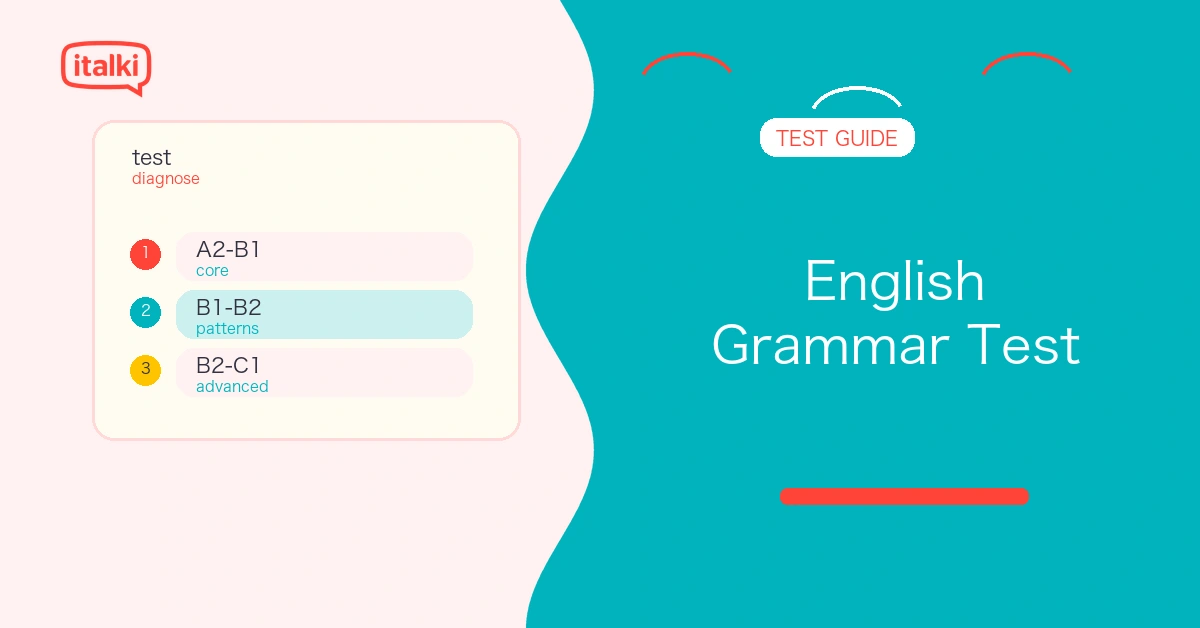
Grammar level test: A2 to B1
These questions test core grammar that learners typically master moving from A2 to B1. Complete without looking anything up.
1. ___ you like a cup of tea? a) Do b) Would c) Will d) Should
2. She has lived here ___ ten years. a) since b) for c) ago d) during
3. I haven’t spoken to him ___ last Tuesday. a) for b) since c) from d) ago
4. They ___ watching TV when I arrived. a) were b) are c) have been d) had
5. ___ she works hard, she never seems stressed. a) Although b) Despite c) However d) Even
6. Can you tell me where ___ ? a) is the station b) the station is c) the station d) is station
7. I need someone to help me. Do you know ___ could do it? a) who b) whom c) which d) what
8. He ___ be at home: his car is in the driveway. a) can b) might c) must d) should
9. She asked me where I ___ from. a) come b) came c) had come d) was coming
10. By the time he retires, he ___ here for 30 years. a) will work b) will be working c) will have worked d) has worked
Answers (A2-B1): 1-b, 2-b, 3-b, 4-a, 5-a, 6-b (indirect questions use statement word order), 7-a, 8-c, 9-b (reported speech shifts tense), 10-c (future perfect for completed action by a future time)
Find your perfect teacher
Build real English confidence with personalized lessons from a teacher who matches your goals, schedule, and learning style.
Grammar level test: B1 to B2
11. ___ the bad weather, the event went ahead. a) Although b) In spite of c) Even though d) Despite of
12. The documents ___ before the deadline, weren’t they? a) submitted b) were submitting c) were submitted d) had submitted
13. I wish I ___ more attention in that meeting. a) paid b) had paid c) would pay d) was paying
14. She is used to ___ early. It is not a problem for her. a) wake b) woke c) waking d) be waking
15. Had they told me earlier, I ___ something. a) would do b) would have done c) did d) had done
16. The more you practise, ___ you become. a) the more fluent b) more fluent c) fluent d) most fluent
17. Rarely ___ such a confident speaker. a) I have seen b) have I seen c) I had seen d) did I see
18. It is high time they ___ a decision. a) make b) made c) have made d) will make
19. She had her car ___ at the garage last week. a) repair b) repaired c) repairing d) to repair
20. He denied ___ the money. a) to take b) taking c) took d) take
Answers (B1-B2): 11-b (despite + noun/gerund; despite of is wrong), 12-c, 13-b (wish + past perfect for past regrets), 14-c (be used to + -ing), 15-b (third conditional), 16-a, 17-b (inversion after negative adverb), 18-b (it is high time + past tense), 19-b (causative have + object + past participle), 20-b (deny + gerund)
Grammar level test: B2 to C1
21. Not until she got home ___ she realise she had left her bag. a) she did b) did she c) she d) had she
22. The proposal, ___ was submitted last week, has been approved. a) that b) which c) who d) what
23. He spoke so quietly that we could ___ hear him. a) barely b) hardly ever c) seldom d) a and b
24. No sooner ___ sat down than someone knocked at the door. a) he had b) had he c) he has d) has he
25. She is thought ___ the best candidate for the role. a) to be b) being c) that she is d) she is
26. Whatever ___, I will support you. a) happens b) will happen c) happened d) has happened
27. The company, ___ CEO resigned last month, is now under new management. a) which b) whose c) who’s d) that
28. Were it not for your help, we ___ this without you. a) would not manage b) would not have managed c) did not manage d) had not managed
29. The evidence, ___ you may disagree, strongly suggests otherwise. a) with which b) of which c) for which d) in which
30. I cannot ___ but wonder what would have happened. a) help b) stop c) avoid d) prevent
Answers (B2-C1): 21-b (inversion after not until), 22-b (non-defining relative clause uses which), 23-a (barely and hardly both work; hardly ever = rarely, not barely), 24-b (inversion after no sooner), 25-a (passive reporting structure), 26-a, 27-b (possessive relative clause), 28-b (inverted third conditional), 29-a (with which = despite which), 30-a (cannot help but is a fixed phrase)
Find your perfect teacher
Build real English confidence with personalized lessons from a teacher who matches your goals, schedule, and learning style.
How to read your results
Mostly A2-B1 questions wrong: Your core grammar is still forming. Focus on: present perfect vs. past simple, indirect questions, and basic reported speech. These patterns appear constantly in everyday English.
Mostly B1-B2 questions wrong: This is the most common plateau. Focus on: conditionals (all types), inversion after negative adverbs, causative have/get, and wish/if only with past perfect. These are the patterns that distinguish B1 from B2 in real communication.
Mostly B2-C1 questions wrong: Your grammar is strong but formal and complex structures need work. Focus on: inversion patterns (not until, no sooner, were it not for), non-defining relative clauses, and reporting structures (is thought to be, is said to have). These appear in formal writing, journalism, and academic contexts.
A private English tutor can look at exactly which questions you got wrong and design a two-session plan that covers just those patterns: far more efficient than reviewing all grammar from scratch.
The most common grammar mistakes and how to fix them
1. Articles: a, an, the Why it is hard: English uses articles where other languages use none, and the rules have exceptions. Fix: Articles need context practice. Read the rules, then find 10 example sentences in real English text. The pattern becomes clear through exposure more than rules alone.
2. Conditionals Why it is hard: English has four distinct conditional forms and mixing them is common. Fix: Learn each conditional type as a complete sentence to memorise:
- Zero: Water boils if you heat it to 100 degrees.
- First: If it rains, I will take an umbrella.
- Second: If I had more time, I would travel.
- Third: If she had left earlier, she would have caught the train.
3. Prepositions Why it is hard: Prepositions are largely idiomatic and resist rule-based learning. Fix: Learn prepositions as fixed phrases, not standalone words: interested in, responsible for, depending on, result in, worry about. Create a personal phrase bank.
4. Reported speech Why it is hard: Tense backshifting feels unnatural when you know the original statement is still true. Fix: Practice converting direct speech to reported speech in both directions. Focus on the said that and asked whether patterns first.
5. Subject-verb agreement with collective nouns Why it is hard: Team, group, government, family take singular verbs in American English but often plural in British English. Fix: Choose one consistent standard and apply it throughout a piece of writing.
Recommended reading: Learn English with Quizzes: 50 Grammar, Vocabulary, and Speaking Quizzes
Find your perfect teacher
Build real English confidence with personalized lessons from a teacher who matches your goals, schedule, and learning style.
Fix your grammar faster with a teacher
Knowing which grammar rules you break is only the first step. The harder part is retraining the habit: producing the correct form automatically, without stopping to think, in the middle of a real conversation.
That retraining takes repetition with feedback. Reading the correction is not enough: you need to produce the correct form yourself, repeatedly, until it feels natural. A teacher can create drills for your specific error types, catch mistakes in real-time conversation, and tell you when you have genuinely internalised a pattern versus when you are still checking the rule in your head.
italki has 30,000+ expert tutors trusted by over 10 million learners worldwide. Book a trial lesson: bring your test results, and build a lesson around what they actually show.
Find your perfect teacher
Build real English confidence with personalized lessons from a teacher who matches your goals, schedule, and learning style.
FAQ
How accurate are online grammar tests for measuring English level?
Grammar tests measure one component of language ability. A grammar score gives you a reasonable indication of which structures you control, but it does not measure fluency, listening comprehension, or vocabulary range. Use it as one signal among several, not as a complete level assessment.
Should I retake the same test to measure progress?
Not immediately. Taking the same test again too soon measures memory, not learning. Wait at least three weeks after studying the target grammar before retaking a test on that area. If possible, use a parallel test (same structure, different questions) for the most accurate comparison.
What is the difference between a grammar mistake and a language habit?
A grammar mistake is a rule you do not yet know. A language habit is a rule you know but apply inconsistently because an older form is more automatic. Most B1-B2 learners have more habits than mistakes. Correcting habits requires repetition in production, not re-studying the rule.
How long does it take to fix a grammar weakness?
It depends on how deeply ingrained the wrong form is. A new pattern you have never used incorrectly can be learned in a few practice sessions. A pattern you have been producing incorrectly for years (like a first-language transfer error) can take months of conscious practice to replace. Focus on production drills, not re-reading grammar explanations.
Want to learn a language at italki?
Here are the best resources for you!