Key takeaways
- When Spanish abbreviates a plural noun, it often doubles the consonant: EE.UU. (Estados Unidos), RR.HH. (Recursos Humanos), FF.AA. (Fuerzas Armadas). This doubled-consonant convention signals plurality and does not exist in English abbreviations.
- Periods appear in Spanish abbreviations differently from English: Sr. has a period, Dra. has a period, but many institutional acronyms spelled out as full words (UNESCO, OTAN) drop the periods and uppercase all letters. The rule is that abbreviations of individual words take periods; acronyms pronounced as words do not.
- Internet abbreviations in Spanish compress phonetically rather than alphabetically: xfa (por favor) uses x because the letter name equis sounds like es- in rapid speech; x also appears in xq (porque) and xa (para) for the same reason.
- Abbreviations vary by country: the same concept may use different abbreviations in Spain, Mexico, and Argentina. DNI (Documento Nacional de Identidad) is the Spanish national ID; Mexico uses CURP and INE for equivalent documents. Reading Spanish text from a specific country may require knowing the local conventions.
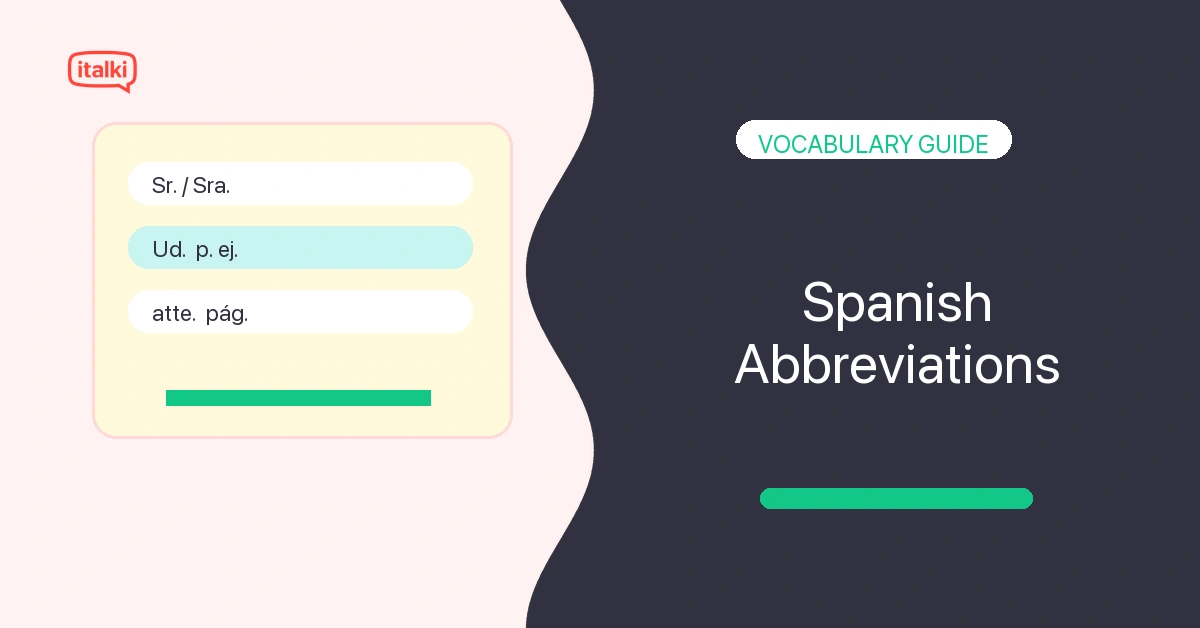
Spanish abbreviations appear in every form of written Spanish, from formal legal documents to text messages, and learners encounter them constantly in real materials. The problem is that standard language courses cover vocabulary and grammar but not abbreviations, which means intermediate learners can read a Spanish newspaper or text and still be stopped by Sr., p.ej., RR.HH., or q.e.p.d.
This guide covers 150+ Spanish abbreviations across six categories: formal titles and honorifics, academic and professional abbreviations, common institutional acronyms, internet and texting shortcuts, time and date abbreviations, and business abbreviations.
Abbreviations are a category of written Spanish that learners encounter constantly in real materials but that standard courses don’t address. Working through them with a Spanish language tutor on italki, which has connected over 10 million learners with qualified teachers since 2007, adds the register and regional context that a list alone cannot give you.

Find your perfect teacher
Build real speaking confidence with personalized lessons from a teacher who matches your goals, schedule, and learning style.
Book a trial lesson
Formal titles and honorifics
These appear in formal letters, official documents, academic contexts, and business correspondence. Periods are standard.
| Abbreviation | Full form | English |
|---|---|---|
| Sr. | señor | Mr. |
| Sra. | señora | Mrs. / Ms. |
| Srta. | señorita | Miss |
| Dr. | doctor | Doctor (male) |
| Dra. | doctora | Doctor (female) |
| Prof. | profesor | Professor (male) |
| Profa. | profesora | Professor (female) |
| Lic. | licenciado/a | Bachelor’s degree holder (title used in Latin America) |
| Ing. | ingeniero/a | Engineer |
| Arq. | arquitecto/a | Architect |
| Abog. | abogado/a | Lawyer |
| Excmo./Excma. | excelentísimo/a | Excellency (formal address for high officials) |
| Ilmo./Ilma. | ilustrísimo/a | Most Illustrious (formal address for certain officials) |
| S.M. | Su Majestad | His/Her Majesty |
| S.A.R. | Su Alteza Real | His/Her Royal Highness |
| Rdo./Rvdo. | reverendo | Reverend |
Usage note: In Spain, professional titles like Ing. and Arq. are less commonly written before names than in Mexico and Latin America, where they appear frequently in formal contexts, business cards, and email signatures.
Academic and professional abbreviations
These appear in academic writing, research papers, textbooks, footnotes, and professional documents.
| Abbreviation | Full form | English equivalent |
|---|---|---|
| p. / pág. | página | page |
| pp. / págs. | páginas | pages |
| cap. | capítulo | chapter |
| ed. | edición / editor/a | edition / editor |
| vol. | volumen | volume |
| núm. / nº | número | number |
| fig. | figura | figure |
| cfr. / cf. | confróntese / confer | compare with / see also |
| ibíd. | ibídem | in the same place (same source, same page) |
| íd. | ídem | the same (same author) |
| op. cit. | opere citato | in the work cited |
| v. / véase | véase | see |
| s.f. | sin fecha | no date (for undated sources) |
| s.l. | sin lugar | no place (for sources without publication location) |
| aprox. | aproximadamente | approximately |
| etc. | etcétera | etc. |
| p.ej. | por ejemplo | e.g. (for example) |
| es decir / i.e. | esto es | i.e. (that is) |
| a saber | a saber | namely |
| entre otros / entre otras | entre otros/as | among others |
| y otros / et al. | y otros | et al. |
| sig. / sigs. | siguiente / siguientes | following |
| trad. | traducido/a por | translated by |
| reimpr. | reimpresión | reprint |
A Spanish teacher online can help you read academic Spanish texts that are dense with these abbreviations, explaining not only what they mean but how to use them correctly in your own writing. italki has 30,000+ teachers across 150+ languages, including Spanish teachers with academic backgrounds who support learners working with formal written Spanish.
Find your perfect teacher
Build real speaking confidence with personalized lessons from a teacher who matches your goals, schedule, and learning style.
Book a trial lesson
Institutional acronyms
These are acronyms for organizations, agencies, and institutions. Most are written in all uppercase without periods.
International organizations:
| Acronym | Full form | English |
|---|---|---|
| ONU | Organización de las Naciones Unidas | UN (United Nations) |
| UE | Unión Europea | EU (European Union) |
| OTAN | Organización del Tratado del Atlántico Norte | NATO |
| FMI | Fondo Monetario Internacional | IMF |
| OMS | Organización Mundial de la Salud | WHO |
| UNESCO | Organización de las Naciones Unidas para la Educación, la Ciencia y la Cultura | UNESCO |
| UNICEF | Fondo de las Naciones Unidas para la Infancia | UNICEF |
| ONG | Organización No Gubernamental | NGO |
| Cruz Roja | Cruz Roja Internacional | Red Cross |
Spanish national institutions:
| Acronym | Full form | English |
|---|---|---|
| DNI | Documento Nacional de Identidad | Spanish national ID |
| NIE | Número de Identificación de Extranjero | Foreigner ID number (Spain) |
| NIF | Número de Identificación Fiscal | Tax identification number |
| IVA | Impuesto sobre el Valor Añadido | VAT (Value Added Tax) |
| IRPF | Impuesto sobre la Renta de las Personas Físicas | Personal income tax |
| SEPE | Servicio Público de Empleo Estatal | Spanish public employment service |
| SS / CCSS | Seguridad Social | Social Security |
| BOE | Boletín Oficial del Estado | Official State Gazette |
| RENFE | Red Nacional de los Ferrocarriles Españoles | Spanish national railway |
Economic and demographic:
| Acronym | Full form | English |
|---|---|---|
| PIB | Producto Interior Bruto | GDP |
| IPC | Índice de Precios al Consumo | CPI (Consumer Price Index) |
| RR.HH. | Recursos Humanos | HR (Human Resources) |
| EE.UU. | Estados Unidos | USA |
| FF.AA. | Fuerzas Armadas | Armed Forces |
| PP | Partido Popular | People’s Party (Spain) |
| PSOE | Partido Socialista Obrero Español | Spanish Socialist Workers’ Party |
For greetings and conversational phrases used in Spain and Latin America, the guide to how to say how are you in Spanish covers the regional variants and register differences that come up in Spanish-speaking contexts across countries.
Internet and texting abbreviations
Spanish texting uses phonetic compression more than alphabetic abbreviation. The letter x appears frequently because its name in Spanish (equis) sounds like the syllable es- or ex-.
| Abbreviation | Full form | English |
|---|---|---|
| xfa / x fa | por favor | please |
| xq / porq | porque | because |
| xa | para | for |
| q | que | that / which / what |
| tb / tmb | también | also |
| d | de | of / from |
| t | te | you (object pronoun) |
| k | que | that (alternative spelling) |
| msj | mensaje | message |
| bss / bsos | besos | kisses |
| mxo / mcho | mucho | a lot |
| ntp | no te preocupes | don’t worry |
| tqm | te quiero mucho | I love you a lot |
| tkm | te quiero mucho | I love you a lot (variant) |
| vdd / vd | verdad | truth / is that true? |
| ymam / llam | llamar | to call (phonetic) |
| wap/wapa/wapo | guapa/guapo | beautiful / handsome |
| jaja / jejeje / jiji | ja ja ja… | haha (laughter) |
| OMG | Oh Dios mío | OMG (borrowed from English) |
| ok | de acuerdo | okay / agreed |
| lol | (borrowed from English) | lol |
| fin | fin | end / finished |
| grax / grac | gracias | thanks |
| buenas | buenos días/tardes | hi / good day (casual) |
| buen finde | buen fin de semana | have a good weekend |
Regional note: Most internet abbreviations are shared across Spanish-speaking countries, but some are more common in Spain (finde for weekend) or Latin America. Emoji use often replaces abbreviations entirely in informal messaging across all regions.
Find your perfect teacher
Build real speaking confidence with personalized lessons from a teacher who matches your goals, schedule, and learning style.
Book a trial lesson
Time, date, and measurement abbreviations
| Abbreviation | Full form | English |
|---|---|---|
| a.m. | ante meridiem | a.m. |
| p.m. | post meridiem | p.m. |
| h | hora/s | hour/s |
| min. | minuto/s | minute/s |
| seg. / s | segundo/s | second/s |
| d.C. | después de Cristo | AD |
| a.C. | antes de Cristo | BC |
| s. / S. | siglo | century |
| km | kilómetro/s | kilometer/s |
| km/h | kilómetros por hora | km/h |
| m | metro/s | meter/s |
| cm | centímetro/s | centimeter/s |
| mm | milímetro/s | millimeter/s |
| kg | kilogramo/s | kilogram/s |
| g / gr | gramo/s | gram/s |
| l / lt | litro/s | liter/s |
| ml | mililitro/s | milliliter/s |
| ºC | grados Celsius | degrees Celsius |
| ºF | grados Fahrenheit | degrees Fahrenheit |
| m² | metros cuadrados | square meters |
| m³ | metros cúbicos | cubic meters |
Business abbreviations
| Abbreviation | Full form | English |
|---|---|---|
| S.A. | Sociedad Anónima | PLC / Corporation |
| S.L. | Sociedad Limitada | LLC / Limited company |
| S.A.U. | Sociedad Anónima Unipersonal | Single-member corporation |
| S.L.U. | Sociedad Limitada Unipersonal | Single-member LLC |
| S.C. | Sociedad Colectiva | General partnership |
| Cía. | compañía | company |
| Cdo. / Cdo | condado | county |
| dpto. / depto. | departamento | department |
| avda. / avd. | avenida | avenue |
| c/ | calle | street (used in addresses) |
| n.º / nº | número | number (in addresses) |
| P.D. | posdata | P.S. (postscript) |
| Att. / Atto. | atentamente | sincerely / attentively |
| s/n | sin número | without number (addresses with no street number) |
| Ref. | referencia | reference |
| Fax | fax | fax |
| Tel. | teléfono | telephone |
| Ext. | extensión | extension |
| c.c. | con copia | cc (carbon copy) |
| cco / CCO | con copia oculta | bcc (blind carbon copy) |
| adj. | adjunto | attached |
| IVA inc. | IVA incluido | VAT included |
| s/IVA | sin IVA | excluding VAT |
| DTO. | descuento | discount |
| VTO. | vencimiento | due date / maturity date |
| PVP | precio de venta al público | RRP (recommended retail price) |
| q.e.p.d. | que en paz descanse | R.I.P. (rest in peace) |
| s.s.s. | su seguro servidor | yours truly (archaic, formal letter closing) |
Find your perfect teacher
Build real speaking confidence with personalized lessons from a teacher who matches your goals, schedule, and learning style.
Book a trial lesson
Reading abbreviations in context
Book a trial lesson today and bring a Spanish text that’s full of abbreviations and acronyms you haven’t fully decoded. A teacher who reads and writes in Spanish daily will decode those abbreviations in context, not just as isolated entries.
With 30,000+ expert tutors trusted by over 10 million learners worldwide, italki has Spanish teachers who can explain which abbreviations are formal, informal, regional, or outdated.
Find your perfect teacher
Build real speaking confidence with personalized lessons from a teacher who matches your goals, schedule, and learning style.
Book a trial lesson
FAQ
Why do some Spanish abbreviations double the consonant for plurals?
In Spanish, doubling the consonant in an abbreviation signals that the full word is plural. EE.UU. (Estados Unidos), RR.HH. (Recursos Humanos), and FF.AA. (Fuerzas Armadas) follow this convention. It is a formal written convention that does not appear in informal abbreviation or in acronyms pronounced as words.
Is p.ej. the same as e.g.?
Yes. P.ej. stands for por ejemplo and functions exactly like e.g. in English. Es decir (abbreviated i.e. in Spanish texts, following the Latin convention) means “that is” and functions like i.e. in English. The distinction between introducing an example (p.ej.) and giving a clarification (es decir) is the same as the English distinction between e.g. and i.e..
What is the difference between an abreviatura and an acrónimo in Spanish?
An abreviatura is a shortened form of a word using its initial letters or letters with a period: Sr., pág., vol. An acrónimo is an abbreviation of multiple words read as a single word: UNESCO, OTAN, NASA. A sigla is an abbreviation of multiple words read letter by letter: DNI, PIB, ONG. In common use, these terms overlap and all three are sometimes called siglas.
Does Spain use the same abbreviations as Latin America?
Most academic and formal abbreviations are shared. Business abbreviations differ for company types (S.A. and S.L. are Spanish; S.A. de C.V. is the Mexican equivalent of a corporation). National institution abbreviations (DNI, NIE) are Spain-specific; each country has its own ID document abbreviations. Internet abbreviations are largely shared but with some regional variations in slang.
Want to learn a language at italki?
Here are the best resources for you!