Key takeaways
- Spanish nouns carry grammatical gender (masculine or feminine), which determines the article (el/la, un/una) and the adjective endings used with the noun
- Most masculine nouns end in -o and most feminine nouns end in -a, but common exceptions (el día, la mano, el problema, la foto) must be memorized with their gender
- Learning nouns grouped by theme builds faster recall than random memorization: the vocabulary you need in a restaurant, at work, or when talking about family clusters naturally
- The 200 nouns in this guide are among the most frequently used in everyday Spanish and cover the situations learners encounter most: daily life, travel, conversation, and the physical world
Spanish vocabulary lists often start at 1,000 words and feel overwhelming from the first page. The practical approach is to learn the nouns that cover the situations you actually encounter: people around you, the spaces you move through, what you eat, how you describe time, and what you talk about at work and home.
italki connects learners with Spanish teachers who can put these nouns in conversational context so you move from recognition to actual use.
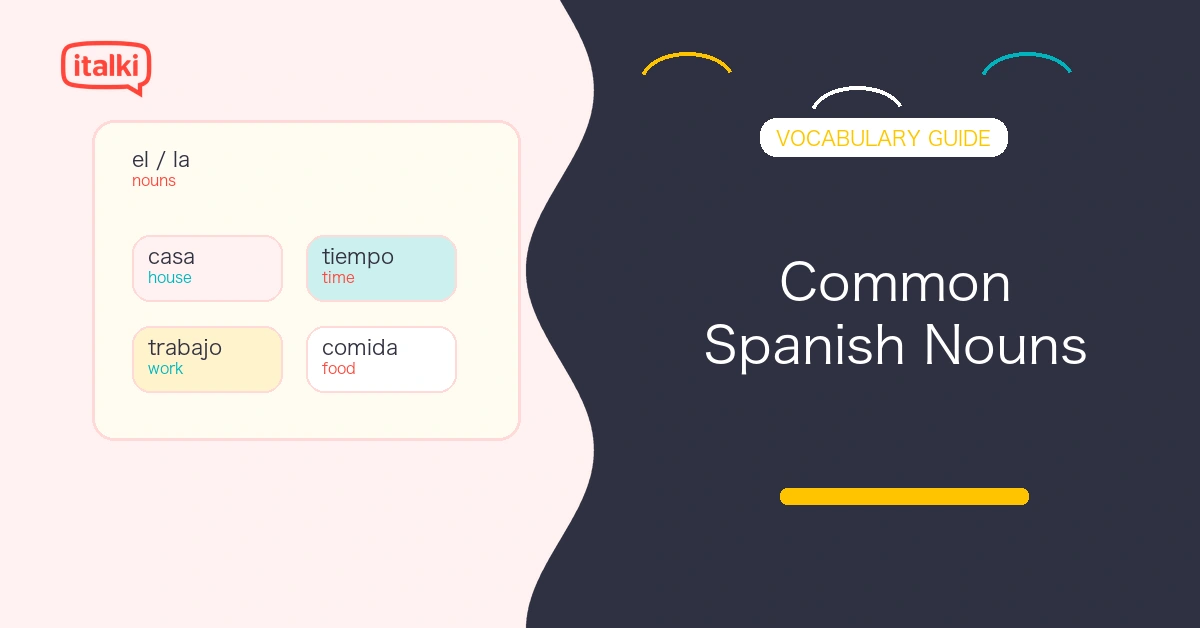
This guide covers 200 of the most common Spanish nouns organized by theme, with gender markers and English translations, plus notes on gender patterns, common exceptions, and how to build noun vocabulary more effectively.

Find your perfect teacher
Build real speaking confidence with personalized lessons from a teacher who matches your goals, schedule, and learning style.
Book a trial lesson
How Spanish noun gender works
Every Spanish noun is either masculine or feminine, and that gender affects everything connected to it: the article, the adjective form, and any pronoun that replaces the noun. El libro rojo (the red book) uses masculine article and adjective; la mesa roja (the red table) uses feminine forms. Getting the gender wrong does not always prevent communication, but it marks you as someone still learning the system.
As a rough guide: nouns ending in -o are usually masculine (el libro, el año, el tiempo), and nouns ending in -a are usually feminine (la casa, la mesa, la idea). But the exceptions are frequent enough to learn as fixed pairs: el día (day), el mapa (map), el problema (problem), el clima (climate), and la mano (hand), la foto (photo), la moto (motorcycle) all break the pattern.
People and family
| Spanish | Gender | English |
|---|---|---|
| hombre | m | man |
| mujer | f | woman |
| niño | m | boy / child |
| niña | f | girl |
| persona | f | person |
| familia | f | family |
| madre | f | mother |
| padre | m | father |
| hijo | m | son |
| hija | f | daughter |
| hermano | m | brother |
| hermana | f | sister |
| amigo | m | friend (m) |
| amiga | f | friend (f) |
| novio | m | boyfriend |
| novia | f | girlfriend |
| esposo | m | husband |
| esposa | f | wife |
| abuelo | m | grandfather |
| abuela | f | grandmother |
Find your perfect teacher
Build real speaking confidence with personalized lessons from a teacher who matches your goals, schedule, and learning style.
Book a trial lesson
Body
| Spanish | Gender | English |
|---|---|---|
| cabeza | f | head |
| cara | f | face |
| ojo | m | eye |
| oído | m | ear |
| nariz | f | nose |
| boca | f | mouth |
| mano | f | hand |
| brazo | m | arm |
| pierna | f | leg |
| pie | m | foot |
| corazón | m | heart |
| espalda | f | back |
| cuello | m | neck |
| hombro | m | shoulder |
| dedo | m | finger / toe |
Note that mano (hand) is feminine despite ending in -o. It is one of the most important exceptions to learn early.
Home and everyday objects
| Spanish | Gender | English |
|---|---|---|
| casa | f | house / home |
| habitación | f | room |
| cama | f | bed |
| mesa | f | table |
| silla | f | chair |
| puerta | f | door |
| ventana | f | window |
| cocina | f | kitchen |
| baño | m | bathroom |
| sala | f | living room |
| libro | m | book |
| bolígrafo | m | pen |
| teléfono | m | telephone |
| computadora | f | computer |
| llave | f | key |
| dinero | m | money |
| ropa | f | clothes |
| bolsa | f | bag |
| espejo | m | mirror |
| reloj | m | clock / watch |
Find your perfect teacher
Build real speaking confidence with personalized lessons from a teacher who matches your goals, schedule, and learning style.
Book a trial lesson
Food and drink
| Spanish | Gender | English |
|---|---|---|
| agua | f | water |
| comida | f | food / meal |
| pan | m | bread |
| carne | f | meat |
| pollo | m | chicken |
| pescado | m | fish |
| arroz | m | rice |
| fruta | f | fruit |
| verdura | f | vegetable |
| leche | f | milk |
| café | m | coffee |
| jugo | m | juice |
| vino | m | wine |
| cerveza | f | beer |
| aceite | m | oil |
| sal | f | salt |
| azúcar | m/f | sugar |
| huevo | m | egg |
| queso | m | cheese |
| sopa | f | soup |
Agua is feminine (la/una agua) but takes the masculine article el in the singular for phonetic reasons: el agua fría (the cold water). The adjective still agrees in the feminine form.
Nature and the outdoors
| Spanish | Gender | English |
|---|---|---|
| sol | m | sun |
| luna | f | moon |
| estrella | f | star |
| cielo | m | sky |
| tierra | f | earth / land |
| mar | m | sea |
| río | m | river |
| montaña | f | mountain |
| árbol | m | tree |
| flor | f | flower |
| lluvia | f | rain |
| viento | m | wind |
| nieve | f | snow |
| fuego | m | fire |
| campo | m | field / countryside |
| bosque | m | forest |
| playa | f | beach |
| isla | f | island |
| nube | f | cloud |
| piedra | f | stone / rock |
Find your perfect teacher
Build real speaking confidence with personalized lessons from a teacher who matches your goals, schedule, and learning style.
Book a trial lesson
Places and travel
| Spanish | Gender | English |
|---|---|---|
| ciudad | f | city |
| pueblo | m | town / village |
| país | m | country |
| calle | f | street |
| parque | m | park |
| tienda | f | store / shop |
| mercado | m | market |
| hospital | m | hospital |
| escuela | f | school |
| universidad | f | university |
| aeropuerto | m | airport |
| estación | f | station |
| hotel | m | hotel |
| restaurante | m | restaurant |
| banco | m | bank |
| iglesia | f | church |
| museo | m | museum |
| oficina | f | office |
| plaza | f | square / plaza |
| avenida | f | avenue |
Spanish synonyms and Spanish medical terminology are useful next steps once you have the core noun patterns in place.
Time
| Spanish | Gender | English |
|---|---|---|
| día | m | day |
| noche | f | night |
| mañana | f | morning / tomorrow |
| tarde | f | afternoon / evening |
| hora | f | hour |
| minuto | m | minute |
| semana | f | week |
| mes | m | month |
| año | m | year |
| momento | m | moment |
| vez | f | time / instance |
| tiempo | m | time / weather |
| rato | m | while / short time |
| fecha | f | date |
| siglo | m | century |
The word vez (time/instance) is used in expressions like una vez (once), dos veces (twice), and a veces (sometimes). Telling time in Spanish puts time vocabulary into fuller conversational context.
Find your perfect teacher
Build real speaking confidence with personalized lessons from a teacher who matches your goals, schedule, and learning style.
Book a trial lesson
Work and education
| Spanish | Gender | English |
|---|---|---|
| trabajo | m | work / job |
| empleo | m | employment |
| empresa | f | company |
| reunión | f | meeting |
| proyecto | m | project |
| clase | f | class |
| tarea | f | homework / task |
| examen | m | exam |
| nota | f | grade / note |
| profesor | m | teacher (m) |
| profesora | f | teacher (f) |
| alumno | m | student (m) |
| lección | f | lesson |
| materia | f | subject |
| carrera | f | career / degree |
| idioma | m | language |
| título | m | title / degree |
| sueldo | m | salary |
| jefe | m | boss |
| resultado | m | result |
Emotions and abstract concepts
| Spanish | Gender | English |
|---|---|---|
| vida | f | life |
| amor | m | love |
| felicidad | f | happiness |
| tristeza | f | sadness |
| miedo | m | fear |
| esperanza | f | hope |
| libertad | f | freedom |
| paz | f | peace |
| guerra | f | war |
| verdad | f | truth |
| mentira | f | lie |
| idea | f | idea |
| problema | m | problem |
| solución | f | solution |
| opinión | f | opinion |
| razón | f | reason |
| cambio | m | change |
| oportunidad | f | opportunity |
| poder | m | power |
| suerte | f | luck |
Problema (problem) is masculine despite ending in -a: el problema, los problemas. The same applies to programa, sistema, and tema: words of Greek origin ending in -ma are typically masculine.
Find your perfect teacher
Build real speaking confidence with personalized lessons from a teacher who matches your goals, schedule, and learning style.
Book a trial lesson
Clothing and accessories
| Spanish | Gender | English |
|---|---|---|
| camisa | f | shirt |
| pantalón | m | pants / trousers |
| zapato | m | shoe |
| vestido | m | dress |
| falda | f | skirt |
| abrigo | m | coat |
| calcetín | m | sock |
| sombrero | m | hat |
| cinturón | m | belt |
| chaqueta | f | jacket |
Animals
| Spanish | Gender | English |
|---|---|---|
| perro | m | dog |
| gato | m | cat |
| pájaro | m | bird |
| caballo | m | horse |
| vaca | f | cow |
| pez | m | fish (alive) |
| ratón | m | mouse |
| conejo | m | rabbit |
| serpiente | f | snake |
| mariposa | f | butterfly |
Note that pez (alive fish) and pescado (cooked/caught fish) are different words used in different contexts.
Find your perfect teacher
Build real speaking confidence with personalized lessons from a teacher who matches your goals, schedule, and learning style.
Book a trial lesson
Technology and communication
| Spanish | Gender | English |
|---|---|---|
| internet | m | internet |
| red | f | network / web |
| mensaje | m | message |
| correo | m | email / mail |
| aplicación | f | app |
| pantalla | f | screen |
| cámara | f | camera |
| video | m | video |
| foto | f | photo |
| música | f | music |
Foto is feminine despite ending in -o: la foto. It is a shortened form of fotografía (photography), which is feminine.
Gender patterns and common exceptions
The ending rules give you a starting point, but Spanish has enough exceptions that learning each noun with its article is the more reliable long-term strategy.
Patterns that hold most of the time:
- Nouns ending in -o are usually masculine: el libro, el año, el trabajo
- Nouns ending in -a, -ión, -dad, -tad, -tud are usually feminine: la casa, la nación, la ciudad, la libertad, la actitud
- Nouns ending in -ema, -ama, -oma (Greek-origin) are usually masculine: el problema, el programa, el idioma, el tema, el sistema
Common exceptions to memorize:
- Feminine despite ending in -o: la mano, la foto, la moto, la radio
- Masculine despite ending in -a: el día, el mapa, el clima, el idioma, el planeta, el programa
- Masculine despite appearing neutral: el agua, el águila (water, eagle: feminine nouns that use masculine article in singular)
Practical tip: When you encounter a new noun, learn it as el/la + noun from the start. Relearning the gender of a word you already know takes more effort than learning it correctly the first time. A private Spanish tutor can correct gender mistakes in real time as you speak, which is the fastest way to internalize the pattern.
Find your perfect teacher
Build real speaking confidence with personalized lessons from a teacher who matches your goals, schedule, and learning style.
Book a trial lesson
Practice Spanish nouns with a tutor
Nouns in a list give you recognition. Producing them accurately in a real sentence, with the right article, the right adjective ending, and the right pronoun, requires active use. italki has 30,000+ expert tutors trusted by over 10 million learners worldwide, including Spanish tutors who can take any category from this list and build a conversation around it so you move from passive recall to fluent use. Book a trial lesson and start using these nouns in real Spanish today.
Find your perfect teacher
Build real speaking confidence with personalized lessons from a teacher who matches your goals, schedule, and learning style.
Book a trial lesson
FAQ
Why do I need to learn noun gender in Spanish?
Gender affects the article (el/la), the adjective form (rojo/roja), and any pronoun that refers back to the noun (él/ella, lo/la). Skipping gender means every connected word has a 50-50 chance of being wrong. While native speakers understand you regardless, incorrect gender creates a noticeable pattern that signals early-stage learning. Getting it right from the start is much easier than correcting a deeply ingrained habit later.
Are there any reliable rules for predicting Spanish noun gender?
The ending rules (nouns in -o tend to be masculine; nouns in -a, -ión, -dad tend to be feminine) are correct often enough to be useful as defaults. But the exceptions are frequent and include very common words, so the rules are best used as a starting point rather than as guarantees. Learning each noun with its article (el año, la vida, el problema) is the most reliable long-term approach.
What is the difference between pez and pescado?
Pez refers to a living fish in the water. Pescado refers to fish that has been caught or prepared for eating. The distinction mirrors the pair cerdo/puerco (pig on the farm) vs carne de cerdo (pork for eating) in some regional usages. In a fish market or on a menu, you will see pescado; in an aquarium or a river, you would say pez.
Want to learn a language at italki?
Here are the best resources for you!