Key takeaways
- Making a reservation: Quisiera reservar una mesa para dos personas para las ocho de la noche. This is the single most useful sentence before you arrive.
- Spanish menus typically divide into: entradas/aperitivos, primeros platos, segundos platos, postres, and bebidas. Knowing these five categories lets you navigate any Spanish-language menu.
- The most natural way to order is Quisiera… or Para mí… followed by what you want. Quiero works but sounds slightly abrupt. ¿Me recomienda algo? (What do you recommend?) is a useful phrase in any restaurant.
- Asking for the bill: ¿Me trae la cuenta, por favor? To ask if service is included: ¿Está incluido el servicio? Tipping norms vary significantly across Spanish-speaking countries.
Most Spanish learners know enough Spanish to survive a restaurant but not enough to feel comfortable. The gap between survival and comfort is usually a handful of specific phrases for each stage of the meal.
italki connects you with Spanish teachers who can run restaurant role-plays with you, so the phrases feel automatic before your first real conversation at a restaurant in a Spanish-speaking country.
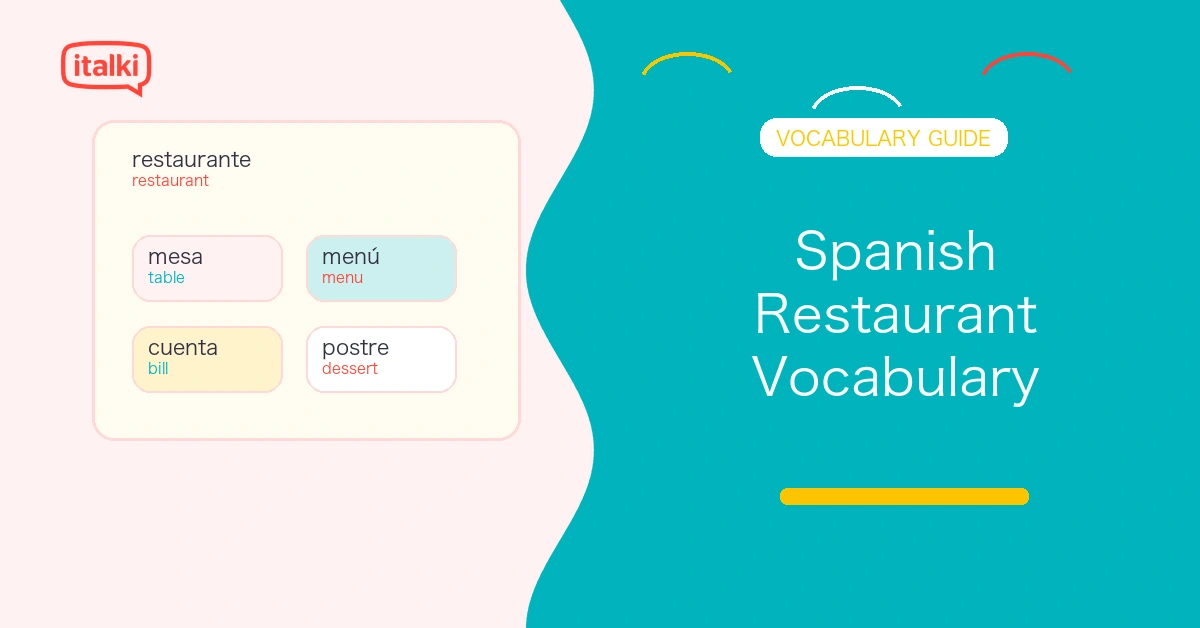
This guide covers Spanish restaurant vocabulary from the first phone call through the final bill: reservations, greetings and seating, reading the menu, ordering, handling special requests, and paying.

Find your perfect teacher
Build real speaking confidence with personalized lessons from a teacher who matches your goals, schedule, and learning style.

Making a reservation in Spanish
Most restaurants in Spanish-speaking countries accept reservations by phone. This is the vocabulary you need.
Key phrases for reservations:
| Spanish | English |
|---|---|
| Quisiera reservar una mesa. | I would like to reserve a table. |
| Para dos / cuatro / seis personas. | For two / four / six people. |
| Para esta noche, por favor. | For tonight, please. |
| Para el sábado a las ocho. | For Saturday at eight. |
| ¿Tienen disponibilidad? | Do you have availability? |
| ¿A qué nombre? | Under what name? |
| A nombre de García. | Under the name García. |
| ¿Necesito reservar con anticipación? | Do I need to book in advance? |
| ¿Tienen terraza disponible? | Do you have a terrace available? |
| Quisiera una mesa en el interior. | I would like an inside table. |
Canceling or changing a reservation:
| Spanish | English |
|---|---|
| Quisiera cancelar mi reserva. | I would like to cancel my reservation. |
| Quisiera cambiar la hora. | I would like to change the time. |
| Llegaremos tarde, aproximadamente a las nueve. | We will arrive late, at around nine. |
Work with a Spanish language tutor to practice these phone calls out loud. Phone Spanish is different from in-person Spanish because you lose facial expressions and context cues.
Arriving and being seated
When you arrive, the host or server will typically greet you with Buenas noches or Bienvenidos. Here is how the conversation typically goes.
At the door:
| Spanish | English |
|---|---|
| Tengo una reserva a nombre de… | I have a reservation under the name… |
| Somos tres personas. | There are three of us. |
| ¿Tienen mesa libre? | Do you have a free table? |
| ¿Cuánto tiempo de espera hay? | How long is the wait? |
| Preferimos una mesa junto a la ventana. | We prefer a table by the window. |
The server may say:
| Spanish | English |
|---|---|
| Por aquí, por favor. | This way, please. |
| ¿Les parece bien esta mesa? | Is this table alright for you? |
| Ahora les traigo la carta. | I will bring you the menu now. |
| ¿Desean algo para beber mientras esperan? | Would you like something to drink while you wait? |
Find your perfect teacher
Build real speaking confidence with personalized lessons from a teacher who matches your goals, schedule, and learning style.
Reading a Spanish menu
Spanish-language menus follow a standard structure. Knowing the sections prevents ordering something you did not intend.
| Menu section | Spanish | What it contains |
|---|---|---|
| Starters | Entradas / Aperitivos / Tapas | Small dishes, soups, salads, bread |
| First courses | Primeros platos | Pasta, rice, vegetable dishes |
| Main courses | Segundos platos | Meat, fish, seafood |
| Desserts | Postres | Sweets, ice cream, cheese |
| Drinks | Bebidas | Water, wine, beer, soft drinks |
| Menu of the day | Menú del día | Fixed-price set menu (Spain) |
Useful menu vocabulary:
| Spanish | English |
|---|---|
| la carta | the menu (a la carte) |
| el menú del día | set menu of the day |
| el plato del día | dish of the day |
| casero/a | homemade |
| a la plancha | grilled |
| al horno | oven-baked |
| frito/a | fried |
| en su punto | cooked perfectly, medium |
| bien hecho | well done (meat) |
| poco hecho | rare (meat) |
| sin gluten | gluten-free |
| vegetariano/a | vegetarian |
| picante | spicy |
| incluye | includes |
| IVA incluido | VAT included |
Common food items across Spanish-speaking countries:
| Spanish | English |
|---|---|
| el arroz | rice |
| los frijoles / las judías | beans |
| la carne de res / la ternera | beef |
| el cerdo / el chancho | pork |
| el pollo | chicken |
| el marisco | seafood |
| los camarones / las gambas | shrimp |
| el pescado | fish |
| la ensalada | salad |
| el pan | bread |
| las papas / las patatas | potatoes |
| la sopa | soup |
| el caldo | broth |
Ordering food and drinks
Once you have looked at the menu, the server will ask: ¿Qué van a pedir? or ¿Están listos para pedir?
Ordering:
| Spanish | English |
|---|---|
| Quisiera… | I would like… |
| Para mí… | For me… |
| Voy a tomar… | I will have… |
| ¿Me puede traer…? | Can you bring me…? |
| ¿Me recomienda algo? | What do you recommend? |
| ¿Cuál es el plato del día? | What is the daily special? |
| ¿En qué consiste el…? | What does the… consist of? |
| Sin cebolla, por favor. | Without onion, please. |
| Y para beber, agua con gas. | And to drink, sparkling water. |
| Una copa de vino tinto / blanco. | A glass of red / white wine. |
| Una cerveza, por favor. | A beer, please. |
| Agua del grifo / agua de la llave. | Tap water. |
A private Spanish tutor can run restaurant ordering role-plays with you, including the unpredictable parts: when something is sold out, when the server speaks quickly, or when you need to modify your order.
Find your perfect teacher
Build real speaking confidence with personalized lessons from a teacher who matches your goals, schedule, and learning style.
During the meal
Useful phrases while eating:
| Spanish | English |
|---|---|
| Está delicioso. | It is delicious. |
| Está muy bueno. | It is very good. |
| Disculpe, esto no es lo que pedí. | Excuse me, this is not what I ordered. |
| ¿Me puede traer más pan? | Can you bring me more bread? |
| ¿Me trae sal / pimienta? | Can you bring me salt / pepper? |
| ¿Podría traerme un tenedor? | Could you bring me a fork? |
| ¿Tienen salsa picante? | Do you have hot sauce? |
| Todo está muy bien, gracias. | Everything is great, thank you. |
Table settings vocabulary:
| Spanish | English |
|---|---|
| el tenedor | fork |
| el cuchillo | knife |
| la cuchara | spoon |
| la cucharilla | teaspoon |
| el plato | plate |
| la copa | wine glass |
| el vaso | glass |
| la servilleta | napkin |
| el mantel | tablecloth |
Paying the bill
Asking for the bill:
| Spanish | English |
|---|---|
| ¿Me trae la cuenta, por favor? | Can you bring me the bill, please? |
| La cuenta, por favor. | The bill, please. |
| ¿Cuánto le debo? | How much do I owe you? |
| ¿Está incluido el servicio? | Is service included? |
| ¿Se puede pagar con tarjeta? | Can I pay by card? |
| ¿Aceptan efectivo? | Do you accept cash? |
| ¿Me puede dar un recibo? | Can you give me a receipt? |
| Vamos a pagar por separado. | We are going to pay separately. |
| Todo junto, por favor. | All together, please. |
| Quédese con el cambio. | Keep the change. |
Tipping notes: In Spain, tipping is not mandatory and small amounts (rounding up or leaving coins) are typical. In Mexico, 10-15% is expected. In Argentina, 10% is common. In many other Latin American countries, tipping practices vary significantly. When in doubt, observe what locals do.
Find your perfect teacher
Build real speaking confidence with personalized lessons from a teacher who matches your goals, schedule, and learning style.
Useful vocabulary for dietary needs
| Spanish | English |
|---|---|
| Soy vegetariano/a. | I am vegetarian. |
| Soy vegano/a. | I am vegan. |
| Tengo alergia al… | I am allergic to… |
| Soy intolerante a la lactosa. | I am lactose intolerant. |
| No como gluten. | I do not eat gluten. |
| Sin mariscos, por favor. | Without seafood, please. |
| ¿Contiene nueces? | Does it contain nuts? |
| ¿Hay opciones sin carne? | Are there meatless options? |
| ¿Es apto para veganos? | Is it vegan-friendly? |
| Soy kosher / halal. | I keep kosher / halal. |
For a broader starter word base, the guide to essential Spanish words covers high-frequency vocabulary you will reuse in travel and restaurant situations.
Build confidence for real conversations
Vocabulary lists prepare you for the predictable parts of a restaurant experience. Real confidence comes from handling the moments that are not on any list: when the special is sold out, when the server rattles off the menu too fast, or when you need to send something back. That kind of fluency only comes from practice.
A Spanish tutor can set up role-play scenarios that cover every stage of the meal and drill you on exactly the phrases you go blank on.
Learn Spanish faster with personal guidance from 2500+ expert Spanish teachers online, trusted by over 10 million learners worldwide. Book a trial lesson and practice your next restaurant conversation before you need it.
Find your perfect teacher
Build real speaking confidence with personalized lessons from a teacher who matches your goals, schedule, and learning style.
FAQ
What is the difference between la carta and el menú?
La carta is the full a la carte menu where each item is priced individually. El menú or menú del día is a fixed-price meal, usually a two or three-course set lunch popular in Spain. If you want to order freely from the full menu, ask for la carta.
Is tap water free at Spanish restaurants?
In Spain, restaurants are legally required to serve tap water (agua del grifo) upon request. Whether it is free varies by establishment. In most of Latin America, restaurants typically serve bottled water. Always specify agua del grifo if you want tap, or agua embotellada for bottled.
What does IVA incluido mean on a menu or bill?
IVA (Impuesto sobre el Valor Añadido) is the equivalent of VAT or sales tax. IVA incluido means the tax is already included in the listed prices. In some restaurants the prices on the menu do not include IVA, and it is added to the final bill.
How do I handle a situation where I receive the wrong dish?
Say: Disculpe, creo que esto no es lo que pedí. Yo pedí [dish name]. (Excuse me, I think this is not what I ordered. I ordered [dish name].) Be polite and direct. Spanish-speaking servers handle these corrections without issue.
Want to learn a language at italki?
Here are the best resources for you!