Key takeaways
- TOEFL vocabulary is different from everyday English: the test uses academic words you rarely hear in regular conversation, so standard fluency alone is not enough.
- The Academic Word List (AWL), a set of 570 word families that appear frequently in academic texts, is the most efficient starting point for TOEFL vocabulary preparation.
- Learning words in context, using spaced repetition, and practicing on real TOEFL passages helps you remember words far better than a plain word list.
- A TOEFL specialist tutor can identify which vocabulary gaps are hurting your score in the reading and speaking sections before exam day.
TOEFL vocabulary is not the same as everyday English. The test uses academic words like substantiate, mitigate, prevalent, and albeit in its reading and listening sections, but you would rarely hear these in a regular conversation.
A student who speaks confident English can still find TOEFL reading passages difficult because the vocabulary is genuinely different from what you use day to day.
Knowing which words to study, in what order, and how to remember them is the difference between spending three months on the wrong material and building a TOEFL-ready vocabulary in half the time. italki connects test takers with TOEFL specialist tutors who can find the vocabulary gaps most likely to affect your score.
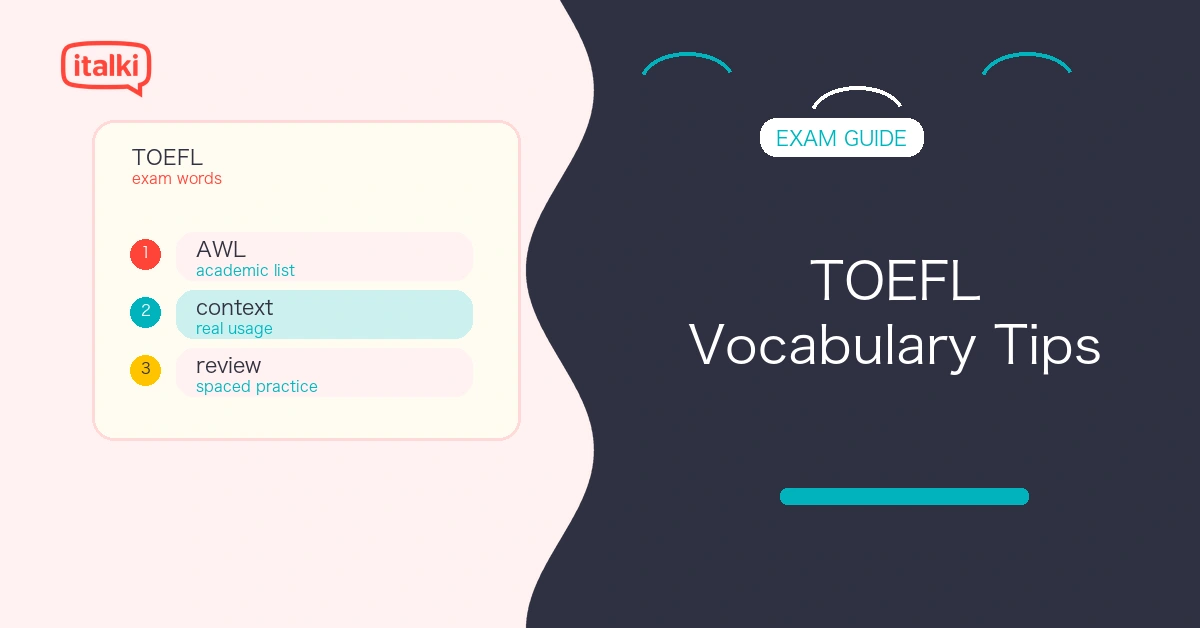
This guide covers five practical TOEFL vocabulary tips: Academic Word List targeting, context-based learning, spaced repetition, real passage practice, and tutor-led gap analysis.
Work through these tips, then bring your weakest area to a TOEFL specialist tutor who can shape the preparation around your current score range.

Find your perfect teacher
Build real English confidence with personalized lessons from a teacher who matches your goals, schedule, and learning style.

Why toefl vocabulary is different from everyday English
TOEFL tests the kind of English used in university lectures and textbooks, not everyday conversation. The reading section uses passages from fields like ecology, economics, archaeology, and physics. The listening section includes university lectures. The speaking and writing tasks ask you to summarize, contrast, and evaluate academic arguments.
This matters for how you study. A word like analyze comes up far more often in TOEFL than check. Demonstrate appears more than show. Establish replaces set up. The test does not ask you to know rare or obscure vocabulary: it tests whether you know the formal academic version of words you already know informally.
There is also the challenge of words with multiple meanings. Subject in academic writing can mean a topic, a grammatical subject, or a research participant. Argue in academic writing almost always means to make a reasoned claim, not to fight. These shifts trip up learners who only know the everyday meaning.
Both of these challenges are covered by the five tips below. If you are also deciding whether TOEFL is the right test for you, see this comparison of TOEFL vs. IELTS and this overview of what English proficiency tests measure.
Tip 1: start with the academic word list
The Academic Word List (AWL), developed by researcher Averil Coxhead, contains 570 word families that appear frequently in academic texts across disciplines. It is the best starting point for TOEFL vocabulary preparation. The AWL is free online and organized into sublists by how often the words appear.
The first sublist has the 60 most common word families: words like analyze, approach, area, assess, assume, authority, benefit, and concept. A high-scoring TOEFL student should not just recognize these words but be able to use them accurately in writing and speaking.
How to use the AWL for TOEFL:
Start with sublists 1 through 4 (around 240 word families). These cover the core academic vocabulary that appears most often on the test. Move to sublists 5 through 10 once the core is solid.
For each word family, learn the most common forms it takes: analysis (noun), analyze (verb), analytical (adjective), analytically (adverb). TOEFL writing tasks reward using the right word form, and choosing analysis when analytical fits better costs you points.
| AWL sublist | Word families | Priority for TOEFL |
|---|---|---|
| 1 | 60 | Essential |
| 2 | 60 | Essential |
| 3 | 60 | High |
| 4 | 60 | High |
| 5-10 | 330 | Useful, not primary |
Find your perfect teacher
Build real English confidence with personalized lessons from a teacher who matches your goals, schedule, and learning style.
Tip 2: learn words in context, not in isolation
A word list tells you what a word means. Context shows you how the word is actually used, what words it pairs with, and where it fits. Both matter for TOEFL, but context is the more powerful teacher.
When you encounter a new word, find it in at least two complete sentences before adding it to your study system. Ask yourself: What comes before and after it? Does it follow a specific preposition (argue for, argue against, argue that)? Does it pair with specific nouns (conduct research, conduct an experiment, conduct an interview)? Is it used to agree, contrast, or expand a point?
Context-learning technique: the three-sentence method
For each new TOEFL word:
- Write the definition in your own words, not copied from the dictionary.
- Write one sentence where the word appears in an academic context, from a textbook, TOEFL article, or news source.
- Write one original sentence using the word in a subject you know well.
This three-step process helps you actually understand the word and how to use it, instead of just vaguely recognizing it. Vague recognition is not enough: TOEFL questions ask you to identify the exact meaning of a word within a specific passage, which requires a deeper understanding than a dictionary definition gives you.
Collocations to learn alongside core AWL words:
| Base word | Common TOEFL collocations |
|---|---|
| evidence | provide evidence, lack evidence, substantial evidence, evidence suggests |
| factor | contributing factor, key factor, primary factor, factor in |
| approach | systematic approach, alternative approach, adopt an approach |
| process | complex process, ongoing process, initiate a process |
| structure | underlying structure, organizational structure, structure of |
| significant | statistically significant, significant role, significant impact |
Tip 3: use spaced repetition to make words stick
Spaced repetition is a study method where you review vocabulary at increasing intervals: a new word today, again in two days, again in a week, again in three weeks. The idea is to review each word right before you would forget it, which is when your brain locks it in most effectively.
Spaced repetition works better than cramming because cramming builds short-term memory that fades quickly. For TOEFL, you need words available under test conditions, months after you first learned them. Spaced repetition is designed for exactly that.
Practical setup:
The most accessible spaced repetition tool is Anki, a free flashcard app that automatically calculates your review schedule. Create a deck specifically for TOEFL vocabulary. For each card:
- Front: the word in a complete sentence, not the word alone
- Back: the meaning, one key word pairing, and the other word forms
Alternatively, Quizlet’s Spaced Repetition mode or TOEFL-specific apps like Magoosh Vocabulary Builder offer pre-built decks with the scheduling already set up.
One thing spaced repetition does not do:
It reviews words you have already seen. It does not introduce new vocabulary in context, which is why tip 2 and tip 3 work together. Tip 2 is how you first learn a word. Tip 3 is how you keep it accessible over months.
A study schedule for a student with three months before the test:
- Weeks 1 to 4: AWL sublists 1 and 2, adding 10 to 15 new words per day, reviewing via spaced repetition daily.
- Weeks 5 to 8: AWL sublists 3 and 4, continuing daily review of all words studied so far.
- Weeks 9 to 12: AWL sublists 5 and 6, plus focused review of any words still feeling uncertain.
Find your perfect teacher
Build real English confidence with personalized lessons from a teacher who matches your goals, schedule, and learning style.
Tip 4: practice vocabulary on actual toefl passages
The TOEFL reading section has three to four passages of around 700 words each on academic topics. Every passage contains AWL vocabulary used in context. Practicing on real TOEFL passages, from official prep materials or released test forms, is the best way to see how your vocabulary holds up under timed conditions.
What to do after each practice passage:
After answering the questions, go back through the passage and find every word you did not know or were uncertain about. Add these to your spaced repetition deck. Look at how the word works in the sentence: is it a noun, verb, or modifier? What does the sentence mean without it?
TOEFL reading questions often include questions like: The word [X] in paragraph 2 is closest in meaning to which of the following? These do not just test the standard definition. They test whether you can identify the meaning that fits the specific sentence. Yield means something very different in the experiment yielded unexpected results versus the driver yielded at the intersection.
Good sources for practice passages:
- ETS Official TOEFL Preparation Materials (the most accurate match for test-day content)
- Official TOEFL Practice Online (full-length tests from ETS directly)
- Magoosh TOEFL blog and prep materials (free passages with explanations)
Working through practice passages with a TOEFL tutor helps you understand exactly why you got a vocabulary question wrong and what the passage-specific meaning actually is.
Tip 5: work with a tutor on your specific vocabulary gaps
The first four tips can be done independently. This one cannot. A tutor who has worked with many TOEFL students at your score level can identify, in a single session, which vocabulary patterns are most likely holding you back.
Common vocabulary gaps that hurt scores:
- Using casual words when the task expects formal ones (writing show instead of demonstrate in a writing task)
- Wrong word pairings (writing do research instead of conduct research, which stands out in formal academic writing)
- Words with multiple meanings (misreading a passage because you applied the everyday meaning instead of the academic one)
- False friends (words that look similar to your first language but mean something different in English)
A tutor also helps with the speaking section, where the challenge is not whether you know a word but whether you can find it quickly under pressure. TOEFL speaking tasks give you 15 to 30 seconds to prepare and 60 seconds to deliver. If you know corroborate from reading but cannot recall it mid-sentence while speaking, the answer is spoken practice with a tutor, not more flashcards.
Find your perfect teacher
Build real English confidence with personalized lessons from a teacher who matches your goals, schedule, and learning style.
Build the vocabulary before exam day
TOEFL vocabulary preparation works best when the AWL, context learning, and spaced repetition build on each other rather than operating as separate activities. A learner who studies AWL words in context, reviews them via spaced repetition, and tests them on real passages builds real, layered knowledge of each word: what it means, what it pairs with, and how it shifts across different subjects.
The gap between this kind of preparation and last-minute cramming shows clearly on reading and writing sections on test day. Accurate vocabulary under time pressure is what the test measures, and building that takes consistent practice over weeks, not one heavy session before the exam.
italki’s 30,000+ expert tutors include TOEFL specialists who work with test takers across all score ranges. Trusted by over 10 million learners worldwide, the platform lets you find a tutor with verified TOEFL experience. Book a trial lesson and start with a vocabulary diagnostic: bring your most recent practice passage score, and your tutor can identify within one session which vocabulary patterns need the most attention before your test date.
Find your perfect teacher
Build real English confidence with personalized lessons from a teacher who matches your goals, schedule, and learning style.
FAQ
How many vocabulary words do I need to know for TOEFL?
There is no fixed number, but learners who have worked through AWL sublists 1 through 6 (around 360 word families, which expands to 1,000 to 2,000 distinct words when you count all forms) are well prepared for the reading section. The speaking and writing sections require you to use words accurately, not just recognize them.
Is the Academic Word List enough for TOEFL preparation?
The AWL covers the core academic vocabulary that comes up most often on TOEFL. It is not exhaustive: the test also uses discipline-specific terms (biology, economics, archaeology) within passages. However, discipline-specific words are usually defined within the passage itself, so knowing the AWL lets you focus on those terms as they appear.
How long does it take to learn TOEFL vocabulary?
Most learners who study 10 to 15 new words per day and review consistently via spaced repetition build a solid TOEFL vocabulary foundation in eight to twelve weeks. Starting at least three months before your test date gives you time to cover the AWL and practice on real passages.
What is the difference between TOEFL vocabulary and IELTS vocabulary?
Both tests use academic vocabulary. TOEFL focuses on North American academic English; IELTS includes more British English usage. The AWL is useful for both. For a full side-by-side comparison of the two tests, see this TOEFL and IELTS comparison.
Do I need to memorize vocabulary definitions exactly?
No. TOEFL reading questions ask which answer is closest in meaning to the word as used in that passage. Knowing how a word is used in context is more valuable than a memorized definition, which is why learning words in context (tip 2) and practicing on real passages (tip 4) matter more than dictionary memorization.
Want to learn a language at italki?
Here are the best resources for you!