Key takeaways
- “A university” is correct. “An university” is wrong.
- The rule for “a” vs. “an” is based on sound, not spelling: “an” before a vowel sound, “a” before a consonant sound.
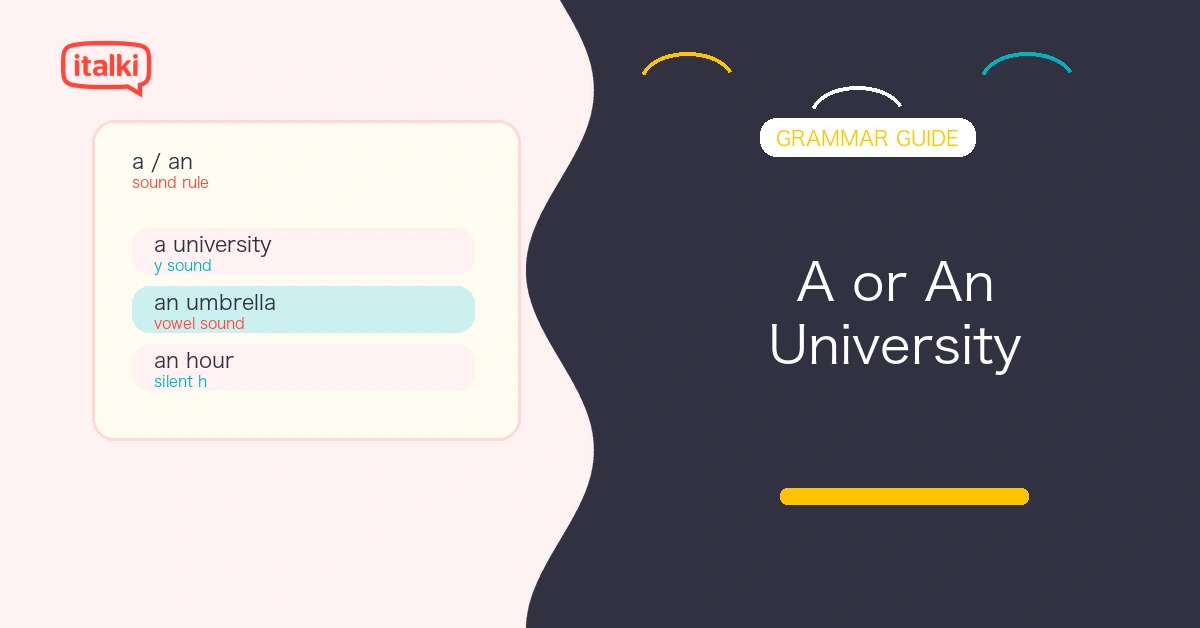
- “University” begins with a /juː/ sound (like “you”), which is a consonant sound.
- The same rule applies to similar words: “a uniform,” “a unique,” “a European,” “a useful.”
- “An” is correct before words that begin with a true vowel sound, even if the word starts with a consonant letter.
You see a word beginning with the letter “u” and reach for “an.” That instinct is right most of the time, but “university” is one of the exceptions where it leads you wrong. The rule is not about the letter the word starts with; it is about the sound.
This guide explains exactly why “a university” is correct, shows you the pattern behind similar words, and gives you the test to apply whenever you are unsure. With 150+ languages and 10M+ learners, italki connects you with English tutors who help you hear and practice the sound distinctions that drive English article usage.
The rule: sounds, not letters Use “a” before a consonant sound. Use “an” before a vowel sound. The /j/ sound (as in “you,” “yellow,” “yard”) is a consonant sound, even though it does not correspond to a vowel letter.

Find Your Perfect Teacher
Build real English confidence with personalized lessons from a teacher who matches your goals, schedule, and learning style.
Book a trial lesson
Why “university” takes “a”
The word “university” is spelled with a “u” but pronounced /juːnɪvɜːsɪti/. The first sound is /j/, the same consonant sound that begins “you,” “year,” and “yellow.” Because the word starts with a consonant sound, it takes “a.”
- Correct: a university
- Incorrect: an university
Other words that follow the same pattern
| Word | Pronunciation | Article | Example |
|---|---|---|---|
| uniform | /juːnɪfɔːm/ | a | a uniform |
| unique | /juːniːk/ | a | a unique opportunity |
| unit | /juːnɪt/ | a | a unit of measurement |
| union | /juːniən/ | a | a union meeting |
| useful | /juːsfʊl/ | a | a useful tool |
| European | /jʊərəˈpiːən/ | a | a European country |
| ewe | /juː/ | a | a ewe (female sheep) |
| eulogy | /juːlədʒi/ | a | a eulogy |
Practice pronunciation with online English teachers on italki to understand the sound patterns behind article choice.
Find Your Perfect Teacher
Build real English confidence with personalized lessons from a teacher who matches your goals, schedule, and learning style.
Book a trial lesson
Words that begin with a consonant letter but a vowel sound
| Word | Pronunciation | Article | Example |
|---|---|---|---|
| hour | /aʊər/ | an | an hour |
| honest | /ɒnɪst/ | an | an honest person |
| heir | /eər/ | an | an heir to the throne |
| honour | /ɒnər/ | an | an honour to be here |
Apply sound patterns to new words with an English tutor during conversation practice.
Abbreviations and acronyms
| Abbreviation | Spoken form | Article | Example |
|---|---|---|---|
| MBA | em-bee-ay | an | an MBA |
| FAQ | eff-ay-cue | an | an FAQ page |
| URL | you-are-el | a | a URL |
| FBI | eff-bee-eye | an | an FBI investigation |
Build automatic article choice through sound awareness. With 30,000+ expert tutors on italki, you can find an English tutor who offers pronunciation-focused lessons.Book a trial lesson today and practice reading words aloud with your teacher.
Find Your Perfect Teacher
Build real English confidence with personalized lessons from a teacher who matches your goals, schedule, and learning style.
Book a trial lesson
FAQ
Is “an historic” or “a historic” correct?
Both appear in published writing. In American English, the “h” in “historic” is almost always pronounced, making it a consonant sound and requiring “a historic.” “A historic” is the standard in most modern usage. Why do some style guides still write “an hotel”? This is a legacy of older pronunciation patterns where the “h” was not pronounced in certain words. Modern standard usage in both British and American English treats the “h” as pronounced in “hotel,” making “a hotel” the standard form. Does the rule apply to numbers? Yes. “An 8-hour shift” is correct (eight starts with the vowel sound /eɪ/). “A 1-year contract” is correct (one starts with the consonant sound /w/). Say the number aloud and apply the rule to what you hear.
Want to learn a language at italki?
Here are the best resources for you!