Key takeaways:
- Keigo (敬語) is necessary for Japanese business communication, with three levels: respectful, humble, and polite forms
- Learn basic workplace phrases before complex grammar to build confidence quickly
- Understanding Japanese workplace culture matters as much as language fluency for professional success
- Regular practice with native Japanese tutors helps you learn business Japanese faster than textbooks alone
- Why does Business Japanese differ from casual Japanese?
- What is keigo and why does it matter for Japanese professionals?
- Essential Japanese for work phrases
- How to build workplace-specific Japanese vocabulary
- Common mistakes people make with Japanese for work
- How to practice Japanese for work
- Understanding Japanese workplace culture alongside language
- Preparing for job interviews in Japanese
- Continuing your business Japanese journey
- FAQs
Learning Japanese for work opens doors to career opportunities across Japan’s thriving economy. Preparing for a job interview in Tokyo, communicating with Japanese clients, or relocating for a position in Osaka requires more than basic language skills. The Japanese language used in professional settings follows strict formality rules that don’t exist in casual conversation, making business-specific expressions and etiquette necessary to study.
This guide walks you through practical phrases, vocabulary, and cultural insights you need to communicate professionally in Japanese workplaces. You’ll learn the fundamentals of keigo (polite language), understand when to use different speech levels, and learn how to avoid common mistakes that trip up even advanced Japanese language learners.
Working with an experienced Japanese tutor who understands business contexts speeds up your progress significantly, providing real-world practice that textbooks miss.

Find Your Perfect Teacher
Your Japanese doesn’t have to sound like a textbook. Get personalized lessons from native tutors who’ll help you speak naturally, not just correctly.
Book a trial lesson
Why does Business Japanese differ from casual Japanese?
Japanese business language differs fundamentally from casual speech because it reflects the hierarchical structure of Japanese society and workplace relationships. In professional settings, you must constantly adjust your language based on the listener’s position, age, and relationship to you, using different verb forms and vocabulary to show appropriate respect.
While studying Japanese for daily life, you might use the plain dictionary form of verbs like 行く (iku, “to go”) or 食べる (taberu, “to eat”). At work, these become 行きます (ikimasu) or 参ります (mairimasu) depending on context, and 食べます (tabemasu) or いただきます (itadakimasu) when showing humility. This constant adjustment requires understanding grammar rules and the social distance between speakers.
Protip: Take the verb 行く (“to go”) from the example above. The single sentence “I’ll go to the meeting” has multiple variations: 会議に行く (kaigi ni iku), 会議に行きます (kaigi ni ikimasu), or 会議に参ります (kaigi ni mairimasu), each appropriate for different situations.
Japanese workplace culture emphasizes harmony and clear hierarchies. Your language choices signal your understanding of these unwritten rules. Speaking too casually to a superior damages professional relationships, while being overly formal with close colleagues might create unnecessary distance. This balance makes business Japanese particularly challenging for foreigners who come from more egalitarian workplace cultures.
Japanese people appreciate when foreigners make an effort to use proper workplace language, even with mistakes. Focus on learning core polite forms first, then gradually add respectful and humble variations as you gain experience.
What is keigo and why does it matter for Japanese professionals?
Keigo (敬語) is the system of honorific language in Japanese that expresses respect, humility, and politeness through specific word choices and grammatical structures. Using appropriate keigo demonstrates professional competence and cultural awareness in Japanese business settings, directly impacting how colleagues and clients perceive your credibility.
The Japanese language has three main levels of keigo that serve different functions:
1. Respectful form (尊敬語, Sonkeigo)
This form elevates the actions of the person you’re speaking to or about. You use sonkeigo when describing what your boss, client, or anyone in a higher position does.
| Plain Form | Respectful Form | Meaning |
|---|---|---|
| する (suru) | なさる (nasaru) / される (sareru) | to do |
| 言う (iu) | おっしゃる (ossharu) | to say |
| 来る (kuru) | いらっしゃる (irassharu) | to come |
| 見る (miru) | ご覧になる (goran ni naru) | to see |
| 食べる (taberu) | 召し上がる (meshiagaru) | to eat |
| 知る (shiru) | ご存知 (gozonji) | to know |
Example in context:
- Plain: 部長は資料を見ました (The manager saw the documents)
- Respectful: 部長は資料をご覧になりました (The manager saw the documents – showing respect)
2. Humble form (謙譲語, Kenjōgo)
This form lowers your own actions or your in-group’s actions when speaking to someone of higher status. By humbling yourself, you indirectly show respect to the listener.
| Plain Form | Humble Form | Meaning |
|---|---|---|
| する (suru) | いたす (itasu) | to do |
| 言う (iu) | 申す (mōsu) / 申し上げる (mōshiageru) | to say |
| 行く (iku) / 来る (kuru) | 参る (mairu) | to go/come |
| 聞く (kiku) | 伺う (ukagau) / 拝聴する (haichō suru) | to hear/ask |
| 見る (miru) | 拝見する (haiken suru) | to see |
| 食べる (taberu) | いただく (itadaku) | to eat |
| 知る (shiru) | 存じる (zonjiru) | to know |
Example in context:
- Plain: 私は明日会社に行きます (I will go to the company tomorrow)
- Humble: 私は明日会社に参ります (I will go to the company tomorrow – showing humility)
3. Polite form (丁寧語, Teineigo)
This is the basic polite level that adds です (desu) and ます (masu) endings to sentences. You use this as the foundation for all workplace communication, even with colleagues at similar levels.
| Plain Form | Polite Form | Extra Polite |
|---|---|---|
| だ (da) | です (desu) | でございます (de gozaimasu) |
| ある (aru) | あります (arimasu) | ございます (gozaimasu) |
| 行く (iku) | 行きます (ikimasu) | – |
| 見る (miru) | 見ます (mimasu) | – |
Example:
- Plain: これは私の資料だ (This is my document)
- Polite: これは私の資料です (This is my document)
- Extra polite: こちらは私の資料でございます (This is my document)
Understanding when to use each level requires awareness of the relationship dynamics. Generally, use respectful forms for superiors’ actions, humble forms for your own actions when addressing superiors, and polite forms as the baseline for professional conversation.
Find Your Perfect Teacher
Your Japanese doesn’t have to sound like a textbook. Get personalized lessons from native tutors who’ll help you speak naturally, not just correctly.
Book a trial lesson
Essential Japanese for work phrases
Learning a core set of Japanese for workplace phrases gives you the confidence to handle daily interactions while you continue building broader language skills. These expressions cover the most common situations in Japanese business environments.
Greetings and basic courtesies
| Situation | Japanese | Romaji | English |
|---|---|---|---|
| Morning greeting | おはようございます | Ohayō gozaimasu | Good morning |
| All-day greeting | お疲れ様です | Otsukaresama desu | Thank you for your hard work |
| Entering a room | 失礼します | Shitsurei shimasu | Excuse me |
| Leaving before others | お先に失礼します | Osaki ni shitsurei shimasu | Excuse me for leaving first |
| End of day | お疲れ様でした | Otsukaresama deshita | Good work today |
ProTip: Japanese workers say お疲れ様です (Otsukaresama desu) dozens of times per day. It works for passing colleagues in hallways, starting conversations, or acknowledging someone’s presence.
Phone and email expressions
| Purpose | Japanese | Romaji |
|---|---|---|
| Answering calls | お電話ありがとうございます | O-denwa arigatō gozaimasu |
| Business greeting | いつもお世話になっております | Itsumo osewa ni natte orimasu |
| Email opening | お世話になっております | Osewa ni natte orimasu |
| Regarding… | 〜の件でご連絡いたしました | ~ no ken de go-renraku itashimashita |
| Standard closing | 何卒よろしくお願いいたします | Nanitozo yoroshiku onegai itashimasu |
| Quick message closing | 取り急ぎご連絡まで | Toriisogi go-renraku made |
Requests and responses
| Type | Japanese | Romaji | Usage |
|---|---|---|---|
| Polite request | 〜していただけますか | ~ shite itadakemasu ka | Could you please…? |
| Very polite request | 〜をお願いできますでしょうか | ~ wo onegai dekimasu deshō ka | Would it be possible…? |
| Apology before request | 恐れ入りますが | Osore irimasu ga | I’m sorry to trouble you |
| Formal acceptance | かしこまりました | Kashikomarimashita | Certainly |
| Standard acceptance | 承知いたしました | Shōchi itashimashita | Understood |
| Immediate action | すぐに対応いたします | Sugu ni taiō itashimasu | I’ll handle it right away |
| Polite decline | 申し訳ございませんが | Mōshiwake gozaimasen ga | I’m terribly sorry, but… |
Meeting language
| Phase | Japanese | Romaji |
|---|---|---|
| Starting meeting | それでは始めさせていただきます | Soredewa hajime sasete itadakimasu |
| Thank you for gathering | 本日はお集まりいただきありがとうございます | Honjitsu wa o-atsumari itadaki arigatō gozaimasu |
| Please share opinions | ご意見をお聞かせください | Go-iken wo okikase kudasai |
| Request time | 少々お時間をいただけますか | Shōshō o-jikan wo itadakemasu ka |
| I have a question | 質問があるのですが | Shitsumon ga aru no desu ga |
| Thank you for today | 本日はありがとうございました | Honjitsu wa arigatō gozaimashita |
These phrases form the backbone of daily workplace interactions. Practice them until they become automatic for handling most common situations with confidence.
How to build workplace-specific Japanese vocabulary
Building business vocabulary requires focusing on high-frequency words within your specific industry while learning common verbs that appear across all professional contexts. Start with the most frequently used expressions in your field, then expand to general business terminology.
Key business verbs
These common verbs appear constantly in workplace conversations. Learn both their dictionary form and keigo variations:
| Dictionary Form | Meaning | Polite Form | Humble Form | Respectful Form |
|---|---|---|---|---|
| 行く (iku) | to go | 行きます (ikimasu) | 参ります (mairimasu) | いらっしゃいます (irasshaimasu) |
| 来る (kuru) | to come | 来ます (kimasu) | 参ります (mairimasu) | いらっしゃいます (irasshaimasu) |
| する (suru) | to do | します (shimasu) | いたします (itashimasu) | なさいます (nasaimasu) |
| 見る (miru) | to see | 見ます (mimasu) | 拝見します (haiken shimasu) | ご覧になります (goran ni narimasu) |
| 言う (iu) | to say | 言います (iimasu) | 申します (mōshimasu) | おっしゃいます (osshaimasu) |
| 聞く (kiku) | to hear/ask | 聞きます (kikimasu) | 伺います (ukagaimasu) | お聞きになります (o-kiki ni narimasu) |
| 食べる (taberu) | to eat | 食べます (tabemasu) | いただきます (itadakimasu) | 召し上がります (meshiagarimasu) |
| 知る (shiru) | to know | 知っています (shitte imasu) | 存じております (zonjite orimasu) | ご存知です (gozonji desu) |
The verb to work in Japanese: 働く (hataraku) is the main verb meaning “to work.” In business settings, you’ll typically say 働いています (hataraite imasu) for “I work” or 勤めています (tsutomete imasu) meaning “I’m employed at.” When describing your company, use 勤務しております (kinmu shite orimasu) for a humble, professional tone.
Industry-specific vocabulary
Different professions require different vocabulary priorities. Here’s how to approach learning for common fields:
| Industry | Core Terms | Japanese | Romaji |
|---|---|---|---|
| IT & Tech | System | システム | shisutemu |
| Development | 開発 | kaihatsu | |
| Project | プロジェクト | purojekuto | |
| Specifications | 仕様書 | shiyōsho | |
| Deadline | 納期 | nōki | |
| Sales & Marketing | Sales | 営業 | eigyō |
| Customer/Client | 顧客 | kokyaku | |
| Proposal | 提案 | teian | |
| Contract | 契約 | keiyaku | |
| Sales revenue | 売上 | uriage | |
| Finance | Accounting | 会計 | kaikei |
| Budget | 予算 | yosan | |
| Expenses | 経費 | keihi | |
| Settlement | 決算 | kessan | |
| Profit | 利益 | rieki |
Rather than memorizing random business words, create a personal vocabulary list from actual documents, emails, and meetings you encounter. This contextual learning helps you remember words and understand their proper usage.
Common office vocabulary
| Category | Term | Japanese | Romaji |
|---|---|---|---|
| Titles | Company president | 社長 | shachō |
| Department manager | 部長 | buchō | |
| Section chief | 課長 | kachō | |
| Senior colleague | 先輩 | senpai | |
| Junior colleague | 後輩 | kōhai | |
| Office items | Meeting room | 会議室 | kaigishitsu |
| Materials/Documents | 資料 | shiryō | |
| Paperwork | 書類 | shorui | |
| Business card | 名刺 | meishi | |
| Tea | お茶 | o-cha | |
| Time | Business hours | 営業時間 | eigyō jikan |
| Deadline | 締め切り | shimekiri | |
| Overtime work | 残業 | zangyō | |
| Break | 休憩 | kyūkei | |
| Year-end period | 年末年始 | nenmatsu nenshi |
The honorific prefixes お (o-) and ご (go-) appear frequently with workplace vocabulary. You’ll hear お茶 (o-cha) rather than just 茶 (cha), and ご意見 (go-iken) instead of 意見 (iken). These small additions make your Japanese speech more polite and natural.
Consistent practice with these vocabulary categories builds a strong foundation. Working with teachers specializing in Japanese for work helps you learn which words are appropriate for different situations and relationships.
Find Your Perfect Teacher
Your Japanese doesn’t have to sound like a textbook. Get personalized lessons from native tutors who’ll help you speak naturally, not just correctly.
Book a trial lesson
Common mistakes people make with Japanese for work
Foreigners most commonly struggle with choosing the appropriate keigo level for different workplace relationships, often using polite style when they should use humble forms or vice versa. This confusion stems from not understanding whose action is being described, the speaker’s, the listener’s, or a third party’s.
1. Mixing casual and business language
| Error Type | Wrong | Correct | Why |
|---|---|---|---|
| Using humble for others | 部長は明日参ります | 部長は明日いらっしゃいます | 参る is humble; use respectful いらっしゃる for your boss |
| Using respectful for yourself | 私は資料をご覧になりました | 私は資料を拝見いたしました | ご覧になる elevates you; use humble 拝見する instead |
2. Incorrect honorific prefix usage
| Always Use Prefix | Never Use Prefix |
|---|---|
| お名前 (o-namae) – name | 私 (watashi) – I/me |
| ご住所 (go-jūsho) – address | あなた (anata) – you |
| お電話 (o-denwa) – telephone | パソコン (pasokon) – computer |
| ご意見 (go-iken) – opinion | レポート (repōto) – report |
Generally, use お (o-) with words of Japanese origin and ご (go-) with words of Chinese origin (kanji compounds). Many exceptions exist, making this an area where exposure to natural Japanese speech helps more than memorizing rules.
3. Incorrect pronoun usage
| Context | Use | Avoid |
|---|---|---|
| Formal “I” | 私 (watashi) | 俺 (ore), 僕 (boku) |
| Humble “we” | 私ども (watakushidomo) | – |
| Addressing people | [Name]さん or title | あなた (anata) |
Japanese people typically address others by name plus さん (san) or by title (部長、課長) rather than using “you.” Saying 田中さんはどう思われますか (Tanaka-san wa dō omowaremasu ka, “What do you think, Tanaka-san?”) sounds more natural than using あなた.
4. Mixing casual and business language
Common mixing error:
- “田中さん、資料見た?” (Tanaka-san, shiryō mita?) – using polite さん but casual verb form
- Better: “田中さん、資料をご覧になりましたか?” (Tanaka-san, shiryō wo goran ni narimashita ka?)
This mistake happens when Japanese language learners know business vocabulary but haven’t internalized that every verb needs appropriate conjugation. Even simple words like 見る (miru, “to see”) need careful attention in workplace contexts.
How to practice Japanese for work
The best way to learn Japanese for work is through regular conversation practice with native Japanese business teachers who correct your keigo usage in real time and explain the nuances behind different expressions. Textbooks teach grammar patterns, but workplace language requires understanding context and relationship dynamics that only emerge through practice.
1. Structured learning with native Japanese tutors
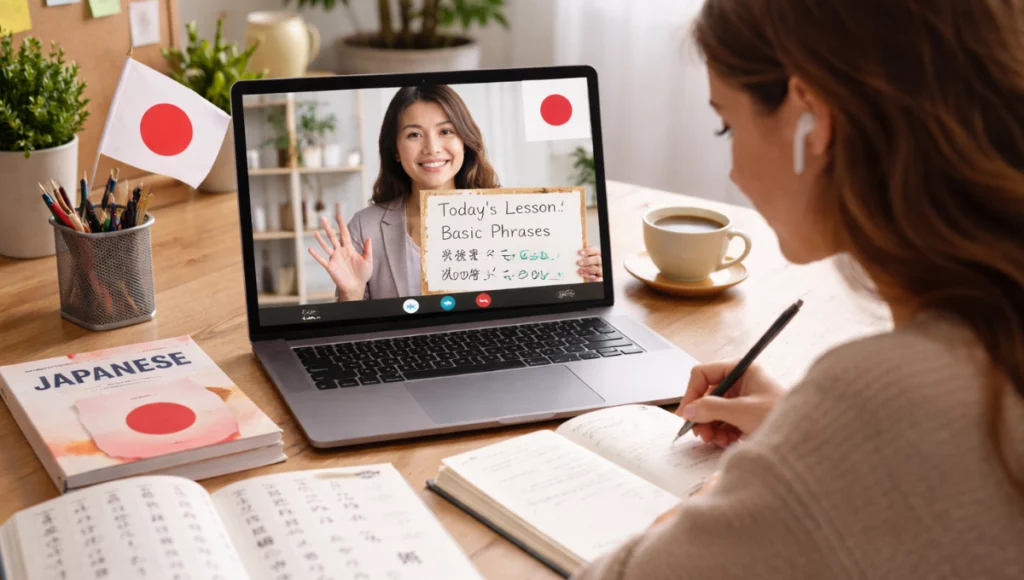
Working with experienced tutors provides immediate feedback on subtle mistakes that written exercises miss. A good Japanese teacher notices when you use respectful language where humble language belongs, or when your tone doesn’t match the situation.
italki connect you with over 1000Japanese teachers who specialize in different aspects of the language. Many tutors have professional experience in Japanese companies and share real workplace scenarios during lessons. This practical approach beats studying from teaching materials alone because you learn how Japanese people talk at work, not just textbook examples.
What to practice in tutoring sessions:
- Role-playing common workplace scenarios (meetings, phone calls, client interactions)
- Reviewing actual emails or documents you need for work
- Discussing industry-specific vocabulary relevant to your field
- Getting corrections on subtle keigo mistakes you make repeatedly
- Understanding cultural context behind different expressions
Find Your Perfect Teacher
Your Japanese doesn’t have to sound like a textbook. Get personalized lessons from native tutors who’ll help you speak naturally, not just correctly.
Book a trial lesson
2. Immersion through real workplace materials
| Material Type | How to Use |
|---|---|
| Business emails | Note common opening/closing phrases, request patterns |
| Company announcements | Study formal writing style, internal communication norms |
| Industry publications | Build field-specific vocabulary, professional writing patterns |
| Business podcasts | Train ear for natural keigo usage, conversational flow |
| LinkedIn posts | Observe how professionals discuss work topics |
Read these materials actively, noting phrases you don’t understand and researching their components. When you see 〜させていただく (sasete itadaku) appearing frequently, investigate why this humble expression is so common in business writing. Understanding patterns through real examples makes them stick better than memorizing isolated grammar points.
For a comprehensive overview of different Japanese learning resources, explore various options that complement your business Japanese study.
3. Structuring your practice by level
| Level | Focus Areas | Activities |
|---|---|---|
| Beginner | Polite style (です/ます) | Memorize set phrases, use scripts for calls |
| Common workplace greetings | Practice introductions, basic requests | |
| Intermediate | Humble and respectful forms | Handle unpredictable conversations |
| Email writing | Draft messages with proper formality | |
| Advanced | Natural formality switching | Navigate complex diplomatic situations |
| Regional variations | Understand industry-specific expressions |
Start with scripts and gradually move toward spontaneous conversation as your confidence builds.
Each level requires different practice approaches. Don’t rush to advanced topics if your foundation in polite style isn’t solid. Japanese business language has various levels of formality, and you’ll have better results building them progressively.
4. Daily study routine (30-45 minutes)
| Time | Activity | Purpose |
|---|---|---|
| 10 min | Review vocabulary flashcards | Reinforce previous learning |
| 15 min | Read business email or article | Exposure to authentic materials |
| 15-20 min | Speaking practice | Conversation exchange or tutoring |
| 5 min | Write one paragraph | Apply new vocabulary and grammar |
Focus practice sessions around situations you’ll face. Preparing for a job interview next month means dedicating more time to self-introduction phrases and discussing your experience. Planning to write client emails means spending extra time on business writing conventions.
5. Language exchange and community
Language exchange partners provide free conversation practice, though they typically don’t offer the structured feedback that professional tutors provide.
Making language exchange work:
- Find partners who work in professional settings
- Set clear goals for each session (practice phone conversations, review presentation slides)
- Ask specific questions about word choices and formality levels
- Record sessions to review your mistakes later
Combining language exchange for casual practice with Business Japanese lessons for structured learning creates balance. The free conversation helps you build fluency, while guided instruction builds correct habits. If you’re exploring where to learn Japanese and comparing different options, consider mixing several approaches for comprehensive skill development.
Over 5 million learners have used italki’s platform because it offers flexibility that traditional classroom settings miss. You schedule lessons around your work schedule, focus on exactly the skills you need, and progress at your own pace. This personalized approach works well for professionals who need specific business Japanese skills rather than general language study.
Understanding Japanese workplace culture alongside language
Language proficiency alone won’t make you function well in Japanese business settings without understanding the cultural context that shapes workplace communication. Japanese culture emphasizes group harmony, respect for hierarchy, and indirect communication styles that differ significantly from Western business norms.
Hierarchy and relationships in Japanese companies
Japanese organizations operate on clear hierarchical structures where seniority and position determine communication patterns. Your language choices must reflect these relationships.
| R/ship Type | Japanese | Meaning | Impact on Language |
|---|---|---|---|
| Senior/Junior | 先輩・後輩 (Senpai/Kōhai) | Based on join date | Use respectful language to seniors |
| Superior/Subordinate | 上司・部下 (Jōshi/Buka) | Organizational position | Adjust keigo level accordingly |
| In-group/Out-group | 内・外 (Uchi/Soto) | Company boundaries | Humble language for in-group to outsiders |
When representing your company to outsiders, you use humble language for your own company’s actions (including your boss’s) and respectful language for the client’s company, regardless of actual positions. This uchi/soto (in-group/out-group) dynamic confuses beginners who expect to always elevate their boss.
Example: When telling a client what your manager said:
- Don’t say: 部長がおっしゃっていました (Buchō ga osshatte imashita) – “My manager said…” Using respectful language for your own boss
- Say: 部長が申しておりました (Buchō ga mōshite orimashita) – “My manager said…”
Using humble language because you’re speaking to an outsider
Your manager becomes part of your in-group when speaking to outsiders, so you humble their actions to elevate the client.
Reading between the lines in Japanese communication
| Phrase | Literal Meaning | Actual Meaning |
|---|---|---|
| 検討させていただきます | I’ll consider it | This is unlikely to happen |
| 前向きに考えます | I’ll think positively | I’m interested but need internal discussion |
| 難しいかもしれません | It might be difficult | This won’t work |
| ちょっと… | A little… | Polite refusal |
Japanese people value harmony (和, wa) and avoid direct confrontation. A soft “no” maintains the relationship better than a harsh rejection. Foreign professionals often miss these signals, taking polite deflections as genuine interest.
Protip: Pay attention to hesitation words like ちょっと (chotto, “a little”) and そうですね (sō desu ne, “well…”). When someone says “ちょっと難しいですね” (chotto muzukashii desu ne), they’re politely declining, not asking for solutions to overcome difficulty.
Business card exchange protocol
| Step | Action | Cultural Significance |
|---|---|---|
| 1 | Present with both hands, text facing recipient | Shows respect through physical gesture |
| 2 | Say よろしくお願いします | Establishes relationship |
| 3 | Receive with both hands | Acknowledges the person’s importance |
| 4 | Read carefully | Shows genuine interest |
| 5 | Place on table during meeting | Keeps hierarchy visible |
| 6 | Store respectfully in card case | Final show of respect |
Never write on someone’s business card in front of them, fold it, or put it in your back pocket. These actions show disrespect to the person.
Meeting behavior follows structured patterns. Arrive 5-10 minutes early, wait to be seated (with the highest-ranking person furthest from the door), and let senior people speak first unless asked for your opinion.
Gift-giving in business
| Occasion | Japanese | When |
|---|---|---|
| After trips | お土産 (omiyage) | Return from business travel |
| Year-end | お歳暮 (oseibo) | December, for important clients |
| Mid-year | お中元 (ochūgen) | July, for important clients |
| First visit | 手土産 (temiyage) | Visiting someone’s office |
Gifts should be nicely wrapped, presented with both hands, and accompanied by humble phrases like “つまらないものですが” (tsumaranai mono desu ga, “It’s nothing special, but…”). This ritual humility is expected even for expensive gifts.
Working hours and dedication expectations
Japanese workplace culture historically valued long hours and visible dedication, though this is gradually changing among younger professionals and foreign companies.
Understanding workplace norms:
- Arriving before your boss shows dedication
- Leaving after your boss shows respect (though becoming less strict)
- Drinking parties (飲み会, nomikai) with colleagues build relationships
- Refusing social invitations harms team dynamics
These expectations vary significantly by company culture and industry. Tech startups and foreign companies in Japan typically have more relaxed approaches than traditional Japanese corporations. When interviewing or joining a company, observe these patterns to understand expectations.
The concept of 空気を読む (kūki wo yomu, “reading the air”) means understanding unspoken expectations and group dynamics. This skill matters as much as language proficiency for success in Japanese workplaces.
Find Your Perfect Teacher
Your Japanese doesn’t have to sound like a textbook. Get personalized lessons from native tutors who’ll help you speak naturally, not just correctly.
Book a trial lesson
Preparing for job interviews in Japanese
Job interviews in Japan follow specific patterns and expectations that differ from Western interview practices. Preparation requires understanding both the language and the cultural scripts that govern these interactions.
Standard interview questions
| Question Type | Japanese | What to Prepare |
|---|---|---|
| Self-introduction | 自己紹介をお願いします | 2-minute background summary |
| Motivation | 志望動機は何ですか | Specific reasons for this company |
| Strengths | 長所は何ですか | Examples from past work |
| Weaknesses | 短所は何ですか | Self-awareness + improvement plan |
| Career goals | 将来の目標は何ですか | Long-term commitment to company |
Self-introduction opening: “本日はお時間をいただき、ありがとうございます。私は[名前]と申します。” (Honjitsu wa o-jikan wo itadaki, arigatō gozaimasu. Watashi wa [name] to mōshimasu.) “Thank you for your time today. My name is [name].”
Follow with brief background on education and experience, keeping it under 2 minutes unless asked to elaborate.
Language proficiency levels
| JLPT Level | Business Readiness | Typical Job Requirements |
|---|---|---|
| N5-N4 | Basic daily conversation only | Not sufficient for work |
| N3 | Simple business tasks with support | Entry-level with training |
| N2 | Most business situations | Standard requirement |
| N1 | Near-native proficiency | Preferred for business roles |
JLPT certification helps for initial screening, but practical business Japanese ability matters more in work. An N2 holder who studied business Japanese specifically functions better than an N1 holder who primarily studied academic Japanese.
If you’re just starting your JLPT journey, check out this comprehensive JLPT N5 Study Guide and JLPT N5 Vocabulary to understand the foundational level.
Presenting your experience
When discussing your background and accomplishments, balance confidence with humility. Japanese business culture values modesty, so frame achievements as team efforts rather than personal triumphs.
| Approach | Example | Result |
|---|---|---|
| Good | チームで協力して、売上を20%向上させることができました “Working together as a team, we increased sales by 20%” | Shows team orientation |
| Avoid | 私が売上を20%向上させました “I increased sales by 20%” | Too self-centered for Japan |
This doesn’t mean hiding your contributions, but acknowledging the collaborative context in which you achieved results.
Recommended reading: More Japanese language guides:
- Japanese for Family and Relationships: The Ultimate Guide
- Learn Basic Japanese for Travel: Essential Phrases and Tips
- Best Business Japanese Courses Online
Continuing your business Japanese journey
Learning Japanese for work is a long-term investment that opens career opportunities and deepens cultural understanding. Progress happens through consistent practice, willingness to make mistakes, and regular exposure to workplace situations.
Your journey with business Japanese moves through distinct phases. Initially, focus on core polite expressions and building vocabulary for your specific industry. As confidence grows, incorporate humble and respectful forms into your active usage. Eventually, you’ll handle complex situations, reading subtle cues in Japanese society and adjusting your language naturally based on context.
The most successful Japanese language learners combine multiple approaches: structured lessons with qualified Japanese teachers, regular practice with native speakers, immersion in authentic materials, and real workplace application. Each element reinforces the others, creating a comprehensive learning system.
Professional guidance speeds up this process significantly. While self-study teaches grammar rules, experienced tutors help you understand when to break those rules, why certain phrases sound natural in specific contexts, and how to recover gracefully from mistakes. They bring the cultural insight that textbooks miss.
Ready to advance your business Japanese skills? Learn faster with personal guidance from expert Japanese teachers trusted by over 5 million learners worldwide.
Book a trial lesson today and start practicing real workplace scenarios with teachers who understand professional Japanese contexts.
Find Your Perfect Teacher
Your Japanese doesn’t have to sound like a textbook. Get personalized lessons from native tutors who’ll help you speak naturally, not just correctly.
Book a trial lesson
FAQs
How to learn Japanese for a job?
Start with a qualified Japanese language tutor who has business language experience to build proper foundations in keigo from day one. Combine regular lessons focusing on workplace scenarios with daily practice using business materials like emails and industry publications. Target JLPT N2 level minimum for most professional positions, prioritizing practical speaking and writing skills over test preparation. Most learners need 6-12 months of focused study to reach basic workplace competency with intermediate Japanese, or 2-3 years starting from scratch.
What is the Japanese verb “to work”?
The primary verb is 働く (hataraku), meaning “to work” in general. In professional settings, you’ll more commonly use 勤めています (tsutomete imasu) meaning “I’m employed at [company]” or 勤務しております (kinmu shite orimasu) for a formal, humble version. The verb する (suru) also appears frequently: 仕事をする (shigoto wo suru) means “to do work.”
What does keigo mean in Japanese?
Keigo (敬語) means “respectful language” – the system of specialized vocabulary and grammar that expresses respect, humility, and politeness in Japanese. It has three main categories: respectful form (尊敬語) for elevating others’ actions, humble form (謙譲語) for lowering your own actions, and polite form (丁寧語) for general courtesy. Learning keigo distinguishes basic Japanese speakers from those who function professionally in Japanese workplaces.
What is the difference between keigo and normal Japanese?
Keigo transforms vocabulary and verb forms to show respect, while normal Japanese uses plain dictionary forms without these modifications. For example, “to do” is する (suru) in normal Japanese, but becomes いたします (itashimasu) in humble keigo or なさいます (nasaimasu) in respectful keigo. Normal Japanese works for close friends and casual situations, but keigo is mandatory in business settings to show appropriate respect for colleagues, clients, and superiors.
Want to learn a language at italki?
Here are the best resources for you!