Key takeaways
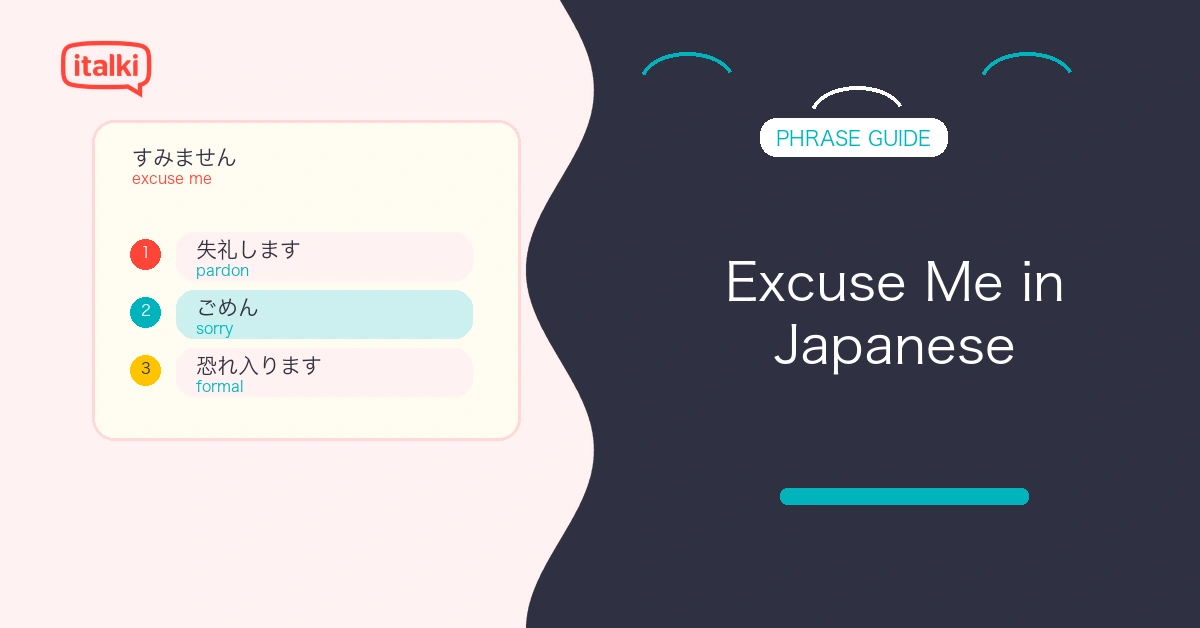
- すみません (sumimasen) is the most versatile expression for excuse me in Japanese and is used to get someone’s attention, thank someone briefly, and offer a light apology; it is appropriate in almost any daily situation
- 失礼します (shitsurei shimasu) literally means I am being rude/discourteous and is used in formal or professional settings: entering a room, walking in front of someone, leaving a meeting before it ends, or ending a phone call
- ごめんなさい (gomen nasai) is a genuine personal apology for something you have done, and is more appropriate for interpersonal situations than for getting attention or navigating through a crowd
- The choice between these expressions is determined by the context and your relationship with the other person, not just translation equivalency
Japanese has multiple ways to say excuse me, and using the wrong one can signal the wrong level of formality or the wrong social intent. Unlike English, where excuse me covers getting attention, passing by someone, and apologizing for a small error, Japanese distributes these functions across different expressions depending on context and register.
italki connects learners with Japanese teachers who can guide you through the situational distinctions that textbooks often compress into a single translation.
This guide covers the main expressions for excuse me in Japanese, their formality levels, when to use each one, and how to respond when someone says these phrases to you.

Find your perfect teacher
Build real speaking confidence with personalized lessons from a teacher who matches your goals, schedule, and learning style.
Book a trial lesson
すみません (sumimasen): the everyday standard
すみません (sumimasen) is the single most useful expression for daily life in Japan. It covers three main uses:
1. Getting someone’s attention:
- In a restaurant, cafe, or shop: すみません!(sumimasen!) to call the server or staff
- Asking a passerby for directions: すみません、駅はどこですか?(sumimasen, eki wa doko desu ka: Excuse me, where is the train station?)
- Addressing someone on the street or in a public space
2. Thanking someone informally: When someone does something kind for you and a full 「ありがとうございます」 (arigatou gozaimasu) feels like the right level, すみません signals both gratitude and a slight sense of being indebted. You will hear native speakers say すみません when someone holds a door or hands them something.
3. Light apology or brief sorry:
- Brushing past someone: すみません (as you move by)
- Being slightly late: すみません、遅くなりました (sumimasen, osoku narimashita: sorry for being late)
- Correcting a small error
Formality: Polite and appropriate for most everyday contexts. Not so formal that it feels stiff, not so casual that it feels insufficient.
Note: すみません comes from the verb 済む (sumu: to come to an end, to be settled), through the negative form 済みません (my debt/guilt is not yet settled). The nuance is that you feel the other person has gone to trouble on your account and you cannot fully repay it.
失礼します (shitsurei shimasu): formal and professional
失礼します (shitsurei shimasu) means I am committing a rudeness or excuse my discourtesy. It is the formal register equivalent of すみません for specific professional and social situations.
When to use 失礼します:
| Situation | Example use |
|---|---|
| Entering a room (office, teacher’s room, meeting room) | ドアをノックして、失礼します (knock, then say shitsurei shimasu as you enter) |
| Walking in front of someone (passing between people, crossing in front of a screen) | 失礼します (as you walk through) |
| Leaving a meeting or room before others | お先に失礼します (osaki ni shitsurei shimasu: excuse me for leaving first) |
| Ending a business phone call | では、失礼します (dewa, shitsurei shimasu: well then, excuse me) |
| Ending a business meeting | 失礼します (as you bow and depart) |
| Asking to look at something, move something, or touch an object belonging to someone else | 失礼します (before reaching over or touching) |
Key phrase: お先に失礼します (osaki ni shitsurei shimasu) literally means excuse me for going first/ahead. This is the standard phrase for leaving the office before your colleagues or superiors, with the implication that you are sorry for leaving while others are still working.
Formality: Business and formal social register. Appropriate with people of higher status, clients, customers, teachers, and in any situation where politeness level matters.
Find your perfect teacher
Build real speaking confidence with personalized lessons from a teacher who matches your goals, schedule, and learning style.
Book a trial lesson
失礼いたします (shitsurei itashimasu): extra polite
失礼いたします (shitsurei itashimasu) is the most formal and deferential version. いたします (itashimasu) is the humble form of します (shimasu), lowering the speaker’s own status further.
This form is used:
- By customer service staff (front desk, hotel staff, retail)
- In very formal business situations with clients or senior executives
- In formal written communication endings (letters and emails sometimes use 失礼いたします as a closing)
For most daily situations, 失礼します is sufficient. 失礼いたします signals keigo (敬語: honorific language) and marks professional service or very high formality.
ごめんなさい (gomen nasai): genuine apology
ごめんなさい (gomen nasai) is a sincere personal apology for something you have done or caused. It is not used for getting attention or navigating crowds.
Use ごめんなさい when:
- You have made a real mistake that affected someone: ごめんなさい、あなたのコーヒーをこぼしてしまいました (gomen nasai, anata no koohii wo koboshite shimaimashita: I’m sorry, I spilled your coffee)
- You are apologizing to a friend or someone you know: ごめん!忘れてた!(gomen! wasurete ta: Sorry! I forgot!)
- You are declining an invitation or refusing something with regret: ごめんなさい、その日は行けません (gomen nasai, sono hi wa ikemasen: I’m sorry, I can’t go that day)
Formality: Polite in its full form. The shortened ごめん (gomen) is casual and used between friends, family, and people of equal or lower status.
Do not use ごめんなさい to get a waiter’s attention or to excuse yourself from passing by someone. For those situations, すみません is the correct choice.
Find your perfect teacher
Build real speaking confidence with personalized lessons from a teacher who matches your goals, schedule, and learning style.
Book a trial lesson
ちょっとすみません (chotto sumimasen): brief excuse me
ちょっとすみません (chotto sumimasen) means excuse me for a moment or pardon me just briefly. It softens the request and is appropriate when:
- You need to interrupt a conversation briefly
- You need to ask for someone’s attention but feel the request is minor
- You are stepping away from a group for a moment
ちょっと (chotto) on its own means a little or for a moment and softens the directness of すみません. Alone, ちょっと is also used to decline politely without a full explanation: ちょっと… (chotto…) said with a trailing-off tone means that would be a bit difficult or I’m not sure about that.
失礼しました (shitsurei shimashita): past tense apology
失礼しました (shitsurei shimashita) is the past tense of 失礼します. It is used to apologize for something that just happened rather than as a current politeness marker.
- After walking in front of someone without warning
- After saying something that came out wrong
- After making a small social error in a formal setting
The difference from 失礼します is timing: 失礼します is used before or during the action; 失礼しました is used after it to acknowledge the rudeness.
Find your perfect teacher
Build real speaking confidence with personalized lessons from a teacher who matches your goals, schedule, and learning style.
Book a trial lesson
通してください (tōshite kudasai): please let me through
通してください (tōshite kudasai) means please let me pass or please let me through. It is used in crowded spaces (trains, elevators, busy hallways) when you need to physically move through a group of people.
- On a crowded train to exit at your stop: 通してください!
- In a busy elevator or corridor
This is more direct and specific than すみません and is preferred when you are literally trying to get through a physical crowd.
すみませんが (sumimasen ga): preface to a request
すみませんが (sumimasen ga) adds が (ga: but) to すみません to preface a question or request. The が signals that you know you are imposing and softens what follows.
- すみませんが、写真を撮っていただけますか?(sumimasen ga, shashin wo totte itadakemasu ka: Excuse me, could you please take a photo for us?)
- すみませんが、道を聞いてもいいですか?(sumimasen ga, michi wo kiite mo ii desu ka: Excuse me, may I ask for directions?)
This construction is more polite and slightly more formal than bare すみません followed by a request and is the recommended form when asking a stranger for help.
Find your perfect teacher
Build real speaking confidence with personalized lessons from a teacher who matches your goals, schedule, and learning style.
Book a trial lesson
Casual register expressions
For friends and casual situations:
| Expression | Pronunciation | Use |
|---|---|---|
| ごめん | gomen | Casual sorry / my bad (between friends) |
| わるい / 悪い | warui | Casual my bad (often used by men) |
| すまない / すまん | sumanai / suman | Casual/archaic excuse me / I’m sorry (often by men; sounds slightly old-fashioned) |
| チョイ待って | choi matte | Wait a sec / Hold on (very casual) |
These are inappropriate in formal contexts and with people of higher status. With friends, family, and peers in casual settings, they are natural and common.
Situations guide: which expression to use when
| Situation | Best expression |
|---|---|
| Calling a restaurant server | すみません (sumimasen) |
| Asking a stranger for directions | すみませんが (sumimasen ga) + question |
| Passing through a crowded train | 通してください (tōshite kudasai) |
| Entering a colleague’s office | 失礼します (shitsurei shimasu) |
| Leaving work before your boss | お先に失礼します (osaki ni shitsurei shimasu) |
| Apologizing to a friend for being late | ごめん!(gomen) |
| Apologizing formally for a mistake at work | 申し訳ございません (moushiwake gozaimasen: the most formal apology) |
| Bumping into someone in the street | すみません (sumimasen) |
| Ending a business phone call | 失礼します (shitsurei shimasu) |
| Interrupting someone briefly | ちょっとすみません (chotto sumimasen) |
Find your perfect teacher
Build real speaking confidence with personalized lessons from a teacher who matches your goals, schedule, and learning style.
Book a trial lesson
Responding when someone says excuse me to you
When someone says すみません to you in a service context (a shop, restaurant), you do not need to say anything: just respond to what they need. If they are apologizing, respond with:
- いいえ、大丈夫ですよ (iie, daijoubu desu yo: No, it’s fine / No worries)
- 気にしないでください (ki ni shinai de kudasai: Please don’t worry about it)
- 大丈夫です (daijoubu desu: It’s fine / No problem)
If someone says 失礼します as they pass through or enter, a slight nod or no response at all is normal. In an office, you might respond with a brief どうぞ (douzo: please go ahead) or nothing.
Practice natural Japanese with a tutor
Knowing which expression to use in which situation is the kind of knowledge that comes most naturally from immersed, conversational practice rather than from reading a list. A native speaker can tell you immediately whether your choice sounds natural, too formal, too casual, or slightly off, in a way that written explanations cannot replicate. italki has 30,000+ expert tutors trusted by over 10 million learners worldwide, including Japanese tutors who can role-play everyday situations with you and help you develop the instinct for register and context that native speakers acquire over years. Book a trial lesson and start building natural Japanese communication.
Find your perfect teacher
Build real speaking confidence with personalized lessons from a teacher who matches your goals, schedule, and learning style.
Book a trial lesson
FAQ
Is すみません or ごめんなさい more appropriate for a genuine apology?
It depends on what you are apologizing for and to whom. For something minor in passing (bumping into someone, a brief interruption), すみません is sufficient and natural. For a real mistake where you caused inconvenience or hurt someone, ごめんなさい is more appropriate as it conveys genuine personal remorse. In formal or business contexts, 申し訳ありません (moushiwake arimasen) or 申し訳ございません is the most serious apology and is used for significant mistakes at work or formal situations.
Why do Japanese people sometimes say すみません when they mean thank you?
Using すみません as thanks reflects the Japanese cultural tendency to frame receiving help as creating an imposition on the giver rather than simply receiving a benefit. Saying すみません when someone does something kind implies: I am sorry for the trouble I have caused you by needing this. This is socially appropriate in Japan and signals humility. It does not mean the person is not grateful; it is a culturally encoded way of expressing gratitude through the acknowledgment of obligation.
What is the difference between 申し訳ありません and ごめんなさい?
ごめんなさい is a personal, direct apology used in everyday situations and is most natural in informal or semi-formal contexts. 申し訳ありません (moushiwake arimasen) is a formal and humble apology, literally meaning there is no excuse (for what I have done). It is the appropriate choice for serious professional mistakes, significant inconveniences caused to others, or any formal setting where a full-register apology is warranted. 申し訳ございません (moushiwake gozaimasen) is the even more polite form, used in customer service and very formal business contexts.
Want to learn a language at italki?
Here are the best resources for you!