Key takeaways
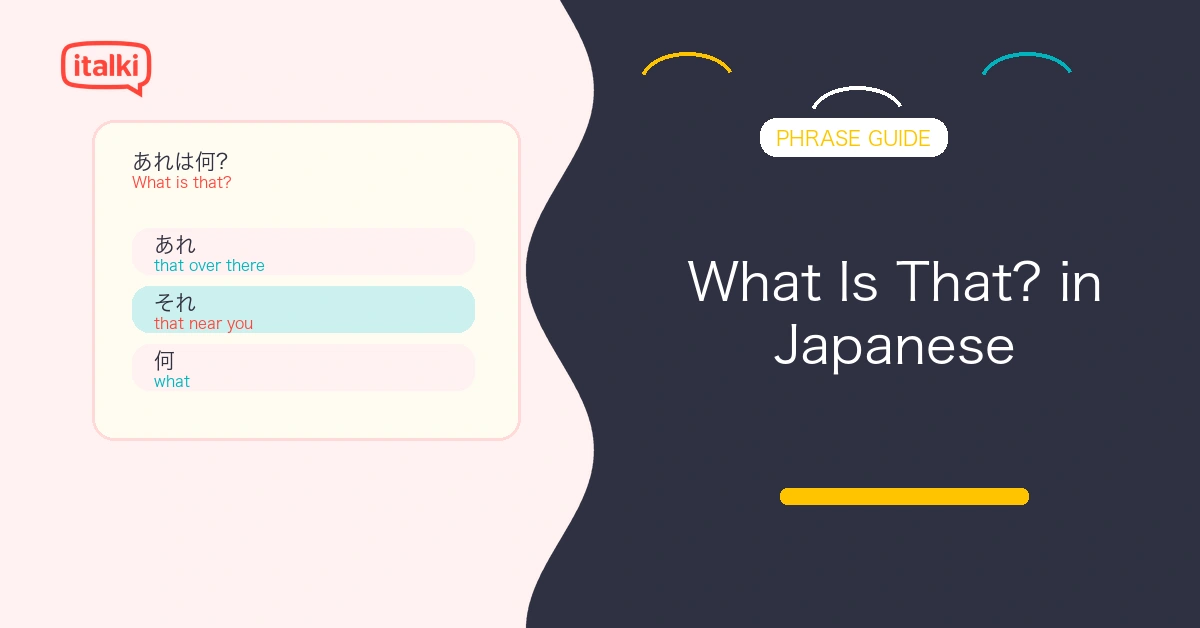
- あれは何ですか (are wa nan desu ka) means “what is that?” for objects far from both speaker and listener.
- Japanese uses three demonstratives: これ (kore) for near you, それ (sore) for near the listener, and あれ (are) for far from both.
- 何 is read as “nan” before desu and “nani” when it stands alone or before most other words.
- In casual speech, あれ何? (are nani?) works between friends without formal sentence structure.
- When someone answers your question, they typically switch to それは (sore wa) in their response.
Most learners assume Japanese has one word for “that,” the way English does. In reality, Japanese has three separate words. Each one is tied to a specific distance, and native speakers notice immediately if you pick the wrong one.
This guide covers the three-demonstrative system (これ, それ, あれ), how to form あれは何ですか, how to give and receive answers, and how to make the question more casual or more formal depending on the situation. italki is one of the most trusted places for learning Japanese online.
With 30,000+ expert tutors and over 10 million learners across 190+ countries, it connects you with a native Japanese tutor for live, one-on-one lessons that fit around your schedule. You can drill these patterns with someone who understands exactly where learners struggle.
Browse Japanese tutors on italki and book a trial lesson before committing to a regular schedule.

Find Your Perfect Teacher
Build real speaking confidence with personalized lessons from a teacher who matches your goals, schedule, and learning style.
Book a trial lesson
The demonstrative system: kore, sore, are
English uses “this” (near) and “that” (far). Japanese uses three levels of distance:
| Japanese | Romaji | English | When to use |
|---|---|---|---|
| これ | kore | This | Near the speaker |
| それ | sore | That | Near the listener |
| あれ | are | That (over there) | Far from both speaker and listener |
“What is that?” in Japanese depends on where the object actually is. If it is close to the person you are talking to, use それは何ですか (sore wa nan desu ka). If it is far from both of you, use あれは何ですか (are wa nan desu ka). In English, both collapse into “that.” In Japanese, the distinction is kept, and using the wrong demonstrative sounds as odd to a native speaker as saying “this” for something on the other side of the room. The kore-sore-are distinction is one of those rules that becomes intuitive once you use it a few times in context.. Book a trial lesson today and practice this with a Japanese teacher.
How to say “what is that?” in Japanese
| Japanese | Romaji | English |
|---|---|---|
| あれは何ですか | are wa nan desu ka | What is that (over there)? |
| それは何ですか | sore wa nan desu ka | What is that (near you)? |
| これは何ですか | kore wa nan desu ka | What is this (near me)? |
The sentence structure is: demonstrative + は (wa: topic marker) + 何 (nan: what) + ですか (desu ka: polite question ending). Why nan and not nani?何 has two readings. It is read なに (nani) when it stands alone or comes before most words. It is read なん (nan) before です (desu) and forms starting with “d” or “n” sounds. In あれは何ですか, 何 comes directly before desu, so it is read “nan.” A Japanese language tutor helps you hear and practice this distinction in spoken conversation, where it happens quickly and is easy to miss in self-study.
Find Your Perfect Teacher
Build real speaking confidence with personalized lessons from a teacher who matches your goals, schedule, and learning style.
Book a trial lesson
Answering “what is that?” in Japanese
| Japanese | Romaji | English |
|---|---|---|
| それは本です | sore wa hon desu | That is a book |
| それは鉛筆です | sore wa enpitsu desu | That is a pencil |
| それはケーキです | sore wa keeki desu | That is a cake |
| それは私のバッグです | sore wa watashi no baggu desu | That is my bag |
| それは財布です | sore wa saifu desu | That is a wallet |
Notice that when someone answers your question, they typically respond with それは (sore wa) even if you asked using あれ (are). This is because the object becomes the topic of conversation from their perspective, shifting to their reference point. The back-and-forth of real dialogue cements this pattern far faster than studying tables alone. Work through these exchanges with the best Japanese tutors on italki. Start your trial lesson today.
Asking what something is called in Japanese
| Japanese | Romaji | English |
|---|---|---|
| あれは日本語で何と言いますか | are wa nihongo de nanto iimasu ka | What do you call that in Japanese? |
| 日本語で何ですか | nihongo de nan desu ka | What is it in Japanese? |
| これの名前は何ですか | kore no namae wa nan desu ka | What is the name of this? |
Find Your Perfect Teacher
Build real speaking confidence with personalized lessons from a teacher who matches your goals, schedule, and learning style.
Book a trial lesson
Casual forms
| Japanese | Romaji | English |
|---|---|---|
| あれ何? | are nani? | What’s that? |
| それ何? | sore nani? | What’s that (near you)? |
| これ何? | kore nani? | What’s this? |
The formal ですか ending and the は topic particle are both dropped. Rising intonation signals that it is a question. Unlike in English, where word order changes to signal questions, Japanese relies on this intonation pattern. Use these casual forms only with people you know well. Switching between formal and casual feels risky until you’ve tried it out loud. Use these casual questions with a Japanese language instructor and build the confidence to sound natural.
Related question structures using the same demonstratives
| Japanese | Romaji | English |
|---|---|---|
| あれは誰ですか | are wa dare desu ka | Who is that (over there)? |
| あれはどこですか | are wa doko desu ka | Where is that? |
| あれはいくらですか | are wa ikura desu ka | How much is that? |
| あれはいつですか | are wa itsu desu ka | When is that? |
The same demonstrative logic applies to questions about location, price, and time. For a deeper dive into how Japanese structures questions more broadly, see the guide to how to ask what is this in Japanese, which covers the これ (kore) side of the same system in more depth and explores similar question patterns. Once you see the pattern, you can ask about almost anything. Start learning Japanese online and practice these patterns with a native speaker. Common mistakes to avoid Using あれ when それ is correct. If the object is next to the person you are speaking to, それは何ですか is the right choice. Reading 何 as nani before desu. In あれは何ですか, 何 is read “nan,” not “nani.” Dropping は from the question. In formal speech, the topic particle は is not optional. Getting the three demonstratives right in real-time conversation is harder than the rule suggests. Learn faster with personal guidance from 30,000+ expert tutors trusted by over 10 million learners worldwide.Book a trial lesson today.
Find Your Perfect Teacher
Build real speaking confidence with personalized lessons from a teacher who matches your goals, schedule, and learning style.
Book a trial lesson
FAQ
Can あれ refer to people?
Yes. あれは誰ですか (are wa dare desu ka) means “who is that (over there)?” In formal situations, many Japanese speakers prefer あの人は (ano hito wa: “that person over there”) when referring to individuals. What is the ko-so-a-do system? Japanese demonstratives follow a four-part pattern: ko (こ) for near the speaker, so (そ) for near the listener, a (あ) for far from both, and do (ど) for question forms. これ (kore), それ (sore), あれ (are), and どれ (dore: which one?) are all part of this system. Is it rude to point and ask あれは何ですか in a shop? No. The phrase is polite and appropriate. For objects and displays, asking あれは何ですか is perfectly fine.
Want to learn a language at italki?
Here are the best resources for you!