Key takeaways
- Filler words in English like um, uh, like, and you know are natural features of spoken language, not errors: every fluent speaker uses them.
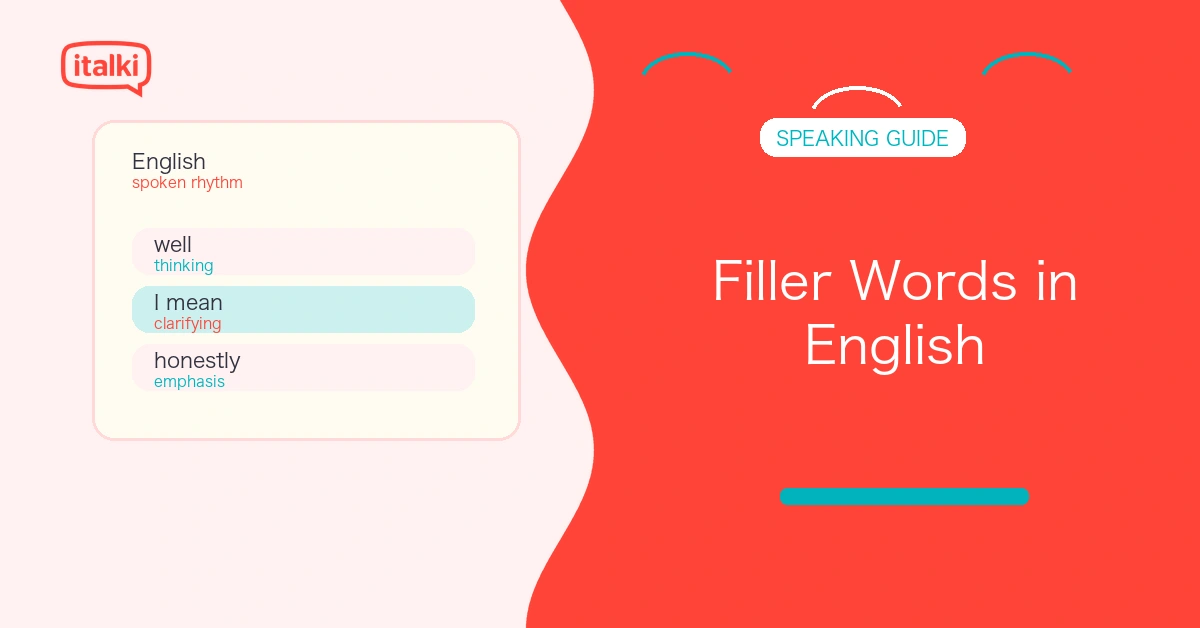
- The 20 filler words in this guide fall into four groups: thinking fillers, hedging fillers, connector fillers, and emphasis fillers, each serving a distinct purpose in conversation.
- Overusing a single filler, especially like or literally, makes speech repetitive and can reduce your credibility in formal or professional settings.
- Practicing real conversations with an English tutor helps you identify which fillers you overuse and when a deliberate pause works better.
Filler words in English are the sounds and short phrases speakers use between ideas: um, you know, basically, honestly, and a handful of others. They fill the space while the brain catches up with the mouth. Every fluent English speaker uses them, and their complete absence can make speech sound rehearsed or robotic.
Understanding why fillers exist is the first step to using them the way native speakers do.
The challenge for learners is that filler words almost never appear in textbooks. Learners often avoid them entirely and sound unnatural, or they latch onto one or two fillers and overuse them until it becomes a distraction.
italki, with 10M+ learners worldwide, connects you with teachers who hear these spoken patterns in real time and help you calibrate. This guide covers 20 filler words in English in four groups: thinking fillers, hedging fillers, connector fillers, and emphasis fillers, with usage notes and examples for each.
Find an English tutor and practice these fillers in real conversation, where their natural rhythm is easier to absorb than any word list.

Find your perfect teacher
Build real English confidence with personalized lessons from a teacher who matches your goals, schedule, and learning style.
Book a trial lesson
What are filler words in English?
Filler words are spoken-language tools. In writing, you have time to choose every word carefully. In speech, you think and talk at the same time, and fillers mark the gaps. Linguists call them discourse markers because they signal something to the listener: a pause to think, a softened claim, a transition, or an intensifier.
The key distinction is between fillers used consciously and those used by habit. A native speaker who says Well, the thing is… is signaling that a nuanced point is coming. A learner who says like eight times in a single sentence has slipped into a habit. Learning the four groups below gives you control over both problems. For a broader look at rhythm, phrasing, and natural delivery, the guide to how to sound natural in English connects filler use with sentence-level fluency.
| Group | Purpose | Example words |
|---|---|---|
| Thinking | Signal a pause to think | um, uh, well, let me think, you see |
| Hedging | Soften or qualify a claim | kind of, sort of, basically, to be fair, I guess |
| Connector | Link one idea to the next | so, right, I mean, does that make sense, thing is |
| Emphasis | Add weight or intensity | literally, actually, you know, honestly, at the end of the day |
Thinking fillers: buying time without losing the thread
Thinking fillers signal to the listener that you are still mid-thought and the sentence is not finished. Without them, an awkward silence can feel like you have stopped speaking entirely.
| Filler | Common form | Typical use |
|---|---|---|
| Um | Um, I think… | Before a complex or uncertain answer |
| Uh | Uh, let me check. | Before searching for specific information |
| Well | Well, that depends on… | Before a nuanced or conditional answer |
| Let me think | Let me think… yes, Thursday works. | Before recalling a specific fact |
| You see | You see, the problem is… | Before explaining a less obvious point |
Um and uh are the most universal thinking fillers. In formal contexts like job interviews or presentations, replace them with a one-second silence: the pause communicates confidence while you think. Well works in both formal and informal speech and signals that a considered answer is coming. You see often introduces a clarification and works best in informal or semi-formal conversation.
One pronunciation note: um sounds like the vowel in cup, not moon. Uh sounds like a very short, neutral vowel, almost like a reduced a. Native speakers say both quickly, so they do not draw attention to themselves when used once or twice.
Find your perfect teacher
Build real English confidence with personalized lessons from a teacher who matches your goals, schedule, and learning style.
Book a trial lesson
Hedging fillers: softening what you say
Hedging fillers lower the strength of a claim. They signal that you are not speaking with total certainty, that you are approximating, or that you are aware there may be exceptions. This is not weakness: it is social accuracy.
| Filler | Example sentence | What it signals |
|---|---|---|
| Kind of / kinda | It is kind of complicated. | Approximation, softened description |
| Sort of / sorta | I sort of understood it. | Partial agreement or partial comprehension |
| Basically | Basically, you just sign in. | Simplified or summary version of a fact |
| To be fair | To be fair, it did work last week. | Acknowledging another perspective |
| I guess | I guess we could try that. | Tentative agreement or uncertainty |
Kind of and sort of are nearly interchangeable. Kinda and sorta are informal contractions used in casual speech. Both signal that the speaker is approximating, not making an exact claim. Basically works well before a simplified explanation, but overusing it can make you sound condescending or vague. To be fair is particularly useful in discussions where you want to acknowledge a point while holding a different view. I guess signals mild agreement or tentative acceptance rather than full conviction.
Hedging is especially useful in professional settings when you do not want to overcommit. Saying it is basically ready leaves room for a caveat, while it is ready sounds absolute.
Connector fillers: linking ideas in spoken speech
Connector fillers stitch sentences together, marking a logical relationship between what was just said and what comes next. They give the listener a half-second to process one idea before the next arrives.
| Filler | Example sentence | Function |
|---|---|---|
| So | So, what happens is… | Introduces a conclusion or next step |
| Right | Right, so we agreed on Tuesday. | Confirms shared understanding, moves forward |
| I mean | I mean, it is not perfect, but… | Rephrases or clarifies what was just said |
| Does that make sense? | So we need to reset the whole thing. Does that make sense? | Checks listener comprehension |
| Thing is | The thing is, we do not have the budget. | Introduces a complicating factor |
So is one of the most versatile connector fillers in English. It can open a new point, introduce a consequence, or signal that you are moving from explanation to action. Right works similarly but has a confirming quality: it often implies that both speakers know this already. I mean is used to self-correct or restate: if you said something that could be misread, I mean introduces the clearer version. The thing is almost always precedes an obstacle, a qualification, or an important detail the listener may not have considered.
An English teacher online can give you real-time feedback on which connectors you use naturally and which ones feel forced when you try to use them.
Find your perfect teacher
Build real English confidence with personalized lessons from a teacher who matches your goals, schedule, and learning style.
Book a trial lesson
Emphasis fillers: adding weight to a point
Emphasis fillers intensify or highlight what follows. Used correctly, they draw the listener’s attention to a key point. Used carelessly, they dilute every statement you make.
| Filler | Example sentence | Appropriate register |
|---|---|---|
| Literally | I literally had no idea. | Casual to semi-formal |
| Actually | It actually costs less than you think. | Casual to formal |
| You know | It is, you know, a lot to process. | Casual only |
| Honestly | Honestly, I prefer the original. | Casual to semi-formal |
| At the end of the day | At the end of the day, results matter most. | Semi-formal to formal |
Literally originally meant exactly as stated but is now widely used as an intensifier even when the statement is not literal. Native speakers use it this way constantly in informal speech, but in formal writing or presentations, it should mean what it says. Actually is one of the most useful fillers because it works across registers: it can gently correct a misunderstanding, emphasize a surprising fact, or soften a contradiction. You know signals shared context and should be used sparingly. At the end of the day is a set phrase that introduces a final, simplified judgment after a complex discussion.
When filler words help and when they hurt
The difference between a natural filler and a distracting habit is frequency and context.
Fillers help when they:
- Signal genuine cognitive work (um, let me think)
- Acknowledge another person’s point before responding (to be fair, right)
- Soften a claim you genuinely cannot make with full certainty (kind of, I guess)
- Bridge two connected ideas so the listener can follow the logic (so, the thing is)
Fillers hurt when they:
- Replace a real pause (saying um constantly sounds more uncertain than staying silent)
- Repeat in every sentence (like five times in two minutes)
- Mismatch the register (you know in a job interview sounds careless)
- Fill every gap instead of allowing natural emphasis through silence
A useful self-check: record one minute of speaking and count how often each filler appears. If any single filler appears more than once every 30 seconds, it has likely become a habit rather than a tool. Practicing with an English language tutor gives you an outside listener who can tell you which ones you are using and whether they sound natural or mechanical.
For learners working on spoken English tests like IELTS or TOEFL, natural filler use in the speaking component signals fluency. None of the fillers in this guide are errors; examiners hear them from native speakers constantly. The goal is controlled, varied use rather than avoidance.
Find your perfect teacher
Build real English confidence with personalized lessons from a teacher who matches your goals, schedule, and learning style.
Book a trial lesson
Practice fillers in real conversation
Reading a list of filler words teaches recognition. Speaking practice builds the habit of using them at the right moment. The fastest way to internalize filler words is to use them in unscripted conversations: questions that require thinking on the spot, topics where you are not sure of the answer, discussions where you need to qualify what you say.
A teacher turns that practice into deliberate work: flagging the moments where you stayed silent but a well would have been natural, or where you said like four times in a row when actually or I mean would have varied the rhythm.
With 30,000+ expert tutors available on italki, trusted by over 10 million learners worldwide, you can book a speaking-focused session around exactly this kind of conversational practice. Book a trial lesson and spend the session talking on topics where fillers come up naturally, so your teacher can coach you on which ones fit your speaking style.
Find your perfect teacher
Build real English confidence with personalized lessons from a teacher who matches your goals, schedule, and learning style.
Book a trial lesson
FAQ
What are the most common filler words in English?
The most common are um, uh, like, you know, so, I mean, basically, and right. These appear in casual conversation across all age groups and regions of native English speech.
Are filler words bad for English learners?
No. Filler words are normal features of spoken English. The goal is to use them selectively, the way native speakers do, rather than overusing one filler until it becomes a distracting tic. Avoiding them entirely can make your speech sound unnaturally scripted.
What is the difference between um and uh?
Both are thinking fillers that buy processing time, and they are often interchangeable. Um tends to precede a slightly longer pause, while uh is shorter. Neither is more correct. Regional and individual variation between the two is normal.
How do I stop saying like too much?
Record yourself speaking for a minute and count how many times like appears. If it is more than two or three times, try replacing some instances with a brief pause, I mean, or actually. Practicing with a tutor who can flag each instance in real time accelerates the habit change faster than self-monitoring alone.
Can filler words be used in formal English?
Some can. Well, actually, to be fair, and at the end of the day all appear in formal spoken contexts. You know, kinda, and literally (as an intensifier) are casual and should be avoided in formal presentations, interviews, or professional calls.
Want to learn a language at italki?
Here are the best resources for you!