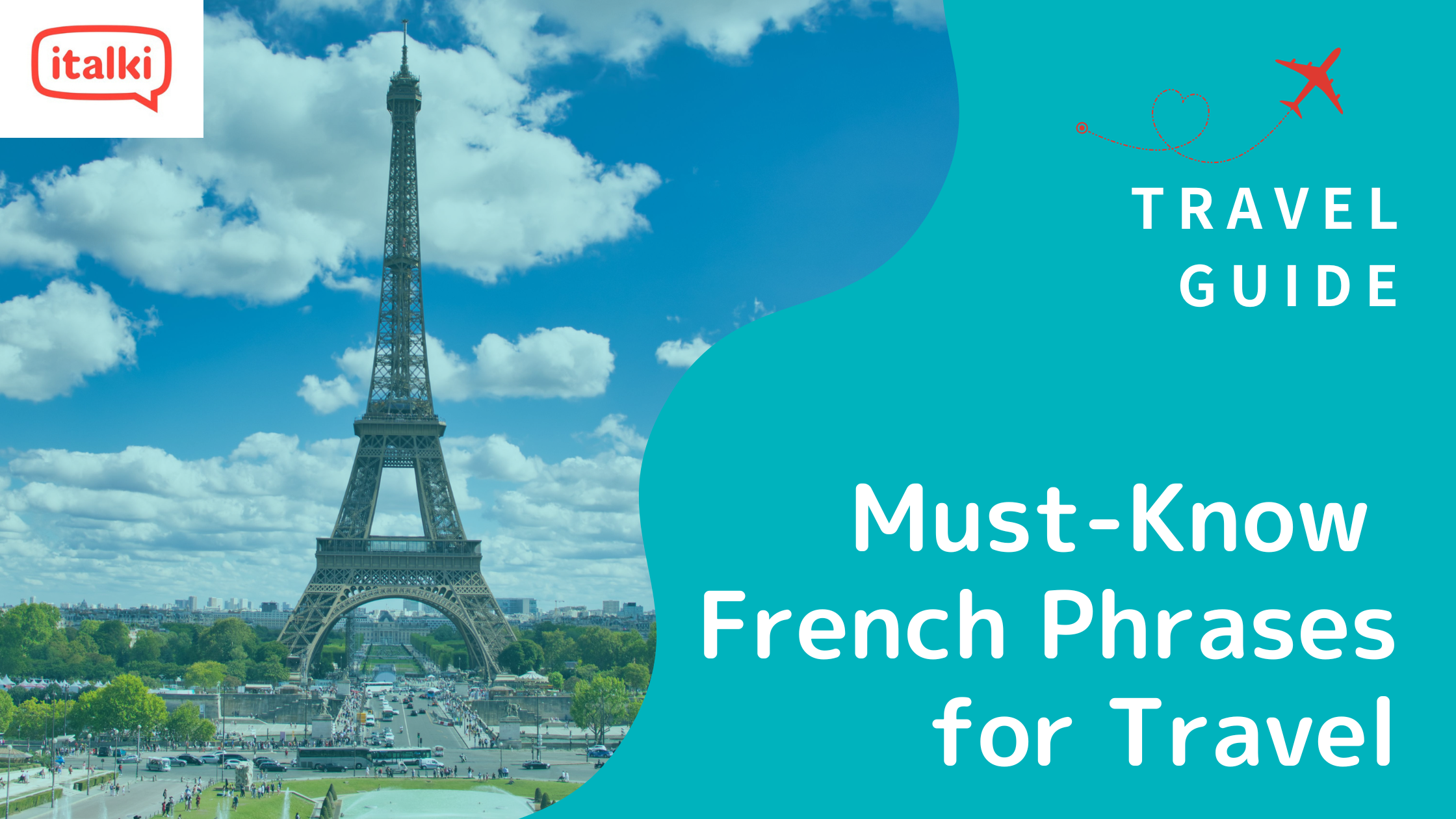
How to learn basic French for travel has a realistic scope: you do not need fluency to have a better trip, but you do need survival phrases, clear pronunciation, and repair strategies for fast replies.
For travel French, italki is useful when a lesson rehearses the exact moments you will face: ordering food, asking for directions, checking into a hotel, buying tickets, and recovering when the answer is too fast.
This guide covers what basic travel French actually requires, what to learn first, how to learn it efficiently in two to four weeks, and how to handle the moment when a native speaker responds at full speed and you need a plan.

Find Your Perfect Teacher
A focused travel lesson can drill restaurant orders, transport questions, hotel check-in, prices, directions, and polite repair phrases before the trip.
Book travel French classes
Key takeaways
- Travel French requires a targeted set of around 100 to 150 phrases and words across six situations: greetings, restaurants, transport, accommodation, shopping, and emergencies. Fluency is not the goal.
- Pronunciation matters more for travel French than grammar: a phrase pronounced clearly with the wrong article gets you understood, while a grammatically correct phrase with English pronunciation often does not.
- The most important repair phrase in any French-speaking country is “Pouvez-vous parler plus lentement, s’il vous plaît?” (Can you speak more slowly, please?). Using it confidently is a skill worth practicing.
- In travel French lessons, a tutor can run a two-hour travel preparation session that covers your specific destination’s most common phrase situations and drills them until they feel natural under low pressure before you face them under real conditions.
What does basic French for travel actually mean?
Basic travel French means being able to initiate common transactions, ask simple questions, respond to likely answers, and signal when you need help. It does not mean holding a conversation about politics or understanding the evening news.
The Organisation internationale de la Francophonie (OIF) reports that French has more than 321 million speakers worldwide and is used as an official language across 29 countries on five continents. That geographic spread means travel French has real value beyond a single trip to Paris: the same core phrases work in Montreal, Brussels, Dakar, Marrakech, and dozens of other destinations.
At the A1 level on the Council of Europe CEFR scale, a learner can “interact in a simple way provided the other person talks slowly and clearly and is prepared to help.” That is an honest description of travel French: you will not be mistaken for a native speaker, but you will be able to function independently in most tourist situations.
The practical target is a working vocabulary of 100 to 150 words and phrases across six situation types: greetings and courtesy, restaurant and food, transport, accommodation, shopping, and emergency. Learners who try to absorb more than this in the two to four weeks before a trip often end up with partial knowledge of many things rather than confident command of the phrases they will actually need.
What French phrases should you learn first for travel?
Priority one is greetings and courtesy. French culture places strong social value on greeting people correctly. Walking into a shop without saying “Bonjour” is considered rude in France, and it affects how locals respond to you. These phrases require almost no French skill but make a measurable difference in how every interaction goes.
| Situation | French phrase | English meaning |
|---|---|---|
| Greeting (daytime) | Bonjour | Hello / Good morning / Good afternoon |
| Greeting (evening) | Bonsoir | Good evening |
| Thank you | Merci / Merci beaucoup | Thank you / Thank you very much |
| Please / excuse me | S’il vous plaît / Excusez-moi | Please / Excuse me |
| Do you speak English? | Parlez-vous anglais? | Do you speak English? |
| I don’t understand | Je ne comprends pas | I don’t understand |
| Speak slowly please | Pouvez-vous parler plus lentement? | Can you speak more slowly? |
| The bill please | L’addition, s’il vous plaît | The check / bill, please |
| Where is…? | Où est…? / Où se trouve…? | Where is…? |
| How much does it cost? | Combien ça coûte? | How much is this? |
Beyond these core phrases, your next priority should be number pronunciation (1 to 100) and simple food vocabulary for the destinations you will visit. Pair this article with French phrases for travel when you want a larger phrase list organized by restaurants, transport, hotels, shopping, and emergencies.
How do you learn French pronunciation quickly enough for travel?
Pronunciation is the most practical skill for travel French and the one that most learners underinvest in. A mispronounced French phrase often fails to communicate even when the vocabulary is correct, because French pronunciation patterns are far enough from English that English-accented French is sometimes not recognized.
Four pronunciation points that matter most for travel:
- Nasal vowels: French has nasal vowels that resonate in the nose, such as the sounds in “bon,” “vin,” and “pain.” English has no exact equivalent. Spending ten minutes per day listening to and repeating these sounds in the first week makes them much more natural by travel time.
- Silent final letters: Most French final consonants are silent. “Vous” sounds like “voo,” not “voos.” “Paris” sounds like “Pah-ree,” not “Pah-ris.” Knowing which letters to pronounce and which to drop prevents the most common intelligibility failures.
- The “r” sound: French “r” is produced at the back of the throat (uvular), unlike the English “r.” You do not need to sound native, but getting the “r” approximately right helps significantly with intelligibility. Practicing the French “r” for five minutes a day for two weeks produces noticeable improvement.
- Linking words (liaison): French speakers link the final consonant of one word to the initial vowel of the next word. “Vous avez” sounds like “voo-za-vay.” This liaison pattern explains why natural French sounds so different from isolated word-by-word pronunciation.
The fastest way to improve travel pronunciation is to find audio recordings of the specific phrases you are learning and repeat them out loud immediately. Passive listening without oral production does not train pronunciation, so choose the best French learning resources that include audio for your target phrase list.
How do you learn travel French efficiently in two to four weeks?
Two to four weeks is enough time to reach practical travel readiness if you focus only on what you need and practice speaking, not just reading phrases on a screen.
Week 1: Core phrases and pronunciation. Learn the 15 to 20 phrases in the table above. Focus on pronunciation: listen to each phrase twice, then say it out loud before moving to the next. Do not write phrases in English phonetics (“bon-JOOR”) because this trains English pronunciation, not French. Write the French directly and connect it to audio.
Week 2: Situation-specific vocabulary. Add the phrases specific to your trip: restaurant vocabulary if you will eat out, transport phrases if you will use trains or metros, accommodation phrases if you will check in and out of hotels. Keep each day’s new phrases to five or fewer and review previous phrases first.
Week 3: Speaking drills. Simulate the situations you will face. Order a meal out loud in French at home. Ask for directions to an imaginary metro station. The muscle memory of speaking in a low-stakes environment before traveling reduces hesitation in real situations.
Week 4 (if available): Correction and confidence. Book a single tutor session to run through your phrase set, get pronunciation feedback, and practice the repair phrases (asking someone to slow down, repeat, or write something). The session also helps with the psychological preparation of speaking French to a real native speaker before you face it under trip conditions.
What do you do when you do not understand the response?
The hardest part of travel French is not speaking: it is listening to the response. Native speakers in France, Quebec, and other French-speaking destinations speak at full speed, use regional vocabulary, and do not simplify their language for tourists unless asked to. This is normal and not a failure on your part.
Three repair strategies that actually work in travel situations:
- “Pouvez-vous parler plus lentement, s’il vous plaît?” (Can you speak more slowly, please?) Most French speakers will slow down and repeat when asked directly. This phrase is worth practicing until it comes out automatically when you are flustered.
- “Pouvez-vous répéter, s’il vous plaît?” (Can you repeat that, please?) Simpler and faster to deploy when the previous phrase feels too long under pressure.
- “Pouvez-vous l’écrire?” (Can you write it?) Particularly useful for addresses, times, prices, or any information where you need precision. Most French speakers will write information for a tourist who asks.
The most important mindset shift: using these repair phrases is not a sign of failure. It is a normal part of real communication in any second language, including for fluent speakers in unfamiliar dialects or situations. Practicing them until they feel natural removes the hesitation that causes travelers to give up on French entirely when the first interaction gets difficult.
How can a single tutor session prepare you for a trip?
A single well-structured tutor session covers more ground than two weeks of solo phrase drilling because the tutor provides real-time feedback on pronunciation and models authentic speech patterns that recordings cannot fully simulate.
What to request from a travel preparation session:
- Ask the tutor to run three to four simulated travel scenarios: checking into an accommodation, ordering a meal, asking for directions, and making a purchase. Practice each scenario twice: once with prompting, once without.
- Ask for pronunciation feedback specifically on the phrases you will use most. Identify the two or three words that you are not pronouncing correctly and drill them in the final ten minutes of the session.
- Practice the repair phrases at full speed so you can deploy them naturally. Ask the tutor to respond quickly and then practice asking them to slow down or repeat without hesitation.
- If your destination is Quebec rather than France, ask for a Canadian French-speaking tutor specifically. The accent and some vocabulary differ enough from European French that separate exposure before the trip is worthwhile.
A follow-up session after the trip is also useful if you plan to travel to French-speaking destinations more than once: identifying what broke in real situations and fixing those specific patterns makes each subsequent trip noticeably smoother.
Rehearse the trip before you go
Travel French is a specific, achievable goal. The phrases that make a trip to a French-speaking destination work are learnable in two to four weeks of focused practice. The difference between a frustrating travel experience and a functional one is often not fluency but pronunciation quality and repair strategy confidence.
Travel French is not about sounding advanced. It is about being polite, clear, and prepared enough to keep the interaction moving when you need food, transport, directions, help, or basic local courtesy.
Find Your Perfect Teacher
Your travel French goal does not have to stay abstract. Get personalized sessions from native French tutors who can simulate travel situations, correct pronunciation on the spot, and help you feel ready before your trip.
French classes for travel
FAQs
How much French do you need to travel in France?
A working vocabulary of 100 to 150 phrases and words covering greetings, food, transport, and emergency situations is enough to travel independently in France. Pronunciation matters more than grammar for basic travel: a phrase said clearly with the wrong article gets you understood; a grammatically correct phrase said with heavy English pronunciation often does not.
Do French people speak English in France?
English is spoken by many people in major tourist areas, hotels, and international restaurants in Paris and other large cities. In smaller towns, rural areas, and everyday service contexts, English fluency is less common. Using basic French phrases, even imperfectly, is consistently received better than assuming English is available everywhere.
Is it rude to speak only English in France?
Beginning with “Bonjour” and a genuine attempt at French before switching to English is standard etiquette in France. Opening in English without attempting French first is considered impolite in many contexts, particularly outside heavily tourist-oriented businesses. A simple “Bonjour, parlez-vous anglais?” (Hello, do you speak English?) resolves most situations politely regardless of what language the conversation continues in.
What is the fastest way to learn French phrases for a trip?
The fastest method combines audio learning with immediate repetition out loud. Listen to a phrase, say it immediately after, and review it again 24 hours later. Daily 15-minute sessions using this method with a focus set of 15 to 20 phrases produces confident command of those phrases within two weeks. A tutor session in the final week before your trip corrects pronunciation errors and simulates real situations.
Want to learn a language at italki?
Here are the best resources for you!