Learning French Creole usually means learning Haitian Creole, a French-based creole with its own grammar, sound system, spelling conventions, and identity.
The biggest mistake beginners make is treating it as simplified French. It isn’t. The two languages share historical roots but work differently, and mixing them in practice creates habits that are hard to undo.
italki is one of the few platforms where you can find tutors who teach Haitian Creole as its own language. With 30,000+ teachers across 150+ languages and 10 million+ learners, it gives you access to native speakers who can keep Creole and French in separate lanes if you’re studying both.
Choose one target first, treat it as its own language, and use French tutors only when you need to understand where French influence shows up in the grammar or sound system.

Find Your Perfect Teacher
If your goal is Haitian Creole or another French-based creole, use lessons to compare sounds, sentence patterns, and when standard French knowledge helps or gets in the way.
Book a French tutor
Key takeaways
- French Creole is not broken French; Haitian Creole has its own grammar, pronunciation, vocabulary patterns, and cultural identity.
- Beginners should choose one variety first, usually Haitian Creole if that is the search goal.
- A teacher familiar with both French and Creole can help you understand where the systems overlap and where they do not.
- Listening and phrase practice matter more than memorizing French spellings.
The most important decision is variety. French-based creoles are not all the same, and the search intent here most often points to Haitian Creole. Choose one target first so your pronunciation, spelling, and phrase choices come from one language system.
If you also study French, separate the two. Use different notebooks, different audio, and different practice days until you can hear the difference without relying on spelling.
The common mistake is assuming Creole is simplified French. Learn the target Creole on its own terms and avoid translating every phrase through standard French. The fix is to choose one Creole variety first and stop measuring progress by how much standard French you recognize.
If you are studying French beside Creole, keep the French study plan separate from Creole practice so French foundations do not blur the target language. For speaking, French conversation practice can reveal whether you are producing the target variety or drifting into a hybrid.
For French Creole, make your first checkpoint a listening task, not a translation task. Choose a short recording, write the words you recognize, and ask which phrases are everyday Creole. This keeps your attention on how people actually speak the language.
Is French Creole the same as French?
French Creole is not the same as standard French. Haitian Creole, the most common English-search intent behind this keyword, has French influence but its own grammar, pronunciation, and vocabulary patterns.
Haitian Creole is a French-based creole, but it is not standard French with changed spelling. Britannica identifies Haitian Creole as a distinct language, so beginners should use Creole-specific audio and phrase resources.
If you study standard French only, you will recognize some words but miss how Creole sentences work. Choose Creole-specific beginner materials when your goal is speaking with Creole speakers.
| Question | Standard French | Haitian Creole |
|---|---|---|
| Grammar | Gender and conjugation-heavy | Often simpler verb marking patterns |
| Pronunciation | French sound-spelling rules | Creole sound system and spelling conventions |
| Use case | France, Quebec, Francophone contexts | Haiti and Haitian diaspora communication |
What should beginners learn first?
Start with pronunciation, greetings, pronouns, everyday verbs, and high-frequency phrases. Listening matters early because Creole spelling and sound patterns need their own habits.
A useful first target is a two-minute self-introduction and a polite request. That gives you practice with identity, needs, questions, and repair phrases.
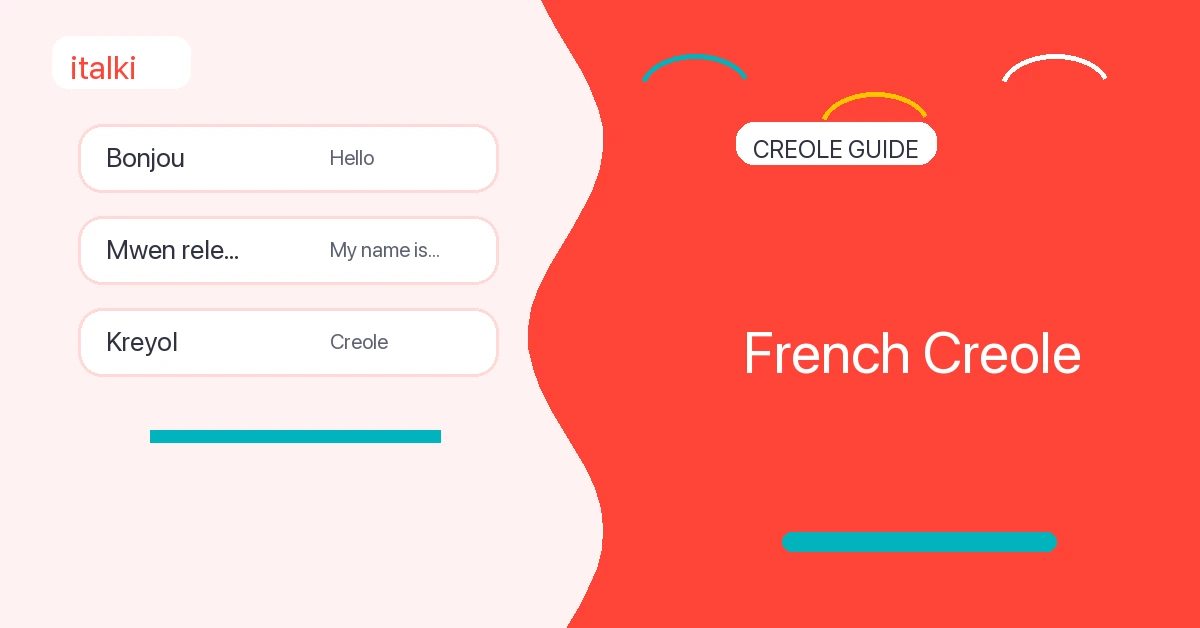
- Bonjou. (Hello.) Use this to open a conversation politely.
- Mwen rele… (My name is…) Use this for a basic self-introduction.
- Mwen ap aprann kreyòl. (I am learning Creole.) Use this to explain why you are practicing.
- Tanpri, pale pi dousman. (Please speak more slowly.) Use this when the other person is too fast.
- Mwen pa konprann ankò. (I still do not understand.) Use this as a repair phrase when you need more help.
How should French speakers approach Creole?
French helps with some vocabulary recognition, but it can also create interference. Treat Creole as a separate language from day one.
Keep a false-friend list and do not assume a French-looking word behaves the same way. Ask a tutor or speaker to correct natural phrasing, not only word choice.
What is the best practice routine?
Use short daily listening, phrase repetition, and corrected speaking. Creole learning is much clearer when you hear real voices and test phrases in conversation.
For broader support, connect this topic to a weekly study plan and a real speaking habit instead of treating it as a one-off reading task.
If your long-term goal includes both French and Creole, separate your study times so each language keeps its own sound and grammar patterns.
How do you choose materials without confusing French and Creole?
Choose materials that name the exact Creole you want. A book or video that only says French Creole may be too vague unless it clearly teaches Haitian Creole or another specific variety.
For Haitian Creole, prioritize sound, spelling, pronouns, everyday verbs, and common sentence patterns. Do not judge progress by how much standard French you recognize, because recognition can hide the fact that the grammar works differently.
If you need both French and Creole, keep a comparison sheet. Put the Creole phrase, the French equivalent, and the English meaning in separate columns so you do not merge them into one hybrid system.
| Material type | Use it for | Watch out for |
|---|---|---|
| Creole audio | Pronunciation and rhythm | No transcript can replace listening |
| Phrase lessons | Daily survival sentences | Avoid word-for-word French translation |
| French resources | Background vocabulary | Do not treat them as Creole lessons |
How can you compare French and Creole without mixing them?
A comparison table is useful only if it protects the two systems from blending. Put the Creole phrase first, the French equivalent second, and the English meaning third. That order reminds you that Creole is the target, not a simplified version of French.
For example, do not assume a French verb pattern will transfer automatically. Listen to the Creole sentence, repeat it, then ask what each word does inside that language.
| Meaning | Haitian Creole example | French equivalent |
|---|---|---|
| I am learning | M ap aprann | J'apprends |
| How are you? | Kijan ou ye? | Comment ça va? |
| I don't understand | Mwen pa konprann | Je ne comprends pas |
| Please repeat | Repete souple | Répétez, s'il vous plaît |
How to keep French and Creole separate
French Creole learning gets clearer when you name the target variety, practice its sound system, and stop translating everything through standard French. If French keeps interfering with your target variety, French Creole tutors can help you compare the systems without treating them as the same language.
Find Your Perfect Teacher
Use your next lesson to check whether you are practicing the target Creole clearly, especially if you are also studying standard French.
Book French Creole lessons
FAQs
Is French Creole easy if I know French?
Some vocabulary may feel familiar, but French Creole has its own grammar and sound system. Treat it as a separate language.
Which French Creole should I learn?
Choose the variety tied to your goal. For most English searches, that usually means Haitian Creole.
Can a French tutor help with Creole?
A French tutor can help compare standard French and Creole, but Creole speaking practice should come from someone who knows the target variety.
Want to learn a language at italki?
Here are the best resources for you!