Japanese verb conjugation practice should help you choose the right form while speaking, not only recognize endings in a chart.
This guide explains the beginner forms that matter most, shows examples with English meanings, and gives exercises you can use immediately.
italki helps when Japanese verb forms look clear on paper but feel uncertain in speech. A teacher can correct not only the ending, but also the politeness level and situation fit.

Find Your Perfect Teacher
Japanese verb forms are easier when you practice them in real situations. A tutor can correct form choice, politeness, and pronunciation in the same exercise.
Practice Japanese verbs
Key takeaways
- Japanese verbs do not change by subject, but they do change by tense, politeness, negation, and function.
- Beginners should focus on dictionary form, masu form, negative, past, and te-form.
- Japanese conjugation practice works better when every form is tied to a situation.
- Teacher feedback helps you choose forms that match the relationship and context.
Table of contents
- Japanese Verb Conjugation Practice: Master the Basics
- What makes Japanese conjugation different from English?
- Which Japanese verb forms should beginners practice first?
- How do you practice Japanese te-form without guessing?
- What exercises make Japanese conjugation stick?
- How can a Japanese teacher help with conjugation practice?
- What mistakes make Japanese conjugation confusing?
- How do you build a Japanese verb practice routine?
- FAQs
What makes Japanese conjugation different from English?
Japanese verbs change for tense, politeness, negation, and connection to other words, but they do not change by subject.
That is good news for English speakers. You do not need separate forms for I eat, you eat, and they eat. The same basic verb can work with different subjects. The challenge is learning the verb endings that show politeness, past time, negative meaning, and requests.
| English issue | Japanese pattern | Example |
|---|---|---|
| Subject agreement | No subject-based verb ending | 私は食べます and 彼は食べます both use 食べます. |
| Politeness | Plain and polite forms differ | 食べる vs 食べます. |
| Negation | Negative forms attach to the verb | 食べない means do not eat. |
| Connection | Te-form links actions | 食べて、行きます means eat and go. |
Which Japanese verb forms should beginners practice first?
Practice dictionary form, masu form, negative form, past form, and te-form before chasing advanced grammar.
| Verb | Reading | Meaning | Masu form | Negative | Past | Learner note |
|---|---|---|---|---|---|---|
| 食べる | taberu | to eat | 食べます | 食べない | 食べた | Ichidan verb |
| 見る | miru | to see/watch | 見ます | 見ない | 見た | Ichidan verb |
| 行く | iku | to go | 行きます | 行かない | 行った | Godan irregular past sound |
| 読む | yomu | to read | 読みます | 読まない | 読んだ | Godan verb |
| 話す | hanasu | to speak | 話します | 話さない | 話した | Godan verb |
| 買う | kau | to buy | 買います | 買わない | 買った | Godan verb |
| する | suru | to do | します | しない | した | Irregular |
| 来る | kuru | to come | 来ます | 来ない | 来た | Irregular |
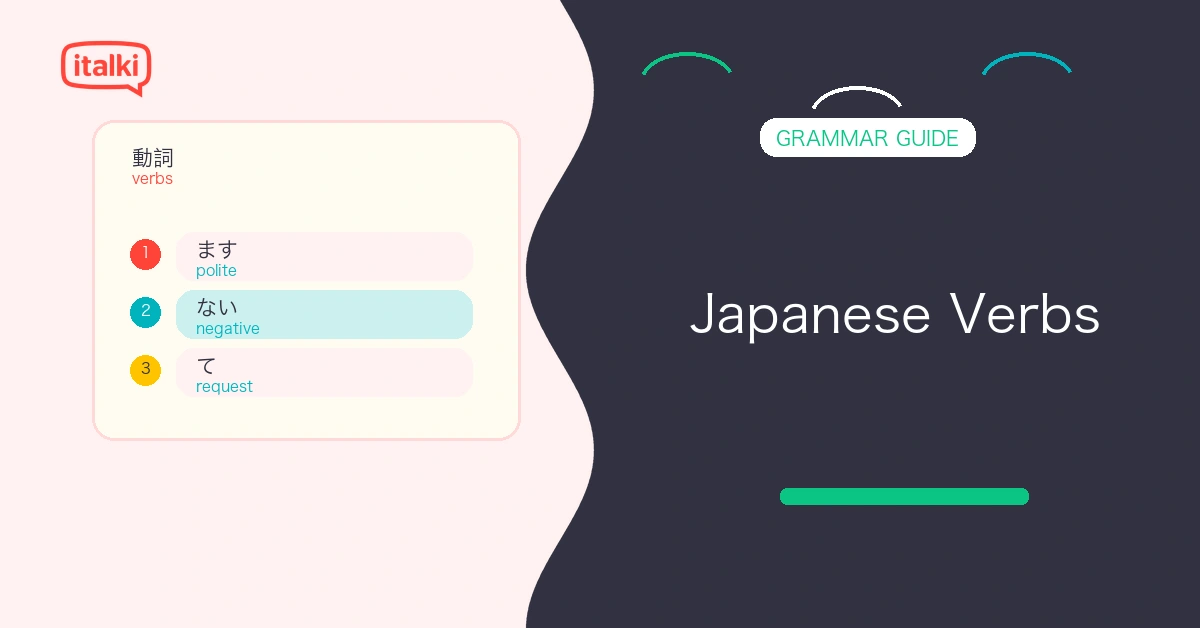
The learner mistake is trying to understand every label before using any form. You need labels eventually, but beginners progress faster when they connect one form to a function: polite statement, negative statement, past action, or request.
How do you practice Japanese te-form without guessing?
Practice te-form by verb group and immediately use it in requests or linked actions.
| Verb ending | Te-form pattern | Example | Use |
|---|---|---|---|
| る ichidan | drop る + て | 食べて | 食べてください. Please eat. |
| く | いて | 書いて | 書いてください. Please write. |
| ぐ | いで | 泳いで | 泳いでいます. I am swimming. |
| む/ぶ/ぬ | んで | 読んで | 本を読んでいます. I am reading a book. |
| す | して | 話して | 日本語を話してください. Please speak Japanese. |
| う/つ/る godan | って | 買って | 水を買ってください. Please buy water. |
| する | して | 勉強して | 勉強しています. I am studying. |
| 来る | 来て | 来てください | Please come. |
Do not practice te-form only as a chart. Say it as a request, a current action, or a sequence.
What exercises make Japanese conjugation stick?
Use form-change drills, sentence drills, and situation drills together.
- Choose four verbs from one group.
- Make polite present sentences.
- Change them to negative.
- Change them to past.
- Use one te-form as a request.
- Say the sentences aloud without looking.
| Form | Meaning / task |
|---|---|
| 食べます | I eat / will eat. |
| 食べません | I do not eat. |
| 食べました | I ate. |
| 食べてください | Please eat. |
| Your sentence | 朝ごはんを食べました. I ate breakfast. |
How can a Japanese teacher help with conjugation practice?
A teacher can hear whether you are choosing the right form for the situation, not only writing the right ending.
This is where italki is useful. Japanese conjugation is tied to politeness and context. A worksheet may mark 食べます correct, but a Japanese tutor can explain whether plain form or polite form fits the conversation.
Ask for a controlled drill: daily routine in masu form, weekend story in past form, and restaurant requests using te-form.
What mistakes make Japanese conjugation confusing?
Japanese conjugation becomes confusing when learners memorize forms without knowing what each form does in a sentence.
For example, 食べて is not just a table entry. It can connect actions, support a request, or appear in progressive patterns. If you only memorize it as te-form, you may not know when to use it.
| Mistake | Weak understanding | Better understanding |
|---|---|---|
| Thinking masu form is the base | 食べます is the dictionary form. | 食べる is dictionary form; 食べます is polite. |
| Learning te-form without use | 食べて equals a grammar label. | 食べて can mean eat and…, please eat, or support ongoing action. |
| Ignoring politeness | Plain and polite forms are interchangeable. | Form choice depends on relationship and setting. |
| Skipping listening | Written forms are enough. | You need to hear contractions, rhythm, and natural speed. |
A good practice habit is to write the function beside every form: polite statement, plain statement, negative, past, request, or connection.
How do you build a Japanese verb practice routine?
Practice fewer verbs more deeply, across several forms and situations.
Japanese beginners often collect many verbs but cannot use them flexibly. A better routine is to choose eight common verbs and rotate them through daily-life sentences.
- Pick two ichidan verbs, four godan verbs, and the irregular verbs する and 来る.
- Make polite present sentences for your daily routine.
- Change the same sentences to negative.
- Change yesterday’s actions to past tense.
- Use te-form for one request and one ongoing action.
- Record yourself saying the sentences.
For example, with 読む, say: 本を読みます. I read a book. 本を読みません. I do not read a book. 昨日、本を読みました. Yesterday, I read a book. 本を読んでいます. I am reading a book.
Ready to make Japanese verb forms usable?
Verb charts help you see patterns. Speaking practice helps you choose the right form when the sentence is yours.
Learn Japanese with guided support and turn verb drills into corrected conversation.
A second reason Japanese conjugation feels difficult is that English translations hide the function of the form. 食べました is not simply ate. It is a polite past statement. 食べた is also past, but plain. 食べてください is not just another ending. It is a request. If you write only English meanings in your notes, you lose the politeness and function information that Japanese needs.
A better notebook format has four columns: verb, form, function, and your sentence. For example, 行きます is polite present or future; 行きました is polite past; 行かない is plain negative; 行ってください is a request. This format helps you choose forms based on communication, not only memory.
| Verb | Form | Function | Your sentence model |
|---|---|---|---|
| 行く | 行きます | Polite present/future | 明日、学校に行きます. I will go to school tomorrow. |
| 行く | 行きました | Polite past | 昨日、駅に行きました. I went to the station yesterday. |
| 行く | 行かない | Plain negative | 今日は行かない. I am not going today. |
| 行く | 行ってください | Request | ここに行ってください. Please go here. |
When you practice, say the situation before the sentence: polite conversation with a teacher, casual note to a friend, past diary entry, or request in a shop. The situation tells your brain which form to reach for. Without that context, conjugation practice becomes a memory game.
Listening matters too. Japanese forms can sound short and fast in real speech. If you only read 行きました, you may recognize it slowly but miss it in conversation. Read, listen, repeat, and then answer a question using the same form.
Japanese practice also needs contrast. Put two forms side by side and ask what changed in the situation. 食べます is polite and present or future. 食べました is polite and past. 食べません is polite and negative. 食べませんでした is polite, negative, and past. This may look obvious in a table, but it becomes powerful when you use the same verb in four real sentences.
For example: 朝ごはんを食べます. I eat breakfast. 昨日、朝ごはんを食べました. Yesterday, I ate breakfast. 今日は朝ごはんを食べません. I will not eat breakfast today. 昨日、朝ごはんを食べませんでした. Yesterday, I did not eat breakfast. This kind of contrast drill teaches meaning, not only endings.
Once the forms are clear, add one question. 何を食べましたか. What did you eat? Answer with your own information. This is the bridge from conjugation practice to conversation.
Do not rush into rare verbs before common verbs feel automatic. 食べる, 飲む, 行く, 来る, 見る, 聞く, 読む, 書く, 買う, 話す, する, and 勉強する can carry a large amount of beginner conversation. If you can use these verbs across polite present, past, negative, and te-form, you can describe routines, plans, study habits, shopping, travel, and simple requests.
A useful self-test is translation in both directions. First translate Japanese to English: 昨日、日本語を勉強しました. Then go English to Japanese: Yesterday, I studied Japanese. Finally, make it true for you: 昨日、文法を勉強しました. Yesterday, I studied grammar. This three-step loop checks recognition, production, and personalization.
When a form keeps slipping, do not add more verbs. Stay with one verb and change the situation. 食べます can become breakfast, dinner, restaurant, travel, health, or family conversation. The repetition may feel simple, but it builds automatic control. Once the form comes quickly, add another verb with the same pattern.
This is also why handwritten drills alone are not enough. Japanese conjugation is a speaking tool. If your mouth cannot produce the form, keep the written drill but add short spoken answers after every line.
Short, accurate answers beat long, uncertain explanations at this stage.
Accuracy first, speed second.
Find Your Perfect Teacher
Japanese verb forms become easier when you practice the form, the situation, and the politeness level with corrective feedback.
Practice with Japanese tutors
FAQs
Is Japanese verb conjugation hard?
It is different from English, but beginners benefit from no subject agreement. The hard part is choosing the right form for tense, politeness, and connection.
What Japanese verb form should I learn first?
Learn dictionary form and masu form first, then negative, past, and te-form.
Do Japanese verbs change for I, you, and they?
No. Japanese verbs do not conjugate by subject the way many European languages do.
Why is te-form important?
Te-form appears in requests, ongoing actions, linked actions, and many grammar patterns, so it becomes useful early.
Should I memorize verb groups?
Yes, but connect each group to examples. Group labels are useful only when they help you produce sentences.
Want to learn a language at italki?
Here are the best resources for you!