Key takeaways
- Canadian French, particularly Quebec French, differs from European French in pronunciation, vocabulary, and everyday expressions, so resources designed for it specifically matter.
- The fastest path to fluency combines one-on-one speaking practice with native Canadian French tutors alongside structured listening and vocabulary tools.
- Several free resources exist for Canadian French learners, including government-funded platforms and authentic Radio-Canada content.
- Matching your resource stack to your current level produces faster progress than using the same tools at every stage.
Table of contents
- Best Resources to Learn Canadian French in 2026
- Canadian French vs. European French: what you actually need to know
- Best resources to learn Canadian French
- Recommended resource stacks by level
- Tips for getting the most out of your resources
- Start speaking Canadian French faster
- Frequently asked questions
If you are looking for the best resources to learn Canadian French, the standard French learning toolkit only gets you partway there. Quebec French has distinct pronunciation, vocabulary, and expressions that general French courses rarely cover.
According to the Government of Canada, almost 10.7 million Canadians can carry on a conversation in French. Whether you are moving to Montreal, working in a bilingual environment, or learning to connect with French-Canadian communities, you need resources built around the real language as it is spoken.
For Canadian French specifically, working with a native Quebec or Franco-Canadian tutor is the most direct path to understanding the accent, expressions, and rhythm of everyday speech. A tutor can also help you decide when a word is standard, informal, regional, or workplace-appropriate.

Find Your Perfect Teacher
Canadian French becomes easier when you practice the accent, vocabulary, and real situations you actually need with a tutor who knows the variety.

Canadian French vs. European French: what you actually need to know
Canadian French and European French share the same written standard, but spoken Canadian French sounds and feels noticeably different. Understanding the key differences helps you choose the right resources from the start.
| Feature | European French | Canadian French (Quebec) |
|---|---|---|
| Pronunciation | Nasal vowels, silent endings | Diphthongized vowels, affricated t/d sounds before some vowels |
| Vocabulary | voiture (car), petite amie (girlfriend) | char (car), blonde (girlfriend) |
| Formality markers | Tu/vous distinction used strictly | Tu used more broadly in everyday speech |
| English influence | Lower in standard speech | Anglicisms appear naturally in many informal contexts |
| Register | Standard French taught in most apps | Joual and informal registers are rarely covered in general courses |
According to The Canadian Encyclopedia, Quebec French retains features connected to older French varieties and reflects long contact with English-speaking communities. That history gives Canadian French its distinctive texture, and it is why resources built around European French alone leave gaps in your listening comprehension.
Statistics Canada reported that in 2021, French was the first official language spoken by more than 7.8 million Canadians. Canadian French is not a small side topic; it is a living variety used in daily life, media, government, work, and culture.
If you want context on where Canadian French sits within the broader Francophone world, French speaking countries covers Francophone communities across continents and how the language varies by region.
Best resources to learn Canadian French
1. Online tutoring
One-on-one lessons with a native Canadian French tutor are the most direct resource for building real comprehension and fluency. No app or podcast can fully replicate live feedback, accent exposure, and the unpredictability of speaking with an actual Quebec or Franco-Canadian speaker.
- Tutors speak the accent you actually need to understand, not only textbook European French.
- You get real-time correction on pronunciation, vocabulary, and register.
- Lessons can focus on your goal: Montreal life, bilingual work, immigration exams, travel, or family conversation.
- Trial lessons let you find the right tutor before committing to a schedule.
Pair lessons with the listening resources below and your comprehension of native-speed Canadian French will improve faster than self-study alone. Find French tutors and choose someone familiar with Canadian French if that is your target variety.
Find Your Perfect Teacher
Your French doesn’t have to sound like a textbook. Get personalized lessons from native tutors who’ll help you speak naturally, not just correctly.
Book a trial lesson
2. Government-funded learning platforms
Mauril is a free French and English learning platform developed by CBC/Radio-Canada with Government of Canada support. The Mauril website describes lessons built around authentic Canadian audio and video content across multiple levels. It is especially useful because it trains comprehension with Canadian voices and real contexts rather than generic textbook dialogues.
One important note: Mauril access may depend on location and content rights, so learners outside Canada should check availability directly.
Francisation Québec is Quebec’s official portal for French learning services. The Government of Quebec offers information on French courses for people living in Quebec, people planning to settle there, workers, and newcomers. This resource is particularly relevant if your Canadian French goal is relocation or integration in Quebec.
3. Apps and software
Mauril is the top app-style pick for Canadian French learners because its content is Canadian. Pimsleur Canadian French can also help audio-focused learners build speaking habits with Quebec-oriented pronunciation and everyday phrases. TV5MONDE is useful as a free video-based supplement, though it leans more international than specifically Canadian.
4. Podcasts
The Quebec French Podcast is useful for learners who already know some French and want more Quebec-focused listening. Radio-Canada podcasts are stronger for intermediate and advanced learners because they are authentic native-speed productions across news, culture, and entertainment.
If you need a broader listening strategy, learn French by podcast explains how to use episodes, transcripts, repetition, and active listening without letting podcasts become passive background noise.
5. YouTube channels
Radio-Canada’s YouTube channel is the most useful authentic Canadian French option for intermediate and advanced learners. Watch short news and culture clips with French subtitles before moving to longer programs. Français avec Pierre and Comme une Française are not Canadian French resources, but they can help build general grammar, informal French, and listening foundations before you specialize.
6. Textbooks and reading materials
Use Quebec-specific books and Quebec literature to add vocabulary and cultural context that standard French textbooks miss. A general grammar reference such as Grammaire Progressive du Français still helps because the core grammar is shared; the Canada-specific layer comes from vocabulary, accent, idioms, and register.
For immersion reading, choose Quebec authors gradually by level. Plays, short stories, and contemporary novels expose you to cultural references and everyday expressions that do not appear in generic coursebooks.
7. Language exchange and community
Language exchange apps can work if you filter for speakers from Quebec, New Brunswick, Ontario, or other Canadian Francophone communities. Online communities can also expose you to informal written Quebec French, but use them as input, not your only correction source.
8. Dictionaries and reference tools
Usito, developed at the Université de Sherbrooke, is one of the most useful references for Quebec French vocabulary and usage. The Usito dictionary helps you understand words that may be regional, Canadian, or absent from France-focused dictionaries.
The OQLF Vitrine linguistique is especially useful for workplace, professional, and technical terminology in Quebec French. WordReference remains practical for everyday bilingual lookups and forum explanations.
Recommended resource stacks by level
| Level | Resource stack | Why this works |
|---|---|---|
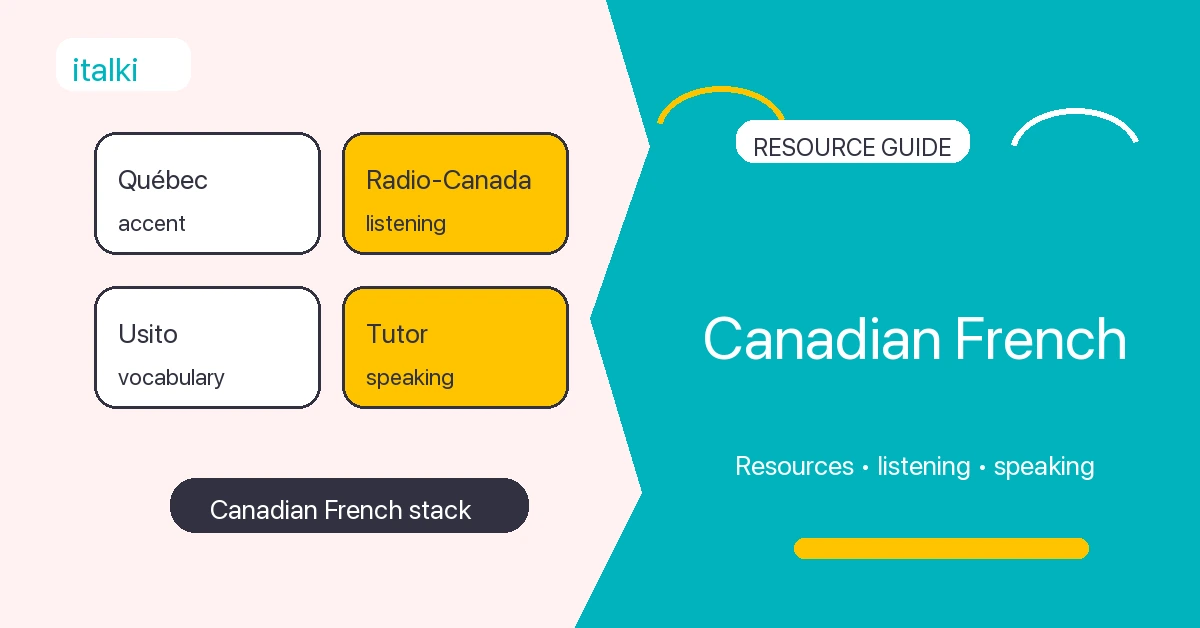
| Complete beginners | 2-3 tutor lessons per week, Mauril if available, Pimsleur Canadian French, A1 grammar reference, WordReference | Build pronunciation and basic conversation while using structured listening and grammar support. |
| Intermediate learners | 1-2 tutor lessons per week, Quebec French Podcast, Radio-Canada YouTube, B1 Quebec reading, Usito | Shift from textbook French into real Canadian speech patterns and regional vocabulary. |
| Advanced learners | Weekly conversation sessions, Radio-Canada podcasts, Quebec literature, Le Devoir, OQLF terminology | Develop speed, nuance, register control, and professional vocabulary. |
Tips for getting the most out of your resources
- Prioritize the accent early. The Quebec accent is often the biggest stumbling block for learners who studied European French first.
- Build a Quebec vocabulary list. Words such as char, blonde, pogner, faque, and tsé appear often in informal Quebec speech.
- Speak more than you study. Reading about Canadian French does not produce speaking ability.
- Watch real Canadian content. Radio-Canada is one of the closest substitutes for immersion outside Canada.
- Structure your study with clear milestones. A TEF Canada learner, a Montreal newcomer, and a workplace learner need different resource stacks.
Use French conversation practice to turn resource input into real output. Bring vocabulary from a podcast, news clip, or dictionary lookup into your next lesson and ask your tutor to make you use it in sentences.
Start speaking Canadian French faster
The resources in this guide work best when combined strategically. Authentic listening builds comprehension. Grammar references fill structural gaps. Dictionaries explain local vocabulary. But none of those fully replaces speaking practice with a native Canadian French speaker.
Learn French faster with personalized guidance from qualified teachers. Book a trial lesson with a French tutor who understands Canadian French and start producing the accent and vocabulary you actually need.
Find Your Perfect Teacher
Canadian French becomes easier when you practice the accent, vocabulary, and real situations you actually need with a tutor who knows the variety.
Frequently asked questions
Is Canadian French hard to learn if I already know European French?
Canadian French adds pronunciation and vocabulary layers rather than a different grammar system. The written standard is shared. If you already know European French at B1 level, you may understand written Quebec French quickly but need focused listening practice to adjust to the spoken accent.
What are the biggest differences between Quebec French and European French?
The main differences are pronunciation, vocabulary, and informal register. Examples include char for car, blonde for girlfriend, and faque for so or therefore. Grammar is largely shared, but real spoken comprehension requires exposure to Quebec voices.
Can I learn Canadian French without living in Canada?
Yes. Native-speaking tutors, Radio-Canada content, Quebec-focused podcasts, dictionaries such as Usito, and online communities give you strong remote exposure. The key is using Canadian French input rather than relying only on France-based resources.
What is the best free resource to learn Canadian French?
Mauril is one of the strongest free options for learners who can access it because it uses authentic Canadian content. Outside Canada, Radio-Canada podcasts and YouTube clips are useful free immersion resources.
How long does it take to learn Canadian French?
If you are starting from zero, use the general French timeline as your baseline. The State Department lists French among easier languages for English speakers, but independent learners vary widely. If you already speak European French, adjusting to Canadian French pronunciation and vocabulary may take a few months of focused listening and tutor practice.
Want to learn a language at italki?
Here are the best resources for you!