Key takeaways
- Spanish, French, Italian, Portuguese, Dutch, Norwegian, Swedish, and Afrikaans are among the easiest languages for English speakers because they use familiar vocabulary, accessible writing systems, or simpler grammar.
- The U.S. Department of State groups Spanish, French, Italian, Portuguese, Dutch, Norwegian, and Swedish among its easier world languages for English-speaking diplomats; its normal course of study is 24 to 30 weeks for these Category I languages.
- Shared vocabulary, familiar grammar, and the Latin alphabet are the three biggest reasons some languages feel faster for English speakers.
- A native-speaking tutor helps you turn an easy language into a spoken language by correcting pronunciation, sentence habits, and conversation gaps early.
Table of contents
- 8 Easiest Languages to Learn for English Speakers (Ranked)
- What makes a language easy to learn for English speakers?
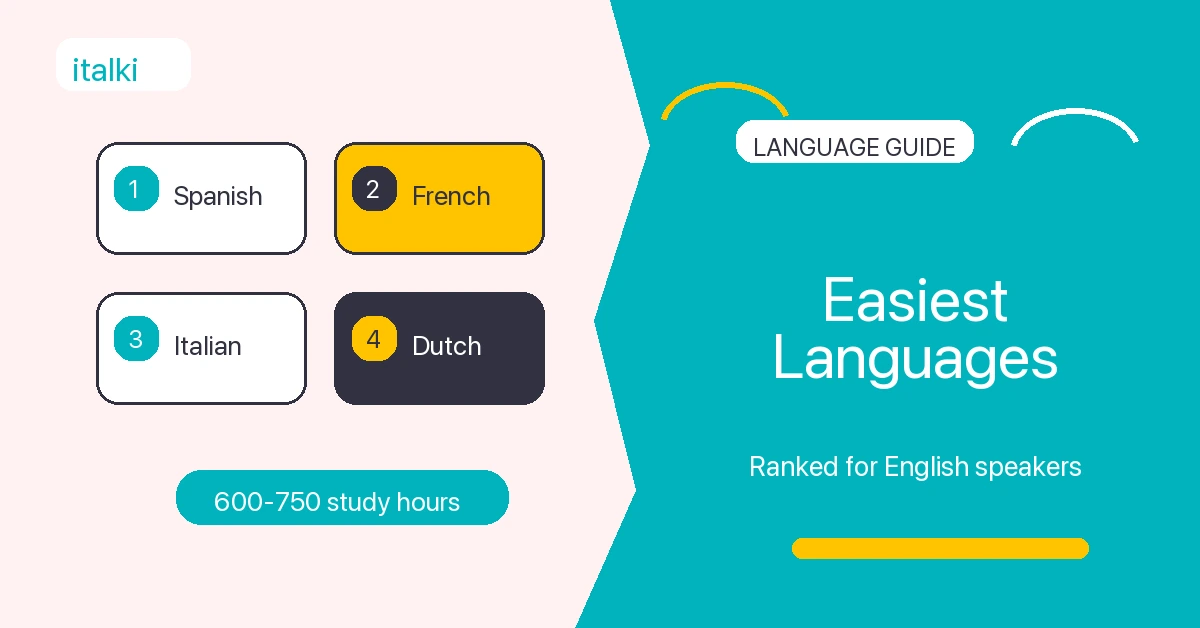
- Quick comparison: the 8 easiest languages ranked
- What is the easiest language to learn for English speakers?
- The 8 easiest languages for English speakers
- How long does it take to learn an easy language?
- How to learn an easy language faster
- Ready to choose a language you will actually speak?
- Frequently asked questions
If you are trying to figure out which language to learn first, the easiest languages to learn for English speakers share three things: familiar vocabulary, readable script, and grammar that does not require rebuilding your entire understanding of how sentences work. This article ranks eight accessible options by difficulty, gives you realistic time estimates, and helps you choose based on your goals.
italki connects learners with tutors across 150+ languages. Whatever language you choose from this list, getting speaking practice with a native or fluent tutor helps you test pronunciation, build confidence, and avoid months of silent study.

Find Your Perfect Teacher
The easiest language still becomes easier when you speak from the start. Get pronunciation feedback, real conversation practice, and a plan that fits your goal.

What makes a language easy to learn for English speakers?
Three factors determine how quickly an English speaker can pick up a new language. None of them make learning automatic, but they reduce the friction that slows beginners down.
1. Shared vocabulary
Languages that share Latin or Germanic roots with English contain thousands of words that look or sound familiar. You already recognize more Spanish, French, Italian, Dutch, or Norwegian than you might expect before opening a textbook.
For example, Spanish words like animal, natural, and hospital are easy to connect to English. Dutch words like water, hand, and man feel familiar for a different reason: English and Dutch are both Germanic languages.
2. Familiar writing system
Languages using the Latin alphabet remove one major learning layer. You still need new sounds and spelling rules, but you are not also learning a new script. That matters in the first weeks, when every piece of friction affects consistency.
3. Grammar structure
Languages with no tonal system, manageable verb patterns, and word order that resembles English usually feel easier in the first few months. Norwegian and Afrikaans stand out here because their verb systems are much simpler than many learners expect.
The U.S. Department of State uses language difficulty groupings for Foreign Service training. Its Category I examples include French, Italian, Portuguese, Spanish, Danish, Dutch, Norwegian, and Swedish, with a normal course of study of 24 weeks for several of them and 30 weeks for French. The takeaway for everyday learners is simple: languages close to English usually demand less time than languages with unfamiliar scripts, tones, or distant grammar.
Quick comparison: the 8 easiest languages ranked
| Rank | Language | Estimated difficulty | Key advantage for English speakers | Best fit |
|---|---|---|---|---|
| 1 | Spanish | FSI Category I | Phonetic spelling and strong Latin vocabulary overlap | Travel, U.S. use, global reach |
| 2 | French | FSI Category I | Large vocabulary overlap with English | Culture, diplomacy, Canada, Africa |
| 3 | Italian | FSI Category I | Highly phonetic spelling and transparent pronunciation | Culture, food, music, travel |
| 4 | Portuguese | FSI Category I | Close to Spanish with broad global use | Brazil, Portugal, music, travel |
| 5 | Dutch | FSI Category I | Germanic roots and English-like structure | Netherlands, Belgium, work |
| 6 | Norwegian | FSI Category I | Simple verb conjugation and no grammatical cases | Scandinavia, grammar simplicity |
| 7 | Swedish | FSI Category I | Germanic roots and strong media access | Culture, music, Nordic travel |
| 8 | Afrikaans | Comparable easy language | Simplified Dutch grammar and no verb conjugation by person | South Africa, Namibia, fast basic conversation |
This ranking is practical, not absolute. Spanish ranks first because it combines easy pronunciation, huge learner support, and broad usefulness. Afrikaans is structurally very friendly, but its practical reach is narrower, so it ranks lower for most learners.
What is the easiest language to learn for English speakers?
Spanish is the easiest language to learn for most English speakers. It uses the Latin alphabet, spelling is mostly phonetic, and it shares a large amount of vocabulary with English through Latin roots.
Spanish also has strong practical value. The U.S. Census Bureau reported that Spanish was the most common non-English language spoken in U.S. homes in 2019. That means many English speakers can find Spanish around them in daily life, media, workplaces, schools, and local communities.
That combination of linguistic simplicity and practical reach makes Spanish the default answer for many English speakers choosing a first language. Norwegian and Afrikaans may feel simpler grammatically, but Spanish usually gives learners more chances to use the language outside lessons.
The 8 easiest languages for English speakers
1. Spanish
Spanish is the most accessible starting point for many English speakers. Pronunciation follows consistent rules, the alphabet is familiar, and cognates are everywhere. Words like animal, color, natural, and hospital are identical or near-identical in both languages.
Why it is easy:
- Phonetic spelling makes new words easier to pronounce.
- Thousands of cognates reduce the vocabulary load.
- Verb conjugation has patterns that can be learned systematically.
- Gendered nouns usually follow predictable endings, especially at beginner level.
Practical reach: Spanish is one of the world’s most widely spoken languages, and it has strong everyday value in the United States, Latin America, Spain, and many travel contexts.
Book a trial lesson with Spanish tutors to get pronunciation feedback early. If you are mapping out the journey, read more about how long it takes to learn Spanish before building your study plan.
2. French
French shares a large amount of vocabulary with English because of centuries of contact between the two languages. Words such as restaurant, genre, ballet, and résumé already feel familiar to many English speakers.
Why it is easy:
- Strong vocabulary overlap with English.
- Latin alphabet with familiar written forms.
- Widely available books, media, courses, and learner resources.
- Useful across Europe, Canada, parts of Africa, and international organizations.
One challenge to prepare for: French pronunciation has silent letters and nasal vowels. Reading often comes faster than speaking, which is why early pronunciation feedback matters.
If you are weighing the two most popular Romance-language options, French vs Spanish breaks down the differences clearly. For a structured path, explore the best way to learn French.
Find French tutors to practice pronunciation from your first lesson, when errors are easiest to correct.
3. Italian
Italian is one of the most phonetically consistent languages on this list. Words usually sound the way they are spelled, which makes reading and listening less confusing in the early stages.
Why it is easy:
- Consistent spelling and pronunciation.
- Strong cognate base with English, including words like cultura, medicina, possibile, and informazione.
- A clear rhythm that helps learners hear sentence patterns.
- Predictable gendered noun patterns for many common words.
Italian also offers rich cultural motivation: film, music, food media, travel, and literature. Learning the most common Italian words can get you into basic conversation faster than many learners expect.
4. Portuguese
Portuguese sits close to Spanish in difficulty. If you already know some Spanish, Portuguese feels more accessible because of overlapping grammar and vocabulary. If you are starting fresh, it still belongs among the easier major languages for English speakers.
Why it is easy:
- Close relationship to Spanish, Italian, and other Romance languages.
- Many recognizable Latin-based words.
- Broad cultural content from Brazil and Portugal.
- Useful across Brazil, Portugal, Mozambique, Angola, and other Lusophone communities.
Brazilian Portuguese and European Portuguese differ in pronunciation and some vocabulary. Many beginners start with Brazilian Portuguese because there is so much music, video, and everyday media available.
If you are deciding between these two closely related languages, should I learn Portuguese or Spanish walks through the practical tradeoffs for English speakers.
5. Dutch
Dutch is a Germanic language, so it shares deeper structural roots with English. Its vocabulary, sentence logic, and word order can feel more familiar than learners expect.
Why it is easy:
- Germanic vocabulary overlap with English, such as water, hand, man, over, and fish.
- Sentence structure often mirrors English more closely than Romance languages do.
- Grammar is less complex than German in several key areas.
- Many Dutch speakers also know English, which can make travel and practice less intimidating.
One challenge to prepare for: Dutch pronunciation includes a guttural g sound and vowel combinations that do not appear in English. For a realistic timeline, read how long it takes to learn Dutch.
Connect with Dutch tutors if pronunciation is your main concern.
6. Norwegian
Norwegian deserves more attention than it usually gets. For English speakers, its grammar is refreshingly manageable, especially compared with languages that use cases or complex verb endings.
Why it is easy:
- No grammatical cases in the way German or Russian learners must handle them.
- Verb conjugation does not change by person in the same way it does in Spanish or French.
- Vocabulary has Germanic overlap with English.
- Sentence structure often feels intuitive to English speakers.
One thing to know: Norwegian has two official written forms, Bokmål and Nynorsk. Most learners start with Bokmål because it is more widely used in media, education, and beginner materials.
7. Swedish
Swedish and Norwegian are closely related. If you learn one, you can often develop some passive understanding of the other over time. Swedish is also supported by rich cultural content: music, TV, books, podcasts, and online creators.
Why it is easy:
- Germanic roots create familiar vocabulary patterns.
- No grammatical cases.
- Verb forms are simpler than many European languages.
- Consistent exposure through media is easy to find.
One unique feature: Swedish uses a pitch accent. This takes ear training, but it is not the same as learning a fully tonal language. Beginners can communicate before mastering the nuance.
8. Afrikaans
Afrikaans is one of the most structurally simple languages for English speakers. It developed from Dutch in southern Africa and has shed much of the grammatical complexity that makes some European languages feel heavy.
Why it is easy:
- No grammatical gender distinctions.
- No verb conjugation by person.
- No grammatical cases.
- Germanic vocabulary roots overlap with English and Dutch.
Practical consideration: Afrikaans has a narrower global reach than Spanish, French, or Portuguese. It can be fast to reach basic conversational ability, but it makes the most sense if you have a personal, travel, family, cultural, or South Africa-related reason to learn it.
How long does it take to learn an easy language?
The State Department language table gives Category I languages a normal course of study of 24 to 30 weeks for professional training contexts. Many public FSI-derived summaries translate this into roughly 600 to 750 classroom hours. For everyday learners, the timeline depends heavily on practice quality.
| Study intensity | Estimated timeline | What it usually feels like |
|---|---|---|
| Full-time intensive study | 24 to 30 weeks | Fast progress, but hard to sustain outside formal programs |
| Part-time structured study | 12 to 18 months | Realistic for adults with work or school commitments |
| Casual daily practice | 18 to 24+ months | Useful, but speaking can lag if you avoid conversation |
These benchmarks are not guarantees. Self-study learners often take longer because they get less correction, less pressure to speak, and less structured review.
Pro tip: Thirty minutes of focused conversation with a native-speaking tutor can be more useful for speaking than a long grammar session with no feedback. Interactive practice helps you notice what you can actually say, not only what you understand.
Flexible lesson scheduling matters because inconsistency is the most common barrier for adult learners. With tutors across many languages and time zones, you can make conversation practice fit your week instead of waiting for the perfect routine.
How to learn an easy language faster
Start speaking before you feel ready
Waiting until you feel ready is one of the most common reasons learners plateau. You do not need complex sentences at the start. You need short, corrected attempts: introducing yourself, ordering food, asking where something is, explaining your schedule, or describing your goal.
Mine cognates first
Romance language learners can make fast early progress by recognizing shared vocabulary deliberately. Spanish, French, Italian, and Portuguese all contain many words that resemble English. Create a list of useful cognates, then practice them in sentences instead of memorizing them as isolated words.
Target high-frequency words
A small number of words appears again and again in daily conversation. Learn the words you need for introductions, time, food, movement, feelings, questions, and basic opinions before chasing rare vocabulary.
Build a listening habit
Listening trains your ear for rhythm, speed, and pronunciation. Use short podcasts, learner videos, songs, and simple TV clips. The goal is not to understand everything. The goal is to hear the same patterns often enough that they stop sounding like noise.
Work with a tutor, not only an app
Apps are useful for drills, but they cannot fully replicate natural conversation. A tutor can hear pronunciation problems, notice repeated grammar errors, and ask follow-up questions that force you to respond in real time.
Find Spanish tutors, French tutors, or browse tutors across the languages on this list through italki teacher search.
Ready to choose a language you will actually speak?
The best language to start with is the one you have a genuine reason to use. Pick one from this list, build a small daily habit, and make speaking part of the plan from the beginning.
Learn a language faster with personal guidance from qualified teachers. Browse language tutors and book a trial lesson when you are ready to test your choice in real conversation.
Find Your Perfect Teacher
The easiest language still becomes easier when you speak from the start. Get pronunciation feedback, real conversation practice, and a plan that fits your goal.
Frequently asked questions
What is the easiest language to learn for English speakers?
Spanish is the easiest choice for most English speakers because it combines phonetic spelling, familiar vocabulary, broad learner support, and strong practical reach. Norwegian and Afrikaans may feel simpler grammatically, but Spanish is usually easier to use in real life.
What language is easiest to learn for English speakers if I want results fast?
Norwegian and Afrikaans can feel fast because their grammar is relatively simple. Spanish remains the stronger all-round choice if you want both speed and wide usefulness.
How many hours does it take to learn an easy language?
For State Department training, Category I languages have a normal course of study of 24 to 30 weeks, often summarized as about 600 to 750 classroom hours. Independent learners may need more or less time depending on consistency, speaking practice, and feedback quality.
Are Romance languages or Germanic languages easier for English speakers?
Both can be easy for different reasons. Romance languages often give you more recognizable vocabulary. Germanic languages often give you more familiar sentence structure. The easier option depends on whether vocabulary recognition or grammar intuition helps you more.
Is French harder than Spanish for English speakers?
Spanish is usually slightly easier because spelling and pronunciation are more consistent. French has silent letters, nasal vowels, and more pronunciation surprises. Both are still among the easier major languages for English speakers.
Want to learn a language at italki?
Here are the best resources for you!