Key takeaways
- French stories help beginners learn vocabulary, grammar, and sentence rhythm in context.
- The best beginner story is one where you understand about 80 to 90% of the text without a dictionary.
- A1 learners should start with short texts about daily routines, family, school, shopping, and travel.
- Reading aloud helps connect written French with pronunciation and speaking confidence.
- A French tutor can help you turn story vocabulary into spoken French.
- What are French stories for beginners?
- Why do French stories help beginners learn faster?
- What level of French story should you read?
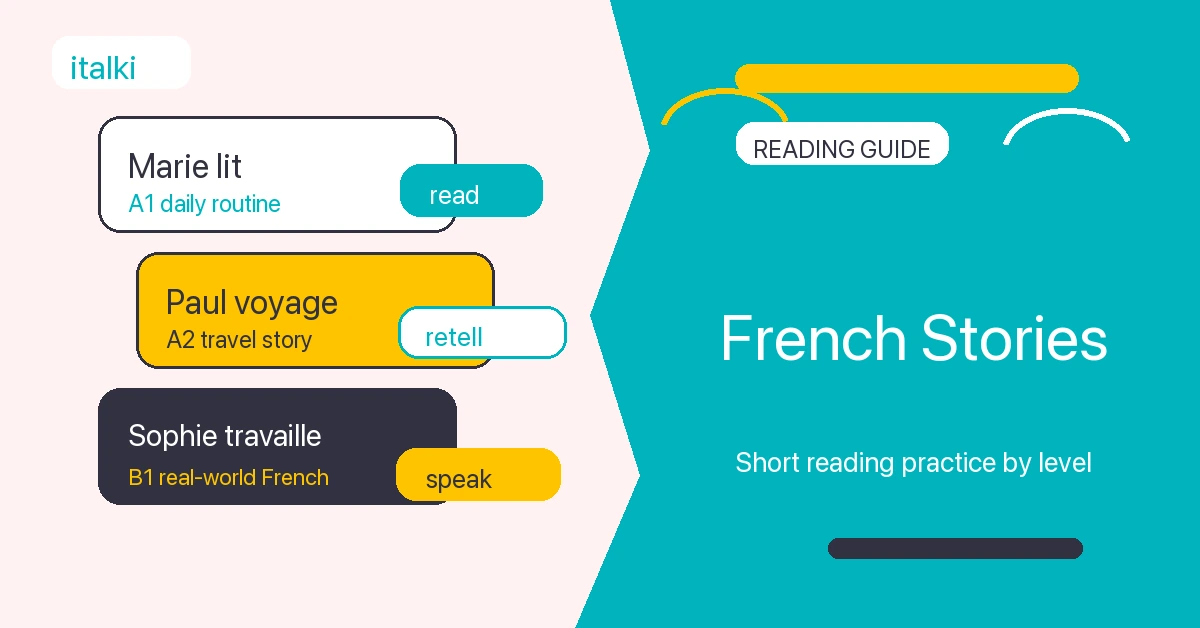
- Short French story for beginners at A1
- Short French story for beginners at A2
- Short French story for beginners at B1
- How to read French stories for better results
- What are the best French stories for absolute beginners?
- How do you turn French reading into speaking practice?
- Common mistakes when reading French stories
- How often should beginners read French stories?
- How to choose the right French story
- Build French reading into real communication
- Frequently asked questions
French stories for beginners help you build vocabulary, understand grammar in context, and get used to natural French sentence patterns. Instead of memorizing isolated words, you see how French works inside real situations.
italki connects more than 10 million learners with 30,000+ teachers across 150+ languages, including French teachers who help learners use reading material for pronunciation, vocabulary, and speaking practice. italki is especially useful for beginners who want private, low-pressure practice after reading on their own.
If you are still building your first vocabulary base, start with basic French words before moving into longer stories.

Find Your Perfect Teacher
French stories become more useful when you can retell them, pronounce them, and reuse the vocabulary in conversation with feedback.

What are French stories for beginners?
French stories for beginners are short reading texts written for A1, A2, or B1 learners. They use familiar topics, controlled vocabulary, and grammar patterns that match your current level.
A good beginner French story should be short enough to finish in one sitting and clear enough that you can follow the meaning without translating every sentence.
Common beginner story topics include family, school, work, food, travel, hobbies, shopping, and daily routines. These topics are useful because they contain the words you will use most often in real conversation.
If you are unsure where your level fits, a French study plan can help you connect reading practice with vocabulary, listening, and speaking goals.
Why do French stories help beginners learn faster?
French stories help because they show vocabulary and grammar in context. You do not learn the word maison only as “house.” You see it inside a sentence, connected to people, actions, and places.
Example:
Le chat dort dans la maison.
From one sentence, you see word order, articles, verb placement, and meaning at the same time.
| Skill | How stories help |
|---|---|
| Vocabulary | Words repeat in meaningful situations |
| Grammar | Sentence patterns become familiar |
| Reading speed | Common structures become easier to recognize |
| Pronunciation | Reading aloud trains rhythm and sound awareness |
| Speaking | Story vocabulary becomes easier to reuse |
Reading is especially useful when paired with French conversation practice, since speaking helps turn passive vocabulary into active language.
What level of French story should you read?
Choose a French story where you understand about 80 to 90% of the words without help. If you need to stop every sentence, the text is too difficult.
| Level | Story length | Best topics |
|---|---|---|
| A1 | 100 to 250 words | Introductions, family, school, daily routines |
| A2 | 250 to 500 words | Travel, hobbies, shopping, simple problems |
| B1 | 500 to 1,000 words | Work, opinions, personal experiences, culture |
A1 learners should focus on short, direct sentences. A2 learners can handle longer texts with past tense and sequencing words. B1 learners can start reading adapted authentic texts.
For a broader path beyond stories, this overview of the best way to learn French can help you combine reading with listening, speaking, and grammar practice.
Short French story for beginners at A1
French text
Bonjour. Je m’appelle Marie. J’habite à Lyon avec ma famille.
Chaque matin, je me lève à sept heures. Je prends mon petit-déjeuner et je vais à l’école. Après l’école, je joue avec mes amis dans le parc.
Le soir, je dîne avec ma famille et je lis un livre avant de dormir.
English translation
Hello. My name is Marie. I live in Lyon with my family.
Every morning, I get up at seven o’clock. I eat breakfast and go to school. After school, I play with my friends in the park.
In the evening, I have dinner with my family and read a book before going to sleep.
Key vocabulary
| French | English |
|---|---|
| famille | family |
| matin | morning |
| école | school |
| amis | friends |
| parc | park |
| livre | book |
| dormir | to sleep |
This story works for A1 learners because it uses present tense, daily routine vocabulary, and short sentences.
If this story still feels difficult, review French greetings, French numbers, and common beginner vocabulary first.
Short French story for beginners at A2
French text
Paul adore voyager. Pendant les vacances d’été, il décide de visiter Marseille pour la première fois.
Le premier jour, il se promène dans le Vieux-Port et goûte une spécialité locale. Ensuite, il visite plusieurs musées et prend beaucoup de photos.
À la fin du voyage, il promet de revenir l’année suivante.
English translation
Paul loves traveling. During the summer holidays, he decides to visit Marseille for the first time.
On the first day, he walks around the Old Port and tries a local specialty. Then he visits several museums and takes many photos.
At the end of the trip, he promises to return the following year.
Key vocabulary
| French | English |
|---|---|
| voyager | to travel |
| vacances | holidays |
| se promener | to walk around |
| goûter | to taste |
| musée | museum |
| voyage | trip |
This A2 story adds travel vocabulary, sequencing words, and slightly longer sentences. Learners preparing for a trip can build on it with French phrases for travel.
Short French story for beginners at B1
French text
Sophie voulait travailler à l’étranger depuis longtemps. Après ses études, elle a accepté un poste dans une entreprise à Montréal.
Les premiers mois ont été difficiles. Elle devait s’adapter à un nouvel environnement, comprendre ses collègues et développer son vocabulaire professionnel.
Peu à peu, elle a gagné en confiance. Aujourd’hui, elle travaille en français tous les jours et aide les nouveaux employés internationaux à s’intégrer.
English translation
Sophie had wanted to work abroad for a long time. After her studies, she accepted a job at a company in Montreal.
The first months were difficult. She had to adapt to a new environment, understand her colleagues, and develop her professional vocabulary.
Little by little, she gained confidence. Today, she works in French every day and helps new international employees settle in.
Key vocabulary
| French | English |
|---|---|
| à l’étranger | abroad |
| poste | job or position |
| entreprise | company |
| s’adapter | to adapt |
| environnement | environment |
| collègues | colleagues |
| confiance | confidence |
This B1 story uses past tense, workplace vocabulary, and more complex sentence patterns. It is useful for learners moving from simple reading to real-world French.
Learners interested in professional situations can also read about French for business.
Find Your Perfect Teacher
French stories become more useful when you can retell them, pronounce them, and reuse the vocabulary in conversation with feedback.
How to read French stories for better results
Read each story at least three times. The first reading is for general meaning. The second is for vocabulary. The third is for pronunciation and fluency.
Step 1: Read without stopping
Read the whole story once without using a dictionary. Your goal is to understand the situation, not every detail.
Step 2: Mark important unknown words
Write down only the words that block your understanding. Do not translate every new word.
Step 3: Check the meaning
Look up the most important words and reread the sentence where each word appears.
Step 4: Read the story again
The second reading should feel easier because the context is now clearer.
Step 5: Read aloud
Reading aloud trains pronunciation, rhythm, and confidence. If French sounds are difficult, review French vowels before reading longer texts aloud.
Step 6: Retell the story
Summarize the story in two or three simple French sentences. This turns reading into production.
You can also bring the story to an online French tutor and practice retelling it with corrections.
What are the best French stories for absolute beginners?
The best A1 and A2 French stories are graded readers, bilingual short stories, and short texts written for learners. They should use simple grammar, common vocabulary, and clear topics.
Good beginner story types include:
| Story type | Why it works |
|---|---|
| Daily routine stories | High-frequency verbs and time expressions |
| Family stories | Common relationship vocabulary |
| Travel stories | Practical phrases and place names |
| School or work stories | Useful everyday sentence patterns |
| Dialogue stories | Natural question and answer forms |
Avoid full novels at the beginning. Many French novels use literary tenses, idioms, and cultural references that can slow beginners down.
If you want a broader list of tools, apps, and reading options, use French learning resources to compare what fits your level.
How do you turn French reading into speaking practice?
Reading becomes more useful when you use the story vocabulary in conversation. After reading, choose five new words and make your own sentences with them.
Example:
Original sentence:
Je vais à l’école.
New sentences:
Je vais au café.
Je vais au marché.
Je vais à la gare.
This simple substitution method helps you reuse grammar without building every sentence from scratch.
For more active practice, discuss the story with a French teacher. Ask the teacher to correct your pronunciation, ask you questions about the story, and help you reuse new vocabulary in conversation.
Common mistakes when reading French stories
Choosing stories that are too difficult
If you need to translate every sentence, the text is not helping you read naturally. Choose an easier story and return to the harder one later.
Translating every word
Translation can help, but too much translation prevents you from reading in French. Focus first on meaning.
Reading only once
Repeated reading helps vocabulary stick. A short story read three times is often more useful than three stories read once.
Ignoring pronunciation
Silent reading builds comprehension, but reading aloud builds pronunciation and speaking rhythm.
Never using the vocabulary
A word is not fully learned until you can use it. Write or say new sentences after each story.
How often should beginners read French stories?
Beginners should read short French stories three to five times per week. Consistency matters more than length.
| Goal | Suggested routine |
|---|---|
| Light practice | 2 short stories per week |
| Regular progress | 3 to 5 short stories per week |
| Intensive study | 1 short story per day |
A 15-minute reading session is enough if you read actively. Read once for meaning, once for vocabulary, and once aloud.
Learners who want a broader path can combine stories with learn French online resources that include speaking, listening, and grammar practice.
How to choose the right French story
Choose a French story based on your level, topic interest, and learning goal.
| Goal | Best story type |
|---|---|
| Learn daily vocabulary | Routine stories |
| Prepare for travel | Travel stories |
| Improve speaking | Dialogue stories |
| Build confidence | Bilingual graded readers |
| Learn culture | Simple stories about French life |
Stories about food, greetings, travel, school, and family are usually the best starting point. Once you reach A2, you can add adapted stories about French culture, cities, and work.
For cultural context, reading about French culture can help you understand the situations and references that appear in stories.
Build French reading into real communication
French stories help you recognize vocabulary, understand sentence patterns, and feel more comfortable with written French. To turn that knowledge into communication, use the story after you read it.
Retell the plot. Answer questions about it. Make new sentences with the vocabulary. Read it aloud until the rhythm feels natural.
Working with French tutors on italki gives you a practical way to discuss stories, correct pronunciation, and use new vocabulary in real conversations.
Learn French faster with personal guidance from qualified French teachers trusted by over 10 million learners worldwide. Book a trial lesson with a French online tutor today.
Find Your Perfect Teacher
French stories become more useful when you can retell them, pronounce them, and reuse the vocabulary in conversation with feedback.
Frequently asked questions
Are French stories good for beginners?
Yes. French stories help beginners learn vocabulary, grammar, and sentence structure in context. Start with short A1 or A2 texts before reading longer stories.
What level should I be before reading French stories?
You can start at A1 if the story uses simple vocabulary and short sentences. Choose texts where you understand about 80 to 90% without a dictionary.
Should I read French stories with English translations?
Bilingual stories are helpful at A1 and A2. Read the French first, use the English to check meaning, then reread the French without relying on the translation.
Is reading enough to become fluent in French?
No. Reading builds vocabulary and comprehension, but speaking and listening practice are also needed. Use stories as material for conversation practice.
Should I read French stories aloud?
Yes. Reading aloud helps pronunciation, rhythm, and confidence. It is especially useful for learners who feel nervous speaking French.
What is the best French story for A1 learners?
The best A1 stories are about daily routines, family, school, greetings, shopping, and travel. These topics use the vocabulary beginners need most.
Want to learn a language at italki?
Here are the best resources for you!