Key takeaways
- Real Japanese conversation practice starts with short exchanges, not long speeches. Learn repair phrases like もう一度お願いします (mou ichido onegai shimasu, “one more time, please”) before tackling open dialogue.
- The best practice mirrors real situations: ordering at a restaurant, meeting someone new, asking for help at a station, or handling workplace small talk in the right politeness register.
- Working with a Japanese tutor turns memorized phrases into usable speech through role plays, live particle correction, and follow-up questions that force unscripted replies.
- Japanese fillers like えっと (etto, “um”), topic-shift phrases like ところで (tokoro de, “by the way”), and back-channel responses called あいづち (aizuchi) keep conversations flowing instead of stalling out.
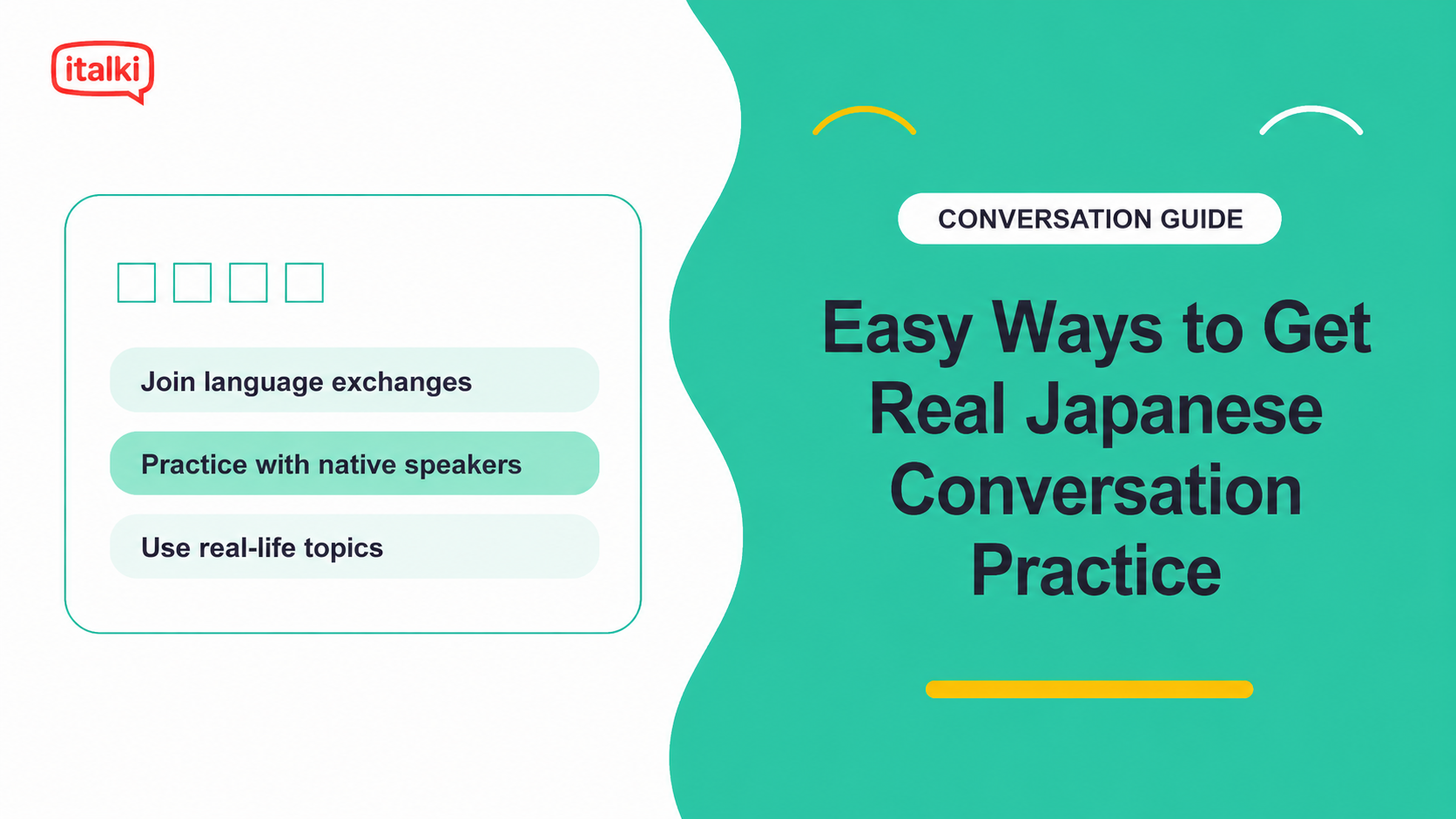
Easy ways to get real Japanese conversation practice include survival exchanges, shadowing with replies, role plays, question chains, working with a tutor, and daily micro conversations, all aimed at responding with short, well-timed Japanese instead of assembling full sentences in your head.
Solo study rarely tells you whether a reply actually landed, which is the gap live feedback closes. italki connects learners with 30,000+ teachers across 150+ languages and has helped over 10 million people get exactly this kind of live speaking practice.
Practice introductions, travel chats, work small talk, and repair phrases with a Japanese tutor who gives real-time correction on particles, politeness, and pronunciation.

Find Your Perfect Teacher
Practice easy ways to get real japanese conversation practice with a Japanese tutor who can correct pronunciation, phrasing, listening speed, and natural replies in real time.

What are the 6 easy ways to get real Japanese conversation practice?
The six easiest methods are survival exchanges, shadowing with replies, role plays, question chains, working with a tutor, and micro conversations. Each one targets a different part of speaking: starting a chat, keeping it alive, repairing breakdowns, and fixing errors that make you sound unnatural.
Real conversation is not the same as reading sentences aloud. You need greetings, reactions, pauses, and short follow-up questions that move the exchange forward. The U.S. Foreign Service Institute classifies Japanese as a Category IV language, estimating 2,200 class hours to reach professional proficiency, a number that drops faster when those hours go into genuine exchanges rather than silent review.
| Practice method | What it trains | Japanese example |
|---|---|---|
| Survival exchanges | Starting, repairing, and exiting chats | もう一度お願いします (mou ichido onegai shimasu), “one more time, please” |
| Shadowing with replies | Faster listening and personal responses | そうですね (sou desu ne), “yes, that is right” |
| Role plays | Goal-driven situational speech | 予約したいです (yoyaku shitai desu), “I want to make a reservation” |
| Question chains | Keeping a conversation going | 週末は何をしましたか (shuumatsu wa nani o shimashita ka), “what did you do this weekend” |
| Working with a tutor | Live particle, register, and pronunciation correction | 助詞を直してください (joshi o naoshite kudasai), “please correct the particles” |
| Micro conversations | Daily speaking courage | これはいくらですか (kore wa ikura desu ka), “how much is this” |
Focus on one clean two-turn exchange at a time. One exchange where you give a real reply helps more than ten memorized sentences that never meet a follow-up question, and the best way to learn conversational Japanese starts with phrases that invite a reply rather than vocabulary drilled in silence.
Find Your Perfect Teacher
Practice easy ways to get real japanese conversation practice with a Japanese tutor who can correct pronunciation, phrasing, listening speed, and natural replies in real time.
How do survival exchanges help you start speaking?
Survival exchanges let you enter, pause, repair, and exit a conversation. These phrases keep the dialogue alive when vocabulary disappears and panic sets in.
Start with phrases that solve real problems. If you miss a word, ask for a repeat. If you need time, use a filler. If you do not understand, say so politely. These are not beginner crutches. Native speakers expect them.
| Situation | Japanese | Pronunciation | Meaning |
|---|---|---|---|
| You missed the sentence | もう一度お願いします | mou ichido onegai shimasu | One more time, please |
| The speaker is too fast | ゆっくりお願いします | yukkuri onegai shimasu | Slowly, please |
| You do not understand | すみません、分かりません | sumimasen, wakarimasen | Sorry, I do not understand |
| You want to confirm | これでいいですか | kore de ii desu ka | Is this okay |
Use these phrases before worrying about complex grammar. They protect the conversation from dead silence, which is what actually kills practice sessions.
A useful beginner exchange: 日本語を勉強していますか (Nihongo o benkyou shiteimasu ka, “are you studying Japanese?”) answered with はい、少し勉強しています (hai, sukoshi benkyou shiteimasu, “yes, a little”). That short reply does not need to be long to sound polite, just one that fits the question and invites the next turn.
Politeness level matters even in short exchanges, since the same word choice can signal respect, distance, or casualness depending on who you are talking to. Practicing with a tutor who can switch the scenario, from a casual friend to a formal office, builds flexibility textbooks skip entirely.
Find Your Perfect Teacher
Practice easy ways to get real japanese conversation practice with a Japanese tutor who can correct pronunciation, phrasing, listening speed, and natural replies in real time.
How does shadowing turn listening into replies?
Shadowing helps your mouth follow Japanese rhythm, but adding a reply step turns passive repetition into conversation practice. Do not shadow a full podcast episode at first; pick one exchange with a clear question and answer, then try this three-step pattern: listen to one sentence, repeat it twice matching the speaker’s rhythm, then answer with a short personal reply.
For example, the audio line 週末は何をしましたか (shuumatsu wa nani o shimashita ka, “what did you do this weekend?”) gets shadowed back exactly, then answered with 友だちと映画を見ました (tomodachi to eiga o mimashita, “watched a movie with a friend”). Swap the reply to practice flexibility: 家で休みました (ie de yasumimashita, “rested at home”) or 買い物に行きました (kaimono ni ikimashita, “went shopping”).
This turns listening into a speaking habit. You hear a question, recognize the structure, and answer with a sentence that changes each time, which is what real conversation demands. Everyday phrases from Japanese greetings make useful shadowing material since they appear in real introductions and small talk, situations beginners face first.
Reaction phrases matter just as much as answers. Japanese conversations rely on small responses called あいづち (aizuchi) that signal active listening, and leaving them out makes you sound disengaged even if you understand everything.
| Reaction | Pronunciation | When to use it |
|---|---|---|
| そうですね | sou desu ne | Agreeing with a point |
| いいですね | ii desu ne | Responding to good news or plans |
| 本当ですか | hontou desu ka | Expressing surprise |
Reply practice works best when the answer is personal. A memorized line becomes real speaking practice only after you change it to fit your own life.
How do role plays make Japanese conversation feel real?
Role plays add a goal, a setting, and time pressure, making them the closest thing to a real conversation before you have one. Start with situations that happen often: a convenience store exchange, a restaurant reservation, or a train station question, each giving you a clear reason to speak and a predictable structure to follow.
Restaurant role play
A: いらっしゃいませ。何名様ですか。(Irasshaimase. Nanmei sama desu ka.) Welcome. How many people?
B: 二人です。(Futari desu.) Two people. ご予約はありますか (go-yoyaku wa arimasu ka, “do you have a reservation?”) いいえ、ありません (iie, arimasen, “no, I do not”).
Numbers freeze people up in these scenes, so building comfort with Japanese numbers before a reservation role play removes one more thing to think about mid-sentence.
Rehearse one real situation three times before using it outside class. A restaurant call rehearsed in a lesson goes smoother than one attempted cold, since the rhythm and likely follow-up questions are already in your ears. An online Japanese teacher who adjusts difficulty, adding an unexpected question like アレルギーはありますか (arerugii wa arimasu ka, “do you have any allergies”), builds confidence scripted dialogues cannot.
How do question chains keep a Japanese chat going?
Question chains help you avoid one-word answers that kill conversations. The pattern is: answer, add one detail, then ask a related question back.
A weak reply ends the exchange: 日本料理が好きですか (Nihon ryouri ga suki desu ka, “do you like Japanese food?”) answered with a flat はい (hai, “yes”). The three-step fix is stronger: answer (はい、好きです, “yes, I like it”), add a detail (特に寿司が好きです, “sushi especially”), then ask back (あなたはどうですか, “how about you”).
Here are flexible question starters that work across topics:
| Japanese | Pronunciation | Meaning |
|---|---|---|
| 何が好きですか | nani ga suki desu ka | What do you like |
| どこに行きましたか | doko ni ikimashita ka | Where did you go |
| どう思いますか | dou omoimasu ka | What do you think |
Use ところで (tokoro de, “by the way”) to shift topics and keep a conversation from running dry, as in ところで、日本の音楽を聞きますか (tokoro de, Nihon no ongaku o kikimasu ka, “by the way, do you listen to Japanese music?”).
Politeness affects how questions land, and using the wrong title can make a good question sound rude. Japanese honorifics covers why さん (san) and 先生 (sensei) shift the feeling of a conversation.
How does working with a tutor fix mistakes a textbook cannot?
A Japanese tutor catches the patterns self-study almost always misses: particles, verb endings, word order, and politeness level. The goal is not perfect grammar, but being understood without the listener mentally rearranging your sentence. Start by asking for correction in specific terms, since vague requests produce vague feedback: 助詞を直してください (joshi o naoshite kudasai, “please correct the particles”) works better than asking “was that okay?”
Here is the most common particle mistake English speakers make: 昨日、友だちを会いました (kinou, tomodachi o aimashita) should be 昨日、友だちに会いました (kinou, tomodachi ni aimashita), both meaning “met a friend yesterday.” 会う (au, to meet) takes に for the person you meet, not を, and English’s transitive “meet” makes を feel logical even though it is wrong. A similar fix applies to 私は寿司が好きです (watashi wa sushi ga suki desu): the adjective 好き (suki, like) takes が, not を, and the same pattern applies to 嫌い (kirai, dislike) and 欲しい (hoshii, want).
A tutor also catches register mismatches, like mixing the casual 何してるの (nani shiteru no) into a setting that calls for the polite 何をしていますか (nani o shiteimasu ka), both meaning “what are you doing?” Japanese for work connects language choice with office situations where the wrong register creates real misunderstanding.
Getting these corrections live, where someone hears the mistake and fixes it on the spot, differs from checking grammar after the fact. Book a session with a Japanese tutor for easy ways to get real japanese conversation practice and ask them to spend 15 minutes correcting only particles and register in free speech.
How do micro conversations build daily speaking habits?
Micro conversations give you low-pressure speaking reps between longer sessions. One short exchange per day trains your brain to retrieve Japanese faster, the same way short sprints build speed. A micro conversation is any exchange with one goal: ask a price, confirm a time, or answer a daily prompt aloud.
| Goal | Japanese | Pronunciation | Meaning |
|---|---|---|---|
| Ask the price | これはいくらですか | kore wa ikura desu ka | How much is this |
| Ask for a location | トイレはどこですか | toire wa doko desu ka | Where is the restroom |
| Ask for a recommendation | おすすめは何ですか | osusume wa nan desu ka | What do you recommend |
If no Japanese speaker is nearby, record a 30-second voice note answering a daily prompt, such as 今日は何をしましたか (kyou wa nani o shimashita ka, “what did you do today?”), then listen back once for hesitation spots. Keep it under 30 seconds since the aim is quick retrieval, not a polished monologue.
For travel-focused speaking, learn basic Japanese for travel pairs well with micro conversations, since ordering at a convenience store or confirming a hotel check-in time double as trip preparation. Sending a few voice notes to a tutor before a lesson turns this solo exercise into corrected practice.
Start speaking Japanese in real exchanges
Real Japanese conversation practice comes from short replies, repair phrases, role plays, question chains, and tutor-led correction, practiced until the replies feel automatic. Pick one method from this article: a restaurant role play, a question chain about weekend plans, or a particle-correction session. With 30,000+ teachers across 150+ languages, italki gives you access to tutors who specialize in this kind of situational practice. Book a trial lesson and ask for conversation practice built around your real life.
Find Your Perfect Teacher
Practice easy ways to get real japanese conversation practice with a Japanese tutor who can correct pronunciation, phrasing, listening speed, and natural replies in real time.
FAQ
What is the easiest way to practice Japanese conversation?
Start with short survival exchanges: もう一度お願いします (mou ichido onegai shimasu, “one more time, please”) and 分かりません (wakarimasen, “I do not understand”). These keep the conversation moving when you miss words.
How long should Japanese conversation practice last?
Ten focused minutes is enough for one exchange, one role play, or one voice note. A short daily session beats a long weekly session filled with silent reading.
Is speaking Japanese hard for beginners?
Speaking feels hard at first because Japanese uses particles and politeness levels with no direct English equivalent. Beginners make faster progress when they practice fixed exchanges before moving to open conversation.
What should a beginner say in a Japanese conversation?
Begin with はじめまして (hajimemashite, “nice to meet you”) and よろしくお願いします (yoroshiku onegai shimasu, “pleased to meet you”), then follow up with あなたはどうですか (anata wa dou desu ka, “how about you”) to keep the exchange going.
How do you practice Japanese if no native speaker is nearby?
Record short answers to daily prompts, shadow questions from podcasts using the three-step method in this article, and schedule online lessons for live replies. A private Japanese teacher catches particle and register errors that solo practice misses.
Want to learn a language at italki?
Here are the best resources for you!