Key takeaways
- Phobia names in English are built from Greek: a Greek root describing the feared thing + the suffix -phobia (from the Greek word phobos, meaning fear). Knowing this pattern lets you decode unfamiliar phobia names and even construct new ones correctly.
- The 10 most common phobias by prevalence include arachnophobia (spiders), acrophobia (heights), claustrophobia (enclosed spaces), and agoraphobia (open or crowded public spaces). These are the ones most likely to appear in conversation, news, and literature.
- In everyday English, people rarely use the clinical phobia name in casual conversation. They are more likely to say I’m terrified of heights than I have acrophobia. Understanding both forms, the clinical name and the conversational description, makes you fluent in a wider range of contexts.
- Phobia vocabulary also appears in extended meanings: xenophobia (hostility toward foreigners), homophobia (hostility toward LGBTQ+ people), and technophobia (resistance to new technology) are used in everyday English far beyond their clinical sense.
Phobia vocabulary appears across English in news articles, psychology discussions, casual conversation, and literature. Knowing the correct names for common phobias, and understanding the Greek-root pattern that generates them, is a useful layer of English vocabulary for any learner moving toward advanced fluency.
italki connects learners with English tutors who can help you work this kind of specialized vocabulary into conversation and reading comprehension. This guide covers the 10 most common phobias in English, the Greek roots behind phobia names, how to talk about fear in everyday conversation, and the extended uses of phobia vocabulary in modern English.
Find an English language tutor to practice using advanced English vocabulary, including phobia terms and the Greek root patterns behind them, in real conversation.

Find your perfect teacher
Build real English confidence with personalized lessons from a teacher who matches your goals, schedule, and learning style.
Book a trial lesson
What is a phobia?
A phobia (noun, plural: phobias) is an intense, irrational fear of a specific object, situation, or activity. The word comes from the Greek word phobos, meaning fear or flight.
In clinical psychology, a phobia is a type of anxiety disorder in which the fear is:
- Disproportionate to the actual threat
- Persistent and not easily overcome by reason
- Capable of causing the person to avoid the feared thing
In everyday English, phobia is used more loosely to describe any strong dislike or aversion, not necessarily a clinical condition. I have a phobia about public speaking in casual speech simply means I am very afraid of public speaking and does not imply a diagnosed disorder.
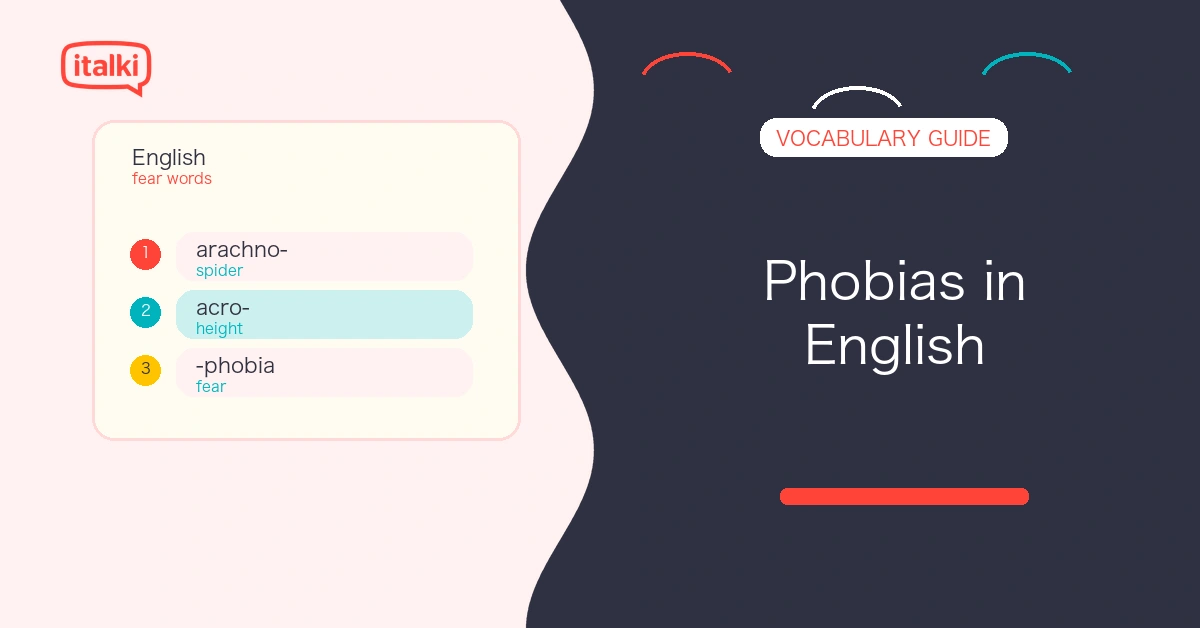
The word phobia functions as both a standalone noun and a suffix. As a suffix, it combines with a Greek root to name the feared thing: arachno- (spider) + -phobia = arachnophobia (fear of spiders).
The 10 most common phobias in English
1. arachnophobia: fear of spiders
Arachnophobia (pronounced ah-RAK-no-FOH-bee-ah) is estimated to be the most common specific phobia worldwide. It comes from the Greek arachne (spider), the same root found in arachnid, the scientific classification that includes spiders, scorpions, and ticks.
In everyday use: She has arachnophobia, so she screams whenever she sees a spider. Casual form: I’m terrified of spiders / I can’t stand spiders.
2. acrophobia: fear of heights
Acrophobia (ak-roh-FOH-bee-ah) comes from the Greek akron, meaning summit or top. It differs from a simple dislike of heights: people with acrophobia may experience panic, dizziness, or paralysis when on tall buildings, bridges, or ladders.
In everyday use: His acrophobia made the glass-floor observation deck impossible to enjoy. Casual form: I’m afraid of heights / I can’t look down from high places.
3. claustrophobia: fear of enclosed spaces
Claustrophobia (klaw-stroh-FOH-bee-ah) comes from the Latin claustrum, meaning a closed or locked place. It is triggered by small, enclosed spaces: elevators, MRI machines, small rooms, crowded vehicles.
In everyday use: She felt claustrophobic in the packed elevator. Note: Claustrophobic as an adjective is commonly used to describe spaces that feel suffocating: This tiny office is so claustrophobic.
4. agoraphobia: fear of open or public spaces
Agoraphobia (ag-or-ah-FOH-bee-ah) comes from the Greek agora, meaning marketplace or public gathering place. Despite being commonly described as a fear of open spaces, it more accurately describes fear of situations where escape feels difficult: crowds, public transport, shopping centers, being outside the home.
In everyday use: Agoraphobia kept her from leaving the apartment for months. Casual form: I feel overwhelmed in large crowds / I avoid busy public places.
5. ophidiophobia: fear of snakes
Ophidiophobia (oh-FID-ee-oh-FOH-bee-ah) comes from the Greek ophidion, meaning little snake. It is one of the most common animal-specific phobias and appears across cultures, possibly with evolutionary origins.
In everyday use: Ophidiophobia made the camping trip stressful every time someone mentioned seeing snakes. Casual form: I’m terrified of snakes / I can’t even look at a snake.
6. aerophobia: fear of flying
Aerophobia (air-oh-FOH-bee-ah) comes from the Greek aer, meaning air. Also called aviophobia (from the Latin avis, bird). It is one of the most practically limiting phobias, affecting travel, career, and daily life for millions of people.
In everyday use: Her aerophobia meant she chose the 14-hour train over a 2-hour flight. Casual form: I hate flying / I’m afraid of planes / Flying makes me anxious.
7. aquaphobia: fear of water
Aquaphobia (ak-wah-FOH-bee-ah) comes from the Latin aqua, meaning water. It is distinct from a simple inability to swim: people with aquaphobia may fear baths, pools, or even large puddles.
In everyday use: Aquaphobia is different from not knowing how to swim, though they often occur together. Casual form: I’m scared of deep water / I can’t go in the pool.
8. dentophobia: fear of dentists
Dentophobia (den-toh-FOH-bee-ah) comes from the Latin dens, meaning tooth. It is one of the most behaviorally significant phobias because it leads many people to avoid dental treatment, with consequences for physical health.
In everyday use: Dentophobia is common enough that some dental practices now specialize in treating anxious patients. Casual form: I hate going to the dentist / The dentist terrifies me.
9. mysophobia: fear of germs and contamination
Mysophobia (my-soh-FOH-bee-ah) comes from the Greek mysos, meaning dirt or contamination. It involves excessive fear of bacteria, germs, dirt, or contamination, and can result in compulsive cleaning or avoidance behaviors.
In everyday use: His mysophobia intensified during the pandemic. Casual form: I’m obsessed with cleanliness / I can’t stop thinking about germs.
10. trypanophobia: fear of needles and injections
Trypanophobia (trip-an-oh-FOH-bee-ah) comes from the Greek trypanon, meaning borer or auger (a drilling tool). It describes fear of needles, syringes, and injections, which can make medical and dental care extremely difficult.
In everyday use: Trypanophobia led her to delay the blood test for months. Casual form: I’m afraid of needles / I can’t stand injections.
Find your perfect teacher
Build real English confidence with personalized lessons from a teacher who matches your goals, schedule, and learning style.
Book a trial lesson
Greek roots in phobia words
Understanding the Greek roots behind phobia names lets you decode unfamiliar ones and recognize patterns across English vocabulary.
| Greek root | Meaning | Phobia name | Fear of |
|---|---|---|---|
| arachno- | spider | arachnophobia | spiders |
| acro- | height / top | acrophobia | heights |
| claustro- | closed space | claustrophobia | enclosed spaces |
| agora- | marketplace | agoraphobia | public / open spaces |
| ophidio- | snake | ophidiophobia | snakes |
| aero- | air | aerophobia | flying |
| aqua- | water | aquaphobia | water |
| dento- | tooth | dentophobia | dentists |
| myso- | dirt | mysophobia | germs |
| trypano- | needle / boring | trypanophobia | needles |
| xeno- | stranger | xenophobia | foreigners / strangers |
| photo- | light | photophobia | light |
| pyro- | fire | pyrophobia | fire |
| thano- | death | thanatophobia | death |
The suffix -phobia always carries the meaning of fear of or aversion to, from the Greek phobos. Many of these Greek roots appear across other English words: aqua- appears in aquarium and aquatic; aero- appears in aerodynamics and aerobics; dento- appears in dentist and dental.
How to talk about fears in everyday English
Phobia names are formal vocabulary. In everyday conversation, English speakers describe fears in several other ways.
Standard conversational phrases for fear:
- I’m afraid of (snakes / the dark / flying)
- I’m scared of (spiders / dogs / large crowds)
- I’m terrified of (heights / needles / water)
- I can’t stand (the sight of blood / confined spaces)
- The thought of (flying) makes me anxious
- I have a phobia about (public speaking)
Degrees of fear in English:
- uneasy / uncomfortable: mild discomfort (I feel uneasy around large dogs.)
- nervous / anxious: moderate apprehension (Flying makes me nervous.)
- scared / afraid: significant fear (I’m afraid of heights.)
- terrified / petrified: intense fear (She’s terrified of spiders.)
- phobic: clinical or intense level (He’s phobic about needles.)
Describing fear you have overcome:
- I used to be afraid of (flying), but I got over it.
- I’ve worked through my fear of (needles).
- I’m still a bit nervous about (the dentist), but I manage.
Find your perfect teacher
Build real English confidence with personalized lessons from a teacher who matches your goals, schedule, and learning style.
Book a trial lesson
Phobia words with extended meanings
Several phobia-derived words have moved beyond clinical use into general English vocabulary describing social attitudes, often negatively.
| Word | Standard meaning | Common usage |
|---|---|---|
| xenophobia | clinical fear of strangers | hostility or prejudice toward people from other countries |
| homophobia | clinical fear of gay people | prejudice or hostility toward LGBTQ+ people |
| Islamophobia | n/a (no clinical usage) | hostility or prejudice toward Muslims |
| technophobia | resistance to technology | fear of or hostility toward new technology |
| germaphobia | excessive focus on germ avoidance | informal term for mysophobia-like behavior |
These words are frequently found in news articles, political commentary, and social discussions, alongside public-discourse vocabulary like the terms covered in English-language political terms. Understanding their meaning and appropriate context is important for advanced English comprehension.
Related fear vocabulary in English
Beyond phobia names, a rich set of English words describes different types and intensities of fear.
| Word | Meaning | Example |
|---|---|---|
| fear | basic emotion of being afraid | Fear is a natural response to danger. |
| anxiety | ongoing worry or unease | She felt anxiety before every presentation. |
| dread | intense fear of something anticipated | He approached the meeting with dread. |
| terror | extreme, overwhelming fear | The earthquake filled the town with terror. |
| panic | sudden, intense fear causing disorganized behavior | Panic spread through the crowd when the alarm sounded. |
| phobia | irrational, intense specific fear | Her phobia of dogs made visits difficult. |
| aversion | strong dislike or avoidance | He has an aversion to the smell of fish. |
| apprehension | mild unease or worry about the future | She felt apprehension before the job interview. |
| unease | a vague sense of discomfort | There was an unease in the room after the announcement. |
| horror | strong shock and revulsion combined with fear | The story was designed to inspire horror in the reader. |
Find your perfect teacher
Build real English confidence with personalized lessons from a teacher who matches your goals, schedule, and learning style.
Book a trial lesson
Practice with a tutor
Phobia vocabulary and Greek root patterns represent the kind of word-building knowledge that opens up thousands of English words simultaneously. A tutor can help you recognize these patterns in texts, practice using them in conversation, and understand them in listening contexts such as news and documentaries.
italki’s 30,000+ expert tutors include native English speakers who specialize in vocabulary development for intermediate and advanced learners. Trusted by over 10 million learners worldwide, the platform lets you find a tutor whose approach fits your learning goals. Book a trial lesson and start building the kind of vocabulary knowledge that makes advanced English texts and conversations accessible.
Find your perfect teacher
Build real English confidence with personalized lessons from a teacher who matches your goals, schedule, and learning style.
Book a trial lesson
FAQ
What does phobia mean in English?
A phobia is an intense, irrational fear of a specific object, situation, or activity. The word comes from the Greek phobos, meaning fear. As a suffix (-phobia), it combines with a Greek root naming the feared thing to create specific phobia names: arachno- (spider) + -phobia = arachnophobia (fear of spiders).
What is the most common phobia?
Arachnophobia (fear of spiders) is widely cited as the most prevalent specific phobia globally, followed closely by acrophobia (fear of heights) and social phobia (fear of social situations). Estimates vary because many people do not seek diagnosis, but these three appear consistently in research on phobia prevalence.
What is the difference between a fear and a phobia?
A fear is a normal emotional response to a real threat. A phobia is an excessive, irrational fear that is disproportionate to the actual risk and persists even when the person knows the fear is unreasonable. A phobia typically causes avoidance behavior and can significantly affect daily life.
What does claustrophobic mean as an adjective in everyday English?
In clinical use, claustrophobic describes someone with claustrophobia (fear of enclosed spaces). In everyday English, it also describes spaces or situations that feel uncomfortably small or confining: This tiny elevator is claustrophobic or The city felt claustrophobic after months in the countryside. This extended, non-clinical use is very common.
What is social phobia?
Social phobia, also called social anxiety disorder, is an intense fear of social situations where the person might be judged, embarrassed, or evaluated by others. It goes beyond normal shyness and can affect work, school, and relationships. In everyday English, people may describe it as I’m afraid of public speaking, I get anxious in social situations, or I avoid parties because they make me too nervous.
Want to learn a language at italki?
Here are the best resources for you!