Key takeaways
- Chinese gym vocabulary covers the full experience: checking in, using equipment, communicating with trainers, tracking progress, and discussing nutrition.
- Many gym terms in China use transliterated English loanwords alongside traditional Chinese descriptions, so learning both forms is useful.
- Gym culture in China is growing rapidly, and gyms in major cities are fully modern; knowing the vocabulary makes the experience much smoother for learners living or traveling in China.
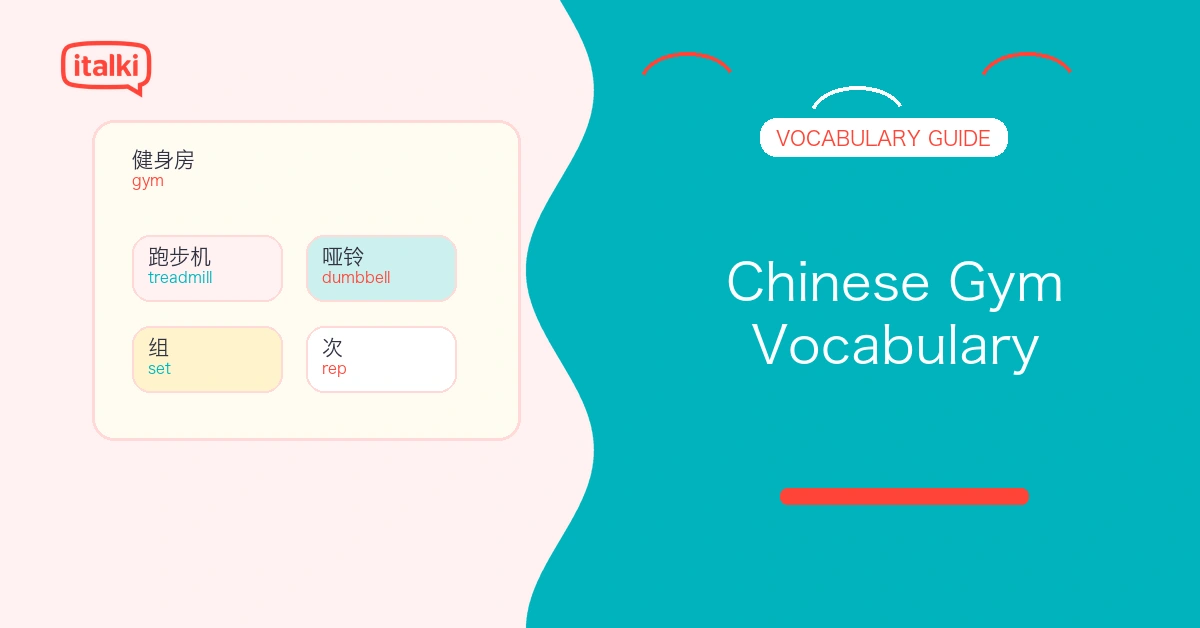
- Measure words (量词) matter when talking about sets and reps: 组 (zǔ) for sets, 次 (cì) for repetitions, 个 (gè) as a general counter.
You can follow an exercise routine by counting reps silently in any language. The moment a trainer gives instructions, a member asks which machine is free, or the gym app prompts you to log your sets, the Chinese vocabulary becomes essential.
italki connects learners with Chinese teachers who can build fitness-themed conversation practice into your lessons so gym vocabulary becomes second nature rather than something you look up mid-workout.
This guide covers 100+ Chinese gym vocabulary words and phrases organized by category: the gym space and check-in, equipment, workout types, muscle groups, exercise instructions, trainer conversations, progress and goals, and nutrition terms.

Find your perfect teacher
Build real speaking confidence with personalized lessons from a teacher who matches your goals, schedule, and learning style.

The gym space and check-in
| Chinese | Pinyin | English |
|---|---|---|
| 健身房 | jiànshēnfáng | gym / fitness center |
| 会员 | huìyuán | member |
| 会员卡 | huìyuán kǎ | membership card |
| 前台 | qiántái | front desk / reception |
| 储物柜 | chǔwù guì | locker |
| 更衣室 | gēngyī shì | changing room |
| 淋浴 | línyù | shower |
| 镜子 | jìngzi | mirror |
| 瑜伽室 | yújiā shì | yoga studio |
| 有氧区 | yǒuyǎng qū | cardio area |
| 力量区 | lìliàng qū | weights area / strength area |
| 游泳池 | yóuyǒng chí | swimming pool |
| 饮水机 | yǐnshuǐ jī | water dispenser |
| 毛巾 | máojīn | towel |
| 运动垫 | yùndòng diàn | exercise mat |
A Chinese language tutor can run a gym check-in simulation with you: practicing signing in at the front desk, asking for a locker, and confirming membership details in Chinese.
Gym equipment
| Chinese | Pinyin | English |
|---|---|---|
| 跑步机 | pǎobù jī | treadmill |
| 椭圆机 | tuǒyuán jī | elliptical machine |
| 动感单车 | dònggǎn dānchē | spin bike / cycling bike |
| 划船机 | huáchuán jī | rowing machine |
| 哑铃 | yǎlíng | dumbbell |
| 杠铃 | gànglíng | barbell |
| 杠铃片 | gànglíng piàn | weight plate |
| 深蹲架 | shēndūn jià | squat rack |
| 史密斯机 | Shǐmìsī jī | Smith machine |
| 拉力绳 | lālì shéng | resistance band / cable |
| 绳索机 | shéngsuǒ jī | cable machine |
| 腹肌轮 | fùjī lún | ab wheel |
| 跳绳 | tiàoshéng | jump rope |
| 药球 | yào qiú | medicine ball |
| 壶铃 | hú líng | kettlebell |
| 泡沫轴 | pàomò zhóu | foam roller |
| 拉伸带 | lāshēn dài | stretching band |
| 护腕 | hù wàn | wrist wraps / wrist support |
| 举重带 | jǔzhòng dài | lifting belt |
Practice naming equipment with an online Chinese teacher by pointing to photos or gym images and describing them in Chinese. This technique builds recognition speed faster than lists alone.
Find your perfect teacher
Build real speaking confidence with personalized lessons from a teacher who matches your goals, schedule, and learning style.
Workout types and training styles
| Chinese | Pinyin | English |
|---|---|---|
| 有氧运动 | yǒuyǎng yùndòng | cardio / aerobic exercise |
| 无氧运动 | wúyǎng yùndòng | anaerobic exercise / strength training |
| 力量训练 | lìliàng xùnliàn | strength training |
| 高强度间歇训练 | gāo qiángdù jiànxiē xùnliàn | HIIT (high-intensity interval training) |
| 瑜伽 | yújiā | yoga |
| 普拉提 | pǔlātí | pilates |
| 跑步 | pǎobù | running |
| 游泳 | yóuyǒng | swimming |
| 骑行 | qí xíng | cycling |
| 拳击 | quánjī | boxing |
| 拉伸 | lāshēn | stretching |
| 热身 | rèshēn | warm-up |
| 放松 | fàngsōng | cool-down / relaxation |
| 循环训练 | xúnhuán xùnliàn | circuit training |
| 功能性训练 | gōngnéngxìng xùnliàn | functional training |
| 自重训练 | zì zhòng xùnliàn | bodyweight training |
Muscle groups
| Chinese | Pinyin | English |
|---|---|---|
| 肌肉 | jīròu | muscle |
| 胸肌 | xiōng jī | chest muscles / pectorals |
| 背肌 | bèi jī | back muscles |
| 肩膀 | jiānbǎng | shoulders |
| 三角肌 | sānjiǎo jī | deltoid (shoulder muscle) |
| 二头肌 | èr tóu jī | biceps |
| 三头肌 | sān tóu jī | triceps |
| 腹肌 | fù jī | abs / abdominal muscles |
| 核心 | héxīn | core |
| 臀部 | túnbù | glutes / buttocks |
| 股四头肌 | gǔ sìtóu jī | quadriceps |
| 腘绳肌 | guóshéng jī | hamstrings |
| 小腿 | xiǎo tuǐ | calves |
| 腓肠肌 | féicháng jī | gastrocnemius (calf muscle) |
| 斜方肌 | xiéfāng jī | trapezius |
| 背阔肌 | bèi kuò jī | latissimus dorsi (lats) |
Body parts in Chinese gives you the head-to-toe vocabulary that supports muscle-group and workout descriptions.
Find your perfect teacher
Build real speaking confidence with personalized lessons from a teacher who matches your goals, schedule, and learning style.
Exercise instructions and form cues
These are phrases you will hear from trainers or workout videos in Chinese.
| Chinese | Pinyin | English |
|---|---|---|
| 组 | zǔ | set (as in sets of reps) |
| 次 | cì | repetition / rep |
| 做三组十次 | zuò sān zǔ shí cì | do three sets of ten reps |
| 保持姿势 | bǎochí zīshì | hold the position |
| 慢慢来 | mànmàn lái | take it slow |
| 深呼吸 | shēn hūxī | deep breath |
| 吸气 | xī qì | inhale |
| 呼气 | hū qì | exhale |
| 收紧核心 | shōujǐn héxīn | engage your core |
| 挺直背部 | tǐngzhí bèibù | keep your back straight |
| 膝盖不要超过脚尖 | xīgài bùyào chāoguò jiǎojiān | do not let your knees go past your toes |
| 重量太轻了 | zhòngliàng tài qīng le | the weight is too light |
| 重量太重了 | zhòngliàng tài zhòng le | the weight is too heavy |
| 换一个重量 | huàn yī gè zhòngliàng | change the weight |
| 休息一下 | xiūxi yīxià | take a rest |
| 再来一组 | zàilái yī zǔ | do one more set |
A private Chinese tutor can read form cues aloud and quiz you on recognizing them by ear, which is much closer to the real gym environment than studying a table silently.
Talking to a trainer or staff member
Useful phrases for communicating with gym staff or a personal trainer.
| Chinese | Pinyin | English |
|---|---|---|
| 我想要一名私人教练 | Wǒ xiǎng yào yī míng sīrén jiàoliàn | I would like a personal trainer |
| 私人教练 | sīrén jiàoliàn | personal trainer |
| 这台机器怎么用? | Zhè tái jīqì zěnme yòng? | How do you use this machine? |
| 这个位置有人吗? | Zhège wèizhi yǒu rén ma? | Is this spot taken? |
| 我可以在你旁边训练吗? | Wǒ kěyǐ zài nǐ pángbiān xùnliàn ma? | Can I train next to you? |
| 帮我保护一下 | Bāng wǒ bǎohù yīxià | Can you spot me? |
| 我刚开始锻炼 | Wǒ gāng kāishǐ duànliàn | I just started working out |
| 我有伤 | Wǒ yǒu shāng | I have an injury |
| 我想减脂 | Wǒ xiǎng jiǎn zhī | I want to lose fat |
| 我想增肌 | Wǒ xiǎng zēng jī | I want to build muscle |
| 我的目标是… | Wǒ de mùbiāo shì… | My goal is… |
| 请给我制定一个计划 | Qǐng gěi wǒ zhìdìng yī gè jìhuà | Please create a plan for me |
Find your perfect teacher
Build real speaking confidence with personalized lessons from a teacher who matches your goals, schedule, and learning style.
Tracking progress and setting goals
| Chinese | Pinyin | English |
|---|---|---|
| 目标 | mùbiāo | goal |
| 减脂 | jiǎn zhī | fat loss |
| 增肌 | zēng jī | muscle building / hypertrophy |
| 体重 | tǐzhòng | body weight |
| 体脂率 | tǐ zhī lǜ | body fat percentage |
| 肌肉量 | jīròu liàng | muscle mass |
| 进步 | jìnbù | progress |
| 记录 | jìlù | record / log |
| 最大重量 | zuìdà zhòngliàng | maximum weight (one-rep max) |
| 有效果了 | yǒu xiàoguǒ le | it is working / seeing results |
| 坚持 | jiānchí | persist / keep going |
| 练了多久了? | Liàn le duō jiǔ le? | How long have you been training? |
| 我锻炼了六个月了 | Wǒ duànliàn le liù gè yuè le | I have been working out for six months |
Nutrition and diet vocabulary
| Chinese | Pinyin | English |
|---|---|---|
| 蛋白质 | dànbáizhì | protein |
| 碳水化合物 | tànshuǐ huàhéwù | carbohydrates |
| 脂肪 | zhīfáng | fat |
| 热量 | rèliàng | calories |
| 蛋白粉 | dànbái fěn | protein powder |
| 增肌粉 | zēng jī fěn | mass gainer |
| 肌酸 | jīsuān | creatine |
| 氨基酸 | ānjī suān | amino acids |
| 维生素 | wéishēngsù | vitamins |
| 补剂 | bǔ jì | supplement |
| 健康饮食 | jiànkāng yǐnshí | healthy diet / eating healthy |
| 高蛋白 | gāo dànbái | high protein |
| 低碳水 | dī tànshuǐ | low carb |
| 卡路里赤字 | kǎlùlǐ chìzì | calorie deficit |
| 增重期 | zēngzhòng qī | bulking phase |
| 减脂期 | jiǎnzhī qī | cutting phase |
Chinese numbers are essential when you log reps, weights, calories, and set counts.
Find your perfect teacher
Build real speaking confidence with personalized lessons from a teacher who matches your goals, schedule, and learning style.
Gym culture in China
Gyms in major Chinese cities are modern and well-equipped, with a growing fitness culture especially among people under 35. A few things that differ from Western gyms:
Personal training is common. Private one-on-one training (私教, sī jiào) is widely available and often sold in packages at the front desk. Many gym members work with a trainer from their first session.
Mobile payment is standard. Membership sign-ups, session bookings, and supplement purchases are typically handled through WeChat Pay or Alipay. Carrying cash is rarely necessary.
Quieter cardio floors. Chinese gym culture tends to be less loud than some Western fitness environments. Music exists but shouting and heavy equipment drops are less common.
Photo culture. Gym selfies and progress photos shared on social media (particularly WeChat Moments and Xiaohongshu) are a normal part of Chinese fitness culture.
Ready to use your Chinese gym vocabulary?
Knowing these words in a list is a start. Using them when a trainer gives you a form cue, when someone asks if the squat rack is free, or when you want to tell a colleague what your training goal is: that is the moment vocabulary becomes language.
italki has 30,000+ expert tutors trusted by over 10 million learners worldwide, including Chinese tutors who can build gym and fitness conversation into your lesson practice. Book a trial lesson and use this vocabulary in a real conversation today.
Find your perfect teacher
Build real speaking confidence with personalized lessons from a teacher who matches your goals, schedule, and learning style.
FAQ
Is it common for gym trainers in China to speak English?
In international gyms in Beijing, Shanghai, or Guangzhou, some trainers may have basic English. In most local gyms and in smaller cities, interaction will be in Chinese. Having a working vocabulary for form cues, equipment names, and goal-setting phrases makes the experience significantly smoother and often leads to better training because you can communicate issues accurately.
Are the English-origin gym terms (like HIIT or Smith machine) understood in Chinese gyms?
Many gym terms are borrowed from English and used in both their English form and a Chinese transliteration. 史密斯机 (Shǐmìsī jī) for Smith machine and HIIT (pronounced in Chinese as HIIT or described as 高强度间歇训练) are recognized in gyms. Learning the Chinese descriptions as well ensures you can communicate even if the English shorthand is not recognized.
How do Chinese measure words apply to gym reps and sets?
组 (zǔ) is the measure word for sets and 次 (cì) is the measure word for repetitions. So three sets of twelve is 三组十二次 (sān zǔ shí èr cì). This structure follows the standard pattern used with Chinese measure words.
Want to learn a language at italki?
Here are the best resources for you!