Key takeaways
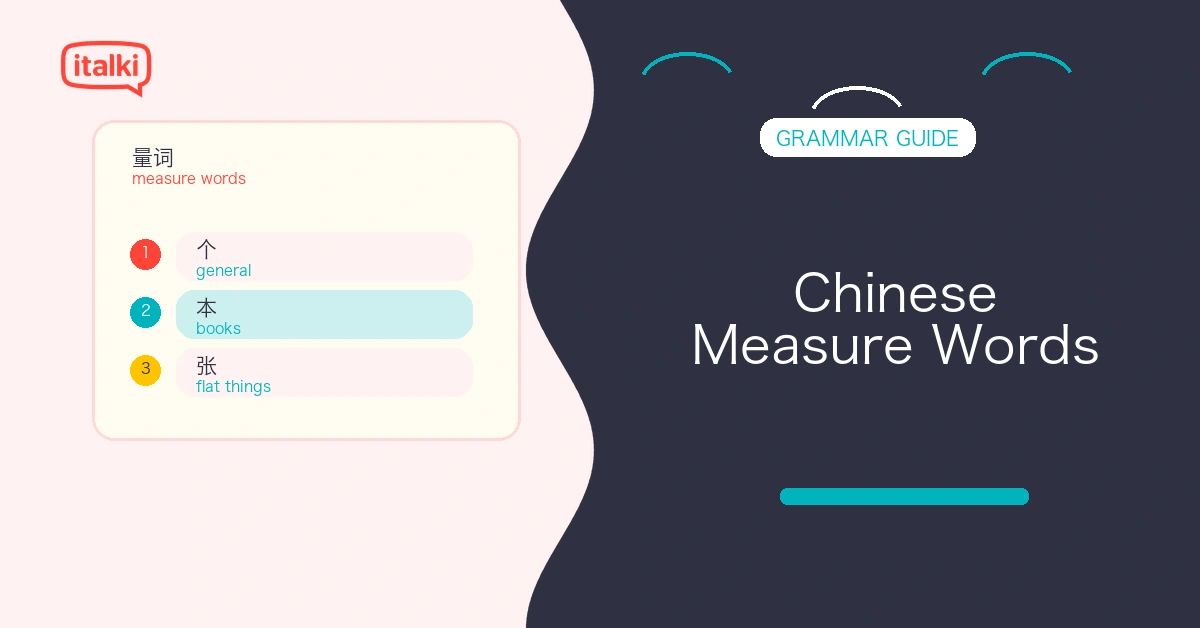
- Chinese measure words (量词 liàngcí, classifiers) are required between a number or demonstrative and a noun: you cannot say three book in Chinese. You must say 三本书 (sān běn shū, three books).
- 个 (gè) is the most versatile measure word and works as a safe default for people and many objects, though using the correct specific classifier sounds more natural.
- Different measure words reflect the physical category of the object: 张 (zhāng) for flat things like paper and tables, 条 (tiáo) for long flexible things like fish and rivers, 本 (běn) for bound books.
- The same Chinese noun can require different measure words depending on context: 一条鱼 (yī tiáo yú, one fish) vs. 一盘鱼 (yī pán yú, one plate of fish). The object and how it is being presented both matter.
One of the first things that surprises new Chinese learners is that you cannot simply put a number next to a noun. You need a word between them, called a measure word or classifier, and the right one depends on what the object is.
This is not random: Chinese measure words reflect the physical properties, category, and typical way of presenting each noun. Once you understand the logic, the system becomes much easier to navigate.
The challenge is that there are dozens of measure words in Chinese, and choosing the wrong one sounds jarring to native speakers even when the meaning is clear. italki connects Chinese learners with native-speaking tutors who use measure words naturally and can correct your choices in real time.
This guide covers the structure of measure words, the 15+ most essential classifiers with examples, how to use measure words with demonstratives, and the most common mistakes learners make.
Find a Chinese tutor and practice building sentences with numbers and measure words until the combinations feel automatic.

Find your perfect teacher
Build real speaking confidence with personalized lessons from a teacher who matches your goals, schedule, and learning style.
Book a trial lesson
How chinese measure words work
The structure in Chinese is: Number + Measure Word + Noun
| Chinese | Pinyin | English |
|---|---|---|
| 三个苹果 | sān gè píngguǒ | three apples |
| 一本书 | yī běn shū | one book |
| 两条鱼 | liǎng tiáo yú | two fish |
| 四张纸 | sì zhāng zhǐ | four pieces of paper |
Notice that Chinese does not add a plural suffix to the noun (no -s like in English). The number itself signals plurality, and the measure word tells you what kind of thing is being counted.
The same structure applies with demonstratives (this / that / which):
| Chinese | Pinyin | English |
|---|---|---|
| 这本书 | zhè běn shū | this book |
| 那条鱼 | nà tiáo yú | that fish |
| 哪个人 | nǎ gè rén | which person |
Knowing Chinese numbers is the foundation for using measure words in sentences, since every measure word phrase requires a number or demonstrative in front of it. This same pattern appears in practical topics like family members in Chinese, where 口 counts people in a household.
个 gè: the default measure word
| Chinese | Pinyin | English |
|---|---|---|
| 个 | gè | general classifier (people and many objects) |
个 (gè) is the most frequently used Chinese measure word. When you are unsure which measure word to use, 个 is understood for many objects, though it is not always technically correct.
Common uses of 个:
| Chinese | Pinyin | English |
|---|---|---|
| 一个人 | yī gè rén | one person |
| 两个苹果 | liǎng gè píngguǒ | two apples |
| 三个问题 | sān gè wèntí | three questions |
| 四个城市 | sì gè chéngshì | four cities |
| 一个小时 | yī gè xiǎoshí | one hour |
| 一个朋友 | yī gè péngyou | one friend |
个 (gè) works for people, many foods, abstract nouns (ideas, questions), and time expressions. It does not work for vehicles, animals, flat objects, or long objects. Those require specific measure words.
Find your perfect teacher
Build real speaking confidence with personalized lessons from a teacher who matches your goals, schedule, and learning style.
Book a trial lesson
Measure words for flat and thin objects
| Chinese | Pinyin | English | Used for |
|---|---|---|---|
| 张 | zhāng | sheet / piece | Flat, thin objects |
张 (zhāng) covers anything flat: paper, cards, photographs, beds, tables, maps, and tickets.
| Chinese | Pinyin | English |
|---|---|---|
| 一张纸 | yī zhāng zhǐ | one piece of paper |
| 两张桌子 | liǎng zhāng zhuōzi | two tables |
| 三张票 | sān zhāng piào | three tickets |
| 一张床 | yī zhāng chuáng | one bed |
| 一张地图 | yī zhāng dìtú | one map |
| 一张照片 | yī zhāng zhàopiàn | one photograph |
Measure words for animals
| Chinese | Pinyin | English | Used for |
|---|---|---|---|
| 只 | zhī | (general small animals) | Cats, birds, hands, one of a pair |
| 头 | tóu | head (large animals) | Cows, pigs, large livestock |
| 条 | tiáo | strip / long flexible | Fish, snakes, worms |
| 匹 | pǐ | (horses) | Horses |
| Chinese | Pinyin | English |
|---|---|---|
| 一只猫 | yī zhī māo | one cat |
| 两只狗 | liǎng zhī gǒu | two dogs |
| 一只鸟 | yī zhī niǎo | one bird |
| 一头牛 | yī tóu niú | one cow |
| 两头猪 | liǎng tóu zhū | two pigs |
| 一条鱼 | yī tiáo yú | one fish |
| 三匹马 | sān pǐ mǎ | three horses |
只 (zhī) is also used for one item in a pair: 一只手 (yī zhī shǒu, one hand), 一只眼睛 (yī zhī yǎnjing, one eye).
Find your perfect teacher
Build real speaking confidence with personalized lessons from a teacher who matches your goals, schedule, and learning style.
Book a trial lesson
Measure words for vehicles and machines
| Chinese | Pinyin | English | Used for |
|---|---|---|---|
| 辆 | liàng | (wheeled vehicles) | Cars, bicycles, buses |
| 台 | tái | platform / stand | Machines, appliances, computers |
| 架 | jià | frame / rack | Airplanes, pianos |
| Chinese | Pinyin | English |
|---|---|---|
| 一辆车 | yī liàng chē | one car |
| 两辆自行车 | liǎng liàng zìxíngchē | two bicycles |
| 一台电脑 | yī tái diànnǎo | one computer |
| 两台电视 | liǎng tái diànshì | two televisions |
| 一台洗衣机 | yī tái xǐyījī | one washing machine |
| 一架飞机 | yī jià fēijī | one airplane |
| 一架钢琴 | yī jià gāngqín | one piano |
Measure words for long, flexible objects
| Chinese | Pinyin | English | Used for |
|---|---|---|---|
| 条 | tiáo | strip | Rivers, roads, pants, fish, snakes, ropes |
条 (tiáo) is one of the most versatile non-default measure words. It covers anything long and flexible, including rivers, roads, pairs of pants, and fish.
| Chinese | Pinyin | English |
|---|---|---|
| 一条河 | yī tiáo hé | one river |
| 一条路 | yī tiáo lù | one road |
| 一条裤子 | yī tiáo kùzi | one pair of pants |
| 一条鱼 | yī tiáo yú | one fish |
| 一条蛇 | yī tiáo shé | one snake |
| 一条项链 | yī tiáo xiàngliàn | one necklace |
| 一条毛巾 | yī tiáo máojīn | one towel |
Find your perfect teacher
Build real speaking confidence with personalized lessons from a teacher who matches your goals, schedule, and learning style.
Book a trial lesson
Measure words for books and documents
| Chinese | Pinyin | English | Used for |
|---|---|---|---|
| 本 | běn | volume / copy | Bound books and notebooks |
| 篇 | piān | piece | Articles, essays, compositions |
| 封 | fēng | seal | Letters and emails |
| 份 | fèn | portion / copy | Documents, newspapers, orders |
| Chinese | Pinyin | English |
|---|---|---|
| 一本书 | yī běn shū | one book |
| 两本杂志 | liǎng běn zázhì | two magazines |
| 一本护照 | yī běn hùzhào | one passport |
| 一篇文章 | yī piān wénzhāng | one article |
| 一封信 | yī fēng xìn | one letter |
| 一份报纸 | yī fèn bàozhǐ | one newspaper |
Measure words for clothing and pairs
| Chinese | Pinyin | English | Used for |
|---|---|---|---|
| 件 | jiàn | item / piece | Upper body clothing, items, matters |
| 条 | tiáo | strip | Pants, skirts, scarves |
| 双 | shuāng | pair | Shoes, socks, chopsticks, eyes, hands |
| 顶 | dǐng | top | Hats, caps |
| Chinese | Pinyin | English |
|---|---|---|
| 一件衣服 | yī jiàn yīfu | one piece of clothing |
| 一件衬衫 | yī jiàn chènshān | one shirt |
| 一件事 | yī jiàn shì | one matter / one thing |
| 一双鞋 | yī shuāng xié | one pair of shoes |
| 一双袜子 | yī shuāng wàzi | one pair of socks |
| 一双筷子 | yī shuāng kuàizi | one pair of chopsticks |
| 一顶帽子 | yī dǐng màozi | one hat |
Find your perfect teacher
Build real speaking confidence with personalized lessons from a teacher who matches your goals, schedule, and learning style.
Book a trial lesson
Measure words for containers and quantities
| Chinese | Pinyin | English | Used for |
|---|---|---|---|
| 杯 | bēi | cup / glass | Hot and cold drinks in a cup |
| 瓶 | píng | bottle | Bottled drinks and liquids |
| 碗 | wǎn | bowl | Food in a bowl |
| 盘 | pán | plate / dish | Food on a plate |
| 块 | kuài | piece / chunk | Cake, soap, land, money (colloquial) |
| 座 | zuò | seat / base | Mountains, cities, large structures |
| Chinese | Pinyin | English |
|---|---|---|
| 一杯咖啡 | yī bēi kāfēi | one cup of coffee |
| 一瓶水 | yī píng shuǐ | one bottle of water |
| 一碗米饭 | yī wǎn mǐfàn | one bowl of rice |
| 一盘饺子 | yī pán jiǎozi | one plate of dumplings |
| 一块蛋糕 | yī kuài dàngāo | one piece of cake |
| 一块肥皂 | yī kuài féizào | one bar of soap |
| 一块钱 | yī kuài qián | one yuan (colloquial) |
| 一座山 | yī zuò shān | one mountain |
| 一座城市 | yī zuò chéngshì | one city |
For vocabulary involving the things you count, especially fruits and foods that use these measure words, the guide to fruits in Chinese provides the vocabulary to practice with.
Measure words for occurrences and events
| Chinese | Pinyin | English | Used for |
|---|---|---|---|
| 次 | cì | time / occurrence | Actions and events that repeat |
| 顿 | dùn | spell / bout | Meals; also scoldings or beatings |
| 场 | chǎng | showing / session | Movies, performances, events |
| Chinese | Pinyin | English |
|---|---|---|
| 一次 | yī cì | one time |
| 两次 | liǎng cì | twice |
| 三次 | sān cì | three times |
| 一顿饭 | yī dùn fàn | one meal |
| 一场电影 | yī chǎng diànyǐng | one movie screening |
| 一场比赛 | yī chǎng bǐsài | one match / competition |
Find your perfect teacher
Build real speaking confidence with personalized lessons from a teacher who matches your goals, schedule, and learning style.
Book a trial lesson
Using measure words with demonstratives
Demonstratives (这 zhè = this, 那 nà = that, 哪 nǎ = which) also require a measure word before the noun.
| Chinese | Pinyin | English |
|---|---|---|
| 这本书 | zhè běn shū | this book |
| 那条鱼 | nà tiáo yú | that fish |
| 哪个人 | nǎ gè rén | which person |
| 这台电脑 | zhè tái diànnǎo | this computer |
| 那双鞋 | nà shuāng xié | those shoes |
| 哪件衣服 | nǎ jiàn yīfu | which piece of clothing |
This structure is used constantly in everyday conversation and in shopping: 这个多少钱? (zhège duōshǎo qián?, meaning: How much is this?)
Common mistakes and how to avoid them
Mistake 1: Using 个 for everything Using 个 when specific measure words are expected sounds unnatural to native speakers, even when the meaning is clear. For vehicles, use 辆. For animals, use 只 or 头. For books, use 本. Start with the most common ones and build from there.
Mistake 2: Forgetting the measure word entirely Saying 三书 (sān shū) instead of 三本书 (sān běn shū) is grammatically incorrect. In Chinese, the measure word cannot be dropped when a number or demonstrative is present.
Mistake 3: Mixing up 两 and 二 with measure words When counting objects in isolation (1, 2, 3…), use 二 (èr) for two. When using a number with a measure word, use 两 (liǎng): 两本书 (liǎng běn shū), not 二本书. The exception is phone numbers, floor numbers, and lists where 二 is used directly.
Mistake 4: Using 条 for all clothing 条 works for pants, skirts, and scarves (long and wrap-around items). For tops, jackets, and dresses, use 件. For hats, use 顶. Match the shape of the object to the measure word.
Find your perfect teacher
Build real speaking confidence with personalized lessons from a teacher who matches your goals, schedule, and learning style.
Book a trial lesson
Build measure words into your chinese practice
The fastest way to get measure words right is to learn them as fixed combinations with the nouns they pair with, not as abstract rules. Learn 一本书 (one book) and 一张纸 (one piece of paper) as vocabulary items rather than trying to apply rules on the spot. Once the pairings feel natural, the grammar takes care of itself.
A native-speaking tutor can correct your measure word choices in real time, which is difficult to replicate from a textbook. Real sentences, such as describing your surroundings, ordering at a restaurant, and asking how many, give you the feedback loop that makes these combinations automatic. italki’s 30,000+ expert tutors include Mandarin native speakers who can run vocabulary-building and grammar practice sessions tailored to your level. Trusted by over 10 million learners worldwide, the platform makes it easy to book regular practice sessions. Book a trial lesson and spend the session describing objects around you in Chinese, with measure word corrections built into the conversation.
Find your perfect teacher
Build real speaking confidence with personalized lessons from a teacher who matches your goals, schedule, and learning style.
Book a trial lesson
FAQ
Do I always need a measure word in Chinese?
Yes, when a number or demonstrative (this, that, which) comes before a noun, a measure word is required. You cannot say 三书 (sān shū). You must say 三本书 (sān běn shū, three books). The only exception is very informal speech where 个 is sometimes dropped, but this is not recommended for learners.
What is the difference between 只 and 头 for animals?
只 (zhī) is used for smaller animals: cats, dogs, birds, rabbits, and also for insects and small creatures. 头 (tóu) is used for larger livestock: cows, pigs, donkeys, and elephants. 条 (tiáo) is used for fish, snakes, and other long animals.
Can the same measure word be used for different types of objects?
Yes, and that is one of the things that makes measure words interesting. 条 (tiáo, strip/long flexible) covers rivers, roads, fish, pants, neckties, and dogs (in some dialects). The connection is shape: long and flexible. Understanding the physical logic behind a measure word helps you apply it to new objects.
Is 个 always wrong when used for objects that have specific measure words?
Not wrong, but it sounds less natural. Native speakers will understand you if you say 一个车 (one car) but will notice the error. Using the correct 一辆车 marks you as a more careful and advanced learner. Start with 个 for confidence and add the specific classifiers as you encounter them.
How many Chinese measure words are there?
Estimates vary, but everyday Chinese uses around 20-30 measure words regularly. There are hundreds of specialized or literary measure words, but for spoken Mandarin, mastering the 20 or so most common ones covers the vast majority of what you will encounter in daily life.
Want to learn a language at italki?
Here are the best resources for you!