Key takeaways
- Chinese verbs do not conjugate for tense: the verb 吃 (chī: to eat) is the same form whether the action happened yesterday, is happening now, or will happen tomorrow. Context and time words do the work that verb endings do in English
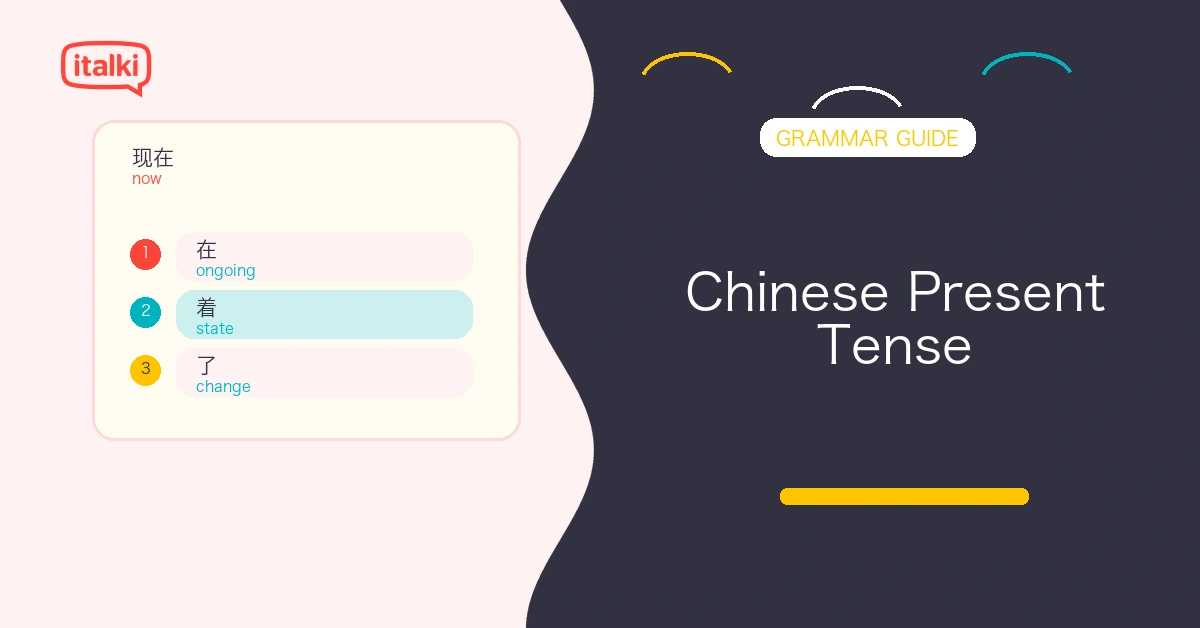
- The most common way to express am/is/are doing in Chinese is to place 在 (zài) before the verb: 我在看书 (wǒ zài kàn shū: I am reading a book right now)
- 正在 (zhèngzài) is the emphatic version of 在, stressing that the action is happening at this very moment: 他正在睡觉 (tā zhèngzài shuìjiào: he is sleeping right now, please don’t disturb)
- Adjectives in Chinese function as stative verbs: they describe a present state without needing a separate verb to be: 天气很好 (tiānqì hěn hǎo: the weather is good)
One of the first things English speakers discover about Chinese grammar is that Chinese verbs do not change form to show tense. There is no past form of 吃 (chī: to eat), no present progressive of 走 (zǒu: to walk), no future tense of 去 (qù: to go). The verb stays the same.
Instead, Chinese uses time words, aspect markers, and context to convey when an action takes place. italki connects learners with Chinese teachers who can help you make sense of aspect-based grammar and feel the difference between these markers in real conversations.
This guide covers how Chinese expresses present-tense meaning: habitual actions, actions in progress, stative descriptions, and the aspect markers that create these meanings, with common mistakes and corrections throughout.

Find your perfect teacher
Build real speaking confidence with personalized lessons from a teacher who matches your goals, schedule, and learning style.

No tense morphology in Chinese
In English, the verb changes form to signal tense:
- I eat (present)
- I ate (past)
- I will eat (future)
- I am eating (present progressive)
In Chinese, 吃 (chī) never changes:
- 我吃苹果 (wǒ chī píngguǒ): I eat apples / I am eating apples / I ate apples / I will eat apples
The meaning depends entirely on context, time words, and aspect markers. This can feel disorienting at first, but it removes an entire category of errors: Chinese verbs never need to be conjugated.
Instead of asking what tense is this verb in? in Chinese, the better question is: what aspect markers or time words tell me when and how this action is happening?
Chinese measure words show another place where Chinese grammar adds meaning without changing the verb form.
Expressing the present with time words
The simplest way to express present time in Chinese is to add a time word to the sentence. No change to the verb is needed.
| Time word | Pinyin | English |
|---|---|---|
| 现在 | xiànzài | now |
| 今天 | jīntiān | today |
| 这个星期 | zhège xīngqī | this week |
| 这个月 | zhège yuè | this month |
| 今年 | jīnnián | this year |
| 最近 | zuìjìn | recently / lately |
| 现阶段 | xiàn jiēduàn | at the current stage |
| 目前 | mùqián | at present (formal) |
Examples:
- 我现在学中文。(wǒ xiànzài xué Zhōngwén): I am studying Chinese now.
- 她今天不上班。(tā jīntiān bù shàngbān): She is not going to work today.
- 最近我忙得很。(zuìjìn wǒ máng de hěn): Lately I am very busy.
Note: in speech and informal writing, time words that are understood from context are often omitted. If someone just asked you What are you doing?, your answer 我看书 (wǒ kàn shū: I am reading) is complete without 现在.
Find your perfect teacher
Build real speaking confidence with personalized lessons from a teacher who matches your goals, schedule, and learning style.
在/正在: the present continuous
To express an action that is in progress right now, place 在 (zài) or 正在 (zhèngzài) before the verb.
Structure: Subject + 在/正在 + Verb (+ Object)
Examples with 在:
| Chinese | Pinyin | English |
|---|---|---|
| 我在看书。 | wǒ zài kàn shū | I am reading (a book). |
| 他在打电话。 | tā zài dǎ diànhuà | He is on the phone. |
| 她在做饭。 | tā zài zuò fàn | She is cooking. |
| 我们在开会。 | wǒmen zài kāihuì | We are in a meeting. |
| 孩子们在玩儿。 | háizimen zài wánr | The children are playing. |
正在 for emphasis: 正在 (zhèngzài) carries the meaning of right at this moment, often implying that the timing is inconvenient or significant.
- 他正在睡觉,你等一下吧。(tā zhèngzài shuìjiào, nǐ děng yīxià ba): He is sleeping right now, please wait a moment.
- 我正在吃饭,待会儿回电话。(wǒ zhèngzài chīfàn, dāihuìr huí diànhuà): I am eating right now, I will call back later.
Optional 呢 (ne) at the end: A sentence-final particle 呢 (ne) can reinforce the ongoing nature of the action. 我在看书呢 feels slightly more casual and emphatic than 我在看书.
着 (zhe): ongoing states and simultaneous actions
着 (zhe) is placed after a verb to describe an ongoing state or a background action that accompanies another action.
Ongoing state:
- 门开着。(mén kāi zhe): The door is open. (The state of being open is ongoing.)
- 他穿着红色的衣服。(tā chuān zhe hóngsè de yīfú): He is wearing a red shirt. (The state of wearing it is ongoing.)
- 墙上挂着一幅画。(qiáng shàng guà zhe yī fú huà): A painting is hanging on the wall.
Simultaneous background action: When two actions happen at the same time, 着 marks the background or manner of the main action.
- 她站着说话。(tā zhàn zhe shuōhuà): She is speaking while standing. (Standing is the background manner.)
- 他笑着说了一声谢谢。(tā xiào zhe shuō le yī shēng xièxie): He said thank you with a smile. (Smiling is the manner of speaking.)
- 我听着音乐写作业。(wǒ tīng zhe yīnyuè xiě zuòyè): I am doing homework while listening to music.
Key difference between 在 and 着: 在 marks the action itself as currently happening. 着 marks a state or accompanying action. Compare:
- 他在开着窗户。would be redundant; instead say 窗户开着 (the window is open, state) or 他在开窗户 (he is opening the window, action).
Find your perfect teacher
Build real speaking confidence with personalized lessons from a teacher who matches your goals, schedule, and learning style.
Habitual present: no special marker
Regular, repeated, or habitual actions in the present require no special aspect marker. Add a frequency adverb or time word to clarify.
| Chinese | Pinyin | English |
|---|---|---|
| 我每天跑步。 | wǒ měitiān pǎobù | I run every day. |
| 她通常七点起床。 | tā tōngcháng qī diǎn qǐchuáng | She usually wakes up at 7. |
| 他们周末打篮球。 | tāmen zhōumò dǎ lánqiú | They play basketball on weekends. |
| 我一般坐地铁上班。 | wǒ yībān zuò dìtiě shàngbān | I usually take the subway to work. |
| 这家店卖新鲜蔬菜。 | zhè jiā diàn mài xīnxiān shūcài | This shop sells fresh vegetables. |
Common frequency adverbs for habitual actions:
- 总是 (zǒngshì: always)
- 经常 (jīngcháng: often)
- 有时候 (yǒushíhòu: sometimes)
- 偶尔 (ǒuěr: occasionally)
- 很少 (hěn shǎo: rarely)
- 从不 (cóngbù: never)
Stative adjectives as present-tense verbs
In Chinese, adjectives function as predicates without needing an additional verb to be. This is called the stative adjective construction.
Structure: Subject + (很) + Adjective
| Chinese | Pinyin | English |
|---|---|---|
| 天气很好。 | tiānqì hěn hǎo | The weather is good. |
| 他很高。 | tā hěn gāo | He is tall. |
| 这个问题很难。 | zhège wèntí hěn nán | This question is difficult. |
| 苹果很甜。 | píngguǒ hěn tián | The apples are sweet. |
Note on 很 (hěn: very): In simple stative sentences, 很 (very) appears before the adjective not always to intensify it but to fill the expected place of a copula. Without 很, the sentence sounds comparative: 他高 implies he is tall (compared to something). The 很 neutralizes this comparative feeling and makes the sentence a simple description.
Find your perfect teacher
Build real speaking confidence with personalized lessons from a teacher who matches your goals, schedule, and learning style.
是 (shì): using “to be” correctly
是 (shì) is the Chinese verb for to be when linking two noun phrases or making identity statements. It is NOT used with adjectives.
Correct use of 是:
- 我是学生。(wǒ shì xuéshēng): I am a student. (Noun = Noun)
- 她是老师。(tā shì lǎoshī): She is a teacher.
- 这是我的书。(zhè shì wǒ de shū): This is my book.
- 今天是星期三。(jīntiān shì xīngqísān): Today is Wednesday.
Incorrect use of 是 with adjectives:
- ✗ 天气是好。
- ✓ 天气很好。(tiānqì hěn hǎo): The weather is good.
- ✗ 他是高。
- ✓ 他很高。(tā hěn gāo): He is tall.
Using 是 before an adjective is one of the most common errors made by English speakers. Resist the habit of always adding a to be verb before descriptive words.
了 (le): why this is NOT only past tense
了 (le) is often taught as a past tense marker, but this is a simplification that causes errors. 了 marks completion or a change of state: it tells you that an action has been completed or that a situation has changed. This can apply to the present or the future, not just the past.
Present implication of 了: describing a change that is relevant now:
- 我懂了。(wǒ dǒng le): I understand now. (I didn’t before, now I do: change of state)
- 他来了。(tā lái le): He has arrived. / He is here now.
- 我饿了。(wǒ è le): I’m hungry now. (I wasn’t before, now I am)
- 春天来了。(chūntiān lái le): Spring has come / Spring is here.
Future completion with 了:
- 我吃了饭再去。(wǒ chī le fàn zài qù): I will go after I eat. (eat + 了 = once eating is complete)
The key distinction: 了 is an aspect marker for completion, not a tense marker. A completed event described in a present or future context still uses 了. A past action that was habitual or ongoing may not use 了 at all.
Find your perfect teacher
Build real speaking confidence with personalized lessons from a teacher who matches your goals, schedule, and learning style.
Common mistakes by English speakers
Mistake 1: Adding 是 before adjectives ✗ 这个苹果是好吃。 ✓ 这个苹果很好吃。(This apple is delicious.)
Mistake 2: Using 正在/在 for habitual actions ✗ 我在每天跑步。 ✓ 我每天跑步。(I run every day: no 在 needed for habitual actions)
Mistake 3: Translating am/is/are literally into 是 for all present-tense sentences ✗ 我是忙。 ✓ 我很忙。(I am busy.)
Mistake 4: Assuming 了 always means past tense ✗ Reading 我懂了 as I understood (past) ✓ 我懂了 means I understand now or I get it (present realization)
Mistake 5: Omitting 在 and 着 when they are needed ✗ 他睡觉 (for a right-now context) ✓ 他在睡觉 (He is sleeping right now.) Note: 他睡觉 is correct for habits (he sleeps / he goes to sleep) or general facts, but not for he is asleep at this moment.
Present tense versus aspect: a summary table
| What you want to express | Structure | Example |
|---|---|---|
| Action in progress right now | 在 + V | 我在看书 (I am reading) |
| Action in progress right now (emphatic) | 正在 + V | 他正在睡觉 (He is sleeping right now) |
| Ongoing state | V + 着 | 门开着 (The door is open) |
| Action while doing something else | V1 + 着 + V2 | 站着说话 (Speaking while standing) |
| Habitual / regular action | Time word + V | 我每天跑步 (I run every day) |
| Describing a state (adjective) | Subject + 很 + Adj | 他很高 (He is tall) |
| Identity or classification | Subject + 是 + Noun | 我是学生 (I am a student) |
| Change of state (now different) | V + 了 | 我饿了 (I’m hungry now) |
Find your perfect teacher
Build real speaking confidence with personalized lessons from a teacher who matches your goals, schedule, and learning style.
Practice Chinese grammar with a tutor
Grammar patterns in Chinese are clearest when you test them in real sentences with a partner who can tell you whether your output sounds natural. The difference between 他在睡觉 and 他睡觉 might seem minor on paper but carries real meaning in use.
italki has 30,000+ expert tutors trusted by over 10 million learners worldwide, including Chinese tutors who can work through these grammar patterns with you in conversation, correct your output, and explain the why behind each aspect marker. Book a trial lesson and get your Chinese grammar built on a solid foundation.
Find your perfect teacher
Build real speaking confidence with personalized lessons from a teacher who matches your goals, schedule, and learning style.
FAQ
If Chinese has no tense, how do speakers know when something happened?
Context does most of the work, along with time words (yesterday, last year, in the past) that appear in the sentence. When a situation is clear from context, no time word is needed at all. In a conversation about last night’s dinner, all verbs refer to the past without any tense marking. Chinese speakers rely heavily on shared context, conversational flow, and time words to locate events in time, the same way English relies on time words to clarify otherwise ambiguous tenses like I am going (which can refer to the present or the near future).
Is 了 the same as the English -ed ending?
No. The English -ed ending marks simple past tense: any completed past action gets -ed regardless of aspect. The Chinese 了 marks completion or change of state, which can be past, present, or future. A habitual or continuous past action (I used to walk there every day: 我以前每天走路去那里) does not use 了. A change of state happening right now (I understand now: 我懂了) does use 了. Treating 了 as a direct equivalent of -ed leads to both overuse (adding 了 to past habits) and underuse (omitting 了 from present realizations).
What is the difference between 在 and 正在?
Both indicate an action in progress. 在 is the neutral form for describing what someone is doing: 他在吃饭 (he is eating). 正在 emphasizes that the action is happening at this precise moment, often to explain why something cannot happen or why the timing is noteworthy: 我正在开会,稍后联系 (I am in a meeting right now, will contact you later). In practice, 正在 often appears when the ongoing action is being used as an explanation or when its timing matters in context.
Want to learn a language at italki?
Here are the best resources for you!